Confirming Einstein’s Theory of General Relativity With Calculus, Part 4c: Newton’s Second Law and Newton’s Law of Gravitation

In this series, I’m discussing how ideas from calculus and precalculus (with a touch of differential equations) can predict the precession in Mercury’s orbit and thus confirm Einstein’s theory of general relativity. The origins of this series came from a class project that I assigned to my Differential Equations students maybe 20 years ago.

In this post, following from the previous two posts, we will show that if the motion of a planet around the Sun is expressed in polar coordinates (r,\theta), with the Sun at the origin, then under Newtonian mechanics (i.e., without general relativity) the motion of the planet follows the differential equation

u''(\theta) + u(\theta) = \displaystyle \frac{1}{\alpha},

where u = 1/r and \alpha is a certain constant. Deriving this governing differential equation will require some principles from physics. If you’d rather skip the physics and get to the mathematics, we’ll get to solving this differential equations in the next post.

From Newton’s second law, the gravitational force on the planet as it orbits the Sun satisfies

{\bf F} = m{\bf a},

where the force {\bf F} and the acceleration {\bf a} are vectors. When written in polar coordinates, this becomes

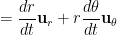
{\bf F} = m \displaystyle \left[ \frac{d^2r}{dt^2} - r \left( \frac{d\theta}{dt} \right)^2 \right] {\bf u}_r + m \left(r \frac{d^2 \theta}{d t^2} + 2 \frac{dr}{dt} \frac{d\theta}{dt} \right) {\bf u}_\theta,

where {\bf u}_r is a unit vector pointing away from the origin and {\bf u}_\theta is a unit vector perpendicular to {\bf u}_r that points in the direction of increasing \theta.

Furthermore, from Newton’s Law of Gravitation, if the Sun is located at the origin, then the gravitational force on the planet is

{\bf F} = \displaystyle -\frac{GMm}{r^2} {\bf u}_r,

where M is the mass of the sun, m is the mass of the planet, and G is the gravitational constant of the universe (which is a constant, no matter what Q from Star Trek: The Next Generation says).

Since these are the same force, the {\bf u}_r components must be the same. (Also, the {\bf u}_\theta component must be zero, but we won’t need to use that fact.) Therefore,

m \displaystyle \left[ \frac{d^2r}{dt^2} - r \left( \frac{d\theta}{dt} \right)^2 \right] = \displaystyle -\frac{GMm}{r^2},

or

\displaystyle  \frac{d^2r}{dt^2} - r \left( \frac{d\theta}{dt} \right)^2 = \displaystyle -\frac{GM}{r^2}.

In a previous post, we showed that

\displaystyle \frac{d\theta}{dt} = \frac{\ell}{mr^2},

where \ell is a constant, and

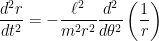
\displaystyle \frac{d^2r}{dt^2} = - \frac{\ell^2}{m^2 r^2} \frac{d^2}{d\theta^2} \left( \frac{1}{r} \right).

Substituting, we find

\displaystyle  - \frac{\ell^2}{m^2 r^2} \frac{d^2}{d\theta^2} \left( \frac{1}{r} \right) - r \left( \frac{\ell}{mr^2} \right)^2  = \displaystyle -\frac{GM}{r^2}

\displaystyle  \frac{\ell^2}{m^2 r^2} \frac{d^2}{d\theta^2} \left( \frac{1}{r} \right) + r \left( \frac{\ell^2}{m^2 r^4} \right)  = \displaystyle \frac{GM}{r^2}

\displaystyle  \frac{\ell^2}{m^2 r^2} \frac{d^2}{d\theta^2} \left( \frac{1}{r} \right) +\frac{\ell^2}{m^2 r^3}  = \displaystyle \frac{GM}{r^2}

\displaystyle  \frac{\ell^2}{m^2 r^2} \left[ \frac{d^2}{d\theta^2} \left( \frac{1}{r} \right) + \frac{1}{r} \right]  = \displaystyle \frac{GM}{r^2}

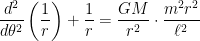
\displaystyle  \frac{d^2}{d\theta^2} \left( \frac{1}{r} \right) + \frac{1}{r} = \displaystyle \frac{GM}{r^2} \cdot \frac{m^2 r^2}{\ell^2}

\displaystyle  \frac{d^2}{d\theta^2} \left( \frac{1}{r} \right) + \frac{1}{r} = \displaystyle \frac{GMm^2}{\ell^2}.

So, substituting u = 1/r and \alpha = \displaystyle \frac{\ell^2}{GMm^2}, we finally obtain the governing equation

\displaystyle  \frac{d^2 u}{d\theta^2}  + u = \displaystyle \frac{1}{\alpha}.

This is the governing differential equation of planetary motion under Newtonian mechanics. For now, it’s not obvious why we chose \displaystyle \frac{1}{\alpha} as the constant on the right-hand side instead of just \alpha, but the reason for this choice will become apparent in future posts.

In the next few posts, we use differential equations (or, if you’d prefer, just calculus) to show that Newtonian mechanics predicts that planets orbit the Sun in ellipses.

Confirming Einstein’s Theory of General Relativity With Calculus, Part 4b: Acceleration in Polar Coordinates

In this series, I’m discussing how ideas from calculus and precalculus (with a touch of differential equations) can predict the precession in Mercury’s orbit and thus confirm Einstein’s theory of general relativity. The origins of this series came from a class project that I assigned to my Differential Equations students maybe 20 years ago.

In this part of the series, we will show that if the motion of a planet around the Sun is expressed in polar coordinates (r,\theta), with the Sun at the origin, then under Newtonian mechanics (i.e., without general relativity) the motion of the planet follows the differential equation
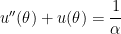
u''(\theta) + u(\theta) = \displaystyle \frac{1}{\alpha},

where u = 1/r and \alpha is a certain constant. Deriving this governing differential equation will require some principles from physics. If you’d rather skip the physics and get to the mathematics, we’ll get to solving this differential equations in the next post.

Part of the derivation of this governing differential equation will involve Newton’s Second Law

{\bf F} = m {\bf a},

where m is the mass of the planet and the force {\bf F} and the acceleration a are vectors. In usual rectangular coordinates, the acceleration vector would be expressed as

{\bf a} = x''(t) {\bf i} + y''(t) {\bf j},

where the components of the acceleration in the x- and y-directors are x''(t) and y''(t), and the unit vectors {\bf i} and {\bf j} are perpendicular, pointing in the positive x and positive y directions.

Unfortunately, our problem involves polar coordinates, and rewriting the acceleration vector in polar coordinates, instead of rectangular coordinates, is going to take some work.

Suppose that the position of the planet is (r,\theta) in polar coordinates, so that the position in rectangular coordinates is {\bf r} = (r\cos \theta, r \sin \theta). This may be rewritten as

{\bf r} = r \cos \theta {\bf i} + r \sin \theta {\bf j} = r ( \cos \theta {\bf i} + \sin \theta {\bf j}) = r {\bf u}_r,

where

{\bf u}_r = \cos \theta {\bf i} + \sin \theta {\bf j}

is a unit vector that points away from the origin. We see that this is a unit vector since

\parallel {\bf u}_r \parallel = {\bf u}_r \cdot {\bf u}_r = \cos^2 \theta + \sin^2 \theta =1.

We also define

{\bf u}_\theta = -\sin \theta {\bf i} + \cos \theta {\bf j}

to be a unit vector that is perpendicular to {\bf u}_r; it turns out that {\bf u}_\theta points in the direction of increasing \theta. To see that {\bf u}_r and {\bf u}_\theta are perpendicular, we observe

{\bf u}_r \cdot {\bf u}_\theta = -\sin \theta \cos \theta + \sin \theta \cos \theta = 0.

Computing the velocity and acceleration vectors in polar coordinates will have a twist that’s not experienced with rectangular coordinates since both {\bf u}_r and {\bf u}_\theta are functions of \theta. Indeed, we have

\displaystyle \frac{d{\bf u}_r}{d\theta} =  \frac{d \cos \theta}{d\theta} {\bf i} + \frac{d\sin \theta}{d\theta} {\bf j} = -\sin \theta {\bf i} + \cos \theta {\bf j} = {\bf u}_\theta.

Furthermore,

\displaystyle \frac{d{\bf u}_\theta}{d\theta} =  -\frac{d \sin \theta}{d\theta} {\bf i} + \frac{d\cos \theta}{d\theta} {\bf j} = -\cos \theta {\bf i} - \sin \theta {\bf j} = -{\bf u}_r.

These two equations will be needed in the derivation below.

We are now in position to express the velocity and acceleration of the orbiting planet in polar coordinates. Clearly, the position of the planet is r {\bf u}_r, or a distance r from the origin in the direction of {\bf u}_r. Therefore, by the Product Rule, the velocity of the planet is

{\bf v} = \displaystyle \frac{d}{dt} (r {\bf u}_r) = \displaystyle \frac{dr}{dt} {\bf u}_r + r \frac{d {\bf u}_r}{dt}

We now apply the Chain Rule to the second term:
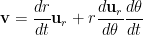
{\bf v} = \displaystyle \frac{dr}{dt} {\bf u}_r + r \frac{d {\bf u}_r}{d\theta} \frac{d\theta}{dt}

= \displaystyle \frac{dr}{dt} {\bf u}_r + r \frac{d\theta}{dt} {\bf u}_\theta.

Differentiating a second time with respect to time, and again using the Chain Rule, we find

{\bf a} = \displaystyle \frac{d {\bf v}}{dt} = \displaystyle \frac{d^2r}{dt^2} {\bf u}_r + \frac{dr}{dt} \frac{d{\bf u}_r}{dt} + \frac{dr}{dt} \frac{d\theta}{dt} {\bf u}_\theta + r \frac{d^2\theta}{dt^2} {\bf u}_\theta + r \frac{d\theta}{dt} \frac{d{\bf u}_\theta}{dt}

= \displaystyle \frac{d^2r}{dt^2} {\bf u}_r + \frac{dr}{dt} \frac{d{\bf u}_r}{d\theta} \frac{d\theta}{dt} + \frac{dr}{dt} \frac{d\theta}{dt} {\bf u}_\theta + r \frac{d^2\theta}{dt^2} {\bf u}_\theta +  r \frac{d\theta}{dt} \frac{d{\bf u}_\theta}{d\theta} \frac{d\theta}{dt}

= \displaystyle \frac{d^2r}{dt^2} {\bf u}_r + \frac{dr}{dt} \frac{d\theta}{dt} {\bf u}_\theta  + \frac{dr}{dt} \frac{d\theta}{dt} {\bf u}_\theta + r \frac{d^2\theta}{dt^2} {\bf u}_\theta -  r \left(\frac{d\theta}{dt} \right)^2 {\bf u}_r

= \displaystyle \left[ \frac{d^2r}{dt^2} -  r \left(\frac{d\theta}{dt} \right)^2 \right] {\bf u}_r + \left[ 2\frac{dr}{dt} \frac{d\theta}{dt} + r \frac{d^2\theta}{dt^2} \right] {\bf u}_\theta.

This will be needed in the next post, when we use both Newton’s Second Law and Newton’s Law of Gravitation, expressed in polar coordinates.

Gravity wells

xkcdgravity_wells

This is one of most creative diagrams that I’ve ever seen: the depth of various solar system gravity wells. A large version of this image can be accessed at http://xkcd.com/681_large/.

From the fine print:

Each well is scaled so that rising out of a physical well of that depth — in constant Earth surface gravity — would take the same energy as escaping from that planet’s gravity in reality.

Depth = \displaystyle \frac{G M}{g r}

It takes the same amount of energy to launch something on an escape trajectory away from Earth as it would to launch is 6,000 km upward under a constant 9.81 \hbox{m}/\hbox{s}^2 Earth gravity. Hence, Earth’s well is 6,000 km deep.

Here’s some more details about the above formula.

Step 1. The escape velocity from the surface of a spherical planet is

v = \displaystyle \sqrt{ \frac{2GM}{r} },

where G is the universal gravitational constant, M is the mass of the planet, and r is the radius of the planet. Therefore, the kinetic energy needed for a rocket with mass m to achieve this velocity is

E = \displaystyle \frac{1}{2} m v^2 = \frac{GMm}{r}

Step 2. Suppose that a rocket moves at constant velocity upward near the surface of the earth. Then the force exerted by the rocket exactly cancel the force of gravity, so that

F = mg,

where g is the acceleration due to gravity near Earth’s surface. Also, work equals force times distance. Therefore, if the rocket travels a distance d against this (hypothetically) constant gravity, then

E = mgd

The depth formula used in the comic is then found by equating these two expressions and solving for d.

Fun with Dimensional Analysis

The principle of diminishing return states that as you continue to increase the amount of stress in your training, you get less benefit from the increase. This is why beginning runners make vast improvements in their fitness and elite runners don’t.

J. Daniels, Daniels’ Running Formula (second edition), p. 13

In February 2013, I began a serious (for me) exercise program so that I could start running 5K races. On March 19, I was able to cover 5K for the first time by alternating a minute of jogging with a minute of walking. My time was 36 minutes flat. Three days later, on March 22, my time was 34:38 by jogging a little more and walking a little less. During that March 22 run, I started thinking about how I could quantify this improvement.

On March 19, my rate of speed was

\displaystyle \frac{5000 \hbox{~m}}{36 \hbox{~min}} = \frac{5000 \hbox{~m}}{36 \hbox{~min}} \times \frac{1 \hbox{~min}}{60 \hbox{~sec}} \approx 2.3148 \hbox{~m/s}.

On March 22, my rate of speed was

\displaystyle \frac{5000 \hbox{~m}}{34 \times 60 + 38 \hbox{~sec}} \approx 2.4062\hbox{~m/s}.

That’s a change of 2.4062 - 2.3148 \approx 0.0913 \hbox{~m/s} over 3 days (accounting for roundoff error in the last decimal place), and so the average rate of change is

\displaystyle \frac{0.0913 \hbox{~m/s}}{3 \hbox{~d}} = \frac{0.0913 \hbox{~m/s}}{3 \hbox{~d}} \times \frac{1 \hbox{~d}}{24 \times 60 \times 60 \hbox{~sec}} \approx 3.524 \times 10^{-7} \hbox{~m/s}^2.

By way of comparison, imagine a keg of beer floating in space. The specifications of beer kegs vary from country to country, but I’ll use the U.S. convention that the mass is 72.8 kg and its height is 23.3 inches = 59.182 cm. Also, for ease of calculation, let’s assume that the keg of beer is a uniformly dense sphere with radius 59.182/2 = 29.591 cm. Under this assumption, the acceleration due to gravity near the surface of the sphere is the same as the acceleration 29.591 cm away from a point-mass of 72.8 kg. Using Newton’s Second Law and the Law of Universal Gravitation, we can solve for the acceleration:

ma = \displaystyle \frac{GMm}{r^2},

where G \approx 6.67384 \times 10^{-11} \hbox{~m}^3/\hbox{kg} \cdot \hbox{s}^2 is the gravitational constant, M = 72.8 \hbox{~kg} is the mass of the beer keg, r = 0.29591 \hbox{~m} is the distance of a particle from the center of the beer keg, m is the mass of the particle, and a is the acceleration of the particle. Solving for a, we find

a = \displaystyle \frac{6.67384 \times 10^{-11} \times 72.8}{0.29591^2} \approx 5.5487 \times 10^{-8} \hbox{~m/s}^2.

Since this is only an approximation based on a hypothetical spherical keg of beer, let’s round off and define 1 beerkeg of acceleration to be equal to 5.5 \times 10^{-8} \hbox{~m/s}^2.

With this new unit, my improvement in speed from March 19 to March 22 can be quantified as

\displaystyle 3.524 \times 10^{-7} \hbox{~m/s}^2 \times \frac{1 \hbox{~beerkeg}}{5.5 \times 10^{-8} \hbox{~m/s}^2} \approx 6.35 \hbox{~beerkegs}.

I love physics: improvements in physical fitness can be measured in kegs of beer.

I chose the beerkeg as the unit of measurement mostly for comedic effect (I’m personally a teetotaler). If the reader desires to present a non-alcoholic version of this calculation to students, I’m sure that coolers of Gatorade would fit the bill quite nicely.

For what it’s worth, at the time of this writing (June 7), my personal record for a 5K is 26:58, and I’m trying hard to get down to 25 minutes. Alas, my current improvements in fitness have definitely witnessed the law of diminishing return and is probably best measured in millibeerkegs.