Different definitions of logarithm (Part 1)

There are two apparently different definitions of a logarithm that appear in the secondary mathematics curriculum:

  1. From Algebra II and Precalculus: If b > 0 and b \ne 1, then f(x) = \log_b x is the inverse function of g(x) = b^x.
  2. From Calculus: for x > 0, we define \ln x = \displaystyle \int_1^x \frac{1}{t} dt.

On the surface, these two ways of viewing logarithms are completely separate from each other, and so even advanced math majors are surprised that these two ways of viewing logarithms are logically interrelated. In the words of Tom Apostol (Calculus, Vol. 1, 2nd edition, 1967, page 227):

The logarithm is an example of a mathematical concept that can be defined in many different ways. When a mathematician tries to formulate a definition of a concept, such as the logarithm, he usually has in mind a number of properties he wants this concept to have. By examining these properties, he is often led to a simple formula or process that might serve as a definition from which all the desired properties spring forth as logical deductions.

In this series of posts, we examine the interrelationship between these two different approaches to logarithms. This is a standard topic in my class for future teachers of secondary mathematics as a way of deepening their understanding of a topic that they think they know quite well.


Functions that commute

At the bottom of this post is a one-liner that I use in my classes the first time I present a theorem where two functions are permitted to commute. At many layers of the mathematics curriculum, students learn about that various functions can essentially commute with each other. In other words, the order in which the operations is performed doesn’t affect the final answer. Here’s a partial list off the top of my head:

  1. Arithmetic/Algebra: a \cdot (b + c) = a \cdot b + a \cdot c. This of course is commonly called the distributive property (and not the commutative property), but the essential idea is that the same answer is obtained whether the multiplications are performed first or if the addition is performed first.
  2. Algebra: If a,b > 0, then \sqrt{ab} = \sqrt{a} \sqrt{b}.
  3. Algebra: If a,b > 0 and x is any real number, then (ab)^x = a^x b^x.
  4. Precalculus: \displaystyle \sum_{i=1}^n (a_i+b_i) = \displaystyle \sum_{i=1}^n a_i + \sum_{i=1}^n b_i.
  5. Precalculus: \displaystyle \sum_{i=1}^n c a_i = c \displaystyle \sum_{i=1}^n a_i.
  6. Calculus: If f is continuous at an interior point c, then \displaystyle \lim_{x \to c} f(x) = f(c).
  7. Calculus: If f and g are differentiable, then (f+g)' = f' + g'.
  8. Calculus: If f is differentiable and c is a constant, then (cf)' = cf'.
  9. Calculus: If f and g are integrable, then \int (f+g) = \int f + \int g.
  10. Calculus: If f is integrable and c is a constant, then \int cf = c \int f.
  11. Calculus: If f: \mathbb{R}^2 \to \mathbb{R} is integrable, \iint f(x,y) dx dy = \iint f(x,y) dy dx.
  12. Calculus: For most differentiable function f: \mathbb{R}^2 \to \mathbb{R} that arise in practice, \displaystyle \frac{\partial^2 f}{\partial x \partial y} = \displaystyle \frac{\partial^2 f}{\partial y \partial x}.
  13. Probability: If X and Y are random variables, then E(X+Y) = E(X) + E(Y).
  14. Probability: If X is a random variable and c is a constant, then E(cX) = c E(X).
  15. Probability: If X and Y are independent random variables, then E(XY) = E(X) E(Y).
  16. Probability: If X and Y are independent random variables, then \hbox{Var}(X+Y) = \hbox{Var}(X) + \hbox{Var}(Y).
  17. Set theory: If A, B, and C are sets, then A \cup (B \cap C) = (A \cup B) \cap (A \cup C).
  18. Set theory: If A, B, and C are sets, then A \cap (B \cup C) = (A \cap B) \cup (A \cap C).

However, there are plenty of instances when two functions do not commute. Most of these, of course, are common mistakes that students make when they first encounter these concepts. Here’s a partial list off the top of my head. (For all of these, the inequality sign means that the two sides do not have to be equal… though there may be special cases when equality happens to happen.)

  1. Algebra: (a+b)^x \ne a^x + b^x if x \ne 1. Important special cases are x = 2, x = 1/2, and x = -1.
  2. Algebra/Precalculus: \log_b(x+y) = \log_b x + \log_b y. I call this the third classic blunder.
  3. Precalculus: (f \circ g)(x) \ne (g \circ f)(x).
  4. Precalculus: \sin(x+y) \ne \sin x + \sin y, \cos(x+y) \ne \cos x + \cos y, etc.
  5. Precalculus: \displaystyle \sum_{i=1}^n (a_i b_i) \ne \displaystyle \left(\sum_{i=1}^n a_i \right) \left( \sum_{i=1}^n b_i \right).
  6. Calculus: (fg)' \ne f' \cdot g'.
  7. Calculus \left( \displaystyle \frac{f}{g} \right)' \ne \displaystyle \frac{f'}{g'}
  8. Calculus: \int fg \ne \left( \int f \right) \left( \int g \right).
  9. Probability: If X and Y are dependent random variables, then E(XY) \ne E(X) E(Y).
  10. Probability: If X and Y are dependent random variables, then \hbox{Var}(X+Y) \ne \hbox{Var}(X) + \hbox{Var}(Y).

All this to say, it’s a big deal when two functions commute, because this doesn’t happen all the time.

green lineI wish I could remember the speaker’s name, but I heard the following one-liner at a state mathematics conference many years ago, and I’ve used it to great effect in my classes ever since. Whenever I present a property where two functions commute, I’ll say, “In other words, the order of operations does not matter. This is a big deal, because, in real life, the order of operations usually is important. For example, this morning, you probably got dressed and then went outside. The order was important.”


Calculators and complex numbers (Part 24)

In this series of posts, I explore properties of complex numbers that explain some surprising answers to exponential and logarithmic problems using a calculator (see video at the bottom of this post). These posts form the basis for a sequence of lectures given to my future secondary teachers.

To begin, we recall that the trigonometric form of a complex number z = a+bi is

z = r(\cos \theta + i \sin \theta) = r e^{i \theta}

where r = |z| = \sqrt{a^2 + b^2} and \tan \theta = b/a, with \theta in the appropriate quadrant. As noted before, this is analogous to converting from rectangular coordinates to polar coordinates.

Theorem. If z = x + i y, where x and y are real numbers, then

e^z = e^x (\cos y + i \sin y)

Definition. Let z = r e^{i \theta} be a complex number so that -\pi < \theta \le \theta. Then we define

\log z = \ln r + i \theta.

Definition. Let z and w be complex numbers so that z \ne 0. Then we define

z^w = e^{w \log z}

Technical point: for the latter two definitions, these are the principal values of the functions. In complex analysis, these are usually considered multiply-defined functions. But I’m not going to worry about this technicality here and will only consider the principal values.

This is the last post in this series, where I state some generalizations of the Laws of Exponents for complex numbers.

In yesterday’s post, we saw that z^{w_1} z^{w_2} = z^{w_1 + w_2} as long as z \ne 0. This prevents something like 0^4 \cdot 0^{-3} = 0^1, since 0^{-3} is undefined.

Theorem. Let z \in \mathbb{C} \setminus \{ 0 \}, w \in \mathbb{C}, and n \in \mathbb{Z}. Then (z^w)^n = z^{wn}.

As we saw in a previous post, the conclusion could be incorrect outside of the above hypothesis, as \displaystyle \left[ (-1)^3 \right]^{1/2} \ne (-1)^{3/2}.

Theorem. Let u \in \mathbb{R} and z \in \mathbb{C}. Then (e^u)^z = e^{uz}.

Theorem. Let x, y > 0 be real numbers and z \in \mathbb{C}. Then x^z y^z = (xy)^z.

Again, the conclusion of the above theorem could be incorrect outside of these hypothesis, as (-2)^{1/2} (-3)^{1/2} \ne \left[ (-2) \cdot (-3) \right]^{1/2}.

green line

For completeness, here’s the movie that I use to engage my students when I begin this sequence of lectures.


Calculators and complex numbers (Part 23)

In this series of posts, I explore properties of complex numbers that explain some surprising answers to exponential and logarithmic problems using a calculator (see video at the bottom of this post). These posts form the basis for a sequence of lectures given to my future secondary teachers.

To begin, we recall that the trigonometric form of a complex number z = a+bi is

z = r(\cos \theta + i \sin \theta) = r e^{i \theta}

where r = |z| = \sqrt{a^2 + b^2} and \tan \theta = b/a, with \theta in the appropriate quadrant. As noted before, this is analogous to converting from rectangular coordinates to polar coordinates.

Theorem. If z = x + i y, where x and y are real numbers, then

e^z = e^x (\cos y + i \sin y)

Definition. Let z = r e^{i \theta} be a complex number so that -\pi < \theta \le \theta. Then we define

\log z = \ln r + i \theta.

Definition. Let z and w be complex numbers so that z \ne 0. Then we define

z^w = e^{w \log z}

Technical point: for the latter two definitions, these are the principal values of the functions. In complex analysis, these are usually considered multiply-defined functions. But I’m not going to worry about this technicality here and will only consider the principal values.

In the remaining posts in this series, I want to explore which properties of exponential functions remain true when complex numbers are used.

To begin, if w is a real rational number, then there is an alternative definition of z^w that matches De Moivre’s Theorem. Happily, the two definitions agree. Suppose that z = r e^{i \theta} with -\pi < \theta \le \pi. Then

z^w = e^{w \log z}

= e^{w [\ln r + i \theta]}

= e^{w \ln r + i w \theta}

= e^{w \ln r} e^{i w \theta}

= r^w (\cos w\theta + i \sin \theta)

Next, one of the Laws of Exponents remains true even for complex numbers:

z^{w_1} z^{w_2} = e^{w_1 \log z} e^{w_2 \log z}

= e^{w_1 \log z + w_2 \log z}

= e^{(w_1 + w_2) \log z}

= z^{w_1 + w_2}.

However, in previous posts, we’ve seen that the rules (x^y)^z = x^(yz) and x^z y^z = (xy)^z may not be true if nonpositive bases, let alone complex bases, are used.

We can also derive the usual rules z^0 = 1 and z^{-w} = \displaystyle \frac{1}{z^w}. First,

z^0 = e^{0 \log z} = e^0 = 1.

Next, we think like an MIT freshman and use the above Law of Exponents to observe that

z^w z^{-w} = z^{w-w} = z^0 = 1.

Dividing, we see that z^{-w} = \displaystyle \frac{1}{z^w}.

green line

For completeness, here’s the movie that I use to engage my students when I begin this sequence of lectures.


Calculators and complex numbers (Part 22)

In this series of posts, I explore properties of complex numbers that explain some surprising answers to exponential and logarithmic problems using a calculator (see video at the bottom of this post). These posts form the basis for a sequence of lectures given to my future secondary teachers.

To begin, we recall that the trigonometric form of a complex number z = a+bi is

z = r(\cos \theta + i \sin \theta) = r e^{i \theta}

where r = |z| = \sqrt{a^2 + b^2} and \tan \theta = b/a, with \theta in the appropriate quadrant. As noted before, this is analogous to converting from rectangular coordinates to polar coordinates.

Theorem. If z = x + i y, where x and y are real numbers, then

e^z = e^x (\cos y + i \sin y)

Definition. Let z = r e^{i \theta} be a complex number so that -\pi < \theta \le \theta. Then we define

\log z = \ln r + i \theta.

At long last, we are now in position to explain the last surprising results from the calculator video below.

Definition. Suppose that z and w are complex numbers so that z \ne 0. Then we define

z^w = e^{w \log z}

Naturally, this definition makes sense if z and w are real numbers.

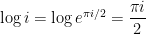
For example, let’s consider the computation of i^i. For the base of i, we note that

\log i = \log e^{\pi i/ 2} = \displaystyle \frac{\pi i}{2}.

Therefore,

i^i = e^{i \log i} = e^{i \pi i/2} = e^{-\pi/2},

which is (surprisingly) a real number.

As a second example, let’s compute (-8)^i. To begin,

\log(-8) = \log \left( 8 e^{\pi i} \right) = \ln 8 + \pi i.

Therefore,

(-8)^i = e^{i \log(-8)}

= e^{i (\ln 8 + \pi i)}

= e^{-\pi + i \ln 8}

= e^{-\pi} (\cos [\ln 8] + i \sin [ \ln 8 ] )

= e^{-\pi} \cos (\ln 8) + i e^{-\pi} \sin (\ln 8)

In other words, a problem like this is a Precalculus teacher’s dream come true, as it contains e, \ln, \pi, \cos, \sin, and i in a single problem.

green line

For completeness, here’s the movie that I use to engage my students when I begin this sequence of lectures.


Calculators and complex numbers (Part 21)

In this series of posts, I explore properties of complex numbers that explain some surprising answers to exponential and logarithmic problems using a calculator (see video at the bottom of this post). These posts form the basis for a sequence of lectures given to my future secondary teachers.

To begin, we recall that the trigonometric form of a complex number z = a+bi is

z = r(\cos \theta + i \sin \theta) = r e^{i \theta}

where r = |z| = \sqrt{a^2 + b^2} and \tan \theta = b/a, with \theta in the appropriate quadrant. As noted before, this is analogous to converting from rectangular coordinates to polar coordinates.

Over the past few posts, we developed the following theorem for computing e^z in the case that z is a complex number.

Definition. Let z = r e^{i \theta} be a complex number so that -\pi < \theta \le \theta. Then we define

\log z = \ln r + i \theta.

Of course, this looks like what the definition ought to be if one formally applies the Laws of Logarithms to r e^{i \theta}. However, this complex logarithm doesn’t always work the way you’d think it work. For example,

\log \left(e^{2 \pi i} \right) = \log (\cos 2\pi + i \sin 2\pi) = \log 1 = \ln 1 = 0 \ne 2\pi i.

This is analogous to another situation when an inverse function is defined using a restricted domain, like

\sqrt{ (-3)^2 } = \sqrt{9} = 3 \ne -3

or

\sin^{-1} (\sin \pi) = \sin^{-1} 0 = 0 \ne \pi.

The Laws of Logarithms also may not work when nonpositive numbers are used. For example,

\log \left[ (-1) \cdot (-1) \right] = \log 1 = 0,

but

\log(-1) + \log(-1) = \log \left( e^{\pi i} \right) + \log \left( e^{\pi i} \right) = \pi i + \pi i = 2\pi i.

green line

For completeness, here’s the movie that I use to engage my students when I begin this sequence of lectures.


Calculators and complex numbers (Part 20)

In this series of posts, I explore properties of complex numbers that explain some surprising answers to exponential and logarithmic problems using a calculator (see video at the bottom of this post). These posts form the basis for a sequence of lectures given to my future secondary teachers.

To begin, we recall that the trigonometric form of a complex number z = a+bi is

z = r(\cos \theta + i \sin \theta) = r e^{i \theta}

where r = |z| = \sqrt{a^2 + b^2} and \tan \theta = b/a, with \theta in the appropriate quadrant. As noted before, this is analogous to converting from rectangular coordinates to polar coordinates.

Over the past few posts, we developed the following theorem for computing e^z in the case that z is a complex number.

Theorem. If z = x + i y, where x and y are real numbers, then

e^z = e^x (\cos y + i \sin y)

As a consequence, there are infinitely many complex solutions of the equation

e^z = -2 - 2i,

namely, z = \ln 2\sqrt{2} - \displaystyle \frac{3\pi}{4} + 2 \pi n i.

Choosing the solution that has an imaginary part in the interval (-\pi,\pi] leads to the definition of the complex logarithm.

Definition. Let z = r e^{i \theta} be a complex number so that -\pi < \theta \le \theta. Then we define

\log z = \ln r + i \theta.

Of course, this looks like what the definition ought to be if one formally applies the Laws of Logarithms to r e^{i \theta}. So, for example,

\log (-2-2i) = \ln 2\sqrt{2} - \displaystyle \frac{3\pi}{4}

A technicality: this is the principal value of the complex logarithm. In complex analysis, this is technically thought of as a multiply-defined function.

The complex version of the natural logarithm function matches the ordinary definition when applied to real numbers. For example,

\log 6 = \log \left( 6 e^{0i} \right) = \ln 6 + 0 i = \ln 6.

A couple of observations. In high school, the symbol \log is usually dedicated to base 10. However, in higher-level mathematics courses, \log always means natural logarithm. That’s because, for the purposes of abstract mathematics, base-10 logarithms are practically useless. They are helpful for us people since our number system uses base 10; it’s easy for me to estimate \log_{10} 9000, but \ln 9000 requires a little more thought. But nearly all major theorems that involve logarithms specifically employ natural logarithms. Indeed, when I first become a professor, I had to remind myself that my students used \ln for natural logarithms and not \log. Still, I write \log_{10} for base-10 logarithms and not \log as a silent acknowledgment of the use of the symbol in higher-level courses.

This use of the logarithm explains the final results of the calculator in the video below. When \ln(-5) is entered, it assumes that a real answer is expected, and so the calculatore returns an error message. On the other hand, when \ln(-5+0i) is entered, it assumes that the user wants the principal complex logarithm. Since -5+0i = 5 e^{i \pi}, the calculator correctly returns \ln 5 + \pi i as the answer. (Of course, the calculator still uses \ln and not \log to mean natural logarithm.)

green line

For completeness, here’s the movie that I use to engage my students when I begin this sequence of lectures.


Calculators and complex numbers (Part 2)

In yesterday’s post, I showed a movie (also provided at the bottom of this post) that calculators can return surprising answers to exponential and logarithmic problems involving complex numbers. In this series of posts, I hope to explain why the calculator returns these results.

To begin, we recall that the trigonometric form of a complex number z = a+bi is

z = r(\cos \theta + i \sin \theta)

where r = |z| = \sqrt{a^2 + b^2} and \tan \theta = b/a, with \theta in the appropriate quadrant.

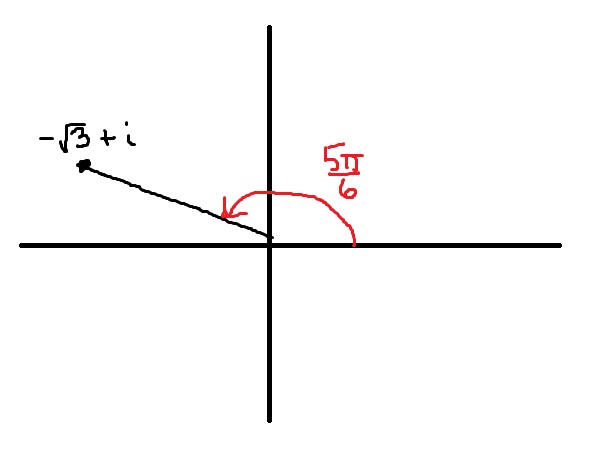
For example, the point z = -\sqrt{3} + i is in the second quadrant of the complex plane. The modulus is

r = \sqrt{ (-\sqrt{3})^2 + (1)^2 } = \sqrt{4} = 2.

(Notice that 1, and not i, appears in the above expression.) Also,

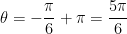
\tan \theta = \displaystyle \frac{1}{-\sqrt{3}}, so that \theta = \displaystyle -\frac{\pi}{6} + n \pi

Since -\sqrt{3} + i is in the second quadrant, we choose \theta = \displaystyle -\frac{\pi}{6} + \pi = \displaystyle \frac{5\pi}{6}. Therefore,

-\sqrt{3} + i = \displaystyle 2 \left( \cos \frac{5\pi}{6} + \sin \frac{5\pi}{6} \right)

This can be checked by simply evaluating the right-hand side and distributing:

\displaystyle 2 \left( \cos \frac{5\pi}{6} + \sin \frac{5\pi}{6} \right) = \displaystyle 2 \left( -\frac{\sqrt{3}}{2} + i \frac{1}{2} \right) = -\sqrt{3} +i

complexplane2

When teaching this in class, I’ll run through about 2-4 more examples to make sure that this concept is stuck in my students’ heads.

Notes:

  • The angle \theta is not uniquely defined… any angle that is coterminal with \frac{5\pi}{6} would also have worked. For example,

-\sqrt{3} + i = \displaystyle 2 \left( \cos \frac{17\pi}{6} + \sin \frac{17\pi}{6} \right)

and

-\sqrt{3} + i = \displaystyle 2 \left( \cos \frac{-7\pi}{6} + \sin \frac{-7\pi}{6} \right)

  • It’s really important to remember that \theta need not be equal to \displaystyle \tan^{-1} \frac{b}{a}. After all, the arctangent of an angle must lie between -\pi/2 and \pi/2, which won’t work for complex numbers in either the second or third quadrant. That said, it is true that

-\sqrt{3} + i = \displaystyle -2 \left( \cos \frac{-\pi}{6} + \sin \frac{-\pi}{6} \right)

  • The above procedure is also the essence of converting from rectangular coordinates to polar coordinates (or vice versa), which is a function pre-programmed on many scientific calculators.
  • When teaching this topic, I often use physical humor to get the above points across.
  1. I’ll pick the direction parallel to the chalkboard to be the positive real axis, and the direction perpendicular to the chalkboard (i.e., pointing toward my students) as the positive imaginary axis. I’ll pick some convenient spot in front of the class to be the origin.
  2. Standing at the origin, I’ll face the positive real axis, spin in an angle of 5\pi/6 = 150^\circ, and take two steps to arrive at the point -\sqrt{3} + i.
  3. Returning to the origin, I’ll face the positive real axis, spin the other direction in an angle of -210^\circ, and take two steps to arrive at the same point.
  4. Returning to the origin, I’ll face the positive real axis, spin in an angle of 510^\circ (getting more than a little dizzy while doing so), and take two steps to arrive at the same point.
  5. Returning to the origin, I’ll face the positive real axis, spin in an angle of only -30^\circ, and take two steps backwards (while doing the moonwalk) to arrive at the same point.

green line

We will need to use this concept of writing a complex number in trigonometric form in order to explain the calculator’s results. For completeness, here’s the movie that I used to begin this series of posts.


Calculators and complex numbers (Part 1)

What is \ln(-5)? Or (-8)^{1/3}? Easy, right? Well, let’s plug into a calculator and find out. (Click anywhere in the image below to start the movie. The important stuff is the screen at the top; you can see the keystrokes that I used if you following the mouse arrow toward the bottom.)
In this series of posts, I’ll try to explain why the calculator provides these unexpected answers. This series of posts will have 24 posts (!) and will contain some fairly sophisticated mathematics to explain why the calculator does what it does as well as some pedagogical discussion when I present these topics to my class of future secondary teachers. Each post can be thought of as a 5-10 minute portion of one of my lectures.