
In this series of posts, I’d like to describe what I tell my students on the very first day of Calculus I. On this first day, I try to set the table for the topics that will be discussed throughout the semester. I should emphasize that I don’t hold students immediately responsible for the content of this lecture. Instead, this introduction, which usually takes 30-45 minutes, depending on the questions I get, is meant to help my students see the forest for all of the trees. For example, when we start discussing somewhat dry topics like the definition of a continuous function and the Mean Value Theorem, I can always refer back to this initial lecture for why these concepts are ultimately important.
I’ve told students that the topics in Calculus I build upon each other (unlike the topics of Precalculus), but that there are going to be two themes that run throughout the course:
- Approximating curved things by straight things, and
- Passing to limits
I then applied these two themes to find the speed of a falling object at impact.
I now switch to a second, completely unrelated (or at least it seems completely unrelated) problem.
Problem #2. Find the area under the parabola
between
and
.
I draw the picture and ask, “OK, what formula from geometry can we use for this one?” Stunned silence.
I say, “Of course you can’t do this yet. This is a curved thing. Back in high school geometry, you learned (with one exception) the areas of straight things. What straight things had area formulas in high school geometry?” I’ll always get rectangles and triangles as responses. Occasionally, someone will volunteer parallelogram or rhombus or kite.
So I ask the leading question, which of these shapes is easiest? Students always answer, “Rectangles.” Which then leads me to the next question: How can we approximate the area under a parabola with a bunch of rectangles?
Again, stunned silence. I let my students think about it for at least a minute, sometimes two minutes. Hopefully, one student will volunteer the answer that I want, though occasionally I’ll have to coax it out of them.
Eventually either a student volunteers (or else I tell the class) that we ought to use a bunch of thin rectangles. For starters, I’ll use five rectangles and a very rough sketch on the board.
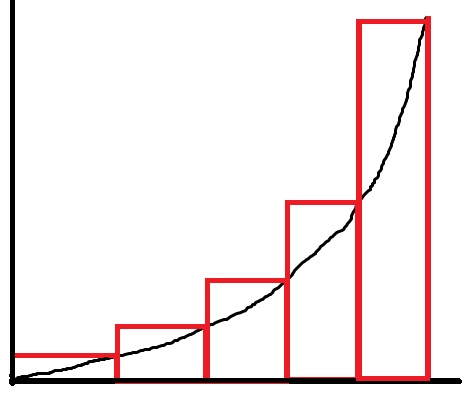
I’ll start with the right-most rectangle… what is its area? Students immediately see that the width is 


I then move to the rectangle that’s second to the right. This also has a width of 

Eventually, we get that the sum of the areas is 
I then ask the same question that I had before: how can we get a better approximation? Students will usually volunteer either “More rectangles” or “Thinner rectangles,” which of course are logically equivalent. I then proceed with 10 equal-width rectangles. Occasionally, a student volunteers that perhaps we should use thinner rectangles only on the right side of the figure, which of course is a very astute observation. However, I tell my class that, for the sake of simplicity, we’ll stick with rectangles of equal width.
With ten rectangles (and I redraw the picture with ten thin rectangles), the approximation is quickly found to be
![0.1 [ (0.1)^2 + (0.2)^2 + \dots + (0.9)^2 + 1^2] = 0.385](https://s0.wp.com/latex.php?latex=0.1+%5B+%280.1%29%5E2+%2B+%280.2%29%5E2+%2B+%5Cdots+%2B+%280.9%29%5E2+%2B+1%5E2%5D+%3D+0.385&bg=ffffff&fg=000000&s=0&c=20201002)
I like using ten rectangles, as that’s probably the largest number that can be handled in class without a calculator (until the very last step of adding up the areas).
By now, the class sees what the next steps are: take more and more rectangles. At this point, I’ll resort to classroom technology to make the process a little quicker. I personally prefer Microsoft Excel, though other software packages can be used for this purpose. For 
![0.01 [ (0.01)^2 + (0.02)^2 + \dots + (0.99)^2 +( 1.00)^2] = 0.33835](https://s0.wp.com/latex.php?latex=0.01+%5B+%280.01%29%5E2+%2B+%280.02%29%5E2+%2B+%5Cdots+%2B+%280.99%29%5E2+%2B%28+1.00%29%5E2%5D+%3D+0.33835&bg=ffffff&fg=000000&s=0&c=20201002)
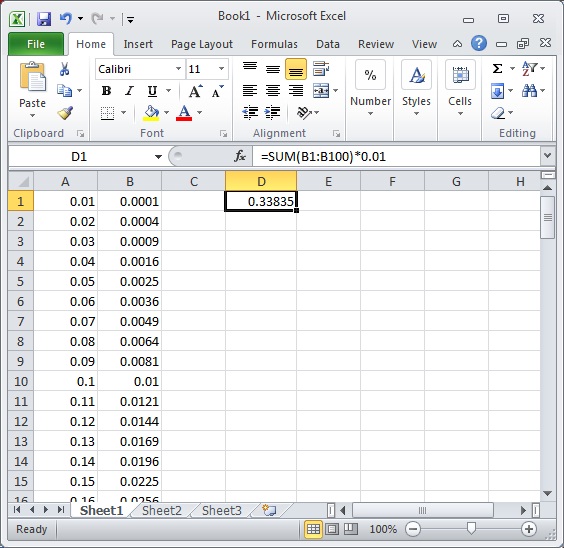
My class can see that the answer is still too large, but it’s certainly closer to the correct answer.
I’ll then tell the class that this is another example of passing to limits, the second theme of calculus. I’ll describe this more fully in the next post.
 seconds is
  . How fast is the student going when he (or she) hits the concrete sidewalk?
 seconds, the approximation is
  ft/s.
ft/s. seconds, the approximation is
  ft/s.
ft/s. seconds, the approximation is
  ft/s.
ft/s. seconds, the approximation is
  ft/s.
ft/s. seconds, the approximation is
  ft/s.
ft/s. seconds since dividing by zero is a no-no.
 and
and  ,
, ,
, is a small positive number. Let’s now simplify this fraction:


 .
. , then
  , matching the previous answer.
 , then
  , matching the previous answer.
 ft/s, which is the final answer.
 .
. , so that
  . (And I make sure that they remember that this quadratic equation has two roots.) The solution
  is clearly extraneous, so the time elapsed until the student meets his/her demise is
 feet by
  and
and  . We see that
  and
and  , and so the new approximation is
  ft/s. I store these two approximations (
 to
to  to
to  ft/s and
  is still
  ft/s. Students will volunteer that this should be better than the previous two approximations but still less than the correct answer.
 to
to  ft/s (by this point, a calculator is certainly needed) and
  ft/s. If we do it again with
  , we see that
  ft/s, for an approximation of
  ft/s.
ft/s. between
  and
and  .
. for the area of a circle. However, they often tell me that they don’t remember a proof or justification for why this formula is true. And they certainly don’t remember a justification that would be appropriate for showing geometry students.

 , a constant, then
  .
. and
and  are both differentiable, then
  .
. is a constant, then
  .
. , where
  is a nonnegative integer, then
  . This may be proved by at least two different techniques:
 is a polynomial, then
  . In other words, taking the derivative of a polynomial is easy.
 . Notice I’ve changed the variable from
  to
to  , but that’s OK. Does this remind you of anything? (Students answer: the area of a circle.) What’s the derivative? Remember,
  is just a constant. So
  . Does this remind you of anything? (Students answer: Whoa… the circumference of a circle.)
 . Does this remind you of anything? (Students answer: the volume of a sphere.) What’s the derivative? Again,
  is just a constant. So
  . Does this remind you of anything? (Students answer: Whoa… the surface area of a sphere.)

 . In other words, imagine starting with a solid red disk of radius
  and then removing a solid white disk of radius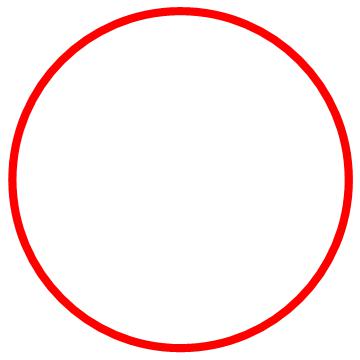
 . If this ring were to be “unpeeled” and flattened, it would approximately resemble a rectangle. The height of the rectangle would be

 , as above. Therefore, by the Fundamental Theorem of Calculus,

![A(r) - A(0) = \displaystyle \left[ \pi t^2 \right]_0^r](https://s0.wp.com/latex.php?latex=A%28r%29+-+A%280%29+%3D+%5Cdisplaystyle+%5Cleft%5B+%5Cpi+t%5E2+%5Cright%5D_0%5Er&bg=ffffff&fg=000000&s=0&c=20201002)

 , the area is
  and the perimeter is
  , which isn’t the derivative of
  . The reason this didn’t work is because the side length

 .
. Mean Green Math