
This is one of my all-time favorite stories to share with students: how a couple of ninth graders in 1995 played with Geometer’s Sketchpad and stumbled upon a brand-new way of using only a straightedge and compass to divide a line segment into any number of equal-sized parts. This article was published in 1997 and made quite a media sensation at the time.
Tag: induction
Solving Problems Submitted to MAA Journals (Part 3)
The following problem appeared in Volume 53, Issue 4 (2022) of The College Mathematics Journal.
Define, for every non-negative integer
, the
.
Consider the sequence of complex polynomials in
defined by
for every non-negative integer
, where
. It is clear that
has degree
and thus has the representation
,
where each
is a positive integer. Prove that
for
.
This problem appeared in the same issue as the probability problem considered in the previous two posts. Looking back, I think that the confidence that I gained by solving that problem gave me the persistence to solve this problem as well.
My first thought when reading this problem was something like “This involves sums, polynomials, and binomial coefficients. And since the sequence is recursively defined, it’s probably going to involve a proof by mathematical induction. I can do this.”
My second thought was to use Mathematica to develop my own intuition and to confirm that the claimed pattern actually worked for the first few values of
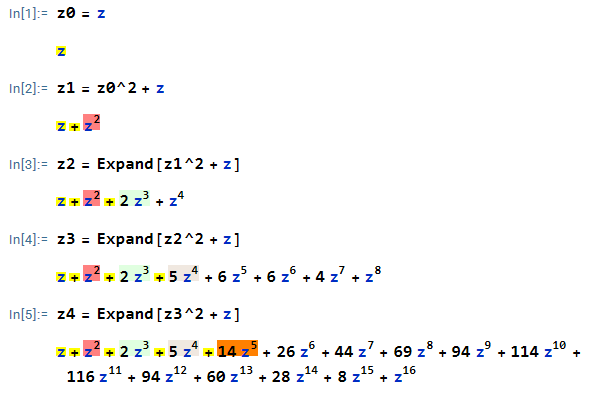
As claimed in the statement of the problem, each 


and the problem claims that the coefficient of

Confident that the pattern actually worked, all that remained was pushing through the proof by induction.
We proceed by induction on 

Although not necessary, I’ll add for good measure that

and


This next calculation illustrates what’s coming later. In the previous calculation, the coefficient of 

This is accomplished by examining all pairs, one from the left product and one from the right product, so that the exponent works out to be

For the inductive step, we assume that, for some 

Our goal is to show that 

For 


For 


The last step used a recursive relationship for the Catalan numbers that I vaguely recalled but absolutely had to look up to complete the proof.
My Favorite One-Liners: Part 98
In this series, I’m compiling some of the quips and one-liners that I’ll use with my students to hopefully make my lessons more memorable for them.
I’ll use today’s quip just after introducing the methodology of mathematical induction to my students:
Induction is so easy that even the army uses it.
My Favorite One-Liners: Part 43
In this series, I’m compiling some of the quips and one-liners that I’ll use with my students to hopefully make my lessons more memorable for them. q Q
Years ago, my first class of students decided to call me “Dr. Q” instead of “Dr. Quintanilla,” and the name has stuck ever since. And I’ll occasionally use this to my advantage when choosing names of variables. For example, here’s a typical proof by induction involving divisibility.
Theorem: If
is a positive integer, then
is a multiple of 4.
Proof. By induction on
:
, which is clearly a multiple of 4.
At this point in the calculation, I ask how I can write this statement as an equation. Eventually, somebody will volunteer that if 
Yes, so let’s name that something with a variable. Naturally, we should choose something important, something regal, something majestic… so let’s choose the letter
. (Groans and laughter.) It’s good to be the king.
So the proof continues:
, where
. We wish to show that
is also a multiple of 4.
At this point, I’ll ask my class how we should write this. Naturally, I give them no choice in the matter:
We wish to show that
, where
is some (possibly different) integer.
Then we continue the proof:


So if we let 
QED

On the flip side of braggadocio, the formula for the binomial distribution is

where 

My Favorite One-Liners: Part 28
In this series, I’m compiling some of the quips and one-liners that I’ll use with my students to hopefully make my lessons more memorable for them. Today’s quip is one that I’ll use when simple techniques get used in a complicated way.
Consider the solution of the linear recurrence relation

where 

To find the solution of this linear recurrence relation, the standard technique — which is a pretty long procedure — is to first solve the characteristic equation, from 

This can be solved by any standard technique at a student’s disposal. If necessary, the quadratic equation can be used. However, for this one, the left-hand side simply factors:


(Indeed, I “developed” the Quintanilla equation on purpose, for pedagogical reasons, because its characteristic equation has two fairly simple roots — unlike the characteristic equation for the Fibonacci sequence.)
From these two roots, we can write down the general solution for the linear recurrence relation:

where 



To find these constants, we plug in
We then plug in 

Using the initial conditions gives


This is a system of two equations in two unknowns, which can then be solved using any standard technique at the student’s disposal. Students should quickly find that 


which is the final answer.
Although this is a long procedure, the key steps are actually first taught in Algebra I: solving a quadratic equation and solving a system of two linear equations in two unknowns. So here’s my one-liner to describe this procedure:
This is just an algebra problem on steroids.
Yes, it’s only high school algebra, but used in a creative way that isn’t ordinarily taught when students first learn algebra.
I’ll use this “on steroids” line in any class when a simple technique is used in an unusual — and usually laborious — way to solve a new problem at the post-secondary level.
My Favorite One Liners: Part 2
In this series, I’m compiling some of the quips and one-liners that I’ll use with my students to hopefully make my lessons more memorable for them.
When doing a large computation, I’ll often leave plenty of blank space on the board to fill it later. For example, when proving by mathematical induction that

the inductive step looks something like
![1 + 3 + 5 \dots + (2k-1) + (2[k+1]-1) =](https://s0.wp.com/latex.php?latex=1+%2B+3+%2B+5+%5Cdots+%2B+%282k-1%29+%2B+%282%5Bk%2B1%5D-1%29+%3D+&bg=ffffff&fg=000000&s=0&c=20201002)


So I explained that, to complete the proof by induction, all we had to do was convert the top line into the bottom line.
As my class swallowed hard as they thought about how to perform this task, I told them, “Yes, this looks really intimidating. Indeed, to quote the great philosopher, ‘You might think that I’m insane. But I’ve got a blank space, baby… so let’s write what remains.’ “
And, just in case you’ve been buried under a rock, here’s the source material for the one-liner (which, at the time of this writing, is the fifth-most watched video on YouTube):
What I Learned from Reading “Gamma: Exploring Euler’s Constant” by Julian Havil: Part 9
When teaching students mathematical induction, the following series (well, at least the first two or three) are used as typical examples:


What I didn’t know (Gamma, page 81) is that Johann Faulhaber published the following cute result in 1631 (see also Wikipedia): If

where 



where again 

When I researching for my series of posts on conditional convergence, especially examples related to the constant 
Boy, was I wrong. As I turned every page, it seemed I hit a new factoid that I had not known before.
In this series, I’d like to compile some of my favorites — while giving the book a very high recommendation.
Mathematical induction and blank space
I tried out a one-liner in class that I’d been itching to try all summer.
I was introducing my students to proofs by mathematical induction; my example was showing that
After describing the principle of mathematical induction, I wrote out the 


Then, for the inductive step, I had my students tell me what the left- and right-hand side would be if I substituted 

So I explained that, to complete the proof by induction, all we had to do was convert the top line into the bottom line.
As my class swallowed hard as they thought about how to perform this task, I told them, “Yes, this looks really intimidating. Indeed, to quote the great philosopher, ‘You might think that I’m insane. But I’ve got a blank space, baby… and I’ll write your name.’ “
The one-liner provoked the desired response from my students… and after the laughter died down, we then worked through the end of the proof.
And, just in case you’ve been buried under a rock for the past few months, here’s the source material for the one-liner (which, at the time of this writing, is the second-most watched video on YouTube):
Proving theorems and special cases (Part 5): Mathematical induction
Today’s post is a little bit off the main topic of this series of posts… but I wanted to give some pedagogical thoughts on yesterday’s post concerning the following proof by induction.
Theorem: If
Proof. By induction on


So if we let
My primary observation is that even very strong math students tend to have a weak spot when it comes to simplifying exponential expressions (as opposed to polynomial expressions). For example, I find that even very good math students can struggle through the logic of this sequence of equalities:

The first step is using the main stumbling block. Students who are completely comfortable with simplifying 


Here’s another algoebraic stumbling block that I’ve often seen: at the beginning of the

Because these students end with a multiple of 4, they fail to notice that the second equality is incorrect since

Again, I attribute this to lack of practice with simplifying exponential expressions in lower grade levels… as well as being a little bit over-excited upon seeing
Proving theorems and special cases (Part 4): Mathematical induction
In a recent class with my future secondary math teachers, we had a fascinating discussion concerning how a teacher should respond to the following question from a student:
Is it ever possible to prove a statement or theorem by proving a special case of the statement or theorem?
Usually, the answer is no… even checking many special cases of a conjecture does not mean that the conjecture is correct. In the previous two posts, we saw that a statement that’s true for the first 40 cases or even the first 
This is the reason that mathematical induction is important, as it provides a way to build from previous cases to prove that the next case is still correct, thus proving that all cases are correct.
Theorem: If
Proof. By induction on
So if we let
QED
In the above proof, we were able to build from the 
By contrast, when trying to “prove” that 

 Mean Green Math