Exponential growth and decay (Part 2): Paying off credit-card debt

The following problem in differential equations has a very practical application for anyone who has either (1) taken out a loan to buy a house or a car or (2) is trying to pay off credit card debt. To my surprise, most math majors haven’t thought through the obvious applications of exponential functions as a means of engaging their future students, even though it is directly pertinent to their lives (both the students’ and the teachers’).

You have a balance of $2,000 on your credit card. Interest is compounded continuously with a relative rate of growth of 25% per year. If you pay the minimum amount of $50 per month (or $600 per year), how long will it take for the balance to be paid?

In this post, I present the actual solution of this problem. In tomorrow’s post, I’ll give some pedagogical thoughts about how this problem, and other similar problems inspired by financial considerations, could fit into a Precalculus course.

green line

Let’s treat this problem as a differential equation (though it could also be considered as a first-order difference equation… more on that later). Let A(t) be the amount of money on the credit card after t years. Then there are two competing forces on the amount of money that will be owed in the future:

  1. The effect of compound interest, which will increase the amount owed by 0.25 A(t) per year.
  2. The amount that’s paid off each year, which will decrease the amount owed by \$600 per year.

Combining, we obtain the differential equation

\displaystyle \frac{dA}{dt} = 0.25 A - 600

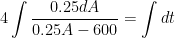
There are a variety of techniques by which this differential equation can be solved. One technique is separation of variables, thus pretending that dA/dt is actually a fraction. (In the derivation below, I will be a little sloppy with the arbitrary constant of integration for the sake of simplicity.)
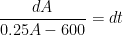
\displaystyle \frac{dA}{0.25 A - 600} = dt

\displaystyle \int \frac{dA}{0.25 A - 600} = \displaystyle \int dt

\displaystyle 4 \int \frac{0.25 dA}{0.25 A - 600} = \displaystyle \int dt

4 \ln |0.25A - 600| = t + C

\ln |0.25A - 600| = 0.25 t + C

|0.25A - 600| = e^{0.25 t + C}

|0.25 A - 600| = C e^{0.25t}

0.25A - 600 = C e^{0.25t}

0.25 A = 600 + C e^{0.25t}

A = 2400 + C e^{0.25t}

To solve for the missing constant C, we use the initial condition A(0) = 2000:

A(0) = 2400 + C e^0

2000 = 2400 + C

-400 = C

We thus conclude that the amount of money owed after t years is

A(t) = 2400 - 400 e^{0.25t}

To determine when the amount of the credit card will be reduced to $0, we see A(t) = 0 and solve for t:

0 = 2400 - 400 e^{0.25 t}

400 e^{0.25 t} = 2400

e^{0.25t} = 6

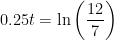
0.25t = \ln 6

t = 4 \ln 6

t \approx 7.2 \hbox{~years}

green line

In tomorrow’s post, I’ll give some pedagogical thoughts about this problem and similar problems.

Exponential growth and decay (Part 1): Phrasing of homework questions

I just completed a series of posts concerning the different definitions of the number e. As part of this series, we considered the formula for continuous compound interest

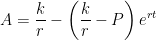
A = Pe^{rt}

Indeed, this formula can be applied to other phenomena besides the accumulation of money. Unfortunately, as they appear in Precalculus textbooks, the wording of questions involving exponential growth or decay can be either really awkward or mathematically imprecise (or both). Here’s a sampling of problems that I’ve collected from various sources:

One thousand bacteria on a petri dish are placed in an incubator, encouraging a relative rate of growth of 10% per hour. How many bacteria will there be in two days?

This is mathematically precise, as it relates to the differential equation A'(t) = r A(t) with solution A = P e^{rt}. The meaning of the value of r is clear from dimensional analysis: the units of A'(t) are \hbox{bacteria}/ \hbox{hour}, while the units of A(t) are \hbox{bacteria}. Therefore, the units of r must be \hbox{hour}^{-1}. So saying that there’s a “relative rate of growth of 10% per hour” makes total sense.

Of course, when Precalculus students are solving this problem, they have no idea about what a differential equation is, making the word relative seem superfluous to the problem.

A sum of $5000 is invested at an interest rate of 9% per year. Find the time required for the money to double if the interest is compounded continuously.

What the problem is trying to say is “Let r = 0.09.” But this is a horrible way to write this in ordinary English! After all, if we plug r = 0.09 and t = 1 into the formula, we obtain

A = P e^{0.09 \times 1} \approx 1.09417P

So it would appear that the interest rate after one year is about 9.417%, and not 9%.

Indeed, if we read the problem at face value that the interest rate is 9% per year, then it stands to reason that, after one year, we have

P(1.09) = P e^{r \cdot 1}

1.09 = e^r

\ln 1.09 = r

In a nutshell, saying that there is “an interest rate of 9% per year” can easily be interpreted to mean that the annual percentage rate is 9% year, and this can be a conceptual barrier for literally-minded students.

I don’t have a good solution for this impasse between ordinary English and giving clear directions to students about what numbers should be used in the formula. But I do think that it’s important for teachers to be aware of this possible misunderstanding as students read their homework questions.

Engaging students: Solving exponential equations

In my capstone class for future secondary math teachers, I ask my students to come up with ideas for engaging their students with different topics in the secondary mathematics curriculum. In other words, the point of the assignment was not to devise a full-blown lesson plan on this topic. Instead, I asked my students to think about three different ways of getting their students interested in the topic in the first place.

I plan to share some of the best of these ideas on this blog (after asking my students’ permission, of course).

This student submission comes from my former student Isis Flores. Her topic, from Precalculus: solving exponential equations.

green line

How could you as a teacher create and activity or project that involves your topic?

For students who have not seen exponential functions before the overall concept might be difficult to comprehend if there is not concrete example that they get to experience. In a mathematics exploration course, TNTX 3100, there was a unique and concrete experience which aided in grasping the concept of exponential functions. I believe that pre-calculus students would benefit just as much if not more from doing a similar activity. The activity itself is to model radioactive decay with m&m’s. Students would be given a set number of m&m’s in a cup. Students would then shake the cup and turn the contents out onto a plate. Those m&m’s with the “m” side up get to be eaten and the number record along with how many times the cup has been turned over (this represents years). Students will continue this pattern until they are out of m&m’s. Students will then take their recorded data and plot it in order to further analyze what is happening and try to come up with a mathematical model for the data. This activity is great in the sense that it involves something concrete, and edible, but also because students get to experiment and a bit of science is included in the process. To shake things up students should be in groups and each group should get to run the experiment at least twice. At the end of the unit it would be a neat idea to ask students to come up with their own representation of exponential functions and maybe try a few of them out as a class.


green lineHow can this topic be used in your students’ future courses in mathematics or science?

After students go through pre-calculus they might take courses which will require them to have some base knowledge of exponential functions. In calculus students will need said base knowledge in order to comprehend what occurs when taking derivatives of exponential functions. Students will also be exposed to “e” and having an understanding of exponential functions will aid them in comprehending what the mathematical definition of “e” is and to recognize its form. Students will also use exponential functions when analyzing interest rates and investments, which is something they may need when they at a later stage in their life (i.e. planning for retirement or calculating college loans). In science students will explore radioactive decay, half-life, and even capacitor discharge all of which will require them to have a good grasp on exponential functions. If students truly understand exponential functions not only will they be able to solve problems presented to them in their science courses, but it will give them an advantage towards actually comprehending what is happening and being able to visualize it, as in the case with capacitor discharge. Such comprehension which goes beyond computations ensures that students are truly learning, and not just mindlessly memorizing steps or formulas.

capacitor

green line

How has this topic appeared on the news?

A topic which has been on the news radar for a period of time is population growth, which behaves exponentially. It would be quite interesting to perhaps introduce the topic of exponential functions with a news article which speaks about the increase population growth, (see nytimes.com link under references) and have students attempt to model said growth. A more exciting news link, at least from a student perspective, was the Red Bull Stratos Jump. The jump was performed form 128,000 feet and was to be sort of an advertisement for the energy drink, Red Bull (which has the slogan “Red Bull gives you wings). Students can explore the exponential decay of atmospheric pressure vs. altitude and have a short clip of the jump be the engage for the lesson. This news topic will definitely interest students since it is not something that occurs a lot, and a few of them might have actually watched the live jump.


References:

TNTX 3100 course

http://gauss.vaniercollege.qc.ca/pwiki/index.php/The_Exponential_Function_and_Its_Applications_in_Science

http://www.nytimes.com/2014/03/27/nyregion/population-growth-in-new-york-city-is-reversing-decades-old-trend-estimates-show.html?_r=0

http://www.redbull.com/cs/Satellite/en_INT/Video/Exclusive-What-Felix-Saw-Red-Bull-Stratos-Live-Jump-POV-021243270932859


Engaging students: Exponential Growth and Decay

In my capstone class for future secondary math teachers, I ask my students to come up with ideas for engaging their students with different topics in the secondary mathematics curriculum. In other words, the point of the assignment was not to devise a full-blown lesson plan on this topic. Instead, I asked my students to think about three different ways of getting their students interested in the topic in the first place.

I plan to share some of the best of these ideas on this blog (after asking my students’ permission, of course).

This student submission comes from my former student Alyssa Mendez. Her topic, from Precalculus: exponential growth and decay.

green line

In July 2002, National Geographic had an article about how America faces a rapid growth of nuclear waste. This is a great example to bring into as an engaging topic by allowing students to think about social issues that have been plaguing societies. We talk about recycling and learning how to reuse old materials. This topic is very well talked about in the media, as recycling is becoming very important and well advertised. I can pose a question to students about how they feel if we never were able to break down all the trash that we expel, including the nuclear waste that builds up, and other toxins. This will lead into the topic of exponential decay. I can also pose a question about how bacteria multiply at an exponential rate. As bacteria grow, there might not eventually be room or nutrients for bacteria. This is what exponential growth would be used for when we have a discussion.

http://math.ucsd.edu/~wgarner/math4c/textbook/chapter4/expgrowthdecay.htm


green lineThere are many ways to express exponential growth and decay. The world population has continuously grown at an exponential rate. As an engage, 1 could ask students how they think the rate of births and deaths grow. How could we gather the information? How do we plot the information? I would like the students to make predictions before we plot data. They could plot this on a hand drawn graph. Then once data is gathered, they could plot an “actual” graph that will show this data, and compare to what they had predicted. We could look at certain points in time, and I could pose questions such as why the graph dips or grows quicker at certain points in time. Time periods such as the plague, people moving to the Americas, and the baby boom.

green line

Ms. Collier gave us a really great activity for exponential growth, and possibly decay. I could use M&Ms, and have the students shake them in boxes. When they open the box, then I they will count all the ones that show an “M” on them. They will tally all the M&Ms that they find, and will notice an exponential pattern. The students could possibly find this activity really fun and exciting. Especially since they can eat the M&Ms afterwards. This will show students what exponential decay and growth would look like. Again I can have them make predictions, before they open the box after one or two shakes.


Calculators and complex numbers (Part 24)

In this series of posts, I explore properties of complex numbers that explain some surprising answers to exponential and logarithmic problems using a calculator (see video at the bottom of this post). These posts form the basis for a sequence of lectures given to my future secondary teachers.

To begin, we recall that the trigonometric form of a complex number z = a+bi is

z = r(\cos \theta + i \sin \theta) = r e^{i \theta}

where r = |z| = \sqrt{a^2 + b^2} and \tan \theta = b/a, with \theta in the appropriate quadrant. As noted before, this is analogous to converting from rectangular coordinates to polar coordinates.

Theorem. If z = x + i y, where x and y are real numbers, then

e^z = e^x (\cos y + i \sin y)

Definition. Let z = r e^{i \theta} be a complex number so that -\pi < \theta \le \theta. Then we define

\log z = \ln r + i \theta.

Definition. Let z and w be complex numbers so that z \ne 0. Then we define

z^w = e^{w \log z}

Technical point: for the latter two definitions, these are the principal values of the functions. In complex analysis, these are usually considered multiply-defined functions. But I’m not going to worry about this technicality here and will only consider the principal values.

This is the last post in this series, where I state some generalizations of the Laws of Exponents for complex numbers.

In yesterday’s post, we saw that z^{w_1} z^{w_2} = z^{w_1 + w_2} as long as z \ne 0. This prevents something like 0^4 \cdot 0^{-3} = 0^1, since 0^{-3} is undefined.

Theorem. Let z \in \mathbb{C} \setminus \{ 0 \}, w \in \mathbb{C}, and n \in \mathbb{Z}. Then (z^w)^n = z^{wn}.

As we saw in a previous post, the conclusion could be incorrect outside of the above hypothesis, as \displaystyle \left[ (-1)^3 \right]^{1/2} \ne (-1)^{3/2}.

Theorem. Let u \in \mathbb{R} and z \in \mathbb{C}. Then (e^u)^z = e^{uz}.

Theorem. Let x, y > 0 be real numbers and z \in \mathbb{C}. Then x^z y^z = (xy)^z.

Again, the conclusion of the above theorem could be incorrect outside of these hypothesis, as (-2)^{1/2} (-3)^{1/2} \ne \left[ (-2) \cdot (-3) \right]^{1/2}.

green line

For completeness, here’s the movie that I use to engage my students when I begin this sequence of lectures.


Calculators and complex numbers (Part 23)

In this series of posts, I explore properties of complex numbers that explain some surprising answers to exponential and logarithmic problems using a calculator (see video at the bottom of this post). These posts form the basis for a sequence of lectures given to my future secondary teachers.

To begin, we recall that the trigonometric form of a complex number z = a+bi is

z = r(\cos \theta + i \sin \theta) = r e^{i \theta}

where r = |z| = \sqrt{a^2 + b^2} and \tan \theta = b/a, with \theta in the appropriate quadrant. As noted before, this is analogous to converting from rectangular coordinates to polar coordinates.

Theorem. If z = x + i y, where x and y are real numbers, then

e^z = e^x (\cos y + i \sin y)

Definition. Let z = r e^{i \theta} be a complex number so that -\pi < \theta \le \theta. Then we define

\log z = \ln r + i \theta.

Definition. Let z and w be complex numbers so that z \ne 0. Then we define

z^w = e^{w \log z}

Technical point: for the latter two definitions, these are the principal values of the functions. In complex analysis, these are usually considered multiply-defined functions. But I’m not going to worry about this technicality here and will only consider the principal values.

In the remaining posts in this series, I want to explore which properties of exponential functions remain true when complex numbers are used.

To begin, if w is a real rational number, then there is an alternative definition of z^w that matches De Moivre’s Theorem. Happily, the two definitions agree. Suppose that z = r e^{i \theta} with -\pi < \theta \le \pi. Then

z^w = e^{w \log z}

= e^{w [\ln r + i \theta]}

= e^{w \ln r + i w \theta}

= e^{w \ln r} e^{i w \theta}

= r^w (\cos w\theta + i \sin \theta)

Next, one of the Laws of Exponents remains true even for complex numbers:

z^{w_1} z^{w_2} = e^{w_1 \log z} e^{w_2 \log z}

= e^{w_1 \log z + w_2 \log z}

= e^{(w_1 + w_2) \log z}

= z^{w_1 + w_2}.

However, in previous posts, we’ve seen that the rules (x^y)^z = x^(yz) and x^z y^z = (xy)^z may not be true if nonpositive bases, let alone complex bases, are used.

We can also derive the usual rules z^0 = 1 and z^{-w} = \displaystyle \frac{1}{z^w}. First,

z^0 = e^{0 \log z} = e^0 = 1.

Next, we think like an MIT freshman and use the above Law of Exponents to observe that

z^w z^{-w} = z^{w-w} = z^0 = 1.

Dividing, we see that z^{-w} = \displaystyle \frac{1}{z^w}.

green line

For completeness, here’s the movie that I use to engage my students when I begin this sequence of lectures.


Calculators and complex numbers (Part 22)

In this series of posts, I explore properties of complex numbers that explain some surprising answers to exponential and logarithmic problems using a calculator (see video at the bottom of this post). These posts form the basis for a sequence of lectures given to my future secondary teachers.

To begin, we recall that the trigonometric form of a complex number z = a+bi is

z = r(\cos \theta + i \sin \theta) = r e^{i \theta}

where r = |z| = \sqrt{a^2 + b^2} and \tan \theta = b/a, with \theta in the appropriate quadrant. As noted before, this is analogous to converting from rectangular coordinates to polar coordinates.

Theorem. If z = x + i y, where x and y are real numbers, then

e^z = e^x (\cos y + i \sin y)

Definition. Let z = r e^{i \theta} be a complex number so that -\pi < \theta \le \theta. Then we define

\log z = \ln r + i \theta.

At long last, we are now in position to explain the last surprising results from the calculator video below.

Definition. Suppose that z and w are complex numbers so that z \ne 0. Then we define

z^w = e^{w \log z}

Naturally, this definition makes sense if z and w are real numbers.

For example, let’s consider the computation of i^i. For the base of i, we note that

\log i = \log e^{\pi i/ 2} = \displaystyle \frac{\pi i}{2}.

Therefore,

i^i = e^{i \log i} = e^{i \pi i/2} = e^{-\pi/2},

which is (surprisingly) a real number.

As a second example, let’s compute (-8)^i. To begin,

\log(-8) = \log \left( 8 e^{\pi i} \right) = \ln 8 + \pi i.

Therefore,

(-8)^i = e^{i \log(-8)}

= e^{i (\ln 8 + \pi i)}

= e^{-\pi + i \ln 8}

= e^{-\pi} (\cos [\ln 8] + i \sin [ \ln 8 ] )

= e^{-\pi} \cos (\ln 8) + i e^{-\pi} \sin (\ln 8)

In other words, a problem like this is a Precalculus teacher’s dream come true, as it contains e, \ln, \pi, \cos, \sin, and i in a single problem.

green line

For completeness, here’s the movie that I use to engage my students when I begin this sequence of lectures.


Calculators and complex numbers (Part 21)

In this series of posts, I explore properties of complex numbers that explain some surprising answers to exponential and logarithmic problems using a calculator (see video at the bottom of this post). These posts form the basis for a sequence of lectures given to my future secondary teachers.

To begin, we recall that the trigonometric form of a complex number z = a+bi is

z = r(\cos \theta + i \sin \theta) = r e^{i \theta}

where r = |z| = \sqrt{a^2 + b^2} and \tan \theta = b/a, with \theta in the appropriate quadrant. As noted before, this is analogous to converting from rectangular coordinates to polar coordinates.

Over the past few posts, we developed the following theorem for computing e^z in the case that z is a complex number.

Definition. Let z = r e^{i \theta} be a complex number so that -\pi < \theta \le \theta. Then we define

\log z = \ln r + i \theta.

Of course, this looks like what the definition ought to be if one formally applies the Laws of Logarithms to r e^{i \theta}. However, this complex logarithm doesn’t always work the way you’d think it work. For example,

\log \left(e^{2 \pi i} \right) = \log (\cos 2\pi + i \sin 2\pi) = \log 1 = \ln 1 = 0 \ne 2\pi i.

This is analogous to another situation when an inverse function is defined using a restricted domain, like

\sqrt{ (-3)^2 } = \sqrt{9} = 3 \ne -3

or

\sin^{-1} (\sin \pi) = \sin^{-1} 0 = 0 \ne \pi.

The Laws of Logarithms also may not work when nonpositive numbers are used. For example,

\log \left[ (-1) \cdot (-1) \right] = \log 1 = 0,

but

\log(-1) + \log(-1) = \log \left( e^{\pi i} \right) + \log \left( e^{\pi i} \right) = \pi i + \pi i = 2\pi i.

green line

For completeness, here’s the movie that I use to engage my students when I begin this sequence of lectures.


Calculators and complex numbers (Part 20)

In this series of posts, I explore properties of complex numbers that explain some surprising answers to exponential and logarithmic problems using a calculator (see video at the bottom of this post). These posts form the basis for a sequence of lectures given to my future secondary teachers.

To begin, we recall that the trigonometric form of a complex number z = a+bi is

z = r(\cos \theta + i \sin \theta) = r e^{i \theta}

where r = |z| = \sqrt{a^2 + b^2} and \tan \theta = b/a, with \theta in the appropriate quadrant. As noted before, this is analogous to converting from rectangular coordinates to polar coordinates.

Over the past few posts, we developed the following theorem for computing e^z in the case that z is a complex number.

Theorem. If z = x + i y, where x and y are real numbers, then

e^z = e^x (\cos y + i \sin y)

As a consequence, there are infinitely many complex solutions of the equation

e^z = -2 - 2i,

namely, z = \ln 2\sqrt{2} - \displaystyle \frac{3\pi}{4} + 2 \pi n i.

Choosing the solution that has an imaginary part in the interval (-\pi,\pi] leads to the definition of the complex logarithm.

Definition. Let z = r e^{i \theta} be a complex number so that -\pi < \theta \le \theta. Then we define

\log z = \ln r + i \theta.

Of course, this looks like what the definition ought to be if one formally applies the Laws of Logarithms to r e^{i \theta}. So, for example,

\log (-2-2i) = \ln 2\sqrt{2} - \displaystyle \frac{3\pi}{4}

A technicality: this is the principal value of the complex logarithm. In complex analysis, this is technically thought of as a multiply-defined function.

The complex version of the natural logarithm function matches the ordinary definition when applied to real numbers. For example,

\log 6 = \log \left( 6 e^{0i} \right) = \ln 6 + 0 i = \ln 6.

A couple of observations. In high school, the symbol \log is usually dedicated to base 10. However, in higher-level mathematics courses, \log always means natural logarithm. That’s because, for the purposes of abstract mathematics, base-10 logarithms are practically useless. They are helpful for us people since our number system uses base 10; it’s easy for me to estimate \log_{10} 9000, but \ln 9000 requires a little more thought. But nearly all major theorems that involve logarithms specifically employ natural logarithms. Indeed, when I first become a professor, I had to remind myself that my students used \ln for natural logarithms and not \log. Still, I write \log_{10} for base-10 logarithms and not \log as a silent acknowledgment of the use of the symbol in higher-level courses.

This use of the logarithm explains the final results of the calculator in the video below. When \ln(-5) is entered, it assumes that a real answer is expected, and so the calculatore returns an error message. On the other hand, when \ln(-5+0i) is entered, it assumes that the user wants the principal complex logarithm. Since -5+0i = 5 e^{i \pi}, the calculator correctly returns \ln 5 + \pi i as the answer. (Of course, the calculator still uses \ln and not \log to mean natural logarithm.)

green line

For completeness, here’s the movie that I use to engage my students when I begin this sequence of lectures.


Calculators and complex numbers (Part 19)

In this series of posts, I explore properties of complex numbers that explain some surprising answers to exponential and logarithmic problems using a calculator (see video at the bottom of this post). These posts form the basis for a sequence of lectures given to my future secondary teachers.

To begin, we recall that the trigonometric form of a complex number z = a+bi is

z = r(\cos \theta + i \sin \theta) = r e^{i \theta}

where r = |z| = \sqrt{a^2 + b^2} and \tan \theta = b/a, with \theta in the appropriate quadrant. As noted before, this is analogous to converting from rectangular coordinates to polar coordinates.

Over the past few posts, we developed the following theorem for computing e^z in the case that z is a complex number.

Theorem. If z = x + i y, where x and y are real numbers, then

e^z = e^x (\cos y + i \sin y)

Example. Find all complex numbers z so that e^z = 5.

Solution. If z = x + iy, then

e^x (\cos y + i \sin y) = 5 (\cos 0 + i \sin 0)

Matching parts, we see that e^x = 5 and that the angle y must be coterminal with 0 radians. In other words,

x = \ln 5 \qquad and \qquad y = 2\pi n for any integer n.

Therefore, there are infinitely many answers: z = \ln 5 + 2 \pi n i.

Notice that there’s nothing particularly special about the number 5. This could have been any nonzero number, including complex numbers, and there still would have been an infinite number of solutions. (This is completely analogous to solving a trigonometric equation like \sin \theta = 1, which similarly has an infinite number of solutions.) For example, the complex solutions of the equation

e^z = -2 - 2i

are z = \ln 2\sqrt{2} - \displaystyle \frac{3\pi}{4} + 2 \pi n i.

These observations lead to the following theorems, which I’ll state without proof.

Theorem. The range of the function f(z) = e^z is \mathbb{C} \setminus \{ 0 \}.

Theorem. e^z = e^w \Longleftrightarrow z = w + 2\pi n i.

Naturally, these conclusions are different than the normal case when z is assumed to be a real number.

green line

For completeness, here’s the movie that I use to engage my students when I begin this sequence of lectures.