Engaging students: Multiplying binomials

In my capstone class for future secondary math teachers, I ask my students to come up with ideas for engaging their students with different topics in the secondary mathematics curriculum. In other words, the point of the assignment was not to devise a full-blown lesson plan on this topic. Instead, I asked my students to think about three different ways of getting their students interested in the topic in the first place.

I plan to share some of the best of these ideas on this blog (after asking my students’ permission, of course).

This student submission again comes from my former student Andy Nabors. His topic, from Algebra: multiplying binomials.

green line

A2. How could you as a teacher create an activity or project that involves your topic?

Multiplying binomials is an interesting concept because there are so many ways in which this can be done. I can think of five ways that binomials can be multiplied: FOIL, the box method, distribution, vertical multiplication, and with algebra tiles. I would incorporate these methods into one of two different ways. In either case, I would split the class into five groups.

  1. In the first way, I would assign each group a different method of multiplication. The groups would each be responsible for exploring their method, working together to master it. Then each group would be responsible for making a poster describing their method in detail. Then would then present their poster to the class, and the students not presenting would be taking notes. Already having one concept of binomial multiplication, the students would be seeing other methods and deciding which makes most sense to them.
  2. In my second idea, I would have five stations in the classroom each with their own method. The groups would rotate station to station figuring out the different methods collaboratively. The groups would rotate every 7-10 minutes until they had been to every station. Then the class would discuss the strengths/weaknesses of each method compared to the others in a class discussion moderated by the teacher.

These activities rely on the students being able to work and learn in groups effectively, which would present difficulty if the class was not used to group work.

green line

B1. How can this topic be used in your students’ future courses in mathematics or science?

I had the privilege of teaching a multiplying binomial lesson to a freshmen algebra one class in CI last spring. My partner and I focused on the box method first, and then used that to introduce FOIL. The box method was easier to grasp because of the visual nature of it. In fact, it looks a lot like something that the students will definitely see in their biology classes. The box method looks almost identical to gene Punnet Squares in biology. In fact, my partner and I used Punnet Squares in our Engage of that lesson. We reminded the students of what a Punnet Square was, and then showed them a filled out square. We went over how the boxes were filled: the letter on top of each column goes into the boxes below and the letters to the left of the box go in each box to the right. Then we showed them an empty Punnet Square with the same letters before. We inquired about what happens when two variables are multiplied together, then filled out the boxes with multiplication signs in between the letters. The students responded well and were able to grasp the concept fairly well from the onset.

green line

E1. How can technology be used to effectively engage students with this topic?

The internet is fast becoming the only place students will go for helpful solutions to school problems. This activity is designed to be a review of multiplying binomials that would allow students to use some internet resources, but make them report as to why the resource is helpful. The class will go to the computer lab or have laptops wheeled in and they will be given a list of sites that cover binomial multiplication. They will pick a site and write about the following qualities of their chosen site: what kind of site? (calculator, tutorial, manipulative, etc.), how is it presented? (organized/easy to use), was it helpful? (just give an answer opposed to listing the steps), did it describe the method it used?, can you use it to do classwork?, etc.

This is a sample list, I would want more sites, but it gives the general idea I’m going for. (general descriptions in parentheses for this project’s sake)

http://www.mathcelebrity.com/binomult.php (calculator, shows basic steps of FOIL of inputted problem)

http://www.webmath.com/polymult.html (calculator, shows very detailed and specific steps of FOIL of inputted problem)

http://calculator.tutorvista.com/foil-calculator.html (calculator, shows general steps of FOIL, not the inputted problem)

http://www.coolmath.com/crunchers/algebra-problems-multiplying-polynomials-FOIL-1.html (calculator but only problems it gives itself, more of a practice site)

http://www.mathwarehouse.com/algebra/polynomial/foil-method-binomials.php (FOIL tutorial site with practice problems with hidden steps)

http://www.themathpage.com/alg/quadratic-trinomial.htm (wordy explanation, lots of practice problems with hidden answers)

https://www.khanacademy.org/math/algebra/multiplying-factoring-expression/multiplying-binomials/v/multiplying-polynomials-2 (many tutoring videos, just the writing no person)

http://www.zooktutoring.com/now-available-my-very-first-instructional-math-video/ (many tutoring videos, tutor is seen with the work)

http://illuminations.nctm.org/Activity.aspx?id=3482 (algebra tile manipulator)

I will assume as a teacher that my students already look for easy solutions online, so I want to make sure they look in places that will help them gain understanding. I would stress that calculator sites are dangerous because if you just use them then you will not be able to perform on your own, but could be helpful to check your answer if you were worried. At the end of the lesson they would have a greater understanding of how to use internet sources effectively and have reviewed multiplying binomials.


Resources:

http://www.mathcelebrity.com/binomult.php

http://www.webmath.com/polymult.html

http://calculator.tutorvista.com/foil-calculator.html

http://www.coolmath.com/crunchers/algebra-problems-multiplying-polynomials-FOIL-1.html

http://www.mathwarehouse.com/algebra/polynomial/foil-method-binomials.php

http://www.themathpage.com/alg/quadratic-trinomial.htm

https://www.khanacademy.org/math/algebra/multiplying-factoring-expression/multiplying-binomials/v/multiplying-polynomials-2

http://www.zooktutoring.com/now-available-my-very-first-instructional-math-video/

http://illuminations.nctm.org/Activity.aspx?id=3482

Lessons from teaching gifted elementary school students (Part 1)

Every so often, I’ll informally teach a class of gifted elementary-school students. I greatly enjoy interacting with them, and I especially enjoy the questions they pose. Often these children pose questions that no one else will think about, and answering these questions requires a surprisingly depth of mathematical knowledge.

Here’s a question I once received:

When playing with my calculator, I noticed the following pattern:

256 \times 256 = 65,5\underline{36}

257 \times 257 = 66,0\underline{49}

258 \times 258 = 66,5\underline{64}

Is there a reason why the last two digits are perfect squares? I know it usually doesn’t work out this way.

I leave a thought bubble in case you’d like to think this. One way of answering this question appears after the bubble.

green_speech_bubbleThe answer is: This always happens as long as the tens digits is either 0 or 5.

To see why, let’s expand (50n + k)^2, where n and k are nonnegative integers and 0 \le k \le 9. If n is odd, then the tens digit of 50n+k will be a 5. But if n is even, then the tens digit of 50n+k will be 0.

Whether n is even or odd, we get

(50n+k)^2 = 2500n^2 + 100nk + k^2 = 100(25n^2 + nk) + k^2

The expression inside the parentheses is not important; what is important is that 100(25n^2 + nk) is a multiple of 100. Therefore, the contribution of this term to the last two digits of (50n+k)^2 is zero. We conclude that the last two digits of (50n+k)^2 is just k^2.

Naturally, elementary-school students are typically not ready for this level of abstraction. That’s what I love about this question: this is a completely natural question for a curious grade-school child to ask, but the teacher has to have a significantly deeper understanding of mathematics to understand the answer.

Engaging students: Inverse Functions

In my capstone class for future secondary math teachers, I ask my students to come up with ideas for engaging their students with different topics in the secondary mathematics curriculum. In other words, the point of the assignment was not to devise a full-blown lesson plan on this topic. Instead, I asked my students to think about three different ways of getting their students interested in the topic in the first place.

I plan to share some of the best of these ideas on this blog (after asking my students’ permission, of course).

This student submission again comes from my former student Brittney McCash. Her topic, from Algebra II: multiplying binomials.

green line

C3. How has this topic appeared in the news.

For the engagement on this aspect of my topic, I would bring a binomial cube with me. I would pose the question, “What do we do when we multiply two binomials together?” The students, of course would not know the answer. I would then say, “Well let’s what one man did that they even did a news article about him!” This in itself catches the students attention because they are piqued about what exactly I am talking about. I would then pass out a copy of this news article so that the students could read. After popcorn reading out loud, we would discuss the article and about how we could use the binomial cube. I would then take out my cube (If possible, put students in groups and give each group a binomial cube to work with) and ask the students, “How in the world did he use this cube to multiply those binomials (points to equation on board)?” I would give them the hint that they have to add up the sides of the square and solve for the perimeter, and see what they can come up with. This is a great engagement for the kids because not only is it hands on, but the article brings in outside aspects of what they’re learning so that they realize they are not the only ones having to learn the material. It’s also a great way to introduce multiplying binomials because it starts at the beginning of adding variables (which they already know how to do), and it’s a visual representation of concept that is sometimes hard to grasp. It’s also a great way to lead into the FOIL, Box, etc…methods to take it into a deeper explanation. For those that have not heard of the binomial cube, here are some pictures of what the students will be working out.

ARTICLE: News Article about Binomial Cube

multiplybinomial

green line<!–[if gte mso 9]>

B2. How does this topic extend what your students should have learned in previous courses?

            A great way to start off with this engagement would be to take the students back to sixth grade. Start off with asking students, “Who remembers when we had to learn how to add and subtract fractions?” Most, if not all, of the students should raise their hands. You can then ask, “Okay, good. So does anyone remember what the next step was after we learned how to add and subtract fractions? What did we learn how to do next?” The answer I am looking for here is multiplying and dividing. After that is established, you can lead in with, “Okay, so who can tell me what the next step would be with what we have previously been learning (adding and subtracting binomials)?” The answer is multiplication and division. Make sure to let them know that you will only be focusing on the multiplication aspect for now. Then you can pose some questions like, “What does multiplying binomials look like? How do we do it? Is there more than one way?” You can then go into a deeper exploration of multiplying binomials and the different ways you can do so. This is a good way to introduce multiplying binomials because not only did I bring in one concept students were already familiar with, I brought in two. I utilized something they already knew (even if subconsciously) back in middle school, and applied that same order to something more complex. It showed them that there was a purpose for learning what they did, and why there is a reason we go in the order that we do. Then you have the aspect of taking something they had been previously working on this semester and extending it further. This helps the students connect with what they are learning and realizing there is a purpose. Because multiplication is repeated addition, we are taking something they have previously learned, and extending it further. Another reason this is a good plan is because you start off with such a basic question, that every student knows the answer. This allows for immediate attention because all the students know what you are talking about, the more they understand, the more likely they are to participate in classroom discussion.

green line<!–[if gte mso 9]>

E1. How can technology be used to effectively engage students with this topic?

In multiplying binomials, technology is a wonderful thing. It can allow students the opportunity to learn in new and interesting ways. When thinking of an engage for this topic, I thought of the 9th grade Algebra 1 class I am currently teaching. High School students are sometimes the hardest to keep entertained, and I think I found the perfect video to help keep there attention. This video is a group of students who did a rap about the FOIL method. What better way to relate to students then students themselves! I would start class off by telling the class, “Today we are going to start of by watching a fun video over something we will be learning today.” Proceed to play the video, and observe how every student is watching. The video is fun while also informing. It describes the method, though not thoroughly, but it gives the students an idea of what will be coming. This video helps show that other students all over the state/world are learning the same thing, and are bringing a fun new aspect to the learning of the material. After the video is played, you might ask the class to try and guess at what exactly you will be covering today. It’s always good to see their minds work and try to figure it out. This question also allows them to connect the video back to the classroom environment and settle down. You can then begin your lesson on multiplying binomials. At the end of the lesson, I would bring up the video again, and ask the class if they can recall what FOIL stands for and to give me an example. I would probably make this their exit ticket for the day and have them write it down on a piece of paper. (This video runs a little long, and I would recommend editing some parts out for time sake. )

Resources:

http://www.youtube.com/watch?v=MG-c7NWFS8U

http://www.noozhawk.com/article/santa_barbara_montessori_school_open_house_binomial_cube_20140118

http://montessorimuddle.org/2012/02/02/using-the-binomial-cube-in-algebra/

Engaging students: Multiplying binomials

In my capstone class for future secondary math teachers, I ask my students to come up with ideas for engaging their students with different topics in the secondary mathematics curriculum. In other words, the point of the assignment was not to devise a full-blown lesson plan on this topic. Instead, I asked my students to think about three different ways of getting their students interested in the topic in the first place.

I plan to share some of the best of these ideas on this blog (after asking my students’ permission, of course).

This student submission comes from my former student Claire McMahon. Her topic, from Algebra I: multiplying binomials like (a+b)(c+d).

green line

I personally have had the pleasure of teaching this part of Algebra 1 to a freshman high school class.  The greatest part about the lesson was how the students were able to work together to really figure all of them out and better yet, they knew why!  You can use several different versions of BINGO for practically anything in math.  And who doesn’t love to win prizes.  This website in particular has led me to some really great lesson plans and I credit a lot of this blog to a lot of the lesson plans I have personally implemented.  Almost every one of them worked with almost little to no tweaking.  I’m not exactly a huge fan of the FOIL concept so I used BINO instead of Bingo!!  Just like singing the song and insert joke here.  So here is the lesson on Distributive Bingo and how it works.  The basic rundown is you give the students either the polynomial or the already factored binomials and have them solve it one way or the other.  For example, if you are trying to focus more on the factoring and zeros making them go from a polynomial to factoring is good practice.  The other really great thing is you can build scaffolds into the game itself by passing out hint cards or key concepts to help them figure out what they are looking for, similar to a formula sheet.

green line

One of the great things about the Internet is there is so much information constantly flowing in and out at all times.  YouTube is a great asset when trying to reinforce good study habits and good metacognition.  Most students are very visual and it gives step-by-step instructions on how to do almost anything.  The other key thing is they can pause rewind and replay if necessary.  If you prefer to have a safer environment for your students to browse then you can lean them toward teacher tube, which has all the same resources without the junk videos.  Here is one of the many multiplying videos that show a method similar to a Punnet Square, which is in line with learning genetics and heredity.  They might have already learned this in biology but if not then it’s a great visual representation of a multiplication table and they will learn it again in science.  It’s easy for the students to check their work and for you to see where any misconceptions can arise.

green line

Algebra tiles are an amazing tool for teaching area models and multiplying binomials.  There are virtual algebra tiles found on the Internet and also many different websites that you can buy a classroom set.   I recommend your students to get used to because they show the value of negative and positive and how multiplying, adding, subtracting or dividing positive and negative integers affects the outcome.  This concept is very important when you are learning to multiply binomials and is often lost or was never present in many student’s previous studies.  You need to make sure that these basic skill benchmarks are met before embarking on an algebra tiles journey.  If you teach the basic rules to play with algebra tiles then you will be set in teaching them multiplication and factoring of binomials and polynomials.  We all love a journey of understanding and this is one of the most awesome tools that students can use to “do math.”

A curious square root (Part 1)

Here’s a square root that looks like a total mess:

\sqrt{5 - \sqrt{6} + \sqrt{22+8\sqrt{6}}}

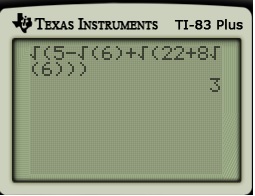
Just look at this monstrosity, which has a triply-embedded square root! But then look what happens when I plug into a calculator:

TImessysquareroot

Hmmm. How is that possible?!?!

I’ll give the answer after the thought bubble, if you’d like to think about it before seeing the answer.

green_speech_bubble

Let’s start from the premise that \sqrt{5 - \sqrt{6} + \sqrt{22+8\sqrt{6}}} = 3 and work backwards. This isn’t the best of logic — since we’re assuming the thing that we’re trying to prove in the first place — but it’s a helpful exercise to see exactly how this happened.

\sqrt{5 - \sqrt{6} + \sqrt{22+8\sqrt{6}}} = 3

5 - \sqrt{6} + \sqrt{22+8\sqrt{6}} = 9

\sqrt{22+8\sqrt{6}} = 4 + \sqrt{6}

22 + 8 \sqrt{6} = (4 + \sqrt{6})^2

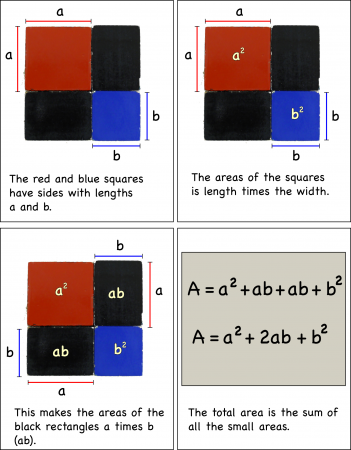
This last line is correct, using the formula (a+b)^2 = a^2 + 2ab + b^2. So, running the logic from bottom to top (and keeping in mind that all of the terms are positive), we obtain the top equation.

green lineThis suggests a general method for constructing such hairy square roots. To begin, start with any similar expression, such as

(2 - \sqrt{3})^2 = 4 - 4\sqrt{3} + 3

(2 - \sqrt{3})^2 = 7 - 4\sqrt{3}

Then we create a nested square root:

2 - \sqrt{3} = \sqrt{7 - 4\sqrt{3}}

Then I get rid of the square root on the left hand side:

2 = \sqrt{3} + \sqrt{7 - 4\sqrt{3}}

Then I add or subtract something so that the left-hand side becomes a perfect square.

25 = 23 + \sqrt{3} + \sqrt{7 - 4 \sqrt{3}}

Finally, I take the square root of both sides:

5 = \sqrt{23 + \sqrt{3} + \sqrt{7 - 4 \sqrt{3}}}

Then I show the right-hand side to my students, ask them to plug into their calculators, and ask them to figure out what happened.