Exponential growth and decay (Part 10): Half-life

In this series of posts, I provide a deeper look at common applications of exponential functions that arise in an Algebra II or Precalculus class. In the previous posts in this series, I considered financial applications. In today’s post, I’ll discuss radioactive decay and the half-life formula.

While these formulas are easy to state, not many high school teachers are aware of the physical principles from which they arise. The basic idea is that if amount A of a radioactive substance (carbon-14, uranium-235, brain cells) is present, the rate at which the substance decays is proportional to the amount of the substance currently present. This can be rewritten as a differential equation, since the rate at which the substance decays is dA/dt. So we find that

\displaystyle \frac{dA}{dt} = - k A

The negative sign on the right-hand side isn’t strictly necessary, but it’s a reminder that amount present decreases as time increases.

This differential equation can be solved in several ways, including separation of variables (below, I’ll be sloppy with the constant of integration for the sake of simplicity):

\displaystyle \frac{dA}{A} = -k

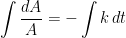
\displaystyle \int \frac{dA}{A} = - \displaystyle \int k \, dt

ln |A| = -k t + C

|A| = e^{-kt+C}

|A| = e^{-kt} e^C

A = \pm e^C e^{-kt}

A = C e^{-kt}

To solve for the constant, we usually use the initial condition A(0) = A_0, a number that must be given in the problem:

A(0) = C e^{-k \cdot 0}

A_0 = C \cdot 1

A_0 = C

Plugging back in, we obtain the final answer

A(t) = A_0 e^{-kt}

Of course, students in Algebra II or Precalculus (or high school chemistry) are usually not ready to understand this derivation using calculus. Instead, they are typically given the final formula and are expected to use this formula to solve problems. Still, I think it’s important for the teacher of Algebra II or Precalculus to be aware of how the origins of this formula, as it only requires mathematics that’s only a year or two away in these students’ mathematical development.

Exponential growth and decay (Part 7): Paying off credit-card debt via recurrence relations

The following problem in differential equations has a very practical application for anyone who has either (1) taken out a loan to buy a house or a car or (2) is trying to pay off credit card debt. To my surprise, most math majors haven’t thought through the obvious applications of exponential functions as a means of engaging their future students, even though it is directly pertinent to their lives (both the students’ and the teachers’).

You have a balance of $2,000 on your credit card. Interest is compounded continuously with a rate of growth of 25% per year. If you pay the minimum amount of $50 per month (or $600 per year), how long will it take for the balance to be paid?

In previous posts, I approached this problem using differential equations. There’s another way to approach this problem that avoids using calculus that, hypothetically, is within the grasp of talented Precalculus students. Instead of treating this problem as a differential equation, we instead treat it as a first-order difference equation (also called a recurrence relation):

A_{n+1} = r A_n - k

The idea is that the amount owed is multiplied by a factor r (which is greater than 1), and from this product the amount paid is deducted. With this approach — and unlike the approach using calculus — the payment period would be each month and not per year. Therefore, we can write

A_{n+1} = \displaystyle \left( 1 + \frac{0.25}{12} \right) A_n - 50

Notice that the meaning of the 25% has changed somewhat… it’s no longer the relative rate of growth, as the 25% has been equally divided for the 12 months.

green line

A full treatment of the solution of difference equations belongs to a proper course in discrete mathematics. In the previous posts, I demonstrated how this difference equation could be solved by directly finding A_1, A_2, A_3, \dots and looking for a pattern.

In this post, I’d like to present an alternative method for deriving the solution. I’ll let the reader decide for him/herself as to whether this technique is pedagogically superior to the previous method. We will attempt to find a solution of the form

A_n = a r^n + b,

where a and b are unknown constants.Why do we guess the solution to have this form? I won’t dive into the details, but this is entirely analogous to constructing the characteristic equation of a linear differential equation with constant coefficients as well as using the method of undetermined coefficients to find a particular solution to a inhomogeneous linear differential equation with constant coefficients.

Substituting n+1 instead of n, we find that

A_{n+1} = a r^{n+1} + b.

So we plug both of these into the difference equation:

A_{n+1} = r A_n - k

a r^{n+1} + b = r \left( a r^n + b \right) - k

a r^{n+1} + b = a r^{n+1} + r b - k

b = r b - k

k = (r-1) b

\displaystyle \frac{k}{r-1} = b

We also use the fact that A_0 = P:

A_0 = a r^0 + b

P = a + b

P - b = a

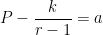
\displaystyle P - \frac{k}{r-1} = a

Combining these, we obtain the solution of the difference equation:

A_n = \displaystyle \left( P - \frac{k}{r-1} \right) r^n +\frac{k}{r-1}

Unsurprisingly, this matches the solution that was obtained in the previous two posts (though the terms have been rearranged).

Exponential growth and decay (Part 4): Paying off credit-card debt

The following problem in differential equations has a very practical application for anyone who has either (1) taken out a loan to buy a house or a car or (2) is trying to pay off credit card debt. To my surprise, most math majors haven’t thought through the obvious applications of exponential functions as a means of engaging their future students, even though it is directly pertinent to their lives (both the students’ and the teachers’).

You have a balance of $2,000 on your credit card. Interest is compounded continuously with a relative rate of growth of 25% per year. If you pay the minimum amount of $50 per month (or $600 per year), how long will it take for the balance to be paid?

In the previous two posts, I presented the general formula

A = \displaystyle \frac{k}{r} - \left( \frac{k}{r} - P \right) e^{rt}

which can be obtained by solving a certain differential equation. So, if r = 0.25, k = 600, and P = 2000, the amount left on the credit card after t years is

A(t) = 2400 - 400 e^{0.25t}.

On the other hand, if the debtor pays $1200 per year, the equation becomes

A(t) = 4800 - 2800 e^{0.25t}

Today, I’ll give some pedagogical thoughts about how this problem, and other similar problems inspired by financial considerations, could fit into a Precalculus course… and hopefully improve the financial literacy of high school students.

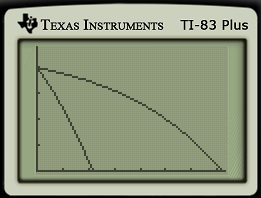
green lineUnder the theory that a picture is worth a thousand words, let’s take a look at the graphs of both of these functions:

creditcardStudents should have no trouble distinguishing which curve is which. Clearly, by paying $1200 per year instead of $600 per year, the credit card debt is paid off considerably quicker.

There’s another immediate take-away from these graphs — especially the graph for k = 600, when the debt is being paid off over 7 years. Notice that the debt is being paid off very slowly in the initial years. Only in the latter years does the pace of paying off the loan pick up. So the moral of the story is: if you can afford to pay extra in the early years of a debt (credit card, mortgage, etc.), it’s much more important to pay off an extra amount in the early years than in the later years.

I believe this to be an important lesson for students to learn before they bury themselves deeply in debt as young adults… and Precalculus provides a natural vehicle for teaching this lesson.


Exponential growth and decay (Part 3): Paying off credit-card debt

The following problem in differential equations has a very practical application for anyone who has either (1) taken out a loan to buy a house or a car or (2) is trying to pay off credit card debt. To my surprise, most math majors haven’t thought through the obvious applications of exponential functions as a means of engaging their future students, even though it is directly pertinent to their lives (both the students’ and the teachers’).

You have a balance of $2,000 on your credit card. Interest is compounded continuously with a relative rate of growth of 25% per year. If you pay the minimum amount of $50 per month (or $600 per year), how long will it take for the balance to be paid?

In yesterday’s post, I showed that the answer to this question was about 7.2 years. To obtain this answer, I started with the differential equation

\displaystyle \frac{dA}{dt} = 0.25 A - 600

which, given the initial condition A(0) = 2000, has solution

A(t) = 2400 - 400 e^{0.25t}.

Today, I’ll give some pedagogical thoughts about how this problem, and other similar problems inspired by financial considerations, could fit into a Precalculus course… and hopefully improve the financial literacy of high school students.

green line

I’ve read many Precalculus books; not many of them include applying exponential functions to the paying off of credit-card debt (or a mortgage on a house or car). Of course, yesterday’s derivation was well above the comprehension level of students in Precalculus. However, there’s no reason why Precalculus students couldn’t be given the general formula
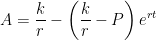
A = \displaystyle \frac{k}{r} - \left( \frac{k}{r} - P \right) e^{rt},

where P is the initial amount, r is the relative rate of growth, and k is the amount paid per year. In other words, students could be given the formula without the full explanation of where it comes from. After all, many Precalculus textbooks give the formula for Newton’s Law of Cooling (the subject of a future post) with neither derivation nor explanation (though its derivation is nearly identical to the work of yesterday’s post), So I don’t see why also giving students the above formula for paying off credit-card debt isn’t more common.

Plugging in k = 600, r = 0.25, and P = 2000 into this equation again yields the function

A(t) = 2400 - 400 e^{0.25t},

from which we find that it will take t = 4\ln 6 \approx 7.2 years to pay off the debt.

A natural follow-up question is “How much money actually was spent to pay off this debt?” By this point, the answer is quite easy: the lender paid \$600 per year for 4\ln 6 years, and so the amount spent is

\$600 \times 4 \ln 6 = \$2400 \ln 6 \approx \$4300.

When I teach this topic in differential equations, I let that answer sink in for a while. The original debt was only \$2000, but ultimately \$4300 needs to be paid over 7.2 years in order to pay off the debt.

The natural question is, “Why did it take so long?” Of course, the answer is that the debtor only paid the minimal amount — $50 per month, or $600 per year. It stands to reason that if extra money was paid each month, then the debt will be paid off faster at lesser expense.

To give one example, let’s repeat the calculation if the debtor paid twice as much ($100 per month, or $1200 per year). Then the amount owed as a function of time would be

A(t) = \displaystyle \frac{1200}{0.25} - \left( \frac{1200}{0.25} - 2000 \right) e^{0.25t} = 4800 - 2800 e^{0.25t}

To find when the credit card will be paid off, we set A(t) = 0:

0 = 4800 - 2800 e^{0.25t}

2800 e^{0.25t} = 4800)

e^{0.25t} = \displaystyle \frac{12}{7}

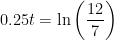
0.25t = \displaystyle \ln \left( \frac{12}{7} \right)

t = \displaystyle 4 \ln \left( \frac{12}{7} \right)

t \approx 2.16

That’s certainly a lot faster! Also, the amount that’s spent over that time is also considerably less:

\displaystyle 1000 \times 4 \ln \left( \frac{12}{7} \right) = 4000 \ln \left( \frac{12}{7} \right) \approx  \$2156.

So, along with being a good way to practice proficiency with exponential and logarithmic functions, this problem lends itself for students discovering some basic principles of financial literacy.


Exponential growth and decay (Part 2): Paying off credit-card debt

The following problem in differential equations has a very practical application for anyone who has either (1) taken out a loan to buy a house or a car or (2) is trying to pay off credit card debt. To my surprise, most math majors haven’t thought through the obvious applications of exponential functions as a means of engaging their future students, even though it is directly pertinent to their lives (both the students’ and the teachers’).

You have a balance of $2,000 on your credit card. Interest is compounded continuously with a relative rate of growth of 25% per year. If you pay the minimum amount of $50 per month (or $600 per year), how long will it take for the balance to be paid?

In this post, I present the actual solution of this problem. In tomorrow’s post, I’ll give some pedagogical thoughts about how this problem, and other similar problems inspired by financial considerations, could fit into a Precalculus course.

green line

Let’s treat this problem as a differential equation (though it could also be considered as a first-order difference equation… more on that later). Let A(t) be the amount of money on the credit card after t years. Then there are two competing forces on the amount of money that will be owed in the future:

  1. The effect of compound interest, which will increase the amount owed by 0.25 A(t) per year.
  2. The amount that’s paid off each year, which will decrease the amount owed by \$600 per year.

Combining, we obtain the differential equation

\displaystyle \frac{dA}{dt} = 0.25 A - 600

There are a variety of techniques by which this differential equation can be solved. One technique is separation of variables, thus pretending that dA/dt is actually a fraction. (In the derivation below, I will be a little sloppy with the arbitrary constant of integration for the sake of simplicity.)

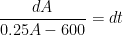
\displaystyle \frac{dA}{0.25 A - 600} = dt

\displaystyle \int \frac{dA}{0.25 A - 600} = \displaystyle \int dt

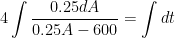
\displaystyle 4 \int \frac{0.25 dA}{0.25 A - 600} = \displaystyle \int dt

4 \ln |0.25A - 600| = t + C

\ln |0.25A - 600| = 0.25 t + C

|0.25A - 600| = e^{0.25 t + C}

|0.25 A - 600| = C e^{0.25t}

0.25A - 600 = C e^{0.25t}

0.25 A = 600 + C e^{0.25t}

A = 2400 + C e^{0.25t}

To solve for the missing constant C, we use the initial condition A(0) = 2000:

A(0) = 2400 + C e^0

2000 = 2400 + C

-400 = C

We thus conclude that the amount of money owed after t years is

A(t) = 2400 - 400 e^{0.25t}

To determine when the amount of the credit card will be reduced to $0, we see A(t) = 0 and solve for t:

0 = 2400 - 400 e^{0.25 t}

400 e^{0.25 t} = 2400

e^{0.25t} = 6

0.25t = \ln 6

t = 4 \ln 6

t \approx 7.2 \hbox{~years}

green line

In tomorrow’s post, I’ll give some pedagogical thoughts about this problem and similar problems.

Exponential growth and decay (Part 1): Phrasing of homework questions

I just completed a series of posts concerning the different definitions of the number e. As part of this series, we considered the formula for continuous compound interest

A = Pe^{rt}

Indeed, this formula can be applied to other phenomena besides the accumulation of money. Unfortunately, as they appear in Precalculus textbooks, the wording of questions involving exponential growth or decay can be either really awkward or mathematically imprecise (or both). Here’s a sampling of problems that I’ve collected from various sources:

One thousand bacteria on a petri dish are placed in an incubator, encouraging a relative rate of growth of 10% per hour. How many bacteria will there be in two days?

This is mathematically precise, as it relates to the differential equation A'(t) = r A(t) with solution A = P e^{rt}. The meaning of the value of r is clear from dimensional analysis: the units of A'(t) are \hbox{bacteria}/ \hbox{hour}, while the units of A(t) are \hbox{bacteria}. Therefore, the units of r must be \hbox{hour}^{-1}. So saying that there’s a “relative rate of growth of 10% per hour” makes total sense.

Of course, when Precalculus students are solving this problem, they have no idea about what a differential equation is, making the word relative seem superfluous to the problem.

A sum of $5000 is invested at an interest rate of 9% per year. Find the time required for the money to double if the interest is compounded continuously.

What the problem is trying to say is “Let r = 0.09.” But this is a horrible way to write this in ordinary English! After all, if we plug r = 0.09 and t = 1 into the formula, we obtain

A = P e^{0.09 \times 1} \approx 1.09417P

So it would appear that the interest rate after one year is about 9.417%, and not 9%.

Indeed, if we read the problem at face value that the interest rate is 9% per year, then it stands to reason that, after one year, we have

P(1.09) = P e^{r \cdot 1}

1.09 = e^r

\ln 1.09 = r

In a nutshell, saying that there is “an interest rate of 9% per year” can easily be interpreted to mean that the annual percentage rate is 9% year, and this can be a conceptual barrier for literally-minded students.

I don’t have a good solution for this impasse between ordinary English and giving clear directions to students about what numbers should be used in the formula. But I do think that it’s important for teachers to be aware of this possible misunderstanding as students read their homework questions.

Different definitions of e (Part 6): Continuous compound interest

In this series of posts, I consider how two different definitions of the number e are related to each other. The number e is usually introduced at two different places in the mathematics curriculum:

  1. Algebra II/Precalculus: If P dollars are invested at interest rate r for t years with continuous compound interest, then the amount of money after t years is A = Pe^{rt}.
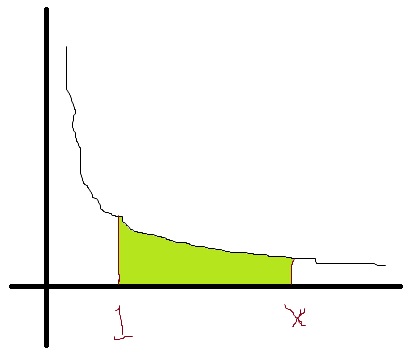
  2. Calculus: The number e is defined to be the number so that the area under the curve y = 1/x from x = 1 to x = e is equal to 1, so that

\displaystyle \int_1^e \frac{dx}{x} = 1.

These two definitions appear to be very, very different. One deals with making money. The other deals with the area under a hyperbola. Amazingly, these two definitions are related to each other. In this series of posts, I’ll discuss the connection between the two.

I should say at the outset that the second definition is usually considered the true definition of e. However, compound interest usually appears earlier in the mathematics curriculum than definite integrals, and so an informal definition of e is given at that stage of the curriculum.

logareagreen line

In yesterday’s post, I presented an informal derivation of the continuous compound interest formula A = Pe^{rt} from the discrete compound interest formula A = \displaystyle P \left( 1 + \frac{r}{n} \right)^{nt}. In today’s post, I’d like to give the more formal derivation using calculus.

What does it mean for something to compound continuously? In a nutshell, the rate at which the money increases should be proportional to the amount currently present. In other words, \$10,000 should earn ten times as much interest as \$1,000. Since A'(t) is the rate at which the money increases and A(t) is the current amount, that means

A'(t) = r A(t)

for some constant of proportionality r. This is a differential equation which can be solved using standard techniques. We divide both sides by A(t) and then integrate:

\displaystyle \frac{A'(t)}{A(t)} = r

\displaystyle \int \frac{A'(t)}{A(t)} dt = \int r dt

\ln |A(t)| = r t + C

|A(t)| = e^{rt+C} = e^rt e^C = C_1 e^{rt}

A(t) = \pm C_1 e^{rt}

A(t) = C_2 e^{rt}

(Technically, a better solution would use an integrating factor [see also MathWorld], but I find that the above derivation is much more convincing to students who are a few semesters removed from a formal course in differential equations.) When presenting this in class, I’ll sometimes lazily write C in place of C_1, with the understanding that e to an arbitrary constant is just an arbitrary positive constant. Also, on the last line, plus or minus an arbitrary constant is just an arbitrary constant (which I’ll usually write as C instead of C_2).

To solve for the missing constant C_2, we use the initial condition A(0) = P:

A(0) = C_2 e^{r\cdot 0}

P = C_2 \cdot 1

P = C_2

Replacing C_2 by P, we have arrived at the continuous compound interest formula A(t) = Pe^{rt}.

Calculators and complex numbers (Part 10)

In this series of posts, I explore properties of complex numbers that explain some surprising answers to exponential and logarithmic problems using a calculator (see video at the bottom of this post). These posts form the basis for a sequence of lectures given to my future secondary teachers.

To begin, we recall that the trigonometric form of a complex number z = a+bi is

z = r(\cos \theta + i \sin \theta)

where r = |z| = \sqrt{a^2 + b^2} and \tan \theta = b/a, with \theta in the appropriate quadrant. As noted before, this is analogous to converting from rectangular coordinates to polar coordinates.

There’s a shorthand notation for the right-hand side (r e^{i \theta}) that I’ll justify later in this series.

Today, I want to share some pedagogical thoughts about this series of posts. I’ll continue with the mathematical development of these ideas tomorrow.

My experience is that most math majors have never seen this particular application of trigonometry to find the nth roots of complex numbers… or even are familiar with the idea of expressing a complex number into trigonometric form at all. This personally surprises me, as this was just one of the topics that I had to learn when I took Precalculus (which was called Trig/Analysis when I took it). I really don’t know if I was fortunate to be exposed to these ideas in my secondary curriculum of the 1980’s or if this was simply a standard topic back then. However, at least in Texas, the trigonometric form of complex numbers does not appear to be a standard topic these days.

This certainly isn’t the most important topic in the mathematics secondary curriculum. That said, I really wish that this was included in a standard Pre-AP course in Precalculus to better serve the high school students who are most likely to take more advanced courses in mathematics and science in college. These ideas are simply assumed in, say, Differential Equations, when students are asked to solve

$y^{5} – 32 y = 0$.

The characteristic equation of this differential equation is r^5 - 32 = 0, and it’s really hard to find all five complex roots unless De Moivre’s Theorem is employed.

To give another example: In physics, even a cursory look at my old electricity and magnetism text reveals that familiarity with the trigonometric form of complex numbers can only facilitate student understanding of these physical concepts. Ditto for many concepts in electrical engineering. Stated another way, students who aren’t used to thinking of complex numbers in this way may struggle through physics and engineering in ways that could have been avoided with prior mathematical training.

green line

For completeness, here’s the movie that I use to engage my students when I begin this sequence of lectures.