My Favorite One-Liners: Part 83

In this series, I’m compiling some of the quips and one-liners that I’ll use with my students to hopefully make my lessons more memorable for them.

Here’s a problem from calculus:

Let f(x) = x^2 e^{3x}. Find f''(x).

We begin by finding the first derivative using the Product Rule:

f'(x) = 2x e^{3x} + 3x^2 e^{3x}.

Next, we apply the Product Rule again to find the second derivative:

f''(x) = (2 e^{3x} + 6x e^{3x}) + (6x e^{3x} + 9x^2 e^{3x}).

At this point, before simplifying to get the final answer, I’ll ask my students why the 6x e^{3x} term appears twice. After a moment, somebody will usually volunteer the answer: the first term came from differentiating x^2 first and then e^{3x} second, while the other term came from differentiating e^{3x} first and then x^2 second. Either way, we end up with the same term.

I then tell my class that there’s a technical term for this: Oops, I did it again.

While on the topic, I can’t resist also sharing this (a few years ago, this was shown on the JumboTron of Dallas Mavericks games during timeouts):

My Favorite One-Liners: Part 82

In this series, I’m compiling some of the quips and one-liners that I’ll use with my students to hopefully make my lessons more memorable for them.

In differential equations, we teach our students that to solve a homogeneous differential equation with constant coefficients, such as

y'''+y''+3y'-5y = 0,

the first step is to construct the characteristic equation

r^3 + r^2 + 3r - 5 = 0

by essentially replacing y' with r, y'' with r^2, and so on. Standard techniques from Algebra II/Precalculus, like the rational root test and synthetic division, are then used to find the roots of this polynomial; in this case, the roots are r=1 and r = -1\pm 2i. Therefore, switching back to the realm of differential equations, the general solution of the differential equation is

y(t) = c_1 e^{t} + c_2 e^{-t} \cos 2t + c_3 e^{-t} \sin 2t.

As t \to \infty, this general solution blows up (unless, by some miracle, c_1 = 0). The last two terms decay to 0, but the first term dominates.

The moral of the story is: if any of the roots have a positive real part, then the solution will blow up to \infty or -\infty. On the other hand, if all of the roots have a negative real part, then the solution will decay to 0 as t \to \infty.

This sets up the following awful math pun, which I first saw in the book Absolute Zero Gravity:

An Aeroflot plan en route to Warsaw ran into heavy turbulence and was in danger of crashing. In desparation, the pilot got on the intercom and asked, “Would everyone with a Polish passport please move to the left side of the aircraft.” The passengers changed seats, and the turbulence ended. Why? The pilot achieved stability by putting all the Poles in the left half-plane.

My Favorite One-Liners: Part 73

In this series, I’m compiling some of the quips and one-liners that I’ll use with my students to hopefully make my lessons more memorable for them.

Today’s entry is courtesy of Season 1 of The Simpsons. I’ll tell this joke just after introducing derivatives to my calculus students. Here is some dialogue from the episode “Bart The Genius”:

Teacher:  So y = r cubed over 3. And if you determine the rate of change in this curve correctly, I think you’ll be pleasantly surprised.
[The class laughs except for Bart who appears confused.]
Teacher:  Don’t you get it, Bart? Derivative dy = 3 r squared dr over 3, or r squared dr, or r dr r. Har-de-har-har!  Get it?

For a more detailed listing of mathematical references, I highly recommend http://www.simpsonsmath.com (or http://mathsci2.appstate.edu/~sjg/simpsonsmath/), maintained by Dr. Sarah J. Greenwald of Appalachian State University and Dr. Andrew Nestler of Santa Monica College.

My Favorite One-Liners: Part 8

In this series, I’m compiling some of the quips and one-liners that I’ll use with my students to hopefully make my lessons more memorable for them.

At many layers of the mathematics curriculum, students learn about that various functions can essentially commute with each other. In other words, the order in which the operations is performed doesn’t affect the final answer. Here’s a partial list off the top of my head:

  1. Arithmetic/Algebra: a \cdot (b + c) = a \cdot b + a \cdot c. This of course is commonly called the distributive property (and not the commutative property), but the essential idea is that the same answer is obtained whether the multiplications are performed first or if the addition is performed first.
  2. Algebra: If a,b > 0, then \sqrt{ab} = \sqrt{a} \sqrt{b}.
  3. Algebra: If a,b > 0 and x is any real number, then (ab)^x = a^x b^x.
  4. Precalculus: \displaystyle \sum_{i=1}^n (a_i+b_i) = \displaystyle \sum_{i=1}^n a_i + \sum_{i=1}^n b_i.
  5. Precalculus: \displaystyle \sum_{i=1}^n c a_i = c \displaystyle \sum_{i=1}^n a_i.
  6. Calculus: If f is continuous at an interior point c, then \displaystyle \lim_{x \to c} f(x) = f(c).
  7. Calculus: If f and g are differentiable, then (f+g)' = f' + g'.
  8. Calculus: If f is differentiable and c is a constant, then (cf)' = cf'.
  9. Calculus: If f and g are integrable, then \int (f+g) = \int f + \int g.
  10. Calculus: If f is integrable and c is a constant, then \int cf = c \int f.
  11. Calculus: If f: \mathbb{R}^2 \to \mathbb{R} is integrable, \iint f(x,y) dx dy = \iint f(x,y) dy dx.
  12. Calculus: For most differentiable function f: \mathbb{R}^2 \to \mathbb{R} that arise in practice, \displaystyle \frac{\partial^2 f}{\partial x \partial y} = \displaystyle \frac{\partial^2 f}{\partial y \partial x}.
  13. Probability: If X and Y are random variables, then E(X+Y) = E(X) + E(Y).
  14. Probability: If X is a random variable and c is a constant, then E(cX) = c E(X).
  15. Probability: If X and Y are independent random variables, then E(XY) = E(X) E(Y).
  16. Probability: If X and Y are independent random variables, then \hbox{Var}(X+Y) = \hbox{Var}(X) + \hbox{Var}(Y).
  17. Set theory: If A, B, and C are sets, then A \cup (B \cap C) = (A \cup B) \cap (A \cup C).
  18. Set theory: If A, B, and C are sets, then A \cap (B \cup C) = (A \cap B) \cup (A \cap C).

However, there are plenty of instances when two functions do not commute. Most of these, of course, are common mistakes that students make when they first encounter these concepts. Here’s a partial list off the top of my head. (For all of these, the inequality sign means that the two sides do not have to be equal… though there may be special cases when equality happens to happen.)

  1. Algebra: (a+b)^x \ne a^x + b^x if x \ne 1. Important special cases are x = 2, x = 1/2, and x = -1.
  2. Algebra/Precalculus: \log_b(x+y) = \log_b x + \log_b y. I call this the third classic blunder.
  3. Precalculus: (f \circ g)(x) \ne (g \circ f)(x).
  4. Precalculus: \sin(x+y) \ne \sin x + \sin y, \cos(x+y) \ne \cos x + \cos y, etc.
  5. Precalculus: \displaystyle \sum_{i=1}^n (a_i b_i) \ne \displaystyle \left(\sum_{i=1}^n a_i \right) \left( \sum_{i=1}^n b_i \right).
  6. Calculus: (fg)' \ne f' \cdot g'.
  7. Calculus \left( \displaystyle \frac{f}{g} \right)' \ne \displaystyle \frac{f'}{g'}
  8. Calculus: \int fg \ne \left( \int f \right) \left( \int g \right).
  9. Probability: If X and Y are dependent random variables, then E(XY) \ne E(X) E(Y).
  10. Probability: If X and Y are dependent random variables, then \hbox{Var}(X+Y) \ne \hbox{Var}(X) + \hbox{Var}(Y).

All this to say, it’s a big deal when two functions commute, because this doesn’t happen all the time.

green lineI wish I could remember the speaker’s name, but I heard the following one-liner at a state mathematics conference many years ago, and I’ve used it to great effect in my classes ever since. Whenever I present a property where two functions commute, I’ll say, “In other words, the order of operations does not matter. This is a big deal, because, in real life, the order of operations usually is important. For example, this morning, you probably got dressed and then went outside. The order was important.”


A Natural Function with Discontinuities: Index

I’m doing something that I should have done a long time ago: collecting a series of posts into one single post. The following links comprised my series on a natural function that nevertheless has discontinuities.

Part 1: Introduction

Part 2: Derivation of this piecewise function, beginning.

Part 3: Derivation of the piecewise function, ending.


Math Maps The Island of Utopia

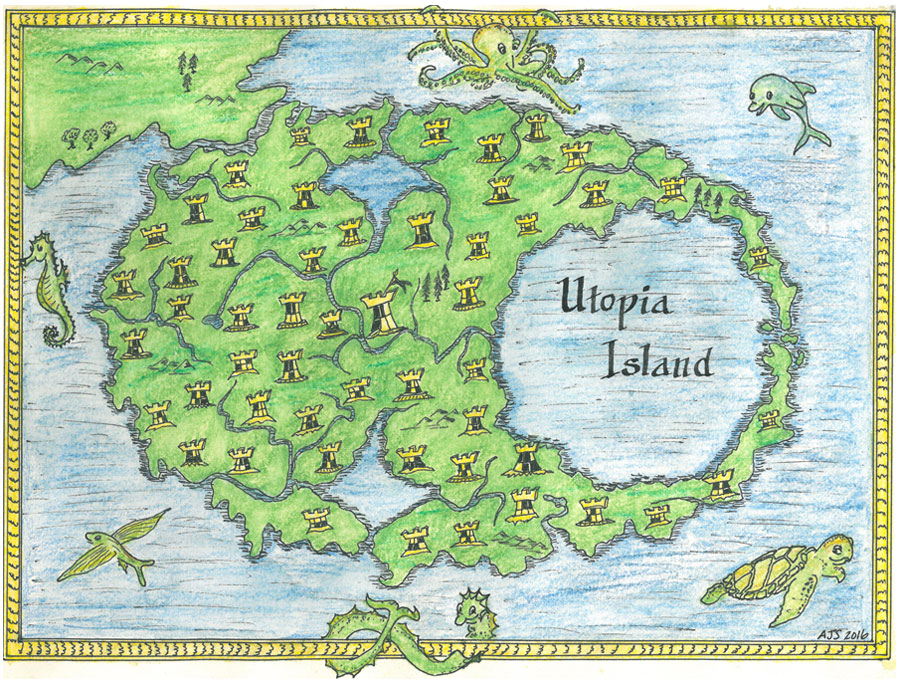
Under the category of “Somebody Had To Figure It Out,” Dr. Andrew Simoson of King University (Bristol, Tennessee) used calculus to determine the shape of the island of Utopia in the 500-year-old book by Sir Thomas More based on the description of island given in the book’s introduction.

News article: https://www.insidescience.org/news/math-maps-island-thomas-mores-utopia

Paper by Dr. Simoson: http://archive.bridgesmathart.org/2016/bridges2016-65.html

A natural function with discontinuities (Part 1)

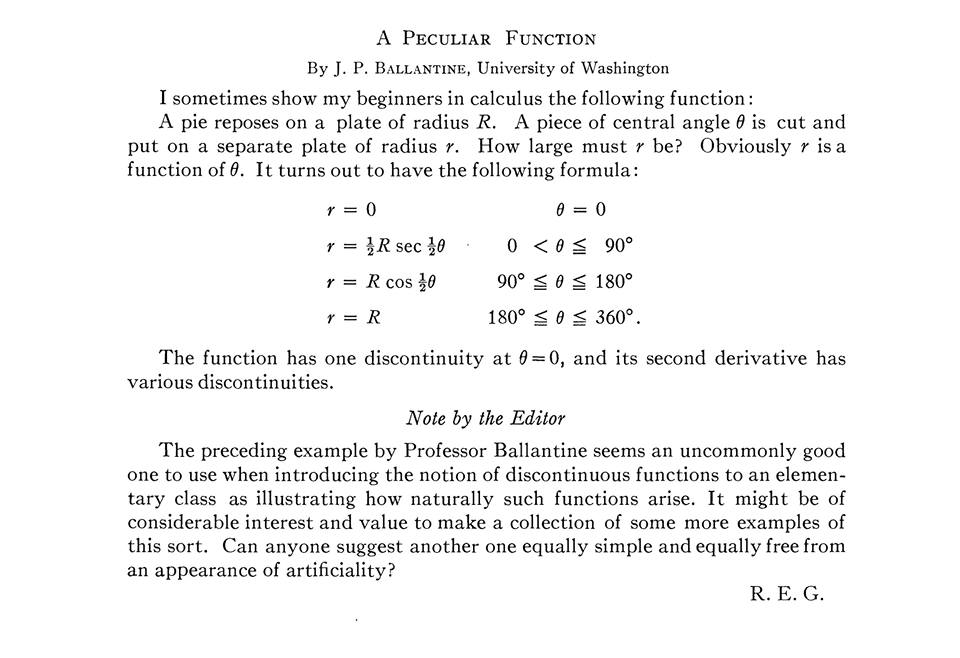
The following tidbit that was published on the American Mathematical Monthly’s Facebook page caught my attention:

discontinuousSource: https://www.facebook.com/AmerMathMonthly/photos/a.250425975006394.53155.241224542593204/1021059947942989/?type=3&theater

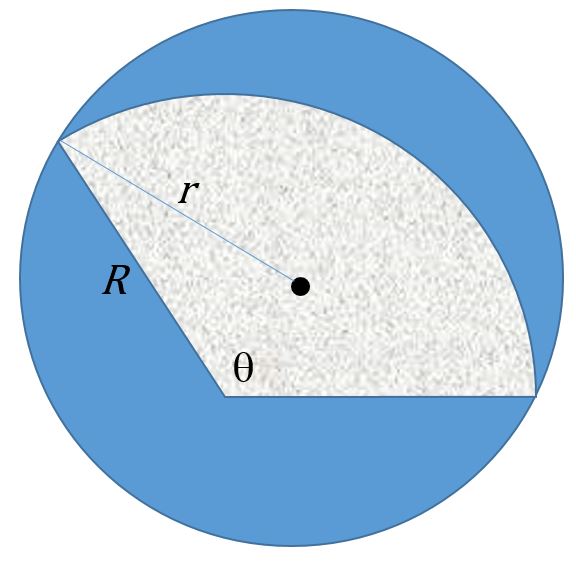
Here’s the relationship between r, R, and \theta in case it isn’t clear from the description. The gray sector is determined by r and \theta, and then the blue circle with radius r is chosen to enclose the sector.

discontinuity0

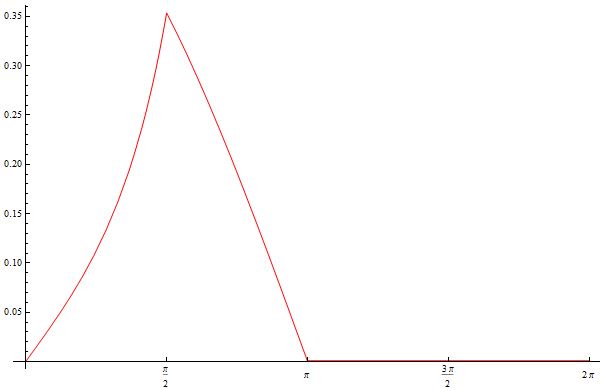
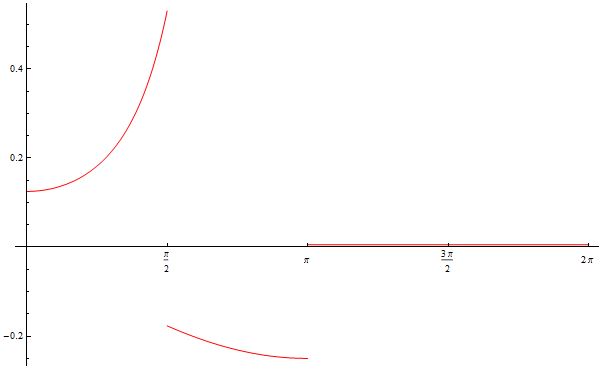
Unfortunately, there was typo for the third case; it should have been r = R \sin \frac{1}{2} \theta if 90^\circ \le \theta \le 180^\circ. Here’s the graph if R = 1, using radians instead of degrees:

discontinuity1

As indicated in the article, there’s a discontinuity at t=0. However, the rest of the graph looks nice and smooth.

Here’s the graph of the first derivative:

discontinuity2

The first derivative is continuous (and so the original graph is smooth). However, there are obvious corners in the graph of the first derivative, which betray discontinuities in the graph of the second derivative:

discontinuity3

Stump the Prof: An Activity for Calculus I

After finishing the Product, Quotient, and Chain Rules in my calculus class, I’d tell my class the following: “Next time, we’re going to play Stump the Prof. Anything that you can write on the board in 15 seconds, I will differentiate. Anything. I don’t care how hard it looks, I’ll differentiate it (if it has a derivative). So do your best to stump me.”

At the next lecture, I would devote the last 15-20 minutes of class time to Stump the Prof. Students absolutely loved it… their competitive juices got flowing as they tried to think of the nastiest, hairiest functions that they could write on the board in 15 seconds. And I’d differentiate them all using the rules we’d just covered.. though I never promised that I would simplify the derivatives!

Sometimes the results were quite funny. Every once in a while, a student would write some amazingly awful expression but forgot to include an x anywhere. Since the given function was a constant, the derivative of course was zero.

The worst one I ever got was something like this:

y = \csc^4(\sec^5(\csc^8(\sec^7(\csc^4(\sec^5(x)))))

Differentiating this took a good 3-4 minutes and took maybe 5 lines across the entire length of the chalkboard; I remember that my arm was sore after writing down the derivative. Naturally, some wise guy used his 15 seconds to write y = in front of my answer, asking me to find the second derivative. At that, I waved my white handkerchief and  surrendered.

The point of this exercise is to illustrate to students that differentiation is a science; there are rules to follow, and by carefully following the rules, one can find the derivative of any “standard” function.

Later on, when we hit integration, I’ll draw a contrast: differentiation is a science, but integration is a combination of both science and art.