Confirming Einstein’s Theory of General Relativity With Calculus, Part 5a: Confirming Orbits under Newtonian Mechanics with Calculus

In this series, I’m discussing how ideas from calculus and precalculus (with a touch of differential equations) can predict the precession in Mercury’s orbit and thus confirm Einstein’s theory of general relativity. The origins of this series came from a class project that I assigned to my Differential Equations students maybe 20 years ago.

We previously showed that if the motion of a planet around the Sun is expressed in polar coordinates (r,\theta), with the Sun at the origin, then under Newtonian mechanics (i.e., without general relativity) the motion of the planet follows the differential equation

u''(\theta) + u(\theta) = \displaystyle \frac{1}{\alpha},

where u = 1/r and \alpha is a certain constant. We will also impose the initial condition that the planet is at perihelion (i.e., is closest to the sun), at a distance of P, when \theta = 0. This means that u obtains its maximum value of 1/P when \theta = 0. This leads to the two initial conditions

u(0) = \displaystyle \frac{1}{P} \qquad \hbox{and} \qquad u'(0) = 0;

the second equation arises since u has a local extremum at \theta = 0.

In the next few posts, we’ll discuss the solution of this initial-value problem. Today’s post would be appropriate for calculus students, which is confirming that

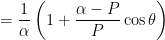
u(\theta) = \displaystyle \frac{1 + \epsilon \cos \theta}{\alpha}

solves this initial-value problem, where \epsilon = \displaystyle \frac{\alpha-P}{P}. Since r is the reciprocal of u, we infer that

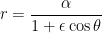
r = \displaystyle \frac{\alpha}{1 + \epsilon \cos \theta}.

As we’ve already seen in this series, this means that the orbit of the planet is a conic section — either a circle, ellipse, parabola, or hyperbola. Since the orbit of a planet is stable and \epsilon = 0 is extremely unlikely, this means that the planet orbits the Sun in an ellipse, with the Sun at one focus of the ellipse.

So, for a calculus student to verify that planets move in ellipses, one must check that

u(\theta) = \displaystyle \frac{1 + \epsilon \cos \theta}{\alpha}

is a solution of the initial-value problem

u''(\theta) + u(\theta) = \displaystyle \frac{1}{\alpha},

u(0) = \displaystyle \frac{1}{P},

u'(0) = 0.

The second line is easy to check:

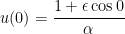
u(0) = \displaystyle \frac{1 + \epsilon \cos 0}{\alpha}

= \displaystyle \frac{1 + \epsilon}{\alpha}

= \displaystyle \frac{1 + \displaystyle \frac{\alpha-P}{P}}{\alpha}

= \displaystyle \frac{1}{\alpha} \frac{P + \alpha - P}{P}

= \displaystyle \frac{1}{\alpha} \frac{\alpha}{P}

= \displaystyle \frac{1}{P}.

The third line is also easy to check:

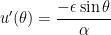
u'(\theta) = \displaystyle \frac{-\epsilon \sin \theta}{\alpha}

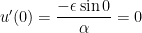
u'(0) = \displaystyle \frac{-\epsilon \sin 0}{\alpha} = 0.

To check the first line, we first find u''(\theta):

u''(\theta) = \displaystyle \frac{-\epsilon \cos \theta}{\alpha},

so that

u''(\theta) + u(\theta) = \displaystyle \frac{-\epsilon \cos \theta}{\alpha} + \frac{1 + \epsilon \cos \theta}{\alpha} = \frac{1}{\alpha},

thus confirming that u(\theta) = \displaystyle \frac{1 + \epsilon \cos \theta}{\alpha} solves the initial-value problem.

While the above calculations are well within the grasp of a good Calculus I student, I’ll be the first to admit that this solution is less than satisfying. We just mysteriously proposed a solution, seemingly out of thin air, and confirmed that it worked. In the next post, I’ll proposed a way that calculus students can be led to guess this solution. Then, we talk about finding the solution of this nonhomogeneous initial-value problem using standard techniques from differential equations.

Confirming Einstein’s Theory of General Relativity With Calculus, Part 4b: Acceleration in Polar Coordinates

In this series, I’m discussing how ideas from calculus and precalculus (with a touch of differential equations) can predict the precession in Mercury’s orbit and thus confirm Einstein’s theory of general relativity. The origins of this series came from a class project that I assigned to my Differential Equations students maybe 20 years ago.

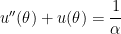
In this part of the series, we will show that if the motion of a planet around the Sun is expressed in polar coordinates (r,\theta), with the Sun at the origin, then under Newtonian mechanics (i.e., without general relativity) the motion of the planet follows the differential equation
u''(\theta) + u(\theta) = \displaystyle \frac{1}{\alpha},

where u = 1/r and \alpha is a certain constant. Deriving this governing differential equation will require some principles from physics. If you’d rather skip the physics and get to the mathematics, we’ll get to solving this differential equations in the next post.

Part of the derivation of this governing differential equation will involve Newton’s Second Law

{\bf F} = m {\bf a},

where m is the mass of the planet and the force {\bf F} and the acceleration a are vectors. In usual rectangular coordinates, the acceleration vector would be expressed as

{\bf a} = x''(t) {\bf i} + y''(t) {\bf j},

where the components of the acceleration in the x- and y-directors are x''(t) and y''(t), and the unit vectors {\bf i} and {\bf j} are perpendicular, pointing in the positive x and positive y directions.

Unfortunately, our problem involves polar coordinates, and rewriting the acceleration vector in polar coordinates, instead of rectangular coordinates, is going to take some work.

Suppose that the position of the planet is (r,\theta) in polar coordinates, so that the position in rectangular coordinates is {\bf r} = (r\cos \theta, r \sin \theta). This may be rewritten as

{\bf r} = r \cos \theta {\bf i} + r \sin \theta {\bf j} = r ( \cos \theta {\bf i} + \sin \theta {\bf j}) = r {\bf u}_r,

where

{\bf u}_r = \cos \theta {\bf i} + \sin \theta {\bf j}

is a unit vector that points away from the origin. We see that this is a unit vector since

\parallel {\bf u}_r \parallel = {\bf u}_r \cdot {\bf u}_r = \cos^2 \theta + \sin^2 \theta =1.

We also define

{\bf u}_\theta = -\sin \theta {\bf i} + \cos \theta {\bf j}

to be a unit vector that is perpendicular to {\bf u}_r; it turns out that {\bf u}_\theta points in the direction of increasing \theta. To see that {\bf u}_r and {\bf u}_\theta are perpendicular, we observe

{\bf u}_r \cdot {\bf u}_\theta = -\sin \theta \cos \theta + \sin \theta \cos \theta = 0.

Computing the velocity and acceleration vectors in polar coordinates will have a twist that’s not experienced with rectangular coordinates since both {\bf u}_r and {\bf u}_\theta are functions of \theta. Indeed, we have

\displaystyle \frac{d{\bf u}_r}{d\theta} =  \frac{d \cos \theta}{d\theta} {\bf i} + \frac{d\sin \theta}{d\theta} {\bf j} = -\sin \theta {\bf i} + \cos \theta {\bf j} = {\bf u}_\theta.

Furthermore,

\displaystyle \frac{d{\bf u}_\theta}{d\theta} =  -\frac{d \sin \theta}{d\theta} {\bf i} + \frac{d\cos \theta}{d\theta} {\bf j} = -\cos \theta {\bf i} - \sin \theta {\bf j} = -{\bf u}_r.

These two equations will be needed in the derivation below.

We are now in position to express the velocity and acceleration of the orbiting planet in polar coordinates. Clearly, the position of the planet is r {\bf u}_r, or a distance r from the origin in the direction of {\bf u}_r. Therefore, by the Product Rule, the velocity of the planet is

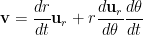
{\bf v} = \displaystyle \frac{d}{dt} (r {\bf u}_r) = \displaystyle \frac{dr}{dt} {\bf u}_r + r \frac{d {\bf u}_r}{dt}

We now apply the Chain Rule to the second term:

{\bf v} = \displaystyle \frac{dr}{dt} {\bf u}_r + r \frac{d {\bf u}_r}{d\theta} \frac{d\theta}{dt}

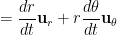
= \displaystyle \frac{dr}{dt} {\bf u}_r + r \frac{d\theta}{dt} {\bf u}_\theta.

Differentiating a second time with respect to time, and again using the Chain Rule, we find

{\bf a} = \displaystyle \frac{d {\bf v}}{dt} = \displaystyle \frac{d^2r}{dt^2} {\bf u}_r + \frac{dr}{dt} \frac{d{\bf u}_r}{dt} + \frac{dr}{dt} \frac{d\theta}{dt} {\bf u}_\theta + r \frac{d^2\theta}{dt^2} {\bf u}_\theta + r \frac{d\theta}{dt} \frac{d{\bf u}_\theta}{dt}

= \displaystyle \frac{d^2r}{dt^2} {\bf u}_r + \frac{dr}{dt} \frac{d{\bf u}_r}{d\theta} \frac{d\theta}{dt} + \frac{dr}{dt} \frac{d\theta}{dt} {\bf u}_\theta + r \frac{d^2\theta}{dt^2} {\bf u}_\theta +  r \frac{d\theta}{dt} \frac{d{\bf u}_\theta}{d\theta} \frac{d\theta}{dt}

= \displaystyle \frac{d^2r}{dt^2} {\bf u}_r + \frac{dr}{dt} \frac{d\theta}{dt} {\bf u}_\theta  + \frac{dr}{dt} \frac{d\theta}{dt} {\bf u}_\theta + r \frac{d^2\theta}{dt^2} {\bf u}_\theta -  r \left(\frac{d\theta}{dt} \right)^2 {\bf u}_r

= \displaystyle \left[ \frac{d^2r}{dt^2} -  r \left(\frac{d\theta}{dt} \right)^2 \right] {\bf u}_r + \left[ 2\frac{dr}{dt} \frac{d\theta}{dt} + r \frac{d^2\theta}{dt^2} \right] {\bf u}_\theta.

This will be needed in the next post, when we use both Newton’s Second Law and Newton’s Law of Gravitation, expressed in polar coordinates.

Confirming Einstein’s Theory of General Relativity With Calculus, Part 4a: Angular Momentum

In this series, I’m discussing how ideas from calculus and precalculus (with a touch of differential equations) can predict the precession in Mercury’s orbit and thus confirm Einstein’s theory of general relativity. The origins of this series came from a class project that I assigned to my Differential Equations students maybe 20 years ago.

In this part of the series, we will show that if the motion of a planet around the Sun is expressed in polar coordinates (r,\theta), with the Sun at the origin, then under Newtonian mechanics (i.e., without general relativity) the motion of the planet follows the differential equation

u''(\theta) + u(\theta) = \displaystyle \frac{1}{\alpha},

where u = 1/r and \alpha is a certain constant. Deriving this governing differential equation will require some principles from physics. If you’d rather skip the physics and get to the mathematics, we’ll get to solving this differential equations in a few posts.

One principle from physics that we’ll need is the Law of Conservation of Angular Momentum. Mathematically, this is expressed by

mr^2 \displaystyle \frac{d\theta}{dt} = \ell,

where \ell is a constant. Of course, this can be written as

\displaystyle \frac{d\theta}{dt} = \displaystyle \frac{\ell}{mr^2};

this will be used a couple times in the derivation below.

As we’ll soon see, we will need to express the second derivative \displaystyle \frac{d^2 r}{d t^2} in a form that depends only on \theta. To do this, we use the Chain Rule to obtain

r' = \displaystyle \frac{dr}{dt}

= \displaystyle \frac{dr}{d\theta} \cdot \frac{d\theta}{dt}

= \displaystyle \frac{\ell}{mr^2} \frac{dr}{d\theta}

= \displaystyle - \frac{\ell}{m} \frac{d}{d\theta} \left( \frac{1}{r} \right).

This last step used the Chain Rule in reverse:

\displaystyle \frac{d}{d\theta} \left( \frac{1}{r} \right) = \frac{d}{dr} \left( \frac{1}{r} \right) \cdot \frac{dr}{dt} = -\frac{1}{r^2} \cdot \frac{dr}{dt}.

To examine the second derivative \displaystyle \frac{d^2 r}{d t^2}, we again use the Chain Rule:

\displaystyle \frac{d^2 r}{d t^2} = \displaystyle \frac{dr'}{dt}

= \displaystyle \frac{dr'}{d\theta} \cdot \frac{d\theta}{dt}

= \displaystyle \frac{\ell}{mr^2} \frac{dr'}{d\theta}

= \displaystyle \frac{\ell}{mr^2} \frac{d}{d\theta} \left[ \frac{dr}{dt} \right]

= \displaystyle \frac{\ell}{mr^2} \frac{d}{d\theta} \left[ - \frac{\ell}{m} \frac{d}{d\theta} \left( \frac{1}{r} \right) \right]

= \displaystyle - \frac{\ell^2}{m^2r^2} \frac{d}{d\theta} \left[ \frac{d}{d\theta} \left( \frac{1}{r} \right) \right]

= \displaystyle - \frac{\ell^2}{m^2r^2} \frac{d^2}{d\theta^2}  \left( \frac{1}{r} \right) .

While far from obvious now, this will be needed when we rewrite Newton’s Second Law in polar coordinates.

Parabolas from String Art (Part 10)

Recently, I announced that my paper Parabolic Properties from Pieces of String had been published in the magazine Math Horizons. The article had multiple aims; in chronological order of when I first started thinking about them:

  • Prove that string art from two line segments traces a parabola.
  • Prove that a quadratic polynomial satisfies the focus-directrix property of a parabola, which is the reverse of the usual logic when students learn conic sections.
  • Prove the reflective property of parabolas.
  • Accomplish all of the above without using calculus.

While I’m generally pleased with the final form of the article, the necessity of publication constraints somewhat abbreviated the original goal of this project: determining a pedagogically sound way of convincing a bright Algebra I student that string art unexpectedly produces a parabola. In this series of posts, I’d wanted to expand on the article with some pedagogical thoughts about connecting string art to parabolas for algebra students. After all, most mathematical studies of string art curves — formally known as “envelopes” — rely on differential equations or at least limits and calculus.

However, string art is simple enough for a young child to construct, and so this study was inspired by the quest of explaining this phenomenon using only simple mathematical tools.

The article linked above has further thoughts on this problem, including a calculus-free way of deriving the reflective property of parabolas. However, I think the article pretty much has all of my thoughts on this matter, and so I don’t think I need to elaborate upon them here.

This series of posts is dedicated to an inspired and inspiring Algebra I student who wanted to understand string art curves using tools that she could understand… even though she progressed much further into the mathematics curriculum by the time my article was published and this series of posts appeared on my blog.

Parabolas from String Art (Part 9)

Recently, I announced that my paper Parabolic Properties from Pieces of String had been published in the magazine Math Horizons. The article had multiple aims; in chronological order of when I first started thinking about them:

  • Prove that string art from two line segments traces a parabola.
  • Prove that a quadratic polynomial satisfies the focus-directrix property of a parabola, which is the reverse of the usual logic when students learn conic sections.
  • Prove the reflective property of parabolas.
  • Accomplish all of the above without using calculus.

While I’m generally pleased with the final form of the article, the necessity of publication constraints somewhat abbreviated the original goal of this project: determining a pedagogically sound way of convincing a bright Algebra I student that string art unexpectedly produces a parabola. While all the necessary mathematics is in the article, I think the article is somewhat lacking on how to sell the idea to students. So, in this series of posts, I’d like to expand on the article with some pedagogical thoughts about connecting string art to parabolas.

We have shown in the last couple of posts that if the three points that generate the Our explorations of string art led us to consider an arbitrary string \overline{PQ} depicted below. For brevity, this string will be called “string s,” matching the (possibly non-integer) x-coordinate of its left endpoint P. Since P is s units to the right of A, the right endpoint Q must correspondingly be s units to the right of B. Therefore, the x-coordinate of Q is s + 8.

Previously, we established that the equation for string s is

y = -\displaystyle \frac{s^2}{4} + \frac{xs}{4} - x + 8.

We also obtained a bonus result that we obtained using only algebra: string s is tangent to the parabola y = \displaystyle \frac{x^2}{16} - x + 8, which is traced by the strings, when x=2s. Of course, tangent lines are usually obtained using calculus, and so calculus should be able to confirm this result. The derivative of this function is

y' = \displaystyle \frac{x}{8} - 1,

so that the slope of the tangent line when x=2s is m = \displaystyle \frac{s}{4} - 1 = \frac{s-4}{4}. We observe that this matches the slope of line segment \overline{PQ} in the above picture:

slope = \displaystyle \frac{s - (s-8)}{(s+8) - 8} = \frac{2s-8}{8} = \frac{s-4}{4}.

Therefore, to show that \overline{PQ} is the tangent line, it suffices to show that either P or Q is on the tangent line.

At x = 2s, the y-coordinate of where the tangent line intersects the curve is

y = \displaystyle \frac{(2s)^2}{16} - 2s + 8 = \frac{s^2}{4} - 2s + 8.

Using the point-slope formula for a line, the equation of the tangent line is thus

y-y_1 = m(x-x_1)

y-\displaystyle \left( \frac{s^2}{4} - 2s + 8 \right) = \frac{s-4}{4} (x-2s)

y = \displaystyle \frac{s-4}{4} (x-2s) +  \frac{s^2}{4} - 2s + 8.

We now check to see if P(s,8-s) is on the tangent line. Substituting x =s, we find

y = \displaystyle \frac{s-4}{4} (s-2s) +  \frac{s^2}{4} - 2s + 8

= \displaystyle \frac{s-4}{4} (-s) +  \frac{s^2}{4} - 2s + 8

= \displaystyle \frac{(s-4)(-s) + s^2}{4} - 2s + 8

= \displaystyle \frac{-s^2+4s + s^2}{4} - 2s + 8

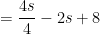
= \displaystyle \frac{4s}{4} - 2s + 8

= s - 2s + 8

= -s + 8

Therefore, the point (s,8-s) is on the tangent line, thus confirming that P is on the tangent line and that \overline{PQ} is the tangent line.

Parabolas from String Art (Part 8)

Recently, I announced that my paper Parabolic Properties from Pieces of String had been published in the magazine Math Horizons. The article had multiple aims; in chronological order of when I first started thinking about them:

  • Prove that string art from two line segments traces a parabola.
  • Prove that a quadratic polynomial satisfies the focus-directrix property of a parabola, which is the reverse of the usual logic when students learn conic sections.
  • Prove the reflective property of parabolas.
  • Accomplish all of the above without using calculus.

While I’m generally pleased with the final form of the article, the necessity of publication constraints somewhat abbreviated the original goal of this project: determining a pedagogically sound way of convincing a bright Algebra I student that string art unexpectedly produces a parabola. While all the necessary mathematics is in the article, I think the article is somewhat lacking on how to sell the idea to students. So, in this series of posts, I’d like to expand on the article with some pedagogical thoughts about connecting string art to parabolas.

We have shown in the last couple of posts that if the three points that generate the Our explorations of string art led us to consider an arbitrary string \overline{PQ} depicted below. For brevity, this string will be called “string s,” matching the (possibly non-integer) x-coordinate of its left endpoint P. Since P is s units to the right of A, the right endpoint Q must correspondingly be s units to the right of B. Therefore, the x-coordinate of Q is s + 8.

Previously, we established that the equation for string s is

y = -\displaystyle \frac{s^2}{4} + \frac{xs}{4} - x + 8.

Finding the curve traced by the strings is a two-step process:

  • For a fixed value of x, find the value of s that maximizes y.
  • Find this optimal value of y.

Previously, we showed using only algebra that the optimal value of s is s = \displaystyle \frac{x}{2}, corresponding to an optimal value of y of y = \displaystyle \frac{x^2}{16} - x + 8.

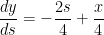
For a student who knows calculus, the optimal value of s can be found by instead solving the equation \displaystyle \frac{dy}{ds} = 0 (or, more accurately, \displaystyle \frac{\partial y}{\partial s} = 0):

\displaystyle \frac{dy}{ds} = -\frac{2s}{4} + \frac{x}{4}

0 = \displaystyle \frac{-2s+x}{4}

0 = -2s + x

2s = x

s = \displaystyle \frac{x}{2},

matching the result that we found by using only algebra.

Parabolic Properties from Pieces of String

I am pleased to announce that my latest paper, “Parabolic Properties from Pieces of String,” has now been published in Math Horizons. This was a really fun project for me. As I describe in the paper, I started wondering if it was possible to convince a student who hadn’t learned calculus yet that string art from two line segments traces a parabola. Not only was I able to come up with a way of demonstrating this without calculus, but I was also able to (1) prove that a quadratic polynomial satisfies the focus-directrix property of a parabola, which is the reverse of the usual logic when students learn conic sections, and (2) prove the reflective property of parabolas. I was really pleased with the final result, and am very happy that this was accepted for publication.

Due to copyright restrictions, I’m not permitted to freely distribute the final, published version of my article. However, I am able to share the following version of the article.

The above PDF file is an Accepted Manuscript of an article published by Taylor & Francis in College Mathematics Journal on February 24, 2022, available online: Full article: Parabolic Properties from Pieces of String (tandfonline.com)

A New Derivation of Snell’s Law without Calculus

Last week, I posted that my latest paper, “A New Derivation of Snell’s Law without Calculus,” has now been published in College Mathematics Journal. In that previous post, I didn’t provide the complete exposition because of my understanding of copyright restrictions at that time.

I’ve since received requests for copies of my paper, which prompted me to carefully read the publisher’s copyright restrictions. In a nutshell, I was wrong: I am allowed to widely distribute preprints that did not go through peer review and, with extra restrictions, the accepted manuscript after peer review.

So, anyway, here it is.

The above PDF file is an Accepted Manuscript of an article published by Taylor & Francis in College Mathematics Journal on January 28, 2022, available online: Full article: A New Derivation of Snell’s Law Without Calculus (tandfonline.com).

A New Derivation of Snell’s Law without Calculus

I’m pleased to say that my latest paper, “A New Derivation of Snell’s Law without Calculus,” has now been published in College Mathematics Journal. The article is now available for online access to anyone who has access to the journal — usually, that means members of the Mathematical Association of America or anyone whose employer (say, a university) has institutional access. I expect that it will be in the printed edition of the journal later this year; however, I’ve not been told yet the issue in which it will appear.

Because of copyright issues, I can’t reproduce my new derivation of Snell’s Law here on the blog, so let me instead summarize the main idea. Snell’s Law (see Wikipedia) dictates the angle at which light is refracted when it passes from one medium (say, air) into another (say, water). If the velocity of light through air is v_1 while its velocity in water is v_2, then Snell’s Law says that

\displaystyle \frac{\sin \theta_1}{v_1} = \displaystyle \frac{\sin \theta_2}{v_2}

From Wikipedia

I was asked by a bright student who was learning physics if there was a way to prove Snell’s Law without using calculus. At the time, I was blissfully unaware of Huygens’s Principle (see OpenStax) and I didn’t have a good answer. I had only seen derivations of Snell’s Law using the first-derivative test, which is a standard optimization problem found in most calculus books (again, see Wikipedia) based on Fermat’s Principle that light travels along a path that minimizes time.

Anyway, after a couple of days, I found an elementary proof that does not require proof. I should warn that the word “elementary” can be a loaded word when used by mathematicians. The proof uses only concepts found in Precalculus, especially rotating a certain hyperbola and careful examining the domain of two functions. So while the proof does not use calculus, I can’t say that the proof is particularly easy — especially compared to the classical proof using Huygens’s Principle.

That said, I’m pretty sure that my proof is original, and I’m pretty proud of it.

Convexity and Orthogonality at Saddle Points

Today, the Texas Section of the Mathematical Association of America is holding its annual conference. Like many other professional conferences these days, this conference will be held virtually, and so my contribution to the conference is saved on YouTube and is available to the public.

Here’s the abstract of my talk: “At a saddle point (like the middle of a Pringles potato chip), the directions of maximum upward concavity and maximum downward concavity are perpendicular. The usual proof requires a fair amount of linear algebra: eigenvectors of different eigenvalues of a real symmetric matrix, like the Hessian, must be orthogonal. For this reason, the orthogonality of these two directions is not often stated in calculus textbooks, let alone proven, when the Second Partial Derivative Test for identifying local extrema and saddle points is discussed. In this talk, we present an elementary proof of the orthogonality of these two directions that requires only ideas from Calculus III and trigonometry. Not surprisingly, this proof can be connected to the usual proof from linear algebra.”

If you have 12 minutes to spare, here’s the talk.