Lessons from teaching gifted elementary school students (Part 4c)

Every so often, I’ll informally teach a class of gifted elementary-school students. I greatly enjoy interacting with them, and I especially enjoy the questions they pose. Often these children pose questions that no one else will think about, and answering these questions requires a surprisingly depth of mathematical knowledge.

Here’s a question I once received:

What is the chance of winning a game of BINGO after only four turns?

When my class posed this question, I was a little concerned that the getting the answer might be beyond the current abilities of a gifted elementary student. As discussed over the past couple of posts, for a non-standard BINGO game with 44 numbers, the answer is

\displaystyle 4 \times \frac{4}{44} \times \frac{3}{43} \times \frac{2}{42} \times \frac{1}{41} = \displaystyle \frac{4}{135,751}

After we got the answer, I then was asked the question that I had fully anticipated but utterly dreaded:

What’s that in decimal?

With these gifted students, I encourage thinking as much as possible without a calculator… and they wanted me to provide the answer to this one in like fashion. For my class, this actually did serve a purpose by illustrating a really complicated long division problem so they could reminded about the number of leading zeroes in such a problem.

Gritting my teeth, I started on the answer:
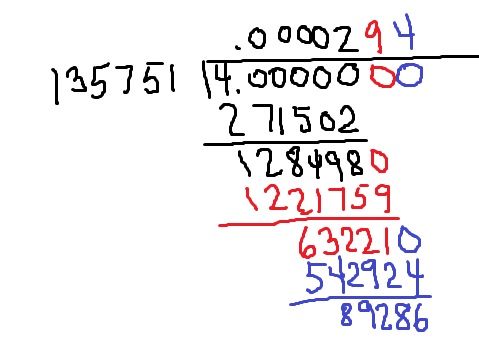
biglongdivisionAt this point, I was asked the other question that I had anticipated but utterly dreaded… motivated by child-like curiosity mixed perhaps with a touch of sadism:

How long do we have before the digits start repeating?

My stomach immediately started churning.

I told the class that I’d have to figure this one later. But I told them that the answer would definitely be less than 135,751 times. My class was surprised that I could even provide this level of (extremely) modest upper limit on the answer. After some prompting, my class saw the reasoning for this answer: there are only 135,751 possible remainders after performing the subtraction step in the division algorithm, and so a remainder has to be repeated after 135,751 steps. Therefore, the digits will start repeating in 135,751 steps or less.

What I knew — but probably couldn’t explain to these elementary-school students, and so I had to work this out for myself and then get back to them with the answer — is that the length of the repeating block n is the least integer so that

135751 \mid 10^n - 1

which is another way of saying that we’ve used the division algorithm enough times so that a remainder repeats. Written in the language of group theory, n is the least integer that satisfies

10^n \equiv 1 \mod 135751

(A caveat:this rule works because neither 2 nor 5 is a factor of 135,751… otherwise, those factors would have to be taken out first.)

Some elementary group theory can now be used to guess the value of n. Let G be the multiplicative group of integers modulo 135,751 which are relatively prime which. The order of this group is denoted by \phi(135751), called the Euler totient function. In general, if m = p_1^{a_1} p_2^{a_2} \dots p_r^{a_r} is the prime factorization of m, then

\phi(m) = n \left( \displaystyle 1 - \frac{1}{p_1} \right) \left( \displaystyle 1 - \frac{1}{p_2} \right) \dots \left( \displaystyle 1 - \frac{1}{p_r} \right)

For the case at hand, the prime factorization of 135,751 can be recovered by examining the product of the fractions near the top of this post:

135751 = 7 \times 11 \times 41 \times 43

Therefore,

\phi(135,751) = 6 \times 10 \times 40 \times 42 = 100,800

Next, there’s a theorem from group theory that says that the order n of an element of a group must be a factor of the order of the group. In other words, the number n that we’re seeking must be a factor of 100,800. This is easy to factor:

100,800 = 2^6 \times 3^2 \times 5^2 \times 7

Therefore, the number n has the form

n = 2^a 3^b 5^c 7^d,

where 0 \le a \le 6, 0 \le b \le 2, 0 \le c \le 2, and 0 \le d \le 1 are integers.

So, to summarize, we can say definitively that n is at most 100,800, and that were have narrowed down the possible values of n to only 7 \times 3 \times 3 \times 2 = 126 possibilities (the product of one more than all of the exponents). So that’s a definite improvement and reduction from my original answer of 135,751 possibilities.

At this point, there’s nothing left to do except test all 126 possibilities. Unfortunately, there’s no shortcut to this; it has to be done by trial and error. Thankfully, this can be done with Mathematica:

biglongdivision2The final line shows that the least such value of n is 210. Therefore, the decimal will repeat after 210 digits. So here are the first 210 digits of \displaystyle \frac{4}{135,751} (courtesy of Mathematica):

0.000029465712959757202525211600651192256410634175807176374391348866675015285338597874048809953517837805983013016478699972744215512224587664\
179269397647162820163387378361853688002298325610861061796966504850792996…

For more on this, see https://meangreenmath.com/2013/08/23/thoughts-on-17-and-other-rational-numbers-part-6/ and https://meangreenmath.com/2013/08/25/thoughts-on-17-and-other-rational-numbers-part-8/.

Arithmetic with big numbers (Part 3)

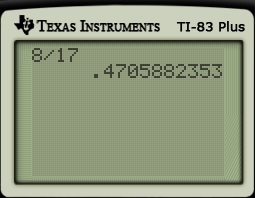
In the previous two posts, we considered the use of base-10^n arithmetic so that a calculator can solve addition and multiplication problems that it ordinarily could not handle. Today, we turn to division. Let’s now consider the decimal representation of \displaystyle \frac{8}{17}.

TI817

There’s no obvious repeating pattern. But we know that, since 17 has neither 2 nor 5 as a factor, that there has to be a repeating decimal pattern.

So… what is it?

When I ask this question to my students, I can see their stomachs churning a slow dance of death. They figure that the calculator didn’t give the answer, and so they have to settle for long division by hand.

That’s partially correct.

However, using the ideas presented below, we can perform the long division extracting multiple digits at once. Through clever use of the calculator, we can quickly obtain the full decimal representation even though the calculator can only give ten digits at a time.

green line

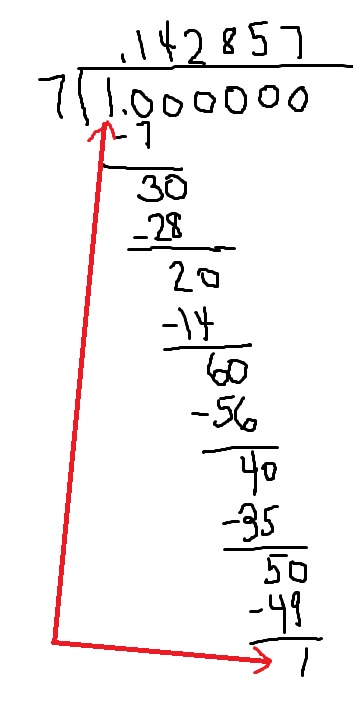
Let’s now return to where this series began… the decimal representation of \displaystyle \frac{1}{7} using long division. As shown below, the repeating block has length 6, which can be found in a few minutes with enough patience. By the end of this post, we’ll consider a modification of ordinary long division that facilitates the computation of really long repeating blocks.

longdivision17

Because we arrived at a repeated remainder, we know that we have found the repeating block. So we can conclude that \displaystyle \frac{1}{7} = 0.\overline{142857}.

Students are taught long division in elementary school and are so familiar with the procedure that not much thought is given to the logic behind the procedure. The underlying theorem behind long division is typically called the division algorithm. From Wikipedia:

Given two integers a and b, with b \ne 0, there exist unique integers q and r such that a = bq+r and $0 \le r < |b|$,  where |b| denotes the absolute value of b.

The number q is typically called the quotient, while the number r is called the remainder.

Repeated application of this theorem is the basis for long division. For the example above:

Step 1.

10 = 1 \times 7 + 3. Dividing by 10, 1 = 0.1 \times 7 + 0.3

Step 2.

30 = 4 \times 7 + 2. Dividing by 100, 0.3 = 0.04 \times 7 + 0.02

Returning to the end of Step 1, we see that

1 = 0.1 \times 7 + 0.3 = 0.1 \times 7 + 0.04 \times 7 + 0.02 = 0.14 \times 7 + 0.02

Step 3.

20 = 2 \times 7 + 6. Dividing by 1000, 0.02 = 0.002 \times 7 + 0.006

Returning to the end of Step 2, we see that

1 = 0.14 \times 7 + 0.02 = 0.14 \times 7 + 0.0002 \times 7 + 0.006 = 0.142 \times 7 + 0.006

And so on.

green line

By adding an extra zero and using the division algorithm, the digits in the decimal representation are found one at a time. That said, it is possible (with a calculator) to find multiple digits in a single step by adding extra zeroes. For example:

Alternate Step 1.

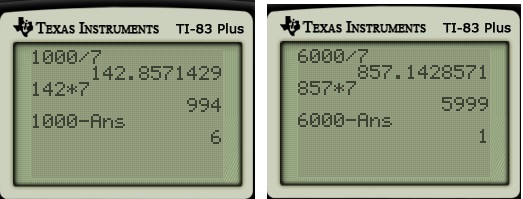
1000 = 142 \times 7 + 6. Dividing by 1000, 1 = 0.142 \times 7 + 0.006

Alternate Step 2.

6000 = 587 \times 7 + 1. Dividing by 100000, 0.006 = 0.000587 \times 7 + 0.000001

Returning to the end of Alternate Step 1, we see that

1 = 0.142 \times 7 + 0.006= 0.142 \times 7 + 0.000587\times 7 + 0.000001 = 0.142857 \times 7 + 0.000001

So, with these two alternate steps, we arrive at a remainder of 1 and have found the length of the repeating block.

The big catch is that, if a = 1000 or a = 6000 and b = 7, the appropriate values of q and r have to be found. This can be facilitated with a calculator. The integer part of 1000/7 and 6000/7 are the two quotients needed above, and subtraction is used to find the remainders (which must be less than 7, of course).

TI17

At first blush, it seems silly to use a calculator to find these values of q and r when a calculator could have been used to just find the decimal representation of 1/7 in the first place. However, the advantage of this method becomes clear when we consider fractions who repeating blocks are longer than 10 digits.

green lineLet’s now return to the question posed at the top of this post: finding the decimal representation of \displaystyle \frac{8}{17}. As noted in Part 6 of this series, the length of the repeating block must be a factor of \phi(17), where \phi is the Euler toitent function, or the number of integers less than 17 that are relatively prime with 17. Since 17 is prime, we clearly see that \phi(17) = 16. So we can conclude that the length of the repeating block is a factor of 16, or either 1, 2, 4, 8, or 16.

Here’s the result of the calculator again:

TI817

We clearly see from the calculator that the repeating block doesn’t have a length less than or equal to 8. By process of elimination, the repeating block must have a length of 16 digits.

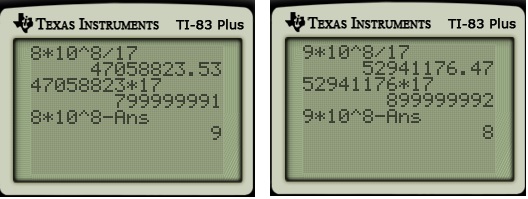
Now we perform the division algorithm to obtain these digits, as before. This can be done in two steps by multiplying by 10^8 = 100,000,000.

TI817b

So, by the same logic used above, we can conclude that

\displaystyle \frac{8}{17} = 0.\overline{4705882352941176}

In other words, through clever use of the calculator, the full decimal representation can be quickly found even if the calculator itself returns only ten digits at a time… and had rounded the final 2941176 of the repeating block up to 3.

(Note: While this post continues exploring the unorthodox use of a calculator to handle arithmetic problems, it also appeared in a previous series on the decimal expansions of rational numbers.)

Engaging students: Adding and subtracting decimals

In my capstone class for future secondary math teachers, I ask my students to come up with ideas for engaging their students with different topics in the secondary mathematics curriculum. In other words, the point of the assignment was not to devise a full-blown lesson plan on this topic. Instead, I asked my students to think about three different ways of getting their students interested in the topic in the first place.

I plan to share some of the best of these ideas on this blog (after asking my students’ permission, of course).

This student submission comes from my former student Elizabeth (Markham) Atkins. Her topic, from Pre-Algebra: adding and subtracting decimals.

green line

Applications

Adding and subtracting decimals is a fun subject to learn about. Decimals are everywhere in the world! Sports use decimals when timing people. Let’s try this problem: “Billy Joe ran a lap in 61.7 seconds the first time and 59.3 seconds the second time. How long did both laps take Billy Joe?” We use decimals to measure rainfall. “On Monday it rained a total of 1.27 inches, measured in a rain gauge. By Tuesday .23 inches had evaporated. Tuesday night’s big storm gave us another 3.58 inches. How much rain was in the rain gauge after Tuesday’s big storm?” We also use decimals with money! “Let’s say you found a lost cat. You return it to its owner for a reward of $50.00.Then you receive your allowance of $50.00. You then get your pay check from work which states you earned $108.75 for a week after taxes were taken out. It’s been a good week! You decide to spend a little money. You put $10.03 of gas in your car. You then by three items: Shoes ($51.99), jeans ($71.27) and gun ($0.97). How much do you have left?”


green line

Technology

 Technology is an awesome tool that we have to use to engage your students. On YouTube there is a song called the decimal song about how to add, subtract, multiply, and divide decimals. There is also a website where you can buy mathematical songs like his YouTube hit the Rappin’ Mathematician Decimals. He has a catchy way to grab student’s attention and they still learn. Technology can be used to enhance a lesson, an anchor video for example. Many website provide games. Mathgamesfun.net is a good example. Calculators are not a good enhancement tool because students can simply have the calculator do all the work for them. Calculators are a good technology to use to check a student’s work! Math.harvard.edu provides examples of math in movies. This way a student can see how math is used in the world. Learnalberta.ca/content/mesg.html/math6web/index.html?page=lessons&lesson=m6lessonshell01.swf is a website devoted to fractions. Another good technology for the teacher’s advantage is kaganonline.com. It is a website of different tools to use when teaching mathematics!


green line

Curriculum

Decimals, along with fractions, numbers, and other basics, are a key foundational mathematical stepping stone to schooling and in life. Students will use math every day of their lives. In their science classes students will use decimals in measurement, weights, and time. Also when the student learns about scientific notation, they will use decimals. Students will use decimals to answer half-life questions. Decimals are used in economy. All of economy deals with money. Money deals with decimals. When learning about the stock market they use decimals. When looking at the mileage on their car, they use decimals. Students will have to learn decimals to help with percentages, sales, interest, sales tax, loans, and any sort of measurements in everyday life. Percentages are just decimals with a fancy symbol. If the students want to save money they need to know how to add and subtract decimals. Decimals are all around us we just have to teach the students how to see and use them!

Formula for an infinite geometric series (Part 11)

Many math majors don’t have immediate recall of the formula for an infinite geometric series. They often can remember that there is a formula, but they can’t recollect the details. While it’s I think it’s OK that they don’t have the formula memorized, I think is a real shame that they’re also unaware of where the formula comes from and hence are unable to rederive the formula if they’ve forgotten it.

In this post, I’d like to give some thoughts about why the formula for an infinite geometric series is important for other areas of mathematics besides Precalculus. (There may be others, but here’s what I can think of in one sitting.)

1. An infinite geometric series is actually a special case of a Taylor series. (See https://meangreenmath.com/2013/07/05/reminding-students-about-taylor-series-part-5/ for details.) Therefore, it would be wonderful if students learning Taylor series in Calculus II could be able to relate the new topic (Taylor series) to their previous knowledge (infinite geometric series) which they had already seen in Precalculus.

2. An infinite geometric series is also a special case of the binomial series (1+x)^n, when n does not have to be a positive integer and hence Pascal’s triangle cannot be used to find the expansion.

3. Infinite geometric series is a rare case when an infinite sum can be found exactly. In Calculus II, a whole battery of tests (e.g., the Root Test, the Ratio Test, the Limit Comparison Test) are introduced to determine whether a series converges or not. In other words, these tests only determine if an answer exists, without determining what the answer actually is.

Throughout the entire undergraduate curriculum, I’m aware of only four types of series that can actually be evaluated exactly.

  • An infinite geometric series with -1 < r < 1
  • The Taylor series of a real analytic function. (Of course, an infinite geometric series is a special case of a Taylor series.)
  • A telescoping series. For example, using partial fractions and cancelling a bunch of terms, we find that

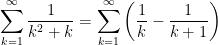
\displaystyle \sum_{k=1}^\infty \frac{1}{k^2+k} = \displaystyle \sum_{k=1}^\infty \left( \frac{1}{k} - \frac{1}{k+1} \right)

\displaystyle \sum_{k=1}^\infty \frac{1}{k^2+k} = \displaystyle \left( 1 - \frac{1}{2} \right) + \left( \frac{1}{2} - \frac{1}{3} \right) \dots

\displaystyle \sum_{k=1}^\infty \frac{1}{k^2+k} = 1

4. Infinite geometric series are essential for proving basic facts about decimal representations that we often take for granted.

5. Properties of an infinite geometric series are needed to find the mean and standard deviation of a geometric random variable, which is used to predict the number of independent trials needed before an event happens. This is used for analyzing the coupon collector’s problem, among other applications.

Why does 0.999… = 1? (Part 5)

Here’s one more way of convincing students that 0.\overline{9} = 1. Here’s the idea: how far apart are the two numbers?

First off, since 1 \ge 0.\overline{9}, we know that 1 - \overline{9} \ge 0.

Of course, we know that 1-0.9 = 0.1. Since 0.\overline{9} must lie between 0.9 and 1, we know that 1 - 0.\overline{9} must be less than 0.1.

Second, we know that 1-0.99 = 0.01. Since 0.\overline{9} must lie between 0.99 and 1, we know that 1 - 0.\overline{9} must be less than 0.01.

Third, we know that 1-0.999 = 0.001. Since 0.\overline{9} must lie between 0.999 and 1, we know that 1 - 0.\overline{9} must be less than 0.001.

By the same reasoning, we conclude that

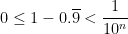
0 \le 1 - 0.\overline{9} < \displaystyle \frac{1}{10^n}

for every integer n. What’s the only number that’s greater than or equal to 0 and less than every decimal of the form 0.00\dots001? Clearly, the only such number is 0. Therefore,

1 - 0.\overline{9} = 0, or 0.\overline{9} = 1.

green lineI like this approach because it really gets at the heart of the difference between integers \mathbb{Z} and real numbers \mathbb{R}. For integers, there is always an integer to the immediate left and to the immediate right. In other words, if you give me any integer (say, 15), I can tell you the largest integer that’s less than your number (in our example, 14) and the smallest integer that’s bigger than your number (16).

Real numbers, however, do not have this property. There is no real number to the immediate right of 0. This is easy to prove by contradiction. Suppose x > 0 is the real number to the immediate left of 0. That means that there are no real numbers between 0 and x. However, x/2 is bigger than 0 and less than x, providing the contradiction.

(For what it’s worth, the above proof doesn’t apply to the set of integers \mathbb{Z} since x/2 doesn’t have to be an integer.)

By the same logic — visually, you can imagine reflecting the number line across the point x = 0.5 — there is no number to the immediate left of 1. So while 0.\overline{9} would appear to be to the immediate left of 1, they are in reality the same point.

Why does 0.999… = 1? (Part 4)

In this series, I discuss some ways of convincing students that 0.999\dots = 1 and that, more generally, a real number may have more than one decimal representation even though a decimal representation corresponds to only one real number. This can be a major conceptual barrier for even bright students to overcome. I have met a few math majors within a semester of graduating — that is, they weren’t dummies — who could recite all of these ways and were perhaps logically convinced but remained psychologically unconvinced.

Method #5. This is a proof by contradiction; however, I think it should be convincing to a middle-school student who’s comfortable with decimal representations. Also, perhaps unlike Methods #1-4, this argument really gets to the heart of the matter: there can’t be a number in between 0.999\dots and 1, and so the two numbers have to be equal.

In the proof below, I’m deliberating avoiding the explicit use of algebra (say, letting x be the midpoint) to make the proof accessible to pre-algebra students.

Suppose that 0.999\dots < 1. Then the midpoint of 0.999\dots and 1 has to be strictly greater than 0.999\dots, since

\displaystyle \frac{0.999\dots + 1}{2} > \displaystyle \frac{0.999\dots + 0.999\dots}{2} = 0.999\dots

Similarly, the midpoint is strictly less than 1:

\displaystyle \frac{0.999\dots + 1}{2} < \displaystyle \frac{1 +1}{2} =1

(For the sake of convincing middle-school students, a number line with three tick marks — for 0.999\dots, 1, and the midpoint — might be more believable than the above inequalities.)

So what is the decimal representation of the midpoint? Since the midpoint is less than 1, the decimal representation has to be 0.\hbox{something} Furthermore, the midpoint does not equal 0.999\dots. That means, somewhere in the decimal representation of the midpoint, there’s a digit that’s not equal to 9. In other words, the midpoint has to have one of the following 9 forms:

midpoint = 0.999\dots 990 \, \_ \, \_ \dots

midpoint = 0.999\dots 991 \, \_ \, \_ \dots

midpoint = 0.999\dots 992 \, \_ \, \_ \dots

midpoint = 0.999\dots 993 \, \_ \, \_ \dots

midpoint = 0.999\dots 994 \, \_ \, \_ \dots

midpoint = 0.999\dots 995 \, \_ \, \_ \dots

midpoint = 0.999\dots 996 \, \_ \, \_ \dots

midpoint = 0.999\dots 997 \, \_ \, \_ \dots

midpoint = 0.999\dots 998 \, \_ \, \_ \dots

In any event, 9 is the largest digit. That means that, no matter what, the midpoint is less than 0.999\dots, contradicting the fact that the midpoint is larger than 0.999\dots (if 0.999\dots < 1).

Why does 0.999… = 1? (Part 3)

In this series, I discuss some ways of convincing students that 0.999\dots = 1 and that, more generally, a real number may have more than one decimal representation even though a decimal representation corresponds to only one real number. This can be a major conceptual barrier for even bright students to overcome. I have met a few math majors within a semester of graduating — that is, they weren’t dummies — who could recite all of these ways and were perhaps logically convinced but remained psychologically unconvinced.

Method #4. This is a direct method using the formula for an infinite geometric series… and hence will only be convincing to students if they’re comfortable with using this formula. By definition,

0.999\dots = \displaystyle \frac{9}{10} + \frac{9}{100} + \frac{9}{1000} + \dots

This is an infinite geometric series. Its first term is \displaystyle \frac{9}{10}, and the common ratio needed to go from one term to the next term is \displaystyle \frac{1}{10}. Therefore,

0.999\dots = \displaystyle \frac{ \displaystyle \frac{9}{10}}{ \quad \displaystyle 1 - \frac{1}{10} \quad}

0.999\dots = \displaystyle \frac{ \displaystyle \frac{9}{10}}{ \quad \displaystyle \frac{9}{10} \quad}

0.999\dots = 1

Why does 0.999… = 1? (Part 2)

In this series, I discuss some ways of convincing students that 0.999\dots = 1 and that, more generally, a real number may have more than one decimal representation even though a decimal representation corresponds to only one real number. This can be a major conceptual barrier for even bright students to overcome. I have met a few math majors within a semester of graduating — that is, they weren’t dummies — who could recite all of these ways and were perhaps logically convinced but remained psychologically unconvinced.

Methods #2 and #3 are indirect methods. We start with a decimal representation that we know and end with 0.999\dots.

Method #2. This technique should be accessible to any student who can do long division. With long division, we know full well that

\displaystyle \frac{1}{3} = 0.333\dots

Multiply both sides by 3:

\displaystyle 3 \times \frac{1}{3} = 3 \times 0.333\dots

\displaystyle 1 = 0.999\dots

Though not logically necessary, this method could be reinforced for students by also considering

\displaystyle 1 = 9 \times \frac{1}{9} = 9 \times 0.111\dots = 0.999\dots

green line

Method #3. With long division, we know full well that

\displaystyle \frac{1}{3} = 0.333\dots \quad and ~ \quad \displaystyle \frac{2}{3} = 0.666\dots

Add them together:

\displaystyle \frac{1}{3} + \frac{2}{3} = 0.333\dots + 0.666\dots

\displaystyle 1 = 0.999\dots

Though not logically necessary, this method could be reinforced for students by also considering any (or all) of the following:

1 = \displaystyle \frac{1}{9} + \frac{8}{9} = 0.111\dots + 0.888\dots = 0.999\dots

1 = \displaystyle \frac{2}{9} + \frac{7}{9} = 0.222\dots + 0.777\dots = 0.999\dots

1 = \displaystyle \frac{4}{9} + \frac{5}{9} = 0.444\dots + 0.555\dots = 0.999\dots

Why does 0.999… = 1? (Part 1)

Our decimal number system is so wonderful that it’s often taken for granted. (If you doubt me, try multiplying 12 and 61 or finding an 18\% tip on a restaurant bill using only Roman numerals.)

However, there’s one little quirk about our numbering system that some students find quite unsettling:

If a number has a terminating decimal representation, then the same number also has a second different terminating decimal representation. (However, a number that does not have a terminating decimal representation does not have a second representation.)

Stated another way, a decimal representation corresponds to a unique real number. However, a real number may not have a unique decimal representation.

Some (perhaps many) students find such equalities to be unsettling at first glance, and for good reason. They’d prefer to think that there is a one-to-one correspondence to the set of real numbers and the set of decimal representations. Stated more simply, students are conditioned to think that if two number look different (like 24 and 25), then they ought to be different.

However, there’s a subtle difference  between a number and a numerical representation. The number 1 is defined to be the multiplicative identity in our system of arithmetic. However, this number has two different representations in our numbering system: 1 and 0.999\dots. (Not to mention its representation in the numbering systems of the ancient Romans, Babylonians, Mayans, etc.)

As usual, let [0,1] be the set of real numbers from 0 to 1 (inclusive), and let D be the set of decimal representations of the form 0.d_1 d_2 d_3 \dots. Then there’s clearly a function f : D \to \mathbb{R}, defined by

f(0.d_1 d_2 d_3\dots) = \displaystyle \sum_{i=1}^\infty \frac{d_n}{10^n}

If I want to give my students a headache, I’ll ask, “In Calculus II, you saw that some series converge and some series diverge. So what guarantee do we have that this series actually converges?” (The convergence of the right series can be verified using the Direct Comparsion Test, the fact that d_i \le 9, and the formula for an infinite geometric series.)

In the language of mathematics: Using the completeness axiom, it can be proven (though no student psychologically doubts this) that f maps D onto [0,1]. In other words, every decimal representation corresponds to a real number, and every real number has a decimal representation. However, the function f is a surjection but not a bijection. In other words, a real number may have more than one decimal representation.

This is a big conceptual barrier for some students — even really bright students — to overcome. They’re not used to thinking that two different decimal expansions can actually represent the same number.

The two most commonly shown equal but different decimal representations are 0.999\dots = 1. Other examples are

0.125 = 0.124999\dots

3.458 = 3.457999 \dots

In this series, I will discuss some ways of convincing students that 0.999\dots = 1. That said, I have met a few math majors within a semester of graduating — that is, they weren’t dummies — who could recite all of these ways and were perhaps logically convinced but remained psychologically unconvinced. The idea that two different decimal representations could mean the same number just remained too high of a conceptual barrier for them to hurdle.

Method #1. This first technique is accessible to any algebra or pre-algebra student who’s comfortable assigning a variable to a number. We convert the decimal representation to a fraction using something out of the patented Bag of Tricks. If students aren’t comfortable with the first couple of steps (as in, “How would I have thought to do that myself?”), I tell my usual tongue-in-cheek story: Socrates gave the Bag of Tricks to Plato, Plato gave it to Aristotle, it passed down the generations, my teacher taught the Bag of Tricks to me, and I teach it to my students.

Let x =0.999\dots. Multiply x by 10, and subtract:

10x = 9.999\dots

x = 0.999\dots

\therefore (10-1)x = 9

x =1

0.999\dots = 1

Thoughts on 1/7 and other rational numbers (Part 10)

In the previous post, I showed a quick way of obtaining a full decimal representation using a calculator that only displays ten digits at a time. To review: here’s what a TI-83 Plus returns as the (approximate) value of 8/17:

TI817

Using this result and the Euler totient function, we concluded that the repeating block had length 16. So we multiply twice by 10^8 (since 10^8 \times 10^8 = 10^{16}) to deduce the decimal representation, concluding that

\displaystyle \frac{8}{17} = 0.\overline{4705882352941176}

TI817b

Though this is essentially multi-digit long division, most students are still a little suspicious of this result on first exposure. So here’s a second way of confirming that we did indeed get the right answer. The calculators show that

8 \times 10^8 = 17 \times 47058823 + 9 and 9 \times 10^8 = 17 \times 52941176 + 8

Therefore,

8 \times 10^{16} = 17 \times (47058823 \times 10^8) + 9 \times 10^8 and 9 \times 10^8 = 17 \times 52941176 + 8

so that

8 \times 10^{16} = 17 \times (47058823 \times 10^8) + 17 \times 52941176 + 8

8 \times 10^{16} = 17 \times 4705882352941176 + 8

8 \times 10^{16} - 8 = 17 \times 4705882352941176

8 (10^{16}-1) = 17 \times 4705882352941176

\displaystyle \frac{8}{17} = \displaystyle \frac{4705882352941176}{10^{16}-1}

Using the rule for dividing by 10^k -1, we conclude that

\displaystyle \frac{8}{17} = 0.\overline{4705882352941176}