
In this series of posts, I explore properties of complex numbers that explain some surprising answers to exponential and logarithmic problems using a calculator (see video at the bottom of this post). These posts form the basis for a sequence of lectures given to my future secondary teachers.
To begin, we recall that the trigonometric form of a complex number 

where 


There’s a shorthand notation for the right-hand side (
This post builds off the previous two posts by completing the proof of De Moivre’s Theorem.
Theorem. If 
![\left[ r (\cos \theta + i \sin \theta) \right]^n = r^n (\cos n \theta + i \sin n \theta)](https://s0.wp.com/latex.php?latex=%5Cleft%5B+r+%28%5Ccos+%5Ctheta+%2B+i+%5Csin+%5Ctheta%29+%5Cright%5D%5En+%3D+r%5En+%28%5Ccos+n+%5Ctheta+%2B+i+%5Csin+n+%5Ctheta%29&bg=ffffff&fg=000000&s=0&c=20201002)
The proof has two parts:
- For
: proof by induction.
- For
: let
, and then use part 1.
In the previous post, I presented how I describe the proof of step 1 to students. Today, I’ll discuss how I present step 2.
My personal opinion is that the proof of step 2 goes easiest when a numerical example is done first. Let 
![\left[ r (\cos \theta + i \sin \theta) \right]^{-5} = \displaystyle \frac{1}{ \left[ r (\cos \theta + i \sin \theta) \right]^{5} }](https://s0.wp.com/latex.php?latex=%5Cleft%5B+r+%28%5Ccos+%5Ctheta+%2B+i+%5Csin+%5Ctheta%29+%5Cright%5D%5E%7B-5%7D+%3D+%5Cdisplaystyle+%5Cfrac%7B1%7D%7B+%5Cleft%5B+r+%28%5Ccos+%5Ctheta+%2B+i+%5Csin+%5Ctheta%29+%5Cright%5D%5E%7B5%7D+%7D&bg=ffffff&fg=000000&s=0&c=20201002)

At this point, students usually want to multiply by the conjugate of the denominator. There’s nothing wrong with doing that, of course, but it’s more elegant to write the numerator in trigonometric form:

![= r^{-5} (\cos [0-5\theta] + i \sin[0-5\theta] )](https://s0.wp.com/latex.php?latex=%3D+r%5E%7B-5%7D+%28%5Ccos+%5B0-5%5Ctheta%5D+%2B+i+%5Csin%5B0-5%5Ctheta%5D+%29&bg=ffffff&fg=000000&s=0&c=20201002)
![= r^{-5} (\cos [-5\theta] + i \sin[ - 5\theta])](https://s0.wp.com/latex.php?latex=%3D+r%5E%7B-5%7D+%28%5Ccos+%5B-5%5Ctheta%5D+%2B+i+%5Csin%5B+-+5%5Ctheta%5D%29&bg=ffffff&fg=000000&s=0&c=20201002)
which matches what we would have expected. Students are now prepared for the proof, which I try to place alongside the above computation for
Proof for 


![\left[ r (\cos \theta + i \sin \theta) \right]^{n} = \displaystyle \frac{1}{ \left[ r (\cos \theta + i \sin \theta) \right]^{-n} }](https://s0.wp.com/latex.php?latex=%5Cleft%5B+r+%28%5Ccos+%5Ctheta+%2B+i+%5Csin+%5Ctheta%29+%5Cright%5D%5E%7Bn%7D+%3D+%5Cdisplaystyle+%5Cfrac%7B1%7D%7B+%5Cleft%5B+r+%28%5Ccos+%5Ctheta+%2B+i+%5Csin+%5Ctheta%29+%5Cright%5D%5E%7B-n%7D+%7D&bg=ffffff&fg=000000&s=0&c=20201002)
I again remind everyone that 
![= \displaystyle \frac{1}{ \left[ r (\cos \theta + i \sin \theta) \right]^m }](https://s0.wp.com/latex.php?latex=%3D+%5Cdisplaystyle+%5Cfrac%7B1%7D%7B+%5Cleft%5B+r+%28%5Ccos+%5Ctheta+%2B+i+%5Csin+%5Ctheta%29+%5Cright%5D%5Em+%7D&bg=ffffff&fg=000000&s=0&c=20201002)
The remaining steps mirror the calculation above:


![= r^{-m} (\cos [0-m\theta] + i \sin[0-m\theta] )](https://s0.wp.com/latex.php?latex=%3D+r%5E%7B-m%7D+%28%5Ccos+%5B0-m%5Ctheta%5D+%2B+i+%5Csin%5B0-m%5Ctheta%5D+%29&bg=ffffff&fg=000000&s=0&c=20201002)
![= r^{-m} (\cos [-m\theta] + i \sin[ - m \theta])](https://s0.wp.com/latex.php?latex=%3D+r%5E%7B-m%7D+%28%5Ccos+%5B-m%5Ctheta%5D+%2B+i+%5Csin%5B+-+m+%5Ctheta%5D%29&bg=ffffff&fg=000000&s=0&c=20201002)
![= r^{n} (\cos [n\theta] + i \sin[ n \theta])](https://s0.wp.com/latex.php?latex=%3D+r%5E%7Bn%7D+%28%5Ccos+%5Bn%5Ctheta%5D+%2B+i+%5Csin%5B+n+%5Ctheta%5D%29&bg=ffffff&fg=000000&s=0&c=20201002)
thus ending the proof. 
For completeness, here’s the movie that I use to engage my students when I begin this sequence of lectures.
 . This is trivial, as the left-hand side is
![\left[ r (\cos \theta + i \sin \theta) \right]^0 = 1](https://s0.wp.com/latex.php?latex=%5Cleft%5B+r+%28%5Ccos+%5Ctheta+%2B+i+%5Csin+%5Ctheta%29+%5Cright%5D%5E0+%3D+1&bg=ffffff&fg=000000&s=0&c=20201002) ,
, .
. . On the board, I write the left-hand side on the top and the right-hand side on the bottom, leaving plenty of space in between:
![\left[ r (\cos \theta + i \sin \theta) \right]^{n+1}](https://s0.wp.com/latex.php?latex=%5Cleft%5B+r+%28%5Ccos+%5Ctheta+%2B+i+%5Csin+%5Ctheta%29+%5Cright%5D%5E%7Bn%2B1%7D&bg=ffffff&fg=000000&s=0&c=20201002)

![= r^{n+1} (\cos [n+1] \theta + i \sin [n+1] \theta)](https://s0.wp.com/latex.php?latex=%3D+r%5E%7Bn%2B1%7D+%28%5Ccos+%5Bn%2B1%5D+%5Ctheta+%2B+i+%5Csin+%5Bn%2B1%5D+%5Ctheta%29&bg=ffffff&fg=000000&s=0&c=20201002) .
.![\left[ r (\cos \theta + i \sin \theta) \right]^{n+1} = \left[ r (\cos \theta + i \sin \theta) \right]^n \cdot \left[ r (\cos \theta + i \sin \theta) \right]](https://s0.wp.com/latex.php?latex=%5Cleft%5B+r+%28%5Ccos+%5Ctheta+%2B+i+%5Csin+%5Ctheta%29+%5Cright%5D%5E%7Bn%2B1%7D+%3D+%5Cleft%5B+r+%28%5Ccos+%5Ctheta+%2B+i+%5Csin+%5Ctheta%29+%5Cright%5D%5En+%5Ccdot+%5Cleft%5B+r+%28%5Ccos+%5Ctheta+%2B+i+%5Csin+%5Ctheta%29+%5Cright%5D+&bg=ffffff&fg=000000&s=0&c=20201002)
![= \left[ r^n (\cos n \theta + i \sin n \theta) \right] \cdot \left[ r (\cos \theta + i \sin \theta) \right]](https://s0.wp.com/latex.php?latex=%3D+%5Cleft%5B+r%5En+%28%5Ccos+n+%5Ctheta+%2B+i+%5Csin+n+%5Ctheta%29+%5Cright%5D+%5Ccdot+%5Cleft%5B+r+%28%5Ccos+%5Ctheta+%2B+i+%5Csin+%5Ctheta%29+%5Cright%5D+&bg=ffffff&fg=000000&s=0&c=20201002)
![=r^n \cdot r (\cos [n \theta + \theta] + i \sin [n \theta + \theta])](https://s0.wp.com/latex.php?latex=%3Dr%5En+%5Ccdot+r+%28%5Ccos+%5Bn+%5Ctheta+%2B+%5Ctheta%5D+%2B+i+%5Csin+%5Bn+%5Ctheta+%2B+%5Ctheta%5D%29&bg=ffffff&fg=000000&s=0&c=20201002)
![= r^{n+1} (\cos [n+1]\theta + i \sin [n+1]\theta)](https://s0.wp.com/latex.php?latex=%3D+r%5E%7Bn%2B1%7D+%28%5Ccos+%5Bn%2B1%5D%5Ctheta+%2B+i+%5Csin+%5Bn%2B1%5D%5Ctheta%29&bg=ffffff&fg=000000&s=0&c=20201002) .
.![\left[ r_1 (\cos \theta_1 + i \sin \theta_1) \right] \cdot \left[ r_2 (\cos \theta_2 + i \sin \theta_2) \right] = r_1 r_2 (\cos [\theta_1+\theta_2] + i \sin [\theta_1+\theta_2])](https://s0.wp.com/latex.php?latex=%5Cleft%5B+r_1+%28%5Ccos+%5Ctheta_1+%2B+i+%5Csin+%5Ctheta_1%29+%5Cright%5D+%5Ccdot+%5Cleft%5B+r_2+%28%5Ccos+%5Ctheta_2+%2B+i+%5Csin+%5Ctheta_2%29+%5Cright%5D+%3D+r_1+r_2+%28%5Ccos+%5B%5Ctheta_1%2B%5Ctheta_2%5D+%2B+i+%5Csin+%5B%5Ctheta_1%2B%5Ctheta_2%5D%29&bg=ffffff&fg=000000&s=0&c=20201002) .
. . (When teaching this in class, I usually choose the exponent to be the current year.)
 as
as 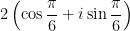 … for reasons that will become apparent later, I tell my students that I’ll use radians and not degrees for this one. Most students can recognize — and this is important, before I formally prove De Moivre’s Theorem — that they need to multiply
  by itself 2014 times and add
  to itself 2014 times. Therefore,
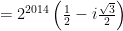
 without a calculator. With some prodding, they’ll recognize that
  , and so they can subtract
  (not
(not  ) without changing the values of sine and cosine. Therefore,

![\displaystyle \frac{ r_1 (\cos \theta_1 + i \sin \theta_1) }{ r_2 (\cos \theta_2 + i \sin \theta_2) } = \displaystyle \frac{r_1}{r_2} (\cos [\theta_1-\theta_2] + i \sin [\theta_1-\theta_2])](https://s0.wp.com/latex.php?latex=%5Cdisplaystyle+%5Cfrac%7B+r_1+%28%5Ccos+%5Ctheta_1+%2B+i+%5Csin+%5Ctheta_1%29+%7D%7B+r_2+%28%5Ccos+%5Ctheta_2+%2B+i+%5Csin+%5Ctheta_2%29+%7D+%3D+%5Cdisplaystyle+%5Cfrac%7Br_1%7D%7Br_2%7D+%28%5Ccos+%5B%5Ctheta_1-%5Ctheta_2%5D+%2B+i+%5Csin+%5B%5Ctheta_1-%5Ctheta_2%5D%29&bg=ffffff&fg=000000&s=0&c=20201002) .
. and
and  terms and then multiplying by the conjugate of the denominator:




![= \displaystyle \frac{r_1}{r_2} (\cos \theta_1 + i \sin \theta_1)( \cos [-\theta_2] + i \sin [-\theta_2])](https://s0.wp.com/latex.php?latex=%3D+%5Cdisplaystyle+%5Cfrac%7Br_1%7D%7Br_2%7D+%28%5Ccos+%5Ctheta_1+%2B+i+%5Csin+%5Ctheta_1%29%28+%5Ccos+%5B-%5Ctheta_2%5D+%2B+i+%5Csin+%5B-%5Ctheta_2%5D%29&bg=ffffff&fg=000000&s=0&c=20201002) ;
; and
and  , they are taught to just distribute (or, using the nomenclature that I don’t like, FOIL it out):
 .
.![\left[ r_1 (\cos \theta_1 + i \sin \theta_1) \right] \cdot \left[ r_2 (\cos \theta_2 + i \sin \theta_2) \right]](https://s0.wp.com/latex.php?latex=%5Cleft%5B+r_1+%28%5Ccos+%5Ctheta_1+%2B+i+%5Csin+%5Ctheta_1%29+%5Cright%5D+%5Ccdot+%5Cleft%5B+r_2+%28%5Ccos+%5Ctheta_2+%2B+i+%5Csin+%5Ctheta_2%29+%5Cright%5D+&bg=ffffff&fg=000000&s=0&c=20201002)

![= r_1 r_2 (\cos \theta_1 \cos \theta_2 - \sin \theta_1 \sin \theta_2 + i[ \sin \theta_1 \cos \theta_2 + \cos \theta_1 \sin \theta_2])](https://s0.wp.com/latex.php?latex=%3D+r_1+r_2+%28%5Ccos+%5Ctheta_1+%5Ccos+%5Ctheta_2+-+%5Csin+%5Ctheta_1+%5Csin+%5Ctheta_2+%2B+i%5B+%5Csin+%5Ctheta_1+%5Ccos+%5Ctheta_2+%2B+%5Ccos+%5Ctheta_1+%5Csin+%5Ctheta_2%5D%29&bg=ffffff&fg=000000&s=0&c=20201002)
![= r_1 r_2 (\cos [\theta_1+\theta_2] + i \sin [\theta_1+\theta_2])](https://s0.wp.com/latex.php?latex=%3D+r_1+r_2+%28%5Ccos+%5B%5Ctheta_1%2B%5Ctheta_2%5D+%2B+i+%5Csin+%5B%5Ctheta_1%2B%5Ctheta_2%5D%29&bg=ffffff&fg=000000&s=0&c=20201002) .
.
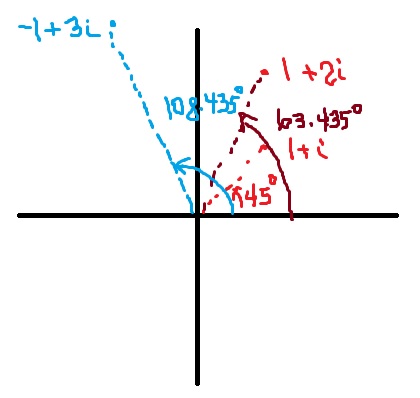
![1 + 2i = \sqrt{5} \left( \cos[\tan^{-1} 2] + i \sin[\tan^{-1} 2] \right) \approx \sqrt{5} \left( \cos 63.435^\circ + i \sin 63.435^\circ \right)](https://s0.wp.com/latex.php?latex=1+%2B+2i+%3D+%5Csqrt%7B5%7D+%5Cleft%28+%5Ccos%5B%5Ctan%5E%7B-1%7D+2%5D+%2B+i+%5Csin%5B%5Ctan%5E%7B-1%7D+2%5D+%5Cright%29+%5Capprox+%5Csqrt%7B5%7D+%5Cleft%28+%5Ccos+63.435%5E%5Ccirc+%2B+i+%5Csin+63.435%5E%5Ccirc+%5Cright%29&bg=ffffff&fg=000000&s=0&c=20201002)
 . Indeed,
 .
.
 is in the second quadrant of the complex plane. The modulus is
 .
. , and not
  , appears in the above expression.) Also,
 , so that
 is in the second quadrant, we choose
 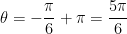 . Therefore,

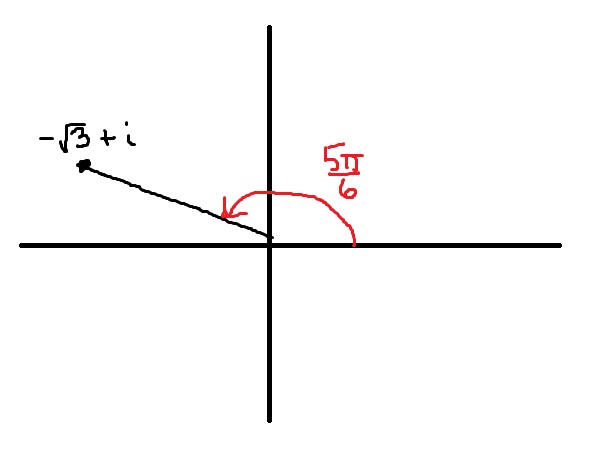
 would also have worked. For example,

 . After all, the arctangent of an angle must lie between
  and
and  , which won’t work for complex numbers in either the second or third quadrant. That said, it is true that
 , and take two steps to arrive at the point
  , and take two steps to arrive at the same point.
 (getting more than a little dizzy while doing so), and take two steps to arrive at the same point.
 , and take two steps backwards (while doing the moonwalk) to arrive at the same point.
 are called complex numbers. In modern English, of course, the word complex is usually associated with phrases like difficult, inscrutable, time-consuming, hard to solve, and other negative connotations that teachers would prefer to not introduce into a math class.
 and the imaginary part $bi$ are joined to form
  . Indeed, my understanding is that complex was chosen to be the opposite of simplex, or a single unit (like a real number).
 Mean Green Math