Calculators and complex numbers (Part 17)

In this series of posts, I explore properties of complex numbers that explain some surprising answers to exponential and logarithmic problems using a calculator (see video at the bottom of this post). These posts form the basis for a sequence of lectures given to my future secondary teachers.

Definition. If z is a complex number, then we define

e^z = \displaystyle \sum_{n=0}^{\infty} \frac{z^n}{n!}

Even though this isn’t the usual way of defining the exponential function for real numbers, the good news is that one Law of Exponents remains true. (At we saw in an earlier post in this series, we can’t always assume that the usual Laws of Exponents will remain true when we permit the use of complex numbers.)

Theorem. If z and w are complex numbers, then e^z e^w = e^{z+w}.

In yesterday’s post, I gave the idea behind the proof… group terms where the sums of the exponents of z and w are the same. Today, I will formally prove the theorem.

The proof of the theorem relies on a principle that doesn’t seem to be taught very often anymore… rearranging the terms of a double sum. In this case, the double sum is

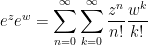
e^z e^w = \displaystyle \sum_{n=0}^{\infty} \sum_{k=0}^{\infty} \frac{z^n}{n!} \frac{w^k}{k!}

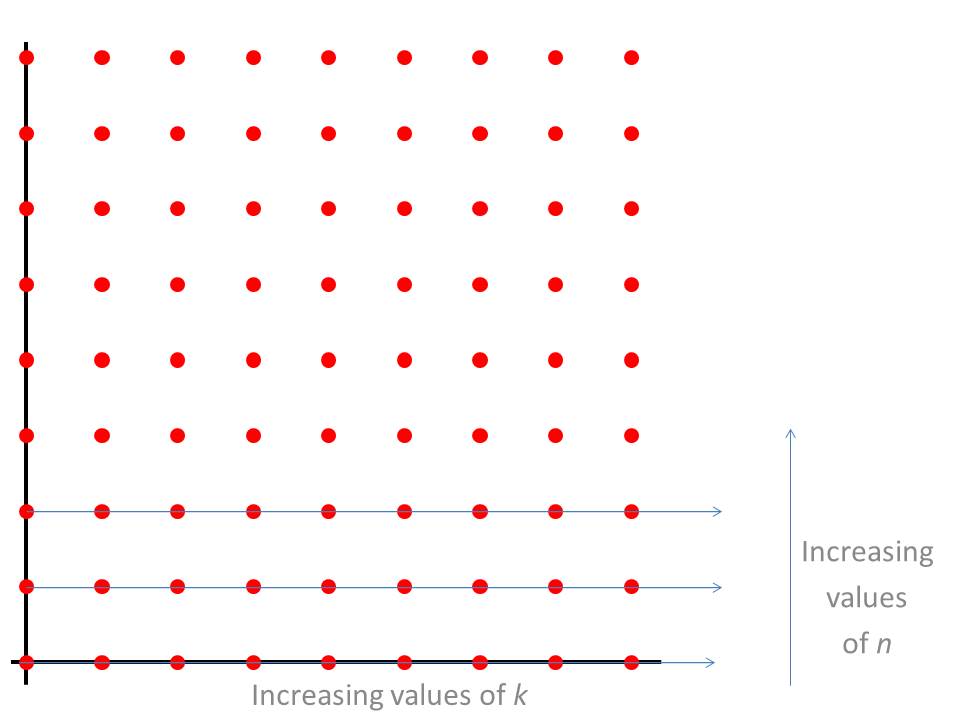
This can be visualized in the picture below, where the x-axis represents the values of k and the y-axis represents the values of n. Each red dot symbolizes a term in the above double sum. For a fixed value of n, the values of k vary from 0 to \infty. In other words, we start with n =0 and add all the terms on the line n = 0 (i.e., the x-axis in the picture). Then we go up to n = 1 and then add all the terms on the next horizontal line. And so on.

double sum 1

I will rearrange the terms as follows: Let j = n+k. Then for a fixed value of j, the values of k will vary from 0 to j. This is perhaps best described in the picture below. The value of j, the sum of the coordinates, is constant along the diagonal lines below. The value of k then changes while moving along a diagonal line.

Even though this is a different way of adding the terms, we clearly see that all of the red circles will be hit regardless of which technique is used for adding the terms.

double sum 2

In this way, the double sum \displaystyle \sum_{n=0}^\infty \sum_{k=0}^\infty gets replaced by \displaystyle \sum_{j=0}^\infty \sum_{k=0}^j. Since n = j-k, we have

e^z e^w = \displaystyle \sum_{j=0}^{\infty} \sum_{k=0}^{j} \frac{z^{j-k}}{(j-k)!} \frac{w^k}{k!}

We now add a couple of j! terms to this expression for reasons that will become clear shortly:

e^z e^w = \displaystyle \sum_{j=0}^{\infty} \sum_{k=0}^{j} \frac{j!}{j!} \frac{1}{k! (j-k)!} w^k z^{j-k}

Since j! does not contain any ks, it can be pulled outside of the inner sum on k. We do this for the j! in the denominator:

= \displaystyle \sum_{j=0}^\infty \frac{1}{j!} \sum_{k=0}^j \frac{j!}{k!(j-k)!} w^k z^{j-k}

We recognize that \displaystyle \frac{j!}{k! (j-k)!} is a binomial coefficent:

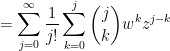
= \displaystyle \sum_{j=0}^\infty \frac{1}{j!} \sum_{k=0}^j {j \choose k} w^k z^{j-k}

The inner sum is recognized as the formula for a binomial expansion:

= \displaystyle \sum_{j=0}^\infty \frac{1}{j!} (w+z)^j

Finally, we recognize this as the definition of e^{w+z}, using the dummy variable j instead of n. This proves that e^z e^w = e^{z+w} even if z and w are complex.

Without a doubt, this theorem was a lot of work. The good news is that, with this result, it will no longer be necessary to explicitly use the summation definition of e^z to actually compute e^z, as we’ll see tomorrow.

green line For completeness, here’s the movie that I use to engage my students when I begin this sequence of lectures.

Calculators and complex numbers (Part 16)

In this series of posts, I explore properties of complex numbers that explain some surprising answers to exponential and logarithmic problems using a calculator (see video at the bottom of this post). These posts form the basis for a sequence of lectures given to my future secondary teachers.

To begin, we recall that the trigonometric form of a complex number z = a+bi is

z = r(\cos \theta + i \sin \theta) = r e^{i \theta}

where r = |z| = \sqrt{a^2 + b^2} and \tan \theta = b/a, with \theta in the appropriate quadrant. As noted before, this is analogous to converting from rectangular coordinates to polar coordinates.

Real mathematicians use the notation e^{i \theta} to represent \cos \theta + i \sin \theta. I say this because I’ve seen textbooks that basically invented the non-standard notation \hbox{cis} \, \theta (pronounced siss), where presumably the c represents \cos and the s represents \sin. I express my contempt for this non-standard notation by saying that this is a sissy way of writing it.

With this shorthand notation of r e^{i \theta}, several of the theorems that we’ve discussed earlier in this series of posts become a lot more memorable.

First, the formula

\left[ r_1 ( \cos \theta_1 + i \sin \theta_1) \right] \cdot \left[ r_2 ( \cos \theta_2 + i \sin \theta_2 ) \right] = r_1 r_2 \left[ \cos( \theta_1 + \theta_2) + i \sin (\theta_1 + \theta_2) \right]

can be rewritten as something that resembles the familiar Law of Exponents:

r_1 e^{i \theta_1} r_2 e^{i \theta_2} = r_1 r_2 e^{i(\theta_1 + \theta_2)}

Similarly, the formula

\displaystyle \frac{ r_1 ( \cos \theta_1 + i \sin \theta_1)}{ r_2 ( \cos \theta_2 + i \sin \theta_2 ) } = \displaystyle \frac{r_1}{ r_2} \left[ \cos( \theta_1 - \theta_2) + i \sin (\theta_1 - \theta_2) \right]

can be rewritten as

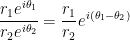
\displaystyle \frac{r_1 e^{i \theta_1}}{ r_2 e^{i \theta_2}} = \displaystyle \frac{r_1 }{r_2} e^{i(\theta_1 - \theta_2)}

Finally, DeMoivre’s Theorem, or

\left[ r (\cos \theta + i \sin \theta) \right]^n = r^n (\cos n \theta + i \sin n \theta)

can be rewritten more comfortably as

\left( r e^{i \theta} \right)^n = r^n e^{i n \theta}

When showing these to students, I stress that these are not the formal proofs of these statements… the formal proofs required trig identites and mathematical induction, as shown in previous posts. That said, now that the proofs have been completed, the e^{i \theta} notation provides a way of remembering these formulas that wasn’t immediately obvious when we began this unit on the trigonometric form of complex numbers.

green line

For completeness, here’s the movie that I use to engage my students when I begin this sequence of lectures.


Calculators and complex numbers (Part 15)

In this series of posts, I explore properties of complex numbers that explain some surprising answers to exponential and logarithmic problems using a calculator (see video at the bottom of this post). These posts form the basis for a sequence of lectures given to my future secondary teachers.

To begin, we recall that the trigonometric form of a complex number z = a+bi is

z = r(\cos \theta + i \sin \theta)

where r = |z| = \sqrt{a^2 + b^2} and \tan \theta = b/a, with \theta in the appropriate quadrant. As noted before, this is analogous to converting from rectangular coordinates to polar coordinates.

There’s a shorthand notation for the right-hand side (r e^{i \theta}) that, at long last, I will explain in today’s post.

Definition. If z is a complex number, then we define

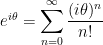
e^z = \displaystyle \sum_{n=0}^{\infty} \frac{z^n}{n!}

This of course matches the Taylor expansion of e^x for real numbers x.

Theorem. If \theta is a real number, then e^{i \theta} = \cos \theta + i \sin \theta.

e^{i \theta} = \displaystyle \sum_{n=0}^{\infty} \frac{(i \theta)^n}{n!}

= \displaystyle 1 + i\theta + \frac{(i\theta)^2}{2!} + \frac{(i\theta)^3}{3!} + \frac{(i\theta)^4}{4!} + \frac{(i\theta)^5}{5!} + \frac{(i\theta)^6}{6!} + \frac{(i\theta)^7}{7!} + \dots

= \displaystyle \left(1 - \frac{\theta^2}{2!} + \frac{\theta^4}{4!} - \frac{\theta^6}{6!} \dots \right) + i \left( \theta - \frac{\theta^3}{3!} + \frac{\theta^5}{5!} - \frac{\theta^7}{7!} \right)

= \cos \theta + i \sin \theta,

using the Taylor expansions for cosine and sine.

This theorem explains one of the calculator’s results:

e^{i \pi} = \cos \pi + i \sin \pi = -1 + 0i = -1.

That said, you can imagine that finding something like e^{4-2i} would be next to impossible by directly plugging into the series and trying to simply the answer. The good news is that there’s an easy way to compute e^z for complex numbers z, which we develop in the next few posts.

green line

For completeness, here’s the movie that I use to engage my students when I begin this sequence of lectures.


Calculators and complex numbers (Part 14)

In this series of posts, I explore properties of complex numbers that explain some surprising answers to exponential and logarithmic problems using a calculator (see video at the bottom of this post). These posts form the basis for a sequence of lectures given to my future secondary teachers.

Definition. If z is a complex number, then we define

e^z = \displaystyle \sum_{n=0}^{\infty} \frac{z^n}{n!}

Even though this isn’t the usual way of defining the exponential function for real numbers, the good news is that one Law of Exponents remains true. (At we saw in an earlier post in this series, we can’t always assume that the usual Laws of Exponents will remain true when we permit the use of complex numbers.)

Theorem. If z and w are complex numbers, then e^z e^w = e^{z+w}.

I will formally prove this in the next post. Today, I want to talk about the idea behind the proof. Notice that

e^z e^w = \displaystyle \left( 1 + z + \frac{z^2}{2!} +\frac{z^3}{3!} + \frac{z^4}{4!} + \dots \right) \left( 1 + w + \frac{w^2}{2!} + \frac{w^3}{3!} + \frac{w^4}{4!} + \dots \right)

Let’s multiply this out (ugh!), but we’ll only worry about terms where the sum of the exponents of z and w is 4 or less. Here we go…

e^z e^w = \displaystyle 1 + z + \frac{z^2}{2!} + \frac{z^3}{3!} + \frac{z^4}{4!} + \dots

+ \displaystyle w + wz + \frac{wz^2}{2!} + \frac{wz^3}{3!} + \dots

+ \displaystyle \frac{w^2}{2!} + \frac{w^2 z}{2!} + \frac{w^2 z^2}{2! \times 2!} + \dots

+ \displaystyle \frac{w^3}{3!} + \frac{w^3 z}{3!} + \dots

+ \displaystyle \frac{w^4}{4!} + \dots

Next, we rearrange the terms according to the sum of the exponents. For example, the terms with z^3, w z^2, w^2 z, and w^3 are placed together because the sum of the exponents for each of these terms is 3.

e^z e^w = 1

+ z + w

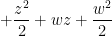
\displaystyle + \frac{z^2}{2} + wz + \frac{w^2}{2}

\displaystyle + \frac{z^3}{6} + \frac{wz^2}{2} + \frac{w^2 z}{2} + \frac{w^3}{6}

\displaystyle + \frac{z^4}{24} + \frac{w z^3}{6} + \frac{w^2 z^2}{4} + \frac{w^3 z}{6} + \frac{w^4}{24} + \dots

For each line, we obtain a common denominator:

e^z e^w = 1

+ z + w

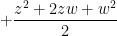
\displaystyle + \frac{z^2 + 2 z w + w^2}{2}

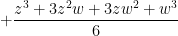
\displaystyle + \frac{z^3 + 3 z^2 w + 3 z w^2 + w^3}{6}

\displaystyle + \frac{z^4+ 4 z^3 w + 6 z^2 w^2 + 4 z w^3 + w^4}{24} + \dots

We recognize the familiar entries of Pascal’s triangle in the coefficients of the numerators, and so it appears that

e^z e^w = 1 + (z+w) + \displaystyle \frac{(z+w)^2}{2!} + \frac{(z+w)^3}{3!} + \frac{(z+w)^4}{4!} + \dots

If the pattern on the right-hand side holds up for exponents greater than 4, this proves that e^z e^w = e^{z+w}.

So that’s the idea of the proof. The formal proof will be presented in the next post.

green line

For completeness, here’s the movie that I use to engage my students when I begin this sequence of lectures.


Calculators and complex numbers (Part 13)

In this series of posts, I explore properties of complex numbers that explain some surprising answers to exponential and logarithmic problems using a calculator (see video at the bottom of this post). These posts form the basis for a sequence of lectures given to my future secondary teachers.

To begin, we recall that the trigonometric form of a complex number z = a+bi is

z = r(\cos \theta + i \sin \theta)

where r = |z| = \sqrt{a^2 + b^2} and \tan \theta = b/a, with \theta in the appropriate quadrant. As noted before, this is analogous to converting from rectangular coordinates to polar coordinates.

There’s a shorthand notation for the right-hand side (r e^{i \theta}) that I’m about to justify.

Definition. If z is a complex number, then we define

e^z = \displaystyle \sum_{n=0}^{\infty} \frac{z^n}{n!}

This of course matches the Taylor expansion of e^x for real numbers x.

For example,

e^i = \displaystyle \sum_{n=0}^{\infty} \frac{i^n}{n!}

= \displaystyle 1 + i + \frac{i^2}{2!} + \frac{i^3}{3!} + \frac{i^4}{4!} + \frac{i^5}{5!} + \frac{i^6}{6!} + \frac{i^7}{7!} + \dots

= \displaystyle \left(1 - \frac{1}{2!} + \frac{1}{4!} - \frac{1}{6!} \dots \right) + i \left( 1 - \frac{1}{3!} + \frac{1}{5!} - \frac{1}{7!} \right)

= \cos 1 + i \sin 1,

using the Taylor expansions for cosine and sine (and remembering that this is 1 radian, not 1 degree).

This was a lot of work, and raising i to successive powers is easy! You can imagine that finding something like e^{4-2i} would be next to impossible by directly plugging into the series and trying to simply the answer.

The good news is that there’s an easy way to compute e^z for complex numbers z, which we develop in the next few posts. Eventually, this will lead to the calculation of e^{\pi i} which is demonstrated in the video below.

green line

For completeness, here’s the movie that I use to engage my students when I begin this sequence of lectures.


Calculators and complex numbers (Part 12)

In this series of posts, I explore properties of complex numbers that explain some surprising answers to exponential and logarithmic problems using a calculator (see video at the bottom of this post). These posts form the basis for a sequence of lectures given to my future secondary teachers.

To begin, we recall that the trigonometric form of a complex number z = a+bi is

z = r(\cos \theta + i \sin \theta)

where r = |z| = \sqrt{a^2 + b^2} and \tan \theta = b/a, with \theta in the appropriate quadrant. As noted before, this is analogous to converting from rectangular coordinates to polar coordinates.

There’s a shorthand notation for the right-hand side (r e^{i \theta}) that I’ll justify later in this series.

In the previous post, we made the following definition for z^q if q is a rational number and -\pi < \theta \le \pi. (Technically, this is the definition for the principal root.)

Definition. z^q = r^q (\cos q \theta + i \sin q \theta).

As it turns out, one of the usual Laws of Exponents remains true even if complex numbers are permitted.

Theorem. z^{q_1} z^{q_2} = z^{q_1 + q_2}

Proof. Using the rule for multiplying complex numbers that are in trigonometric form:

z^{q_1} z^{q_2} = r^{q_1} (\cos q_1 \theta + i \sin q_1 \theta) \cdot r^{q_2} (\cos q_2\theta + i \sin q_2 \theta)

= r^{q_1+q_2} ( \cos [q_1 \theta +q_2\theta] + i \sin [q_1\theta +q_2 \theta])

= r^{q_1+q_2} ( \cos [q_1+q_2]\theta + i \sin [q_1+q_2] \theta)

= z^{q_1+q_2}

However, other Laws of Exponents no longer are true. For example, it may not be true that (zw)^q is equal to z^q w^q. My experience is that this next example is typically presented in secondary schools at about the time that the number i is first introduced. Let z = -2, w = -3, and q = 1/2. Then

\sqrt{-2} \cdot \sqrt{-3} = i \sqrt{2} i \sqrt{3} = -\sqrt{6} \ne \sqrt{6} = \sqrt{(-2) \cdot (-3)}.

Furthermore, the expression (z^{q_1})^{q_2} does not have to equal z^{q_1 q_2} if z is complex. Let z = -1, q_1 = 3, and q_2 = 1/2. Then

\left[ (-1)^3 \right]^{1/2} = (-1)^{1/2}

= [1 (\cos \pi + i \sin \pi)]^{1/2}

= \displaystyle 1^{1/2} \left( \cos \frac{\pi}{2} + i \sin \frac{\pi}{2} \right)

= 1(0+1i)

= i.

 However,

(-1)^{3/2} = [1 (\cos \pi + i \sin \pi)]^{3/2}

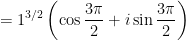
= \displaystyle 1^{3/2} \left( \cos \frac{3\pi}{2} + i \sin \frac{3\pi}{2} \right)

= 1(0-1i)

= -i.

All this to say, the usual Laws of Exponents that work for real exponents and positive bases don’t have to work if the base is permitted to be complex… or even negative.

green line

For completeness, here’s the movie that I use to engage my students when I begin this sequence of lectures.


Calculators and complex numbers (Part 11)

In this series of posts, I explore properties of complex numbers that explain some surprising answers to exponential and logarithmic problems using a calculator (see video at the bottom of this post). These posts form the basis for a sequence of lectures given to my future secondary teachers.

In today’s post, at long last, I can explain one of the unexpected results of the calculator shown in the opening sections of the video below: the different answers for (-8)^{1/3} and (-8+0i)^{1/3}.

To begin, we recall that the trigonometric form of a complex number z = a+bi is

z = r(\cos \theta + i \sin \theta)

where r = |z| = \sqrt{a^2 + b^2} and \tan \theta = b/a, with \theta in the appropriate quadrant. As noted before, this is analogous to converting from rectangular coordinates to polar coordinates.

There’s a shorthand notation for the right-hand side (r e^{i \theta}) that I’ll justify later in this series.

In previous posts, we discussed De Moivre’s Theorem:

Theorem. If n is an integer, then z^n = \left[ r (\cos \theta + i \sin \theta) \right]^n = r^n (\cos n \theta + i \sin n \theta).

This motivates the following definition:

Definition. If q is a rational number, then z^q = r^q (\cos q \theta + i \sin q \theta) if theta is chosen to be in the interval -\pi < \theta \le \pi.

Technically speaking, this defines the principal value of z^q; however, for the purposes of this post, I’ll avoid discussion of branch cuts and other similar concepts from complex analysis. When presenting this to my future secondary teachers, I’ll often break the presentation by asking my students why it’s always possible to choose the angle \theta to be in the range $(-\pi,\pi]$, and why it’s necessary to include exactly one of the two endpoints of this interval. I’ll also point out that this interval really could have been [0,2\pi) or any other interval with length 2\pi, but we choose (-\pi,\pi] for a very simple reason: tradition.

Using this definition, let’s compute (-8+0i)^{1/3}. To begin,

-8+0i = 8 (\cos \pi + i \sin \pi).

So, by definition,

(-8+0i)^{1/3} = 8^{1/3} \displaystyle \left( \cos \frac{\pi}{3} + i \sin \frac{\pi}{3} \right)

= \displaystyle 2 \left( \frac{1}{2} + \frac{\sqrt{3}}{2}i \right)

= 1 + i \sqrt{3}

As noted in an earlier post in this series, this is one of the three solutions of the equation z^3 = -8. Using De Moivre’s Theorem, the other two solutions are z = -2 and z = 1 - i \sqrt{3}.

So, when (-8+0i)^{1/3} is entered into the calculator, the answer 1 + i \sqrt{3} is returned.

On the other hand, when (-8)^{1/3} is entered into the calculator, the calculator determines the solution that is a real number (if possible). So the calculator returns -2 and not 1 + i \sqrt{3}.

green line

For completeness, here’s the movie that I use to engage my students when I begin this sequence of lectures.


Calculators and complex numbers (Part 10)

In this series of posts, I explore properties of complex numbers that explain some surprising answers to exponential and logarithmic problems using a calculator (see video at the bottom of this post). These posts form the basis for a sequence of lectures given to my future secondary teachers.

To begin, we recall that the trigonometric form of a complex number z = a+bi is

z = r(\cos \theta + i \sin \theta)

where r = |z| = \sqrt{a^2 + b^2} and \tan \theta = b/a, with \theta in the appropriate quadrant. As noted before, this is analogous to converting from rectangular coordinates to polar coordinates.

There’s a shorthand notation for the right-hand side (r e^{i \theta}) that I’ll justify later in this series.

Today, I want to share some pedagogical thoughts about this series of posts. I’ll continue with the mathematical development of these ideas tomorrow.

My experience is that most math majors have never seen this particular application of trigonometry to find the nth roots of complex numbers… or even are familiar with the idea of expressing a complex number into trigonometric form at all. This personally surprises me, as this was just one of the topics that I had to learn when I took Precalculus (which was called Trig/Analysis when I took it). I really don’t know if I was fortunate to be exposed to these ideas in my secondary curriculum of the 1980’s or if this was simply a standard topic back then. However, at least in Texas, the trigonometric form of complex numbers does not appear to be a standard topic these days.

This certainly isn’t the most important topic in the mathematics secondary curriculum. That said, I really wish that this was included in a standard Pre-AP course in Precalculus to better serve the high school students who are most likely to take more advanced courses in mathematics and science in college. These ideas are simply assumed in, say, Differential Equations, when students are asked to solve

$y^{5} – 32 y = 0$.

The characteristic equation of this differential equation is r^5 - 32 = 0, and it’s really hard to find all five complex roots unless De Moivre’s Theorem is employed.

To give another example: In physics, even a cursory look at my old electricity and magnetism text reveals that familiarity with the trigonometric form of complex numbers can only facilitate student understanding of these physical concepts. Ditto for many concepts in electrical engineering. Stated another way, students who aren’t used to thinking of complex numbers in this way may struggle through physics and engineering in ways that could have been avoided with prior mathematical training.

green line

For completeness, here’s the movie that I use to engage my students when I begin this sequence of lectures.


Calculators and complex numbers (Part 9)

In this series of posts, I explore properties of complex numbers that explain some surprising answers to exponential and logarithmic problems using a calculator (see video at the bottom of this post). These posts form the basis for a sequence of lectures given to my future secondary teachers.

To begin, we recall that the trigonometric form of a complex number z = a+bi is

z = r(\cos \theta + i \sin \theta)

where r = |z| = \sqrt{a^2 + b^2} and \tan \theta = b/a, with \theta in the appropriate quadrant. As noted before, this is analogous to converting from rectangular coordinates to polar coordinates.

There’s a shorthand notation for the right-hand side (r e^{i \theta}) that I’ll justify later in this series.

In the previous three posts, we discussed De Moivre’s Theorem:

Theorem. If n is an integer, then \left[ r (\cos \theta + i \sin \theta) \right]^n = r^n (\cos n \theta + i \sin n \theta).

Yesterday, we used factoring to show that there are three solutions to z^3 = -27, namely, z = -3 and z = \displaystyle \frac{3}{2} \pm \frac{3\sqrt{3}}{2} i. Let’s now use De Moivre’s Theorem to take on the same task. As we’ll see, De Moivre’s Theorem provides a geometrical interpretation of this result that isn’t readily apparent using solely algebra.

Let z = r(\cos \theta + i \sin \theta), so that

z^3 = -27

becomes

r^3 (\cos 3\theta + i \sin 3 \theta) = 27 (\cos \pi + i \sin \pi)

We now match the corresponding parts. The distances from the original have to match, so that r^3 = 27, or r = 3. (Notice that there is only one answer because r must be a positive real number.) Also, the angles 3\theta and \pi must be coterminal. They do not necessarily have to be equal, but the angles must point in the same direction. Therefore,

3 \theta = \pi + 2\pi k, or \theta = \displaystyle ]frac{\pi}{3} + \frac{2\pi k}{3}

for any integer k. At first blush, it appears that there are infinitely many solutions z since there are infinitely many possible angles \theta. However, it turns out that there are only three answers, as expected.

Let’s now plug in numbers for k. Let’s use the easiest three numbers, k = 0, 1, 2.

If k = 0, then \theta = \displaystyle \frac{\pi}{3}, so that

z = 3 \displaystyle \left( \cos \frac{\pi}{3} + i \sin \frac{\pi}{3} \right)

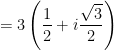
= 3 \displaystyle \left( \frac{1}{2} + i \frac{\sqrt{3}}{2} \right)

= \displaystyle \frac{3}{2} + \frac{3\sqrt{3}}{2} i.

If k = 1, then \theta = \displaystyle \frac{\pi}{3} + \frac{2\pi}{3} = \pi, so that

z = 3 \displaystyle \left( \cos \pi + i \sin \pi \right) = 3(-1+0i) = -3.

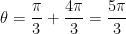
If k = 2, then \theta = \displaystyle \frac{\pi}{3} + \frac{4\pi}{3} = \displaystyle \frac{5\pi}{3}, so that

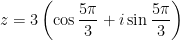
z = 3 \displaystyle \left( \cos \frac{5\pi}{3} + i \sin \frac{5\pi}{3} \right)

= 3 \displaystyle \left( \frac{1}{2} - i \frac{\sqrt{3}}{2} \right)

= \displaystyle \frac{3}{2} - \frac{3\sqrt{3}}{2} i.

Not surprisingly, we obtain the same three answers that we did using algebra.

What if we keep increasing the value of k? Let’s find out with k = 3:

If k = 3, then \theta = \displaystyle \frac{\pi}{3} + \frac{6\pi}{3} = \displaystyle \frac{7\pi}{3}, so that

z = 3 \displaystyle \left( \cos \frac{7\pi}{3} + i \sin \frac{7 \pi}{3} \right)

= 3 \displaystyle \left( \frac{1}{2} + i \frac{\sqrt{3}}{2} \right)

= \displaystyle \frac{3}{2} + \frac{3\sqrt{3}}{2} i.

In other words, since \displaystyle \frac{\pi}{3} and \displaystyle \frac{7\pi}{3} are coterminal, we end up with the same answer. This resolves the apparent paradox of having infinitely many possible angles \theta but only three solutions z.
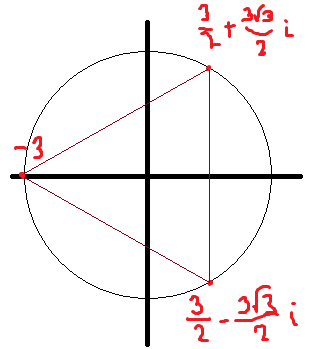
Using De Moivre’s Theorem certainly appears to be much more difficult than just factoring! However, this solution provides a geometric interpretation of the three roots that isn’t otherwise apparent. Let’s using the trigonometric form of these three solutions to plot them in the complex plane:

complex roots

All three points lie a distance of 3 from the origin, and so they lie on the same circle. Also, the angle from the origin increases by \displaystyle \frac{2\pi}{3} as we shift from point to point. This divides the circle (with a total angle of 2\pi into three equal parts, and so the points are evenly spaced around the circle. Also, the points form the vertices of an equilateral triangle inscribed within this circle. Again, none of this would have been apparent by strictly factoring the polynomial z^3 + 27.

All of the above can be repeated for finding the roots of any equation z^n = w. This equation has n roots which lie a distance of |w|^{1/n} from the origin on the points of a regular n-gon inscribed in a circle of this radius. The only tricky part is determining the placement of the initial point (i.e., finding the initial value of \theta from which all other points can be determined.

green line

For completeness, here’s the movie that I use to engage my students when I begin this sequence of lectures.


Calculators and complex numbers (Part 8)

In this series of posts, I explore properties of complex numbers that explain some surprising answers to exponential and logarithmic problems using a calculator (see video at the bottom of this post). These posts form the basis for a sequence of lectures given to my future secondary teachers.

To begin, we recall that the trigonometric form of a complex number z = a+bi is

z = r(\cos \theta + i \sin \theta)

where r = |z| = \sqrt{a^2 + b^2} and \tan \theta = b/a, with \theta in the appropriate quadrant. As noted before, this is analogous to converting from rectangular coordinates to polar coordinates.

There’s a shorthand notation for the right-hand side (r e^{i \theta}) that I’ll justify later in this series.

In the previous three posts, we discussed De Moivre’s Theorem:

Theorem. If n is an integer, then \left[ r (\cos \theta + i \sin \theta) \right]^n = r^n (\cos n \theta + i \sin n \theta).

Let’s now use this theorem to solve an algebraic equation.

Find all z so that z^3 = -27.

When I present this to my students, their kneejerk reaction is always to answer “-3.” To which I politely point out, “This is a cubic equation. So how many roots does it have?” Of course, they answer “Three.” To which I respond, “OK, so how do we find the other two roots?”

With enough patience, a student will usually volunteer that z^3 + 27 = 0 has a known root of z = -3, and so the remaining roots can be found using synthetic division by dividing z+3 into z^3 + 27, yielding

z^3 + 27 = (z+3)(z^2 - 3z + 9)

So the other two roots can be found using the quadratic formula:

z = \displaystyle \frac{3 \pm \sqrt{9 - 36}}{2} = \displaystyle \frac{3}{2} \pm \frac{3\sqrt{3}}{2} i

So there are indeed three roots. Though I usually won’t take class time to do it, I encourage my students to cube these two answers to confirm that they indeed get -27.

As an aside, before moving on to the use of De Moivre’s Theorem, I usually point out to my students that there is a formula for factoring the sum of two cubes:

a^3 + b^3 = (a+b)(a^2 - ab + b^2)

And there’s a formula for the difference of two cubes:

a^3 - b^3 = (a-b)(a^2 + ab + b^2)

My experience is that even math majors are not familiar with these two formulas. They know the difference of two squares formula, but they’re either not proficient with these two formulas or else they’ve never seen them before. These can be generalized for any odd positive exponent and any positive exponent, respectively.

In tomorrow’s post, I’ll describe how these three roots can be found by using De Moivre’s Theorem.

green line

For completeness, here’s the movie that I use to engage my students when I begin this sequence of lectures.