How I Impressed My Wife: Part 4f

Previously in this series, I have used two different techniques to show that

Q = \displaystyle \int_0^{2\pi} \frac{dx}{\cos^2 x + 2 a \sin x \cos x + (a^2 + b^2) \sin^2 x} = \displaystyle \frac{2\pi}{|b|}.

Originally, my wife had asked me to compute this integral by hand because Mathematica 4 and Mathematica 8 gave different answers. At the time, I eventually obtained the solution by multiplying the top and bottom of the integrand by \sec^2 x and then employing the substitution u = \tan x (after using trig identities to adjust the limits of integration).
But this wasn’t the only method I tried. Indeed, I tried two or three different methods before deciding they were too messy and trying something different. So, for the rest of this series, I’d like to explore different ways that the above integral can be computed.
green linePreviously in this series, I have used two different techniques to show that

Q = \displaystyle \int_0^{2\pi} \frac{dx}{\cos^2 x + 2 a \sin x \cos x + (a^2 + b^2) \sin^2 x} = \displaystyle \frac{2\pi}{|b|}.

Originally, my wife had asked me to compute this integral by hand because Mathematica 4 and Mathematica 8 gave different answers. At the time, I eventually obtained the solution by multiplying the top and bottom of the integrand by \sec^2 x and then employing the substitution u = \tan x (after using trig identities to adjust the limits of integration).
But this wasn’t the only method I tried. Indeed, I tried two or three different methods before deciding they were too messy and trying something different. So, for the rest of this series, I’d like to explore different ways that the above integral can be computed.
green lineHere’s my progress so far:

Q = \displaystyle \int_0^{2\pi} \frac{dx}{\cos^2 x + 2 a \sin x \cos x + (a^2 + b^2) \sin^2 x}

= \displaystyle \int_0^{2\pi} \frac{2 \, dx}{1+\cos 2x + 2 a \sin 2x + (a^2 + b^2)(1-\cos 2x)}

= 2 \displaystyle \int_0^{2\pi} \frac{d\theta}{(1+a^2+b^2) + 2 a \sin \theta + (1 - a^2 - b^2) \cos \theta}

= 2 \displaystyle \int_{0}^{2\pi} \frac{d\theta}{S + R \cos (\theta - \alpha)}

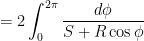
= 2 \displaystyle \int_{0}^{2\pi} \frac{d\phi}{S + R \cos \phi}

= \displaystyle -\frac{4i}{R} \oint_C \frac{dz}{z^2 + 2\frac{S}{R}z + 1},

where this last integral is taken over the complex plane on the unit circle, a closed contour oriented counterclockwise. In these formulas, R = \sqrt{(2a)^2 + (1-a^2-b^2)^2} and S = 1 + a^2 + b^2. (Also, \alpha is a certain angle that is now irrelevant at this point in the calculation).

This contour integral looks complicated; however, it’s an amazing fact that integrals over closed contours can be easily evaluated by only looking at the poles of the integrand. In recent posts, I established that there was only one pole inside the contour, and the residue at this pole was equal to \displaystyle \frac{R}{ 2 \sqrt{S^2-R^2} }.

This residue can be used to evaluate the contour integral. Ordinarily, integrals are computed by subtracting the values of the antiderivative at the endpoints. However, there is an alternate way of computing a contour integral using residues. It turns out that the value of the contour integral is 2\pi i times the sum of the residues within the contour; see Wikipedia and Mathworld for more information.

Therefore,

Q = \displaystyle -\frac{4i}{R} \oint_C \frac{dz}{(z - r_1)(z- r_2)}

= \displaystyle -\frac{4i}{R} \cdot 2\pi i \cdot \frac{R}{ 2 \sqrt{S^2-R^2} }

= \displaystyle \frac{4\pi}{\sqrt{S^2-R^2}}

Next, I use some algebra to simplify the denominator:

S^2 - R^2 = (1+a^2+b^2)^2 - (1-a^2-b^2)^2 - (2a)^2

S^2 - R^2 = [(1 + a^2 + b^2) + (1-a^2-b^2)][(1 + a^2 + b^2) - (1 - a^2 -b^2)] - 4a^2

S^2 - R^2 = 2[2 a^2 + 2b^2] - 4a^2

S^2 - R^2 = 4b^2

Therefore,

Q = \displaystyle \frac{4\pi}{\sqrt{4b^2}} = \displaystyle \frac{4\pi}{2|b|} = \frac{2\pi}{|b|}

Once again, this matches the solution found with the previous methods… and I was careful to avoid a common algebraic mistake.

green lineIn tomorrow’s post, I’ll discuss an alternative way of computing the residue.

How I Impressed My Wife: Part 4e

Previously in this series, I have used two different techniques to show that

Q = \displaystyle \int_0^{2\pi} \frac{dx}{\cos^2 x + 2 a \sin x \cos x + (a^2 + b^2) \sin^2 x} = \displaystyle \frac{2\pi}{|b|}.

Originally, my wife had asked me to compute this integral by hand because Mathematica 4 and Mathematica 8 gave different answers. At the time, I eventually obtained the solution by multiplying the top and bottom of the integrand by \sec^2 x and then employing the substitution u = \tan x (after using trig identities to adjust the limits of integration).
But this wasn’t the only method I tried. Indeed, I tried two or three different methods before deciding they were too messy and trying something different. So, for the rest of this series, I’d like to explore different ways that the above integral can be computed.
green lineHere’s my progress so far:

Q = \displaystyle \int_0^{2\pi} \frac{dx}{\cos^2 x + 2 a \sin x \cos x + (a^2 + b^2) \sin^2 x}

= \displaystyle \int_0^{2\pi} \frac{2 \, dx}{1+\cos 2x + 2 a \sin 2x + (a^2 + b^2)(1-\cos 2x)}

= 2 \displaystyle \int_0^{2\pi} \frac{d\theta}{(1+a^2+b^2) + 2 a \sin \theta + (1 - a^2 - b^2) \cos \theta}

= 2 \displaystyle \int_{0}^{2\pi} \frac{d\theta}{S + R \cos (\theta - \alpha)}

= 2 \displaystyle \int_{0}^{2\pi} \frac{d\phi}{S + R \cos \phi}

= \displaystyle -\frac{4i}{R} \oint_C \frac{dz}{z^2 + 2\frac{S}{R}z + 1}

= \displaystyle -\frac{4i}{R} \oint_C \frac{dz}{(z - r_1)(z- r_2)}

where this last integral is taken over the complex plane on the unit circle, a closed contour oriented counterclockwise. Also,

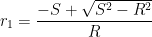
r_1 = \displaystyle \frac{-S + \sqrt{S^2 -R^2}}{R}

and

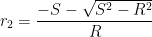
r_2 = \displaystyle \frac{-S - \sqrt{S^2 -R^2}}{R},

are the two distinct roots of the denominator (as long as b \ne 0). In these formulas,R = \sqrt{(2a)^2 + (1-a^2-b^2)^2} and S = 1 + a^2 + b^2. (Also, \alpha is a certain angle that is now irrelevant at this point in the calculation).

This contour integral looks complicated; however, it’s an amazing fact that integrals over closed contours can be easily evaluated by only looking at the poles of the integrand. In yesterday’s post, I established that r_1 lies inside the contour, but r_2 lies outside of the contour.

The next step of the calculation is finding the residue at r_1; see Wikipedia and Mathworld for more information. This means rewriting the rational function

\displaystyle \frac{1}{(z - r_1)(z - r_2)}

as a power series (technically, a Laurent series) about the point z = r_1. This can be done by using the formula for an infinite geometric series (see here, here, and here):

\displaystyle \frac{1}{(z - r_1)(z - r_2)} = \displaystyle \frac{1}{z-r_1} \times \frac{1}{z-r_2}

= \displaystyle \frac{-1}{z-r_1} \times \frac{1}{r_2-z}

= \displaystyle \frac{-1}{z-r_1} \times \frac{1}{(r_2-r_1) - (z-r_1)}

= \displaystyle \frac{-1}{z-r_1} \times \frac{1}{r_2-r_1} \times \frac{ 1}{ 1 - \displaystyle \frac{z-r_1}{r_2-r_1} }

= \displaystyle \frac{-1}{z-r_1} \times \frac{1}{r_2-r_1} \left[ 1 + \left( \displaystyle \frac{z-r_1}{r_2-r_1} \right) + \left( \displaystyle \frac{z-r_1}{r_2-r_1} \right)^2 + \left( \displaystyle \frac{z-r_1}{r_2-r_1} \right)^3 + \dots \right]

= \displaystyle \frac{-1}{z-r_1} \times \frac{1}{r_2-r_1} - \frac{1}{(r_2-r_1)^2} - \frac{z-r_1}{(r_2-r_1)^3} - \frac{(z-r_1)^2}{(r_2-r_1)^4} \dots

The residue of the function at z = r_1 is defined to be the constant multiplying the \displaystyle \frac{1}{z-r_1} term in the above series. Therefore,

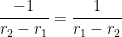
The residue at x = r_1 is \displaystyle \frac{-1}{r_2-r_1} = \displaystyle \frac{1}{r_1-r_2}

From the definitions of r_1 and r_2 above,

\displaystyle \frac{1}{r_1-r_2} = \displaystyle \frac{1}{\displaystyle \frac{-S + \sqrt{S^2 -R^2}}{R} - \frac{-S - \sqrt{S^2 -R^2}}{R}}

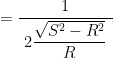
= \displaystyle \frac{1}{ ~ 2 \displaystyle \frac{\sqrt{S^2-R^2}}{R} ~ }

= \displaystyle \frac{R}{ 2 \sqrt{S^2-R^2} }

green lineNow that I’ve identified the residue of the only root that lies inside of the contour, we are in position to evaluate the contour integral above. I’ll discuss this in tomorrow’s post.

How I Impressed My Wife: Part 4d

Previously in this series, I have used two different techniques to show that

Q = \displaystyle \int_0^{2\pi} \frac{dx}{\cos^2 x + 2 a \sin x \cos x + (a^2 + b^2) \sin^2 x} = \displaystyle \frac{2\pi}{|b|}.

Originally, my wife had asked me to compute this integral by hand because Mathematica 4 and Mathematica 8 gave different answers. At the time, I eventually obtained the solution by multiplying the top and bottom of the integrand by \sec^2 x and then employing the substitution u = \tan x (after using trig identities to adjust the limits of integration).
But this wasn’t the only method I tried. Indeed, I tried two or three different methods before deciding they were too messy and trying something different. So, for the rest of this series, I’d like to explore different ways that the above integral can be computed.
green lineHere’s my progress so far:

Q = \displaystyle \int_0^{2\pi} \frac{dx}{\cos^2 x + 2 a \sin x \cos x + (a^2 + b^2) \sin^2 x}

= \displaystyle \int_0^{2\pi} \frac{2 \, dx}{1+\cos 2x + 2 a \sin 2x + (a^2 + b^2)(1-\cos 2x)}

= 2 \displaystyle \int_0^{2\pi} \frac{d\theta}{(1+a^2+b^2) + 2 a \sin \theta + (1 - a^2 - b^2) \cos \theta}

= 2 \displaystyle \int_{0}^{2\pi} \frac{d\theta}{S + R \cos (\theta - \alpha)}

= 2 \displaystyle \int_{0}^{2\pi} \frac{d\phi}{S + R \cos \phi}

= \displaystyle -\frac{4i}{R} \oint_C \frac{dz}{z^2 + 2\frac{S}{R}z + 1}

= \displaystyle -\frac{4i}{R} \oint_C \frac{dz}{(z - r_1)(z- r_2)}

where this last integral is taken over the complex plane on the unit circle, a closed contour oriented counterclockwise. Also,

r_1 = \displaystyle \frac{-S + \sqrt{S^2 -R^2}}{R}

and

r_2 = \displaystyle \frac{-S - \sqrt{S^2 -R^2}}{R},

are the two distinct roots of the denominator (as long as b \ne 0). In these formulas,R = \sqrt{(2a)^2 + (1-a^2-b^2)^2} and S = 1 + a^2 + b^2. (Also, \alpha is a certain angle that is now irrelevant at this point in the calculation).

This contour integral looks more complicated; however, it’s an amazing fact that integrals over closed contours can be easily evaluated by only looking at the poles of the integrand. For this integral, that means finding the values of z where the denominator is equal to 0, and then determining which of those values lie inside of the closed contour.

Let’s now see if either of the two roots of the denominator lies inside of the unit circle in the complex plane. In other words, let’s determine if |r_1| < 1 and/or |r_2| < 1.

I’ll begin with r_1. Clearly, the numbers R, \sqrt{S^2-R^2}, and S are the lengths of three sides of a right triangle with hypotenuse S. So, since the hypotenuse is the longest side,

S > \sqrt{S^2-R^2}

or

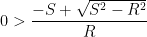
0 > -S + \sqrt{S^2-R^2}

so that

0 > \displaystyle \frac{-S + \sqrt{S^2-R^2}}{R}.

Also, by the triangle inequality,

R + \sqrt{S^2 - R^2} > S

-S + \sqrt{S^2 - R^2} > -R

\displaystyle \frac{-S + \sqrt{S^2-R^2}}{R} > -1

Combining these inequalities, we see that

-1 < \displaystyle \frac{-S + \sqrt{S^2-R^2}}{R} < 0,

and so I see that |r_1| < 1, so that r_1 does lie inside of the contour C.

The second root r_2 is easier to handle:

|r_2| = \left| \displaystyle \frac{-S - \sqrt{S^2 -R^2}}{R} \right| = \left| \displaystyle \frac{S + \sqrt{S^2 -R^2}}{R} \right| > \displaystyle \frac{S}{R} > 1.

Therefore, since r_2 lies outside of the contour, this root is not important for the purposes of computing the above contour integral.

green lineNow that I’ve identified the root that lies inside of the contour, I now have to compute the residue at this root. I’ll discuss this in tomorrow’s post.

How I Impressed My Wife: Part 4c

Previously in this series, I have used two different techniques to show that

Q = \displaystyle \int_0^{2\pi} \frac{dx}{\cos^2 x + 2 a \sin x \cos x + (a^2 + b^2) \sin^2 x} = \displaystyle \frac{2\pi}{|b|}.

Originally, my wife had asked me to compute this integral by hand because Mathematica 4 and Mathematica 8 gave different answers. At the time, I eventually obtained the solution by multiplying the top and bottom of the integrand by \sec^2 x and then employing the substitution u = \tan x (after using trig identities to adjust the limits of integration).
But this wasn’t the only method I tried. Indeed, I tried two or three different methods before deciding they were too messy and trying something different. So, for the rest of this series, I’d like to explore different ways that the above integral can be computed.
green lineHere’s my progress so far:

Q = \displaystyle \int_0^{2\pi} \frac{dx}{\cos^2 x + 2 a \sin x \cos x + (a^2 + b^2) \sin^2 x}

= \displaystyle \int_0^{2\pi} \frac{2 \, dx}{1+\cos 2x + 2 a \sin 2x + (a^2 + b^2)(1-\cos 2x)}

= 2 \displaystyle \int_0^{2\pi} \frac{d\theta}{(1+a^2+b^2) + 2 a \sin \theta + (1 - a^2 - b^2) \cos \theta}

= 2 \displaystyle \int_{0}^{2\pi} \frac{d\theta}{S + R \cos (\theta - \alpha)}

= 2 \displaystyle \int_{0}^{2\pi} \frac{d\phi}{S + R \cos \phi}

= \displaystyle -\frac{4i}{R} \oint_C \frac{dz}{z^2 + 2\frac{S}{R}z + 1},

where this last integral is taken over the complex plane on the unit circle, a closed contour oriented counterclockwise. Also, R = \sqrt{(2a)^2 + (1-a^2-b^2)^2} and S = 1 + a^2 + b^2 (and \alpha is a certain angle that is now irrelevant at this point in the calculation).

This contour integral looks more complicated; however, it’s an amazing fact that integrals over closed contours can be easily evaluated by only looking at the poles of the integrand. For this integral, that means finding the values of z where the denominator is equal to 0, and then determining which of those values lie inside of the closed contour. In this case, that means finding which root(s) of the denominator lie inside the unit circle in the complex plane.

To begin, we use the quadratic formula to find the roots of the denominator:

z^2 + 2\frac{S}{R}z + 1 = 0

Rz^2 + 2Sz + R = 0

z = \displaystyle \frac{-2S \pm \sqrt{4S^2 - 4R^2}}{2R}

z = \displaystyle \frac{-S \pm \sqrt{S^2 -R^2}}{R}.

So we have the two roots r_1 = \displaystyle \frac{-S + \sqrt{S^2 -R^2}}{R} and r_2 = \displaystyle \frac{-S - \sqrt{S^2 -R^2}}{R}. Earlier in this series, I showed that S > R > 0 as long as b \ne 0, and so the denominator has two distinct real roots. So the integral Q may be rewritten as

Q = \displaystyle -\frac{4i}{R} \oint_C \frac{dz}{(z - r_1)(z- r_2)}

green line

Next, we have to determine if either r_1 or r_2 (or both) lies inside of the contour. I’ll discuss this in tomorrow’s post.

How I Impressed My Wife: Part 4b

Previously in this series, I have used two different techniques to show that

Q = \displaystyle \int_0^{2\pi} \frac{dx}{\cos^2 x + 2 a \sin x \cos x + (a^2 + b^2) \sin^2 x} = \displaystyle \frac{2\pi}{|b|}.

Originally, my wife had asked me to compute this integral by hand because Mathematica 4 and Mathematica 8 gave different answers. At the time, I eventually obtained the solution by multiplying the top and bottom of the integrand by \sec^2 x and then employing the substitution u = \tan x (after using trig identities to adjust the limits of integration).
But this wasn’t the only method I tried. Indeed, I tried two or three different methods before deciding they were too messy and trying something different. So, for the rest of this series, I’d like to explore different ways that the above integral can be computed.
green lineLet me backtrack to a point in the middle of the previous solution:

Q = \displaystyle \int_0^{2\pi} \frac{dx}{\cos^2 x + 2 a \sin x \cos x + (a^2 + b^2) \sin^2 x}

= \displaystyle \int_0^{2\pi} \frac{2 \, dx}{1+\cos 2x + 2 a \sin 2x + (a^2 + b^2)(1-\cos 2x)}

= 2 \displaystyle \int_0^{2\pi} \frac{d\theta}{(1+a^2+b^2) + 2 a \sin \theta + (1 - a^2 - b^2) \cos \theta}

= 2 \displaystyle \int_{0}^{2\pi} \frac{d\theta}{S + R \cos (\theta - \alpha)}

= 2 \displaystyle \int_{0}^{2\pi} \frac{d\phi}{S + R \cos \phi},

where R = \sqrt{(2a)^2 + (1-a^2-b^2)^2} and S = 1 + a^2 + b^2 (and \alpha is a certain angle that is now irrelevant at this point in the calculation).

Earlier in this series, I used the magic substitution u = \tan \displaystyle \frac{\phi}{2} to evaluate this last integral. Now, I’ll instead use contour integration; see Wikipedia for more details. I will use Euler’s formula as a substitution (see here and here for more details):

z = e^{i \phi} = \cos \phi + i \sin \phi,

so that the integral Q is transformed to a contour integral in the complex plane. Under this substitution, as discussed in yesterday’s post,

\cos \phi = \displaystyle \frac{1}{2} \left[z + \displaystyle \frac{1}{z} \right]

and

d\phi = \displaystyle -\frac{i}{z} dz

Employing this substitution, the region of integration changes from 0 \le \phi \le 2\pi to a the unit circle C, a closed counterclockwise contour in the complex plane:

Q = 2 \displaystyle \oint_C \frac{\displaystyle -\frac{i}{z} dz}{S + \displaystyle \frac{R}{2} \left[z + \displaystyle \frac{1}{z} \right]}

= -4i \displaystyle \oint_C \frac{dz}{Rz^2 + 2Sz + R}

= \displaystyle -\frac{4i}{R} \oint_C \frac{dz}{z^2 + 2\frac{S}{R}z + 1}

green lineWhile this looks integral in the complex plane looks a lot more complicated than a regular integral, it’s actually a lot easier to compute using residues. I’ll discuss the computation of this contour integral in tomorrow’s post.

How I Impressed My Wife: Part 4a

Previously in this series, I have used two different techniques to show that

Q = \displaystyle \int_0^{2\pi} \frac{dx}{\cos^2 x + 2 a \sin x \cos x + (a^2 + b^2) \sin^2 x} = \displaystyle \frac{2\pi}{|b|}.

Originally, my wife had asked me to compute this integral by hand because Mathematica 4 and Mathematica 8 gave different answers. At the time, I eventually obtained the solution by multiplying the top and bottom of the integrand by \sec^2 x and then employing the substitution u = \tan x (after using trig identities to adjust the limits of integration).
But this wasn’t the only method I tried. Indeed, I tried two or three different methods before deciding they were too messy and trying something different. So, for the rest of this series, I’d like to explore different ways that the above integral can be computed.
green lineLet me backtrack to a point in the middle of the previous solution:

Q = \displaystyle \int_0^{2\pi} \frac{dx}{\cos^2 x + 2 a \sin x \cos x + (a^2 + b^2) \sin^2 x}

= \displaystyle \int_0^{2\pi} \frac{2 \, dx}{1+\cos 2x + 2 a \sin 2x + (a^2 + b^2)(1-\cos 2x)}

= 2 \displaystyle \int_0^{2\pi} \frac{d\theta}{(1+a^2+b^2) + 2 a \sin \theta + (1 - a^2 - b^2) \cos \theta}

= 2 \displaystyle \int_{0}^{2\pi} \frac{d\theta}{S + R \cos (\theta - \alpha)}

= 2 \displaystyle \int_{0}^{2\pi} \frac{d\phi}{S + R \cos \phi},

where R = \sqrt{(2a)^2 + (1-a^2-b^2)^2} and S = 1 + a^2 + b^2 (and \alpha is a certain angle that is now irrelevant at this point in the calculation).

In the previous solution, I used the “magic substitution” u = \tan \displaystyle \frac{\phi}{2} to convert the last integrand to a simple rational function. Starting today, I’ll use a completely different technique to compute this last integral.

The technique that I’ll use is contour integration; see Wikipedia for more details. I will use Euler’s formula as a substitution (see here and here for more details):

z = e^{i \phi} = \cos \phi + i \sin \phi,

so that the integral Q is transformed to a contour integral in the complex plane.

Under this substitution,

\displaystyle \frac{1}{z} = e^{-i\phi} = \cos(-\phi) + i \sin(-\phi) = \cos \phi - i \sin \phi

Using these last two equations, I can solve for \cos \phi and \sin \phi in terms of z and \displaystyle \frac{1}{z}. I’ll begin with \cos \phi:

z + \displaystyle \frac{1}{z} = \cos \phi + i \sin \phi + \cos \phi - i \sin \phi

z + \displaystyle \frac{1}{z} = 2 \cos \phi

\displaystyle \frac{1}{2} \left[z + \displaystyle \frac{1}{z} \right] = \cos \phi

Though not necessary for this particular, let me solve for \sin \phi for completeness:

z - \displaystyle \frac{1}{z} = \cos \phi + i \sin \phi - [ \cos \phi - i \sin \phi]

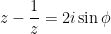
z - \displaystyle \frac{1}{z} = 2i \sin \phi

\displaystyle \frac{1}{2i} \left[z - \displaystyle \frac{1}{z} \right] = \sin\phi

 Finally, let me solve for the differential d\phi:

z = e^{i \phi}

dz = i e^{i \phi} d\phi

\displaystyle \frac{1}{i} e^{-i \phi} dz = d\phi

-i e^{-i \phi} dz = d\phi

\displaystyle -\frac{i}{z} dz = d\phi

green line I’ll continue with this different method of evaluating this integral in tomorrow’s post.

Is 2i less than 3i? (Part 4: Two other attempted inequalities)

In yesterday’s post, I demonstrated that there is no subset \mathbb{C}^+ \subset \mathbb{C} of the complex numbers which satisfies the following four axioms:

  • If z_1, z_2 \in \mathbb{C}^+, then z_1+z_2 \in \mathbb{C}^+
  • If z_1, z_2 \in \mathbb{C}^+, then z_1 z_2 \in \mathbb{C}^+.
  • For every z \ne 0, either z \in \mathbb{C}^+ or -z \in \mathbb{C}^+, but not both.
  • 0 \notin \mathbb{C}^+

However, it’s instructive (and fun) to try to construct such a set. Yesterday I showed that the following subset satisfies three of the four axioms:

\mathbb{C}^+ = \{x + iy : x > 0 \qquad \hbox{or} \qquad x = 0, y > 0\}

Apostol’s calculus suggests two other subsets to try:

\mathbb{C}^+ = \{x + iy : x^2 + y^2 > 0 \}

and

\mathbb{C}^+ = \{x + iy : x > y\}

Neither of these sets work either, but I won’t spoil the fun for you by giving you the proofs. I leave a thought bubble if you’d like to try to figure out which of the four axioms are satisfied by these two notions of “positive” complex numbers.

green_speech_bubble


Is 2i less than 3i? (Part 3: An inequality that almost works)

In yesterday’s post, I demonstrated that there is no subset \mathbb{C}^+ \subset \mathbb{C} of the complex numbers which satisfies the following four axioms:

  • If z_1, z_2 \in \mathbb{C}^+, then z_1+z_2 \in \mathbb{C}^+
  • If z_1, z_2 \in \mathbb{C}^+, then z_1 z_2 \in \mathbb{C}^+.
  • For every z \ne 0, either z \in \mathbb{C}^+ or -z \in \mathbb{C}^+, but not both.
  • 0 \notin \mathbb{C}^+

However, it’s instructive (and fun) to try to construct such a set. One way of attempting this is defining

\mathbb{C}^+ = \{x + iy : x > 0 \qquad \hbox{or} \qquad x = 0, y > 0\}

This set \mathbb{C}^+ leads to the lexicographic ordering of the complex numbers: if z_1 = a_1 + i b_1 and z_2 = a_2 + i b_2, where a_1, a_2, b_1, b_2 \in \mathbb{R}, we say that z_1 \prec z_2 if

a_1 < a_2 \qquad \hbox{or} \qquad a_1 = a_2, b_1 < b_2

I used the symbol z_1 \prec z_2 because, as we’ll see, \prec satisfies some but not all of the usual properties of an inequality. This ordering is sometimes called the “dictionary” order because the numbers are ordered like the words in a dictionary… the real parts are compared first, and then (if that’s a tie) the imaginary parts are compared. See Wikipedia and Mathworld for more information.

In any case, defining \mathbb{C}^+ in this way satisfies three of the four order axioms.

  • Suppose z_1, z_2 \in \mathbb{C}^+. It’s straightforward to show that z_1 + z_2 \in \mathbb{C}^+. Let z_1 = a_1 + i b_1 and z_2 = a_2 + i b_2, where a_1, a_2, b_1, b_2 \in \mathbb{R}. Then a_1, a_2 \ge 0, and so a_1 + a_2 \ge 0.
    • Case 1: If a_1 + a_2 > 0, then clearly z_1 + z_2 \in \mathbb{C}^+.
    • Case 2: If a_1 + a_2 = 0, that’s only possible if a_1 = 0 and a_2 = 0. But since z_1, z_2 \in \mathbb{C}^+, that means that b_1 > 0 and b_2 > 0. Therefore, b_1 + b_2 > 0. Since a_1 + a_2 = 0, we again conclude that z_1 + z_2 \in \mathbb{C}^+.
  • Suppose z = a + bi \ne 0, where a, b \in \mathbb{R}. Then a \ne 0 or b \ne 0. We now show that, no matter what, z \in \mathbb{C}^+ or -z \in \mathbb{C}^+, but not both.
    • Case 1: If a > 0, then -a < 0, and so z \in \mathbb{C}^+ but -z \notin \mathbb{C}^+.
    • Case 2: If a < 0, then -a > 0, and so -z \in \mathbb{C}^+ but z \notin \mathbb{C}^+.
    • Case 3: If a = 0, then b \ne 0 since z \ne 0. Also, if a = 0, then -a = 0, so that z = bi and -z = -bi.
      • Subcase 3A: If b > 0, then -b < 0, and so z \in \mathbb{C}^+ but -z \notin \mathbb{C}^+.
      • Subcase 3B: If b < 0, then -b > 0, and so -z \in \mathbb{C}^+ but z \notin \mathbb{C}^+.
  • By definition, 0 = 0 + 0i \notin \mathbb{C}^+.

However, the fourth property fails. By definition, i = 0 + 1i \in \mathbb{C}^+. However, i \cdot i = -1 + 0i \notin \mathbb{C}^+.

green line

Because this definition of \mathbb{C}^+ satisfies three of the four order axioms, the relation \prec satisfies some but not all of the theorems stated in the first post of this series. For example, if z_1 \prec z_2 and z_2 \prec z_3, then z_1 \prec z_3. Also, if z_1 \prec z_2 and w_1 \prec w_2, then z_1 + w_1 \prec z_2 + w_2.

I’ll leave it to the interested reader to determine which of the theorems are true, and which are false (and have counterexamples).

Is 2i less than 3i? (Part 2: Proof by contradiction)

Is 2i less than 3i?

That’s a very natural question for a student to ask when first learning about complex numbers. The short answer is, “No… there isn’t a way to define inequality for complex numbers that satisfies all the properties of real numbers.”

I demonstrated this in a roundabout way in yesterday’s post. Today, let’s tackle the issue using a proof by contradiction. (I almost said, “Let’s tackle the issue more directly,” but avoided that phrase because a proof by contradiction is sometimes called an indirect proof, which would lead to the awkward sentence “Let’s tackle the issue more directly with an indirect proof.”)

Suppose that there’s a subset \mathbb{C}^+ \subset \mathbb{C} of the complex numbers which satisfies the following four axioms:

  • If z_1, z_2 \in \mathbb{C}^+, then z_1+z_2 \in \mathbb{C}^+
  • If z_1, z_2 \in \mathbb{C}^+, then z_1 z_2 \in \mathbb{C}^+.
  • For every z \ne 0, either z \in \mathbb{C}^+ or -z \in \mathbb{C}^+, but not both.
  • 0 \notin \mathbb{C}^+

As discussed yesterday, the ordinary properties of inequalities derive from these four order axioms. Assuming these four order axioms are true for the complex numbers, let’s investigate whether i is “positive” or not. According to the third axiom, either i \in \mathbb{C}^+ or -i \in \mathbb{C}^+, but not both.

Case 1. i \in \mathbb{C}^+. Then by the second axiom, i \cdot i \in \mathbb{C}^+, or -1 \in \mathbb{C}^+. Applying the second axiom again, since i \in \mathbb{C}^+ and -1 \in \mathbb{C}^+, we have i \cdot (-1) \in \mathbb{C}^+, or -i \in \mathbb{C}^+. But that’s impossible because we assumed that i \in \mathbb{C}^+.

Case 2. -i \in \mathbb{C}^+. Then by the second axiom, (-i) \cdot (-i) \in \mathbb{C}^+, or -1 \in \mathbb{C}^+. Applying the second axiom again, since -i \in \mathbb{C}^+ and -1 \in \mathbb{C}^+, we have (-i) \cdot (-1) \in \mathbb{C}^+, or i \in \mathbb{C}^+. But that’s impossible because we assumed that -i \in \mathbb{C}^+.

Either way, we obtain a contradiction. Therefore, there is no subset \mathbb{C}^+ of the complex numbers that serves as the “positive” complex numbers, and so there’s no way to define inequalities for complex numbers that satisfies all of the usual properties of inequalities.

Is 2i less than 3i? (Part 1: Order Axioms)

Is 2i less than 3i?

That’s a very natural question for a student to ask when first learning about complex numbers. The short answer is, “No… there isn’t a way to define inequality for complex numbers that satisfies all the properties of real numbers.”

However, for this answer to make sense, we need to talk about how inequalities are defined in the first place.

Following Apostol’s calculus, there are four axioms from which the ordinary notions of inequality follow. We shall assume that there exists a certain subset \mathbb{R}^+ \subset \mathbb{R}, called the set of positive numbers, which satisfies the following four order axioms:

  • If x, y \in \mathbb{R}^+, then x+y \in \mathbb{R}^+
  • If x, y \in \mathbb{R}^+, then xy \in \mathbb{R}^+.
  • For every real x \ne 0, either x \in \mathbb{R}^+ or -x \in \mathbb{R}^+, but not both.
  • 0 \notin \mathbb{R}^+

We then define the symbols <, \le, >, and \ge in the obvious way:

  • x < y means that y-x is positive.
  • x > y means that $y < x$.
  • x \le y means that either x < y or x=y.
  • x \ge y means that y \le x

From only these four axioms, many familiar theorems about inequalities can be proven. For what it’s worth, when I was a student in Algebra I, I had to prove nearly all of these theorems.

  • If a, b \in \mathbb{R}, then exactly one of the following three relations is true: a < b, a > b, a = b.
  • If a < b and b < c, then a < c.
  • If a < b, then a + c < b + c.
  • If a < b and c > 0, then ac < bc.
  • If a \ne 0, then a^2 > 0.
  • 1 > 0.

We interrupt this list with a public-service announcement: Yes, there’s a proof that 1 is greater than 0. When I tell this to students, I can usually see their heads start to spin, as they think, “Of course we know that!” Then I ask them what the definitions of 1 and 0 are. Usually, they have no idea. Then I’ll remind them that 0 is defined to be the additive identity (so that x + 0 = x and 0 + x = x for all real numbers x), while 1 is defined to be the multiplicative identity (so that x \cdot 1 = x and 1 \cdot x = x for all real numbers x). Based on those definitions alone, I then ask my students, is it obvious that the multiplicative identity has to be larger than the additive identity? The answer is no, which is why the above order axioms are needed.

Here are some more familiar theorems about inequalities that derive from the four order axioms.

  • If a < b and c < 0, then ac > bc.
  • If a < b, then -a > -b.
  • If a < 0, then -a > 0.
  • If ab > 0, then a and b are either both positive or both negative.
  • If a < c and b < d, then a + b < c + d.
  • If a < 0 and b < 0, then a + b < 0.
  • If a > 0, then 1/a > 0.
  • If a < 0, then 1/a < 0.
  • If 0 < a < b, then 0 < 1/b < 1/a.
  • If a \le b and b \le c, then a \le c.
  • If a \le b \le c and a = c, then b = c.

These last two theorems are less familiar. They basically state that (1) there is no “biggest” real number and (2) there is no positive number that’s immediately to the right of 0.

  • There is no real number a so that x \le a for all real numbers x.
  • If 0 \le x < h for every positive real number h, then x =0.

green line

Here’s another important theorem that ultimately derives from the four order axioms, proving that a number system including \sqrt{-1} is incompatible with the four order axioms.

  • There is no real number x so that x^2 + 1 = 0.

The proof of this theorem is simple, given the theorems above. If x = 0, then x^2 + 1 = 1, which is greater than 0. If x \ne 0, then x^2 > 0, and so x^2 + 1 > 0 + 1 > 1. Since 1 > 0, it follows by transitivity that x^2 > 0. Either way, x^2 + 1 > 0, and so x^2 + 1 \ne 0.