The following problem appeared in Volume 97, Issue 3 (2024) of Mathematics Magazine.
Two points and are chosen at random (uniformly) from the interior of a unit circle. What is the probability that the circle whose diameter is segment lies entirely in the interior of the unit circle?
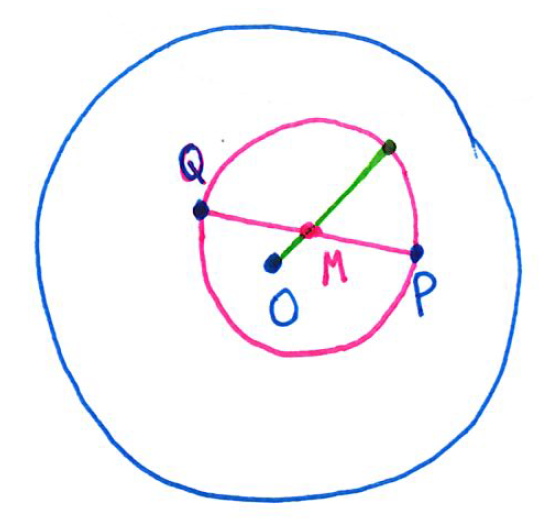
It took me a while to wrap my head around the statement of the problem. In the figure, the points and are chosen from inside the unit circle (blue). Then the circle (pink) with diameter has center , the midpoint of . Also, the radius of the pink circle is .
The pink circle will lie entirely the blue circle exactly when the green line containing the origin , the point , and a radius of the pink circle lies within the blue circle. Said another way, the condition is that the distance plus the radius of the pink circle is less than 1, or
.
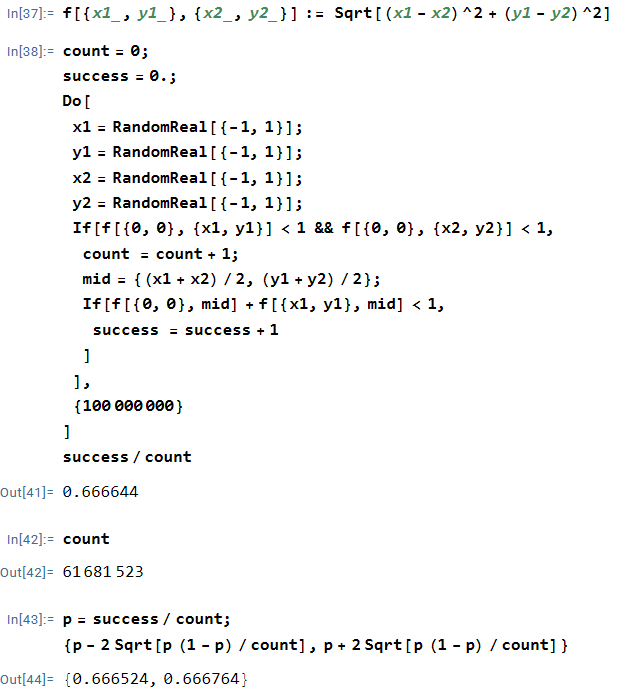
As a first step toward wrapping my head around this problem, I programmed a simple simulation in Mathematica to count the number of times that when points and were chosen at random from the unit circle.
In the above simulation, out of about 61,000,000 attempts, 66.6644% of the attempts were successful. This leads to the natural guess that the true probability is . Indeed, the 95% confidence confidence interval contains , so that the difference of from can be plausibly attributed to chance.
I end with a quick programming note. This certainly isn’t the ideal way to perform the simulation. First, for a fast simulation, I should have programmed in C++ or Python instead of Mathematica. Second, the coordinates of and are chosen from the unit square, so it’s quite possible for or or both to lie outside the unit circle. Indeed, the chance that both and lie in the unit disk in this simulation is , meaning that about of the simulations were simply wasted. So the only sense that this was a quick simulation was that I could type it quickly in Mathematica and then let the computer churn out a result. (I’ll talk about a better way to perform the simulation in the next post.)
In this series, I’m discussing how ideas from calculus and precalculus (with a touch of differential equations) can predict the precession in Mercury’s orbit and thus confirm Einstein’s theory of general relativity. The origins of this series came from a class project that I assigned to my Differential Equations students maybe 20 years ago.
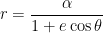
In the previous post, we showed that the polar equation
converts to
in rectangular coordinates. Furthermore, if , then this represents an ellipse with eccentricity whose semi-major axis lies along the axis with one focus at the origin.
It turns out that, for different non-negative values of , the same polar equation represents different conic sections. These are not particularly relevant for our study of precession, but I’m including this anyway in this series as a small tangential discussion.
Let’s take a look at the easy case of . With this substitution, the equation in rectangular coordinates simplifies to
.
Of course, this is the equation of a circle that is centered at the origin with radius .
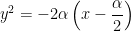
The other easy case is , so that . Then the equation in rectangular coordinates simplifies to
This matches the form of a parabola that opens to the left with a horizontal axis of symmetry:
.
In this case, the vertex of the parabola is located at
,
while the focus of the parabola is located a distance to the left of the vertex. In other words, the origin is the focus of the parabola. (For what it’s worth, the directrix of the parabola would be the vertical line , located to the right of the vertex.)
In my capstone class for future secondary math teachers, I ask my students to come up with ideas for engaging their students with different topics in the secondary mathematics curriculum. In other words, the point of the assignment was not to devise a full-blown lesson plan on this topic. Instead, I asked my students to think about three different ways of getting their students interested in the topic in the first place.
I plan to share some of the best of these ideas on this blog (after asking my students’ permission, of course).
This student submission comes from my former student Emma White. Her topic, from Precalculus: finding the equation of a circle.
How has this topic appeared in pop culture (movies, TV, current music, video games, etc.)?
Ironically, this morning on the way to class I received a notification saying Coldplay dropped a new album called “ Music of the Spheres” and I couldn’t help but look into it more! Although we are talking about circles, as mathematicians (or other people who came across this blog), we realize that circles and spheres are related in some ways. Although that is a discussion for another time, I want to focus on this album and how it relates to our world. Circles are used in various ways when it comes to the “circle of life” or “time on a ticking clock”. One song talks about “Humankind” and how we’re designed. This is a continuous cycle as humans pass away and are born and the cycle continues. While this may be a more serious thing to think about, life happens and cycles (we also see this in history and cycles of conflicts, wars, and much more). Furthermore (and maybe on a more lighthearted feel), we see the concept of circle in “The Circle of Life” as seen in “The Lion King”. I encourage you to look at the lyrics below:
Whatever your background may be, we can agree that much in life happens in cycles (think of cells as well!) and that is done in a metaphorical circular motion. The moon rotates around the sun, the planets rotate around the sun, and so forth. Many songs capture the concept of “circling” or time (think of the Sundial), and I bet if we took the time to really dig deep, we could find more songs with this concept more than we think.
What interesting things can you say about the people who contributed to the discovery and/or the development of this topic?
According to many articles, the discovery of the circle goes way back before recorded history. It started with the Egyptians (the inventors of Geometry) who invented the wheel. I find this intriguing that the people following the Egyptians “investigated” a simple man made tool, the wheel, to go about finding the equation of a circle. I want to emphasize this point because there is so much in life relating to math if only we stop to look and/or think about it more in depth! Furthermore, Euclid (naturally), contributed to the finding of the properties of the circle and “problems of inscribing polygons” (“Circle”, n.d.). Around 650 BC, Thales, a mathematical philosopher who contributed to various elementary geometry theorems, contributed to the theorems regarding circles. Nearly 400 years later, Apollonius, “a Greek mathematician known as ‘The Great Geometer’”, also contributed to the finding of the equation for a circle, specifically the equation itself (J J O’Connor and E F Roberts). He founded the bipolar equation “ represent[ing] a circle whose centre divides the line segment between the two fixed points of the system in the ratio n to m” (“Circle”, n.d.). Needless to say, the people who helped create this equation were years apart and it’s pretty cool to see how their work built off of each other over time.
How can technology (YouTube, Khan Academy [khanacademy.org], Vi Hart, Geometers Sketchpad, graphing calculators, etc.) be used to effectively engage students with this topic?
When it comes to the equation of a circle, using technology would be a great way to visually show students what is happening and understand where the equation comes from. KhanAcademy is a great resource for students to work through problems and furthermore, Desmos could be a resource for students to use at home for homework to check their work and understand how different values for ‘x’ and ‘y’ change the circle. A beneficial video to share/watch with your students would be “Lesson Video: Equation of a Circle”, for it provides a visual representation of how to derive the equation (I think exposing students to how to derive the equation will make the equation easier to understand and how the equation formulated). Giving your students technological resources is beneficial and I bet the students appreciate having multiple resources to help them become more understanding of the subject matter.
In my capstone class for future secondary math teachers, I ask my students to come up with ideas for engaging their students with different topics in the secondary mathematics curriculum. In other words, the point of the assignment was not to devise a full-blown lesson plan on this topic. Instead, I asked my students to think about three different ways of getting their students interested in the topic in the first place.
I plan to share some of the best of these ideas on this blog (after asking my students’ permission, of course).
This student submission comes from my former student Brendan Gunnoe. His topic, from Geometry: finding the area of a circle.
History: Squaring the circle
The ancient Greeks and other groups at the time had a fascination with geometry. These cultures tended to like thinking in terms of simpler geometric shapes, such as circles, equilateral triangles and squares. One of the classic problems proposed by these ancient peoples was “Can you create a square with the same area as a circle with finitely many steps only using a compass and straightedge?”. This problem stood for thousands of years, stumping even the most brilliant of mathematicians that attempted to show it true. Eventually, in the year 1882, it was finally proven impossible because of a property of the number π. It’s not too hard to show that π isn’t an integer, nor is it rational. What was left to show is whether π was algebraic or transcendental. The proof from 1882 showed that π is in fact transcendental, proving that it cannot be made using the rules set out by the original question. If a number is algebraic, then it is a solution to a polynomial with rational coefficients.
Curriculum: Using limit of triangular approximations to get the integral
The teacher starts off class by drawing a circle with an inscribed triangle, another with a square, and so on until a hexagon is inscribed. The teacher then draws isosceles triangles that originate at the circles center and extend to the corners of the polygons. The teacher could ask questions like “What do you notice about the total area of the triangles and the area of the circle as we keep adding sides to the polygon?” and “What do you notice about the triangles we made and the little wedges of the circle, what’s the same and what’s different about them?”. Then the teacher could arrange both the triangles and wedges in an alternating up and down fashion, almost like two zippers, to line up the triangles and wedges. The teacher could ask “What’s the length of the top of the triangles? What about the tops of the wedges, what’s their length?”.
Finally, the teacher asks “What happens when we let the number of pieces gets REALLY big? What happens to difference between the area of the triangles and wedges? What about the tops of the triangles and the tops of the wedges?”. In the limit, the upper edge converges to half of the circumference of the circle and the height of the triangles converges to the radius of the circle. Using this line of thinking, the teacher guides the students into seeing how you can derive the equation for the area of a circle by using approximating it with triangles, and then looking at what happens in the limit.
Application
A telescope’s lens is what’s used to control how much light gets into the eye piece. Suppose you’re an astronomer and want to take a photo of the full Moon on a clear night, which gives off 0.25 lumens/s-m2. Suppose your camera needs to get a total of at least 3 lumens to produce a good photo and 5 lumens to get an amazing photo. What’s the radius of a lens (in centimeters) that can take a good photo in 10 minutes? What’s the radius of a lens that can take an amazing photo in 10 minutes?
Now suppose you’re working with the Hubble space telescope in low Earth orbit trying to get photos of a nearby star system. The radius of the main telescope is 120cm and the star system you want to observe is giving off light at a rate of 10-5 lumens/s-m2. How long will it take to get a good photo with Hubble? What about a great photo?
In my capstone class for future secondary math teachers, I ask my students to come up with ideas for engaging their students with different topics in the secondary mathematics curriculum. In other words, the point of the assignment was not to devise a full-blown lesson plan on this topic. Instead, I asked my students to think about three different ways of getting their students interested in the topic in the first place.
I plan to share some of the best of these ideas on this blog (after asking my students’ permission, of course).
This student submission comes from my former student Noah Mena. His topic, from Precalculus: finding the equation of a circle.
The equation of a circle relies on knowing the definition of a circle, knowing the radius and deciding where the circle is centered at. All of these come into play when a student has to find the equation of a circle. It takes basic understanding of the cartesian grid and understanding the coordinate system. The equation of a circle also builds on students being able to manipulate the equation to get it into standard form and identifying the equation of a circle when it is expanded out. The shape of a circle should also be known, which means with the equation of a circle, students should be able to construct the perfect circle according to the given specifications in the equation.
Learning to write the equation of a circle can be difficult. For one of my teaches last semester my mentor teacher suggested the use of a desmos paired with a worksheet to allow the students to explore what changes the standard equation of a circle. The worksheet had the students enter certain coordinates into the graphing calculator and write down what they thought was the equation of a circle. The next part of the assignment was student driven by having them share their conclusions on what the equation for a circle would be when it is centered at the origin vs. centered at (h,k). The worksheet shows that the students drove their own learning and came to their own conclusions which enhanced engagement through the lesson.
This topic can come up again in trigonometry, upper level calculus and in math modeling. In my TNTX math modeling course, we took a closer look at the derivation of this equation and the subtleties of the standard form. This topic may also be used in physics calculations or in general, science labs. For a physics word problem, it may ask you to calculate the net force and acceleration of a moving object around a circle. In this instance, it would suffice to just know the definition and general shape of a circle to complete these calculations. The definition of a circle is also needed to calculate centripetal force.
In my capstone class for future secondary math teachers, I ask my students to come up with ideas for engaging their students with different topics in the secondary mathematics curriculum. In other words, the point of the assignment was not to devise a full-blown lesson plan on this topic. Instead, I asked my students to think about three different ways of getting their students interested in the topic in the first place.
I plan to share some of the best of these ideas on this blog (after asking my students’ permission, of course).
This student submission comes from my former student Kelsi Kolbe. Her topic, from Precalculus: finding the equation of a circle.
How can technology be used in order to engage the students on this topic?
A simple Desmos program can be used to see different circles and how the variables affect it. You can write a program on Desmos, where you have to manipulate a given circle to ‘collect all the stars.’ There are stars placed around where the circumference should be. Then the students you a variety of sliders to collect the stars. The sliders can change the radius, and move the circle left to right. I think this simple activity will introduce the parts of a circle equation, like the radius and the center, while the students have fun trying to beat their fellow classmates collect the most stars.
How could you as a teacher create an activity or project that involves your topic?
I think a circle themed “Clue” inspired activity could be fun. I would tell the students that there was a crime committed and the students had to use their math skills to figure out what the crime was, who did it, where they did it, and when they did it. The students would get an ‘investigation sheet’ to record their answers. Each group would start off with a question like, ‘Find the equation of a circle that has the center (2,3) and radius 7’. Each table would have an answer to the math questions that corresponds to a clue to answer one of the ‘who, what, where, where’ questions they are trying to figure out, and prompts the next question. Students would continue this process until one team thinks they have it and shouts “EUREKA!” then they say what they think happened and if they are right they win, if they aren’t we keep going until someone does.
How has this topic appeared in high culture (art, classical music, theatre, etc.)?
Circles are seen in a lot of different Islamic Art. Islamic art is known for its geometrical mosaic art. They had a deep fascination with Euclidean geometry. The circle specifically holds meaning in the Islamic culture. The circle represents unity under a monotheistic God. Their religion is so important it can be seen throughout every aspect of their culture. The repetitiveness also symbolizes god infinite nature. For example, his infinite wisdom and love. Along with circles, the 8-point star is also seen as a very powerful symbol. It represents God’s light spreading over the world. The symbols are very important in the Islamic culture and is shown beautifully in a lot of their art. It’s beautiful how they can pack one art piece with so much geometry and also their beliefs.
In my capstone class for future secondary math teachers, I ask my students to come up with ideas for engaging their students with different topics in the secondary mathematics curriculum. In other words, the point of the assignment was not to devise a full-blown lesson plan on this topic. Instead, I asked my students to think about three different ways of getting their students interested in the topic in the first place.
I plan to share some of the best of these ideas on this blog (after asking my students’ permission, of course).
This student submission comes from my former student Michelle Contreras. Her topic, from Geometry: radius, diameter, and circumference of a circle.
How could you as a teacher create an activity or project that involves your topic?
A way to relate circumference, radius, and diameter to my student’s real life would be by incorporating an end of unit project where they find 5 circular things that are cool to them in their home. I will ask the students to measure those 5 circular objects and find the radius, diameter, and circumference: rounding to the tens place. The students will also be asked to divided the found circumference by the diameter for every object and estimate the number they find in the hundredths place. The students should keep getting the same estimated number and realize how the estimated number for π was discovered. The students are to label the 5 objects with their radius, diameter, circumference, and to present all their finding to the class including the special number they found when dividing the circumference by the diameter. I would also participate with my students in this project by finding 5 objects around my house and present it to the class as well. There is so much the students can gain by this project, not just mathematically. Students will get an opportunity to show their classmates a little bit about themselves as well as gaining confidence in their perception about their knowledge of this topic.
What interesting things can you say about the people who contributed to the discovery and/or the development of this topic?
Way before William Jones, observations were made regarding the circumference and diameter of a circle. The human race became curious about the circle and made some discoveries; the people saw a relationship between π (pi), the circumference and the radius. The people observed that every time you tried to see how many times the diameter goes into the circumference a similar number was computed. There was talk about the special number being around 22/7 or 355/113 making it seem that the special number was a rational but Jones believed it was an irrational number. Not only Jones but many others before him saw that this special number approached but never quite reached a specific number because it kept going. William Jones introduced the symbol known today for this special number: π in 1706. Though there is a belief by many that Leonhard Euler was the first to introduce and talk about the symbol π, Jones however, published his second book Synopsis Palmanorum Matheseos in 1706 using the symbol π. William Jones was a self-taught mathematician that was born in 1675 that only had a “local charity school education”. Interesting enough Jones was served for the navy before becoming a math teacher. William Jones would charge a fee to those who come to a coffee shop and listen to his lectures in London. Based on the website historytoday.com William Oughtred “used π to represent the circumference of a given circle, so that his π varied according to the circle’s diameter, rather than representing the constant we know today.” The symbol pi is an important irrational number that connects the circumference to the radius and diameter of a circle. There has been many mathematicians who have contributed in some way to this symbol pi regarding circumference.
How can technology (YouTube, Khan Academy [khanacademy.org], Vi Hart, Geometers Sketchpad, graphing calculators, etc.) be used to effectively engage students with this topic?
YouTube is a great tool to use as a classroom teacher, there are many educational videos that can be beneficial to the student’s education. There are videos that include examples and visuals that your students may or may not relate to. Particularly for the topic regarding circumference and its different features radius and diameter there were many intriguing videos that I came across with. There was one video that I felt I would totally use in one of my lesson about circumference. The video is called “Math Antics: Circles, What is Pi?” I would only show about 3 minutes of the video as an engage at the beginning of the lesson, I really liked however how they explained the definition of a circle with visuals. I believe this video will be very beneficial for my students before starting the unit over the circumference, it also does a very good job at capturing the attention of the audience and explaining pi. I have always believed YouTube to be a great tool for educational purposes but there is a website called mathisfun.com which is my go to for a better explanation or summary of certain concepts. This website gives you really good real world examples that anyone can relate to and great ideas for short engaging activities. The definitions are simplified so any middle school student can understand a concept. The website not only have great examples that you can talk about in your classroom as an engage but also have easy to follow explanations. I would definitely use this website when having trouble explaining, in a simpler form, a certain topic to my students.
In my capstone class for future secondary math teachers, I ask my students to come up with ideas for engaging their students with different topics in the secondary mathematics curriculum. In other words, the point of the assignment was not to devise a full-blown lesson plan on this topic. Instead, I asked my students to think about three different ways of getting their students interested in the topic in the first place.
I plan to share some of the best of these ideas on this blog (after asking my students’ permission, of course).
This student submission comes from my former student Deetria Bowser. Her topic, from Geometry: the area of a circle.
How can technology (YouTube, Khan Academy [khanacademy.org], Vi Hart, Geometers Sketchpad, graphing calculators, etc.) be used to effectively engage students with this topic? Note: It’s not enough to say “such-and-such is a great website”; you need to explain in some detail why it’s a great website.
An example of a helpful and engaging website for students is aaamath.com. On the left side of the webpage, there are a list of subjects. To find the Area of a circle lesson, select geometry and then area of a circle. The lesson is color coded with green being the “learn” part of the lesson, and blue being the “practice.”In the “learn” part of the lesson it explains briefly how to find the area of a circle. While I believe that and actually lesson should be taught before using this website, I think that the “learn” part provided by this lesson would be a great way to quickly review how to find the area of a circle. The next section (“practice”) gives a radius and the student is expected to calculate the area of the circle using said radius. I think this aspect of the lesson will help students gain speed and accuracy in computing the area of a circle. Although I do not think that this website can be used as a complete lesson on finding the area of a circle, on its own, I do believe that it could serve as a great review tool for students.
How could you as a teacher create an activity or project that involves your topic?
Hands on activities are easier to find for geometry topics, and finding the area of a circle is no exception. An example activity can be found in the YouTube video “Proof Without Words: The Circle.” In this video, the area of a circle is proved using beads and a ruler. The demonstrator creates a circle with silver beads, and shows that the radius of the circle can be measured using the ruler, and the circumference of the circle can be measured by unraveling the outermost part of the circle and measuring it (or by plugging the radius into the equation 2πr). The demonstrator then deconstructs the circle and traces the triangle created by it. From this he shows that . Instead of just using symbols to show this idea, I would create a guided explore activity where the students need to actually measure the radius and circumference of the circle they created as well at the base and height of the triangle created by deconstructing the circle they created. I would ask how the circumference and radius of the circle relate to the base and the height of the triangle. Once students recognize that the base of the triangle correlates with the circumference of the circle, and the radius correlates with the height, it will be easier to see why the area of a circle is calculated using the formula
What interesting (i.e., uncontrived) word problems using this topic can your students do now? (You may find resources such as http://www.spacemath.nasa.gov to be very helpful in this regard; feel free to suggest others.)
Practical uses for finding the area of a circle proved to be quite difficult. For example, most questions contain unrealistic examples such as “making a card with three semi-circles” (Glencoe). Although, many of these impractical exist, I found two example problems that could actually be used in the real world. The first example states “The Cole family owns an above-ground circular
swimming pool that has walls made of aluminum. Find the length of aluminum surrounding the pool as shown if the radius is 15 feet. Round to the nearest tenth” (Glencoe). This example is practical because when constructing a pool, one needs to know the surface area which can be found by using . The final example states “A rug is made up of a quadrant and two semicircles. Find the area of the rug. Use 3.14 for and round to the nearest tenth!” (Glencoe). Although this seems less practical than the pool example, it is still related to real life because finding the area of a rug will help when deciding which rug to choose for a room.
References
M. (2012, May 29). Proof Without Words: The Circle. Retrieved October 06, 2017, from

and
are chosen at random (uniformly) from the interior of a unit circle. What is the probability that the circle whose diameter is segment
lies entirely in the interior of the unit circle?





 , then this represents an ellipse with eccentricity
  whose semi-major axis lies along the
  axis with one focus at the origin.
 . With this substitution, the equation in rectangular coordinates simplifies to
 .
. .
. , so that
  . Then the equation in rectangular coordinates simplifies to


 .
. ,
, to the left of the vertex. In other words, the origin is the focus of the parabola. (For what it’s worth, the directrix of the parabola would be the vertical line
  , located
  to the right of the vertex.)
 represent[ing] a circle whose centre divides the line segment between the two fixed points of the system in the ratio n to m” (“Circle”, n.d.). Needless to say, the people who helped create this equation were years apart and it’s pretty cool to see how their work built off of each other over time.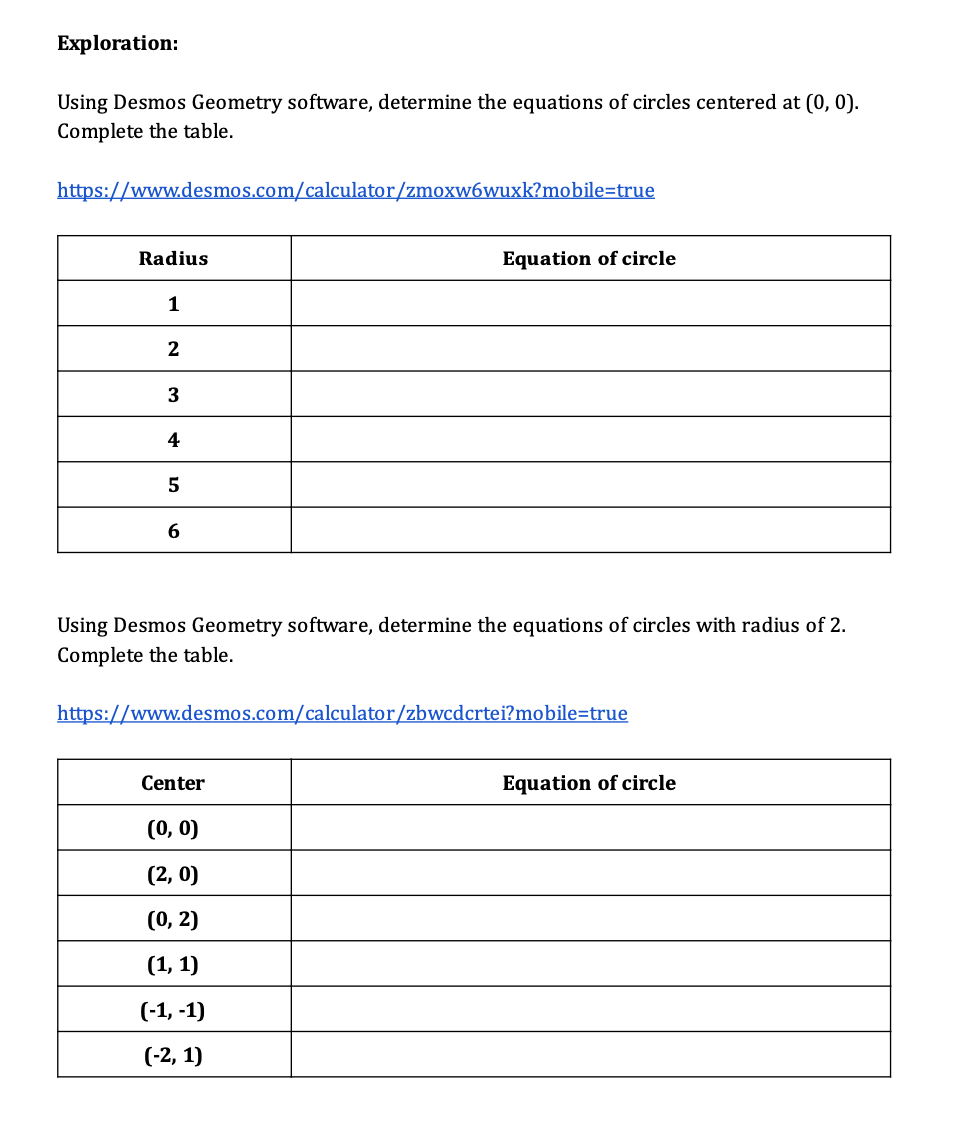
 . Instead of just using symbols to show this idea, I would create a guided explore activity where the students need to actually measure the radius and circumference of the circle they created as well at the base and height of the triangle created by deconstructing the circle they created. I would ask how the circumference and radius of the circle relate to the base and the height of the triangle. Once students recognize that the base of the triangle correlates with the circumference of the circle, and the radius correlates with the height, it will be easier to see why the area of a circle is calculated using the formula
 . The final example states “A rug is made up of a quadrant and two semicircles. Find the area of the rug. Use 3.14 for
  and round to the nearest tenth!” (Glencoe). Although this seems less practical than the pool example, it is still related to real life because finding the area of a rug will help when deciding which rug to choose for a room.
 Mean Green Math