Area of a triangle: Vertices (Part 7)

Suppose that the vertices of a triangle are (1,2), (2,5), and (3,1). What is the area of the triangle?

At first blush, this doesn’t fall under any of the categories of SSS, SAS, or ASA. And we certainly aren’t given a base b and a matching height h. The Pythagorean theorem could be used to determine the lengths of the three sides so that Heron’s formula could be used, but that would be extremely painful to do.

Fortunately, there’s another way to find the area of a triangle that directly uses the coordinates of the triangle. It turns out that the area of the triangle is equal to the absolute value of

\displaystyle \frac{1}{2} \left| \begin{array}{ccc} 1 & 2 & 1 \\ 2 & 5 & 1 \\ 3 & 1 & 1 \end{array} \right|

Notice that the first two columns contain the coordinates of the three vertices, while the third column is just padded with 1s. Calculating, we find that the area is

\left| \displaystyle \frac{1}{2} \left( 5 + 6 + 2 - 15 - 4 - 1 \right) \right| = \left| \displaystyle -\frac{7}{2} \right| = \displaystyle \frac{7}{2}

In other words, direct use of the vertices is, in this case, a lot easier than the standard SSS, SAS, or ASA formulas.

A (perhaps) surprising consequence of this formula is that the area of any triangle with integer coordinates must either be an integer or else a half-integer. We’ll see this again when we consider Pick’s theorem in tomorrow’s post.

green line

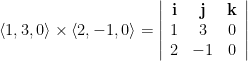
There is another way to solve this problem by considering the three vertices as points in \mathbb{R}^3. The vector from (1,2,0) to (2,5,0) is \langle 1,3,0 \rangle, while the vector from (1,2,0) to (3,1,0) is \langle 2,-1,0 \rangle. Therefore, the area of the triangle is one-half the length of the cross-product of these two vectors. Recall that the cross-product of the two vectors is

\langle 1,3,0 \rangle \times \langle 2,-1,0 \rangle = \left| \begin{array}{ccc} {\bf i} & {\bf j} & {\bf k} \\ 1 & 3 & 0 \\ 2 & -1 & 0 \end{array} \right|

\langle 1,3,0 \rangle \times \langle 2,-1,0 \rangle = -7{\bf k}

So the length of the cross-product is clearly 7, so that the area of the triangle is (again) \displaystyle \frac{7}{2}.

green line

The above technique works for any triangle in \mathbb{R}^3. For example, if we consider a triangle in three-dimensional space with corners at (1,2,3), (4,3,0), and (6,1,9), the area of the triangle may be found by “subtracting” the coordinates to find two vectors along the sides of the triangle and then finding the cross-product of those two vectors.

Furthermore, determinants may be used to find the volume of a tetrahedron in \mathbb{R}^3. Suppose that we now consider the tetrahedron with corners at (1,2,3), (4,3,0), (6,1,9), and (2,5,2). Let’s consider (1,2,3) as the “starting” point and subtract these coordinates from those of the other three points. We then get the three vectors

\langle 3,2,-3 \rangle, \langle 5,-1,6 \rangle, and \langle 1,3,-1 \rangle

One-third of the absolute value of the determinant of these three vectors will be the volume of the tetrahedron.

green line

This post has revolved around one central idea: a determinant represents an area or a volume. While this particular post has primarily concerned triangles and tetrahedra, I should also mention that determinants are similarly used (without the factors of 1/2 and 1/3) for finding the areas of parallelograms and the volumes of parallelepipeds.

This central idea is also the basis behind an important technique taught in multivariable calculus: integration in polar coordinates and in spherical coordinates.
In two dimensions, the formulas for conversion from polar to rectangular coordinates are

x = r \cos \theta and y = r \sin \theta

Therefore, using the Jacobian, the “infinitesimal area element” used for integrating is

dx dy = \left| \begin{array}{cc} \partial x/\partial r & \partial y/\partial r \\ \partial x/\partial \theta & \partial y/\partial \theta \end{array} \right| dr d\theta

dx dy = \left| \begin{array}{cc} \cos \theta & \sin \theta \\ -r \sin \theta & r \cos \theta \end{array} \right| dr d\theta

dx dy = (r \cos^2 \theta + r \sin^2 \theta) dr d\theta

dx dy = r dr d\theta

Similarly, using a 3 \times 3 determinant, the conversion dx dy dz = r^2 \sin \phi dr d\theta d\phi for spherical coordinates can be obtained.
References:

http://www.purplemath.com/modules/detprobs.htm

http://mathworld.wolfram.com/Parallelogram.html

http://en.wikipedia.org/wiki/Parallelogram#Area_formulas

http://mathworld.wolfram.com/Parallelepiped.html

http://en.wikipedia.org/wiki/Parallelopiped#Volume

Area of a triangle: Incenter (Part 6)

Incenter_750Source: http://mathworld.wolfram.com/Incircle.html

The incenter I of a triangle \triangle ABC is defined by the intersection of the angle bisectors of its three angles. A circle can be inscribed within \triangle ABC, as shown in the picture.

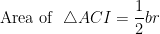
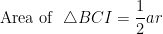
This incircle provides a different way of finding the area of \triangle ABC commonly needed for high school math contests like the AMC 10/12. Suppose that the sides a, b, and c are known and the inradius r is also known. Then \triangle ABI is a right triangle with base c and height r. So

\hbox{Area of ~} \triangle ABI = \displaystyle \frac{1}{2} cr

Similarly,

\hbox{Area of ~} \triangle ACI = \displaystyle \frac{1}{2} br

\hbox{Area of ~} \triangle BCI = \displaystyle \frac{1}{2} ar

Since the area of \triangle ABC is the sum of the areas of these three smaller triangles, we conclude that

\hbox{Area of ~} \triangle ABC = \displaystyle \frac{1}{2} r (a+b+c),

or

\hbox{Area of ~} \triangle ABC = rs,

where s = (a+b+c)/2 is the semiperimeter of \triangle ABC.

green lineThis also permits the computation of r itself. By Heron’s formula, we know that

\hbox{Area of ~} \triangle ABC = \sqrt{s(s-a)(s-b)(s-c)}

Equating these two expressions for the area of \triangle ABC, we can solve for the inradius r:

r = \displaystyle \sqrt{ \frac{(s-a)(s-b)(s-c)}{s} }

For much more about the inradius and incircle, I’ll refer to the MathWorld website.

Area of a triangle: SSS (Part 5)

triangle

In yesterday’s post, we discussed how the area K of a triangle can be found using SAS: two sides and the angle between the two sides. We found that

K = \displaystyle \frac{1}{2} a b \sin C

This can be used as the starting point for the derivation of Heron’s formula, which determines the area of a triangle using SSS (i.e., only the three sides). I won’t give the full derivation in this post — there’s no point in me retyping the details — but will refer to the Wikipedia page and the MathWorld page for the details. However, I will give the big ideas behind the derivation.

1. We begin by recalling that \sin^2 C + \cos^2 C = 1. Since 0 < C < 180^o, we know that \sin C must be positive, so that

\sin C = \sqrt{1 - \cos^2 C}

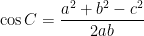
2. From the Law of Cosines, we know that

c^2 = a^2 + b^2 - 2 a b \cos C,

or

\cos C = \displaystyle \frac{a^2 + b^2 - c^2}{2ab}

3. Substituting, we see that

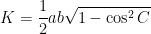
K = \displaystyle \frac{1}{2} ab \sqrt{1 - \cos^2 C}

K = \displaystyle \frac{1}{2} ab \sqrt{1 - \frac{(a^2+b^2-c^2)^2}{4a^2b^2}}

4. This last expression only contains the side lengths a, b, and c. So the “only” work that’s left is simplifying this right-hand side and seeing what happens. After considerable work — requiring factoring the difference of two squares on two different steps — we end up with Heron’s formula:

K = \sqrt{s (s-a) (s-b) (s-c)}

where s = \displaystyle \frac{a+b+c}{2} is the semiperimeter, or half the perimeter of the triangle.
A final note: If you actually are able to start with Step 3 and end with Heron’s formula on your own — without consulting a textbook or the Internet if you get stuck — feel free to cry out “More power!” and grunt like Tim “The Toolman” Taylor:

Area of a triangle: SAS, ASA, and the Law of Sines (Part 4)

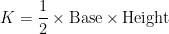
The typical way students remember the area K of a triangle is

K = \displaystyle \frac{1}{2} \times \hbox{Base} \times \hbox{Height}

However, there are other formulas for the area of a triangle which can be helpful if the height is not immediately known.

Case 1: SAS. Suppose that two sides and the angle between the sides — say, b and c and the measure of angle A — are known.

triangle

If \overline{CD} is an altitude for \triangle ABC, then \triangle ACD is a right triangle. Therefore,

\sin A = \displaystyle \frac{\hbox{opposite}}{\hbox{hypotenuse}} = \displaystyle \frac{h}{b}, or h = b \sin A.

Therefore,

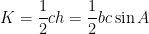
K = \displaystyle \frac{1}{2} ch = \displaystyle \frac{1}{2} bc \sin A.

Using the same picture, one can also show that

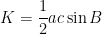
K = \displaystyle \frac{1}{2} ac \sin B

Also, with a different but similar picture, one can show that

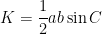
K = \displaystyle \frac{1}{2} ab \sin C

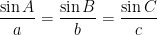
green lineAn important consequence of the SAS area formula is the Law of Sines. Since all three formulas must give the same area K, we have

\displaystyle \frac{1}{2} bc \sin A = \displaystyle \frac{1}{2} ac \sin B = \displaystyle \frac{1}{2} ab \sin C

Multiplying by \displaystyle \frac{2}{abc} produces the Law of Sines:

\displaystyle \frac{\sin A}{a} = \displaystyle \frac{\sin B}{b} = \displaystyle \frac{\sin C}{c}

green lineCase 2: ASA. Now suppose that we are given the measures of two angles and the length of the side in between them — say, angles A and B and side c. Naturally, we can also get the measure of angle C since the sum of the measures of the three angles must be 180^o.

From the SAS formula and the Law of Sines, we have

K = \displaystyle \frac{1}{2} bc \sin A \quad \hbox{and} \quad \displaystyle b = \frac{c \sin B}{\sin C}

Combining these, we find

K = \displaystyle \frac{1}{2} \frac{c \sin B}{\sin C} \cdot c \sin A

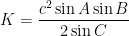
K = \displaystyle \frac{c^2 \sin A \sin B}{2 \sin C}

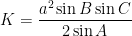
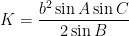
By similar reasoning, we can also find that

K = \displaystyle \frac{a^2 \sin B \sin C}{2 \sin A} ~~ and ~~ K = \displaystyle \frac{b^2 \sin A \sin C}{2 \sin B}

Area of a triangle: Equal cross-sections (Part 2)

Let’s take a second look at the familiar formula for the area of a triangle, A = \displaystyle \frac{1}{2}bh.

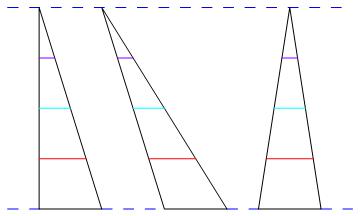
trianglecross1The picture above shows three different triangles: one right, one obtuse, and one acute. The three triangles have bases of equal length and also have the same height. Therefore, even though the triangles have different shapes (i.e., they’re not congruent), they have the same height.

Let’s take a second look at these three triangles. In each triangle, I’ve drawn in three “cross-section” line segments which are parallel to the base. Notice that corresponding cross-sections have equal length. In other words, the red line segments have the same length, the light-blue line segments have the same length, and the purple line segments have the same length.

Why is this true? There are two ways of thinking about this (for the sake of brevity, I won’t write out the details).

  • Algebraically, the length of the cross-section increases linearly as they descend from the top vertex to the bottom base. This linear increase does not depend upon the shape of the triangle. Since the three triangles have bases of equal length, the cross-sections have to have the same length.
  • Geometrically, the length of the cross-sections can be found with similar triangles, comparing the big original triangle to the smaller triangle that has a cross-section as its base. Again, the scale factor between the similar triangles depends only on the height of the smaller triangle and not on the shape of the original triangle. So the cross-sections have to have the same length.

So, since the three triangles share the same height and base length, the three triangles have the same area, and the corresponding cross-sections have the same length.

The reverse principle is also true. This is called Cavalieri’s principle. From Wikipedia:

Suppose two regions in a plane are included between two parallel lines in that plane. If every line parallel to these two lines intersects both regions in line segments of equal length, then the two regions have equal areas.

In other words, if I have any kind of shape that has cross-sections that match those of the triangles above, then the shape has the same area as the triangles. Geometrically, we can think of each triangle a bunch of line segments joined together. So while the positioning of the line segments affects the shape of the region, the positioning does not affect the area of the region.

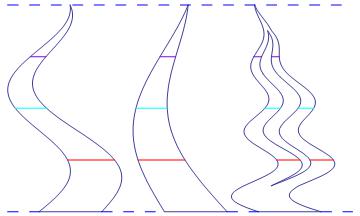
For example, here are three non-triangular regions whose cross-sections match those of the above triangles. The region on the right is especially complex since it has a curvy hole in the middle, so that the cross-sections shown are actually two distinct line segments. Nevertheless, we can say with confidence that, by Cavalieri’s principle, the area of each region matches those of the triangles above.

trianglecross2

Though we wouldn’t expect geometry students to make this connection, Cavalieri’s principle may be viewed as a geometric version of integral calculus. In calculus, we teach that the area between the curves x = f(y) and x = F(y) is equal to

A = \displaystyle \int_{y_1}^{y_2} [F(y) - f(y)] \, dy = \displaystyle \int_{y_1}^{y_2} d(y) \, dy

where $d(y) = F(y) – f(y)$ is the difference in the two curves. In the above formula, I chose integration with respect to y since the $y-$coordinates are constant in the above cross-sections. The difference d(y) is precisely the length of the cross-sections. As with the triangles, the positioning of the cross-sections will affect the shape of the region, but the positioning of the cross-sections does not affect the length d(y) and hence does not affect the area A of the region.

Area of a triangle: Base and height (Part 1)

This begins a series of post concerning how the area of a triangle can be computed. This post concerns the formula that students most often remember:

A = \displaystyle \frac{1}{2} b h

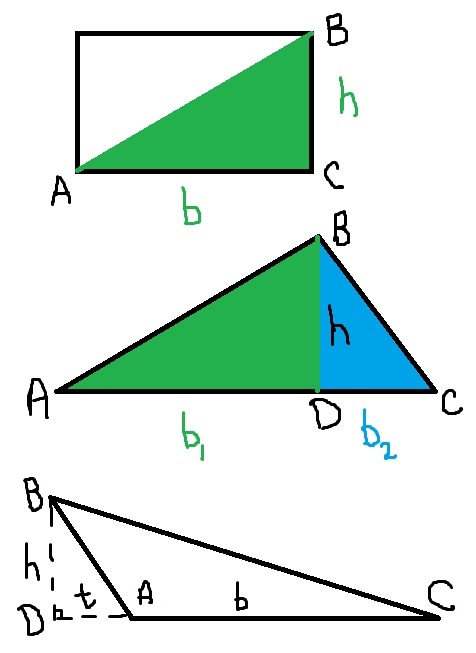
Why is this formula true? Consider \triangle ABC, and form the altitude from B to line AB. Suppose that the length of AC is b and that the altitude has length h. Then one of three things could happen:

triangles

Case 1. The altitude intersects AC at either A or C. Then \triangle ABC is a right triangle, which is half of a rectangle. Since the area of a rectangle is bh, the area of the triangle must be \displaystyle \frac{1}{2} bh.

Knowing the area of a right triangle will be important for Cases 2 and 3, as we will act like a good MIT freshman and use this previous work.

Case 2. The altitude intersects AC at a point D between A and C. Then \triangle ABD and \triangle BCD are right triangles, and so

\hbox{Area of~} \triangle ABC = \hbox{Area of ~} \triangle ABD + \hbox{~Area of~} \triangle BCD

\hbox{Area of~} \triangle ABC = \displaystyle \frac{1}{2} b_1 h + \frac{1}{2} b_2 h

\hbox{Area of~} \triangle ABC = \displaystyle \frac{1}{2} (b_1 + b_2) h

\hbox{Area of~} \triangle ABC = \displaystyle \frac{1}{2} bh

Case 3. The altitude intersects AC at a point D that is not in between A and C. Without loss of generality, suppose that A is between D and C. Then \triangle ABD and \triangle BCD are right triangles, and so

\hbox{Area of~} \triangle ABC = \hbox{Area of ~} \triangle BCD - \hbox{~Area of~} \triangle ACD

\hbox{Area of~} \triangle ABC = \displaystyle \frac{1}{2} (b+t) h + \frac{1}{2} t h

\hbox{Area of~} \triangle ABC = \displaystyle \frac{1}{2} (b+t-t) h

\hbox{Area of~} \triangle ABC = \displaystyle \frac{1}{2} bh

Engaging students: Finding the area of a square or rectangle

In my capstone class for future secondary math teachers, I ask my students to come up with ideas for engaging their students with different topics in the secondary mathematics curriculum. In other words, the point of the assignment was not to devise a full-blown lesson plan on this topic. Instead, I asked my students to think about three different ways of getting their students interested in the topic in the first place.

I plan to share some of the best of these ideas on this blog (after asking my students’ permission, of course).

This student submission comes from my former student Alyssa Dalling. Her topic, from Geometry: finding the area of a square or rectangle.

green line

D. How have different cultures throughout time used this topic in their society?

Giza

  • For three thousand years, the Great Pyramid of Giza was the world’s tallest man-made structure. It is also the oldest structure of the Seven Wonders of the Ancient World. It was built by cutting huge stones into rectangles then placing each stone into place to create the base. It is believed by many that the pharaoh Khufu had his vizier Hemon create the design for the great Pyramids. What is amazing about the design of the Pyramid of Giza is that each of the four sides of the base has an average error of only 58 millimeters in length. Meaning the base is almost a perfect square!
  • It would be fun to start the engage with introducing the Pyramid of Giza and explaining the facts above. Then students would be given the dimensions of other pyramids where they would have to find the area of the base to see whether they created a square or rectangular pyramid. This would get them excited about this topic because students would be exploring math that has actually been used in real life.

Castillo

  • The Mesoamericans also built pyramids with square and rectangular bases. The picture above is in a city known as Chechen Itza which is located in the Mexican state of Yucatan. It is called El Castillo, and also known as the Temple of Kukulkan. Unlike the Egyptian pyramids though, the Mayan pyramids were usually meant as steps to get to a temple on top. The pyramids consisted of several square bases stacked onto each other with steps up each side. El Castillo consists of nine square terraces each about 8.4 feet tall. The main base of the pyramid is approximately 55.3 meters (181 feet).
  • What would be fun to do is have students find the area of each level and compare it to all the levels on the pyramid. I feel students would have fun seeing just how big this type of structure is and understanding the planning it took to create the different levels in this pyramid.

Sources: http://en.wikipedia.org/wiki/Great_Pyramid_of_Giza and http://en.wikipedia.org/wiki/Pyramids#Nigeria

green line

B. How can this topic be used in your students’ future courses in mathematics or science?

  • Finding the area of squares and rectangles will be used a lot in Algebra and Algebra II. One example in Algebra is when students start solving for unknown variables. A student would be asked to find the area of a square when they have two unknown sides.
  • The following is an example engage problem students would use the finding the area of a square or rectangle to solve.

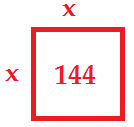
Principal Smith has decided the school needs a new practice basketball court. The current practice court is a square with an area of 144 square feet. She wants the new court to be a rectangle twice as long as it is wide. Find the length of all the sides of both the old court and the new court and find the area of the new court.

rect1rect2

x^2 = 144

So x = 12

Then x(2x) = 2x^2 = 2(12)^2 = 288

The square court has sides of 12.

The rectangular court has sides of 12×24 and an area of 288 square feet.