Engaging students: Finding the area of a square or rectangle

In my capstone class for future secondary math teachers, I ask my students to come up with ideas for engaging their students with different topics in the secondary mathematics curriculum. In other words, the point of the assignment was not to devise a full-blown lesson plan on this topic. Instead, I asked my students to think about three different ways of getting their students interested in the topic in the first place.

I plan to share some of the best of these ideas on this blog (after asking my students’ permission, of course).

This student submission again comes from my former student Juan Guerra. His topic, from Geometry: finding the area of a square or rectangle.

green line

E1.       How can technology (YouTube, Khan Academy [khanacademy.org], Vi Hart, Geometers Sketchpad, graphing calculators, etc.) be used to effectively engage students with this topic?

The website below contains an activity that relates both perimeter and area. In particular, the activity stimulates the student’s mind by making them think of a way to get the amount of fencing that they would need in order to build the stable for animals. After the character in the game learns about perimeter, he is made to think about the area that would be created from the stable. Then the activity mentions the different possibilities of getting the same perimeter but at the same time, the area of each different possibility is also analyzed. The activity makes students realize that even though all stables have the same perimeter, the area was different most of the time. The activity also has the students practice taking measurements and finding the perimeter and area of rectangles. This activity targets multiple objectives and skills because students learn about perimeter, area, and go over measuring the sides with a virtual ruler. This website contains more interactive games that target multiple skills, which will be helpful to the teachers when planning a lesson. Aside from having interactive games, the website also contains videos on tutorials for some basic computations or definitions of terms in math.

http://www.mathplayground.com/area_perimeter.html

green line

F3.   How did people’s conception of this topic change over time?

Ancient civilizations have known how to compute the area of basic figures including the square and the rectangle. These civilizations include the Egyptians, Babylonians, and Hindus. The Babylonians actually had a different formula for the area of a square or rectangle. The formula we know today is a*b, where a and b are the lengths of the figure. The Babylonian formula for multiplying two numbers, which was essentially the same as finding the area was [(a + b)2 – (ab)2]/4. Looking at the formula, it is clear that they had a different perception of what it was to find the product of two numbers and also the area of a square or rectangle. It turns out that the Babylonians were the only ones who used a different formula for the area of a rectangle or square, which means that they saw area differently than the other two civilizations. Another person that represented area was Euclid. In his book named Euclid’s Elements, he showed how multiplying two numbers would look geometrically, which was by taking a segment with length a and another segment with length b and putting them together so that they form a right angle at the ends and completing the rectangle by adding the other two missing sides. This method was used for visualizing the multiplication of numbers but it was also the representation of what area looked like geometrically although Euclid did not mention in his book that this was called area.

http://en.wikipedia.org/wiki/Egyptian_geometry

http://www-history.mcs.st-and.ac.uk/HistTopics/Babylonian_mathematics.html

green line

B1.   How can this topic be used in your students’ future courses in mathematics or science?

In the future, students will need to know the concept of area in general in order to solve other types of problems in courses like calculus. To illustrate a better example, suppose you have the equation y = x. What if you wanted a student to find the area of the triangle formed on the interval from 0 to 5? It would seem obvious that when the student graphs it and creates the triangle from that interval, he or she would use the formula for the area of a triangle once they are able to find the base and the height of the triangle. Another example where they would have to find the area of a rectangle would be when they have an equation like y = 5. Let’s say that you wanted to find the area of the rectangle formed from 0 to 4. The student would naturally use the formula that has been known to them for a long time and plug in the numbers. So what if we asked them to find the area of the function y = x^2 from 0 to 10? Would the student be able to use the formulas for area that he or she knows? This is where the concept of integration can be introduced to the student. The student might develop the curiosity of wanting to find out how it would be possible to find the area under a curve since the formulas for area that he or she has known all along do not apply. This is only one example where area can be seen in future courses but it seems like an activity like this would naturally lead into integration in a calculus class.


Engaging students: Area of a triangle

In my capstone class for future secondary math teachers, I ask my students to come up with ideas for engaging their students with different topics in the secondary mathematics curriculum. In other words, the point of the assignment was not to devise a full-blown lesson plan on this topic. Instead, I asked my students to think about three different ways of getting their students interested in the topic in the first place.

I plan to share some of the best of these ideas on this blog (after asking my students’ permission, of course).

This student submission again comes from my former student Erick Cordero. His topic, from Geometry: finding the area of a triangle.

green line

B1. How can this topic be used in your students’ future courses in mathematics or science?

Students in high school usually take geometry during the first or second year, and after that they might not see it again until college. Three years might be the wait until a student sees geometry again, nevertheless, geometry does come back in the form of trigonometry. Trigonometry is a class taken right before pre-calculus and it is here where students truly see geometry again. The importance of the triangle in geometry is enormous and in fact, there would not be any trigonometry if it were not because of triangles. Students learn in this class different ways of getting the area of a triangle because they are no longer given the height and the length of the base, now students are given angles or other information and they have to somehow find the area. The topic of area is also used throughout college in math classes, although we are not always finding the area of a triangle, we are nonetheless finding the area of something. To make everything even better, those students who decide to become teachers have to take a course called foundations of geometry. Now it is here were the student really understands the triangles and the axiomatic method of doing proofs.

green line

D1. What interesting things can you say about the people who contributed to the discovery and/or the development of this topic?

http://www.britannica.com/EBchecked/topic/194880/Euclid

http://aleph0.clarku.edu/~djoyce/java/elements/toc.html

In ancient Greece, mathematicians did not deal with the concept of area as we do today. In fact, numbers were not used in geometry and mathematicians had other creative ways of expressing algebraic expression. The great mathematician, Euclid, whom was born in 300 BC, would be the person who would unify all the geometry that was around at the time. Euclid’s greatest contributions and perhaps the most famous book in the history of mathematics, The Elements, is a book that for hundreds of years was the standard way of doing geometry. Euclid’s approach is what is referred to as axiomatic geometry in which one proves geometric expression on the basis on a few assumptions that are assumed to be obvious. In many of his proofs, Euclid compares different triangles in order to learn more about the situation or scenario he is trying to prove. Euclid has a nice way of defining the area of a triangle. He first proves that one can construct a parallelogram and then he proves that two triangles fit into this parallelogram, and thus the area of a triangle is half a parallelogram.

Thus, Euclid defines the area of a triangle in terms of parallelograms. He proves this by using the basic properties of a parallelogram, such as the fact the opposite angles and sides are congruent, to prove that in fact two congruent triangles can fit into a parallelogram.

green line

E. How can technology be used to effectively engage students with this topic?

http://aleph0.clarku.edu/~djoyce/java/elements/toc.html

The website above is a great website for high school students to look at, but because of the language (sounds ancient) I would prefer to go and explore this website with the students. This website contains Euclid’s elements and although the students would not be expect to know how to do all the proofs, I would expect them to know how to prove the formula for the area of a triangle using Euclidian methods. I think the history that this website contains is amazing and it also has diagrams of the way Euclid did his proofs and students like pictures, especially with math, so this would be good. The wording on the website could cause students some problems but for the immense knowledge they can learn from visiting this website, I believe its worth it. Students will get introduce to this beautiful way of proving geometric theorems, methods that were developed hundreds of years ago and are still being used in universities today. I believe this is something incredibly amazing and every student in geometry should at least be familiar with this method of proving things. I believe students will enjoy this way of doing proofs because it is new (it is new to them) and it is not so rigid and mechanical as algebra might have seemed to them. Also, I believe it is only right that they get to know, from reading some of the proofs, who this great mathematician that we know as Euclid was and the immense influence he had in the history of mathematics.

Engaging students: Finding the area of a right triangle

In my capstone class for future secondary math teachers, I ask my students to come up with ideas for engaging their students with different topics in the secondary mathematics curriculum. In other words, the point of the assignment was not to devise a full-blown lesson plan on this topic. Instead, I asked my students to think about three different ways of getting their students interested in the topic in the first place.

I plan to share some of the best of these ideas on this blog (after asking my students’ permission, of course).

This student submission again comes from my former student Andrew Wignall. His topic, from Geometry: finding the area of a right triangle.

green lineWhat interesting (i.e., uncontrived) word problems using this topic can your students do now? (You may find resources such as http://www.spacemath.nasa.gov to be very helpful in this regard; feel free to suggest others.)

To introduce the topic of the area of a right triangle early in a lesson, we can first examine the area of a rectangle, which students should already know how to do.

Say you have a large rectangular garden, 60 feet wide and 10 feet long. Home Depot sells sod (which is a pre-grown grass on a net that can be spread on the ground) at a rate of $3/square foot. What is the area of the garden, in square feet? How much sod should you order? How much would it cost to cover the entire garden with sod?

Instead of having the entire garden covered with sod, suppose you wanted to cover part of the garden with sod and leave the rest as soil for planting flowers. To make it more visually interesting, you decide to set the sod as a triangle? The sod triangle will have a base of 60 feet and a height of 10 feet. What is the area of this triangle in relation to the area of the entire garden? What is the area of this triangle? How much sod should you order? How much would it cost to cover the triangular area with sod?

Through this activity, we can investigate a relationship between right triangles and rectangles, and also the relation of the area of a triangle compared to the angle of a rectangle.

green line

How can technology (YouTube, Khan Academy [khanacademy.org], Vi Hart, Geometers Sketchpad, graphing calculators, etc.) be used to effectively engage students with this topic? Note: It’s not enough to say “such-and-such is a great website”; you need to explain in some detail why it’s a great website

One tool to show the area of a right triangle quickly and easily is the Area Tool on Illuminations (http://illuminations.nctm.org/Activity.aspx?id=3567). With trapezoids, parallelograms, and triangles available, you can click and drag the three vertices of a triangle and instantly see how the area is affected. You can create a quick table and keep a running tally of the base, height, and area, so you can recalculate in front of the class.

Illuminations has a sample lesson plan available online for discovering the area of triangles, and integrates this tool into the plan. If not using this tool as part of a similar plan, we must understand that this tool will not be great for introducing the lesson, as there is no button to lock onto a right triangle. However, there is a button to lock the height, so when you move the vertex opposite the base, you can see how the area does not change, see how the height can be outside the triangle, and extend the formula for the area of a right triangle to the area of any triangle. This tool can then be used in further lessons when discussing the area of parallelograms and trapezoids.


green lineHow can this topic be used in your students’ future courses in mathematics or science?

Since triangles are one of the most basic shapes, the area of triangles comes up time and time again. Triangles will also be used to find the area of more complex polygons, such as hexagons and irregular polygons, by breaking down complex shapes into simple triangles and quadrelaterals. Trigonometry uses right (and non-right) triangles extensively; in Precalculus, we will revisit the area of triangles, and learn how to find the area of triangles without explicitly being given the base and height.

Outside the classroom, the area of a triangle is used extensively in architecture, as triangles are strong, and triangular trusses and frames are used in many steel structures. As the inside empty area of the triangle increases, then the stress on the triangle increases, and architects must take this into consideration.

Triangles are also used in 3d computer graphics, as the 3d shapes they design actually consist of lots of little triangles, and they have to fit textures of a certain size (say 512 pixels x 512 pixels) onto a few triangles, so it is important that they know how and where for these textures to lie.


References

Math is Fun, “Activity: Garden Area”. http://www.mathsisfun.com/activity/garden-area.html

Illuminations: Resources for Teaching Math, “Discovering the Area Formula for Triangles”. http://illuminations.nctm.org/Lesson.aspx?id=1874

Illuminations: Resources for Teaching Math, “Area Tool”. http://illuminations.nctm.org/Activity.aspx?id=3567

Home Depot, http://www.homedepot.com/p/StarPro-Greens-Centipede-Southwest-Synthetic-Lawn-Grass-Turf-Sold-by-15-ft-W-rolls-x-Your-L-2-97-Sq-Ft-Equivalent-RGB7/202025213

Math is Fun, “Heron’s Formula”. http://www.mathsisfun.com/geometry/herons-formula.html

Maths in the City, “Most stable shape – triangle”. http://www.mathsinthecity.com/sites/most-stable-shape-triangle

Andre LaMothe, “Texture Mapping Mania”. http://archive.gamedev.net/archive/reference/articles/article852.html


Engaging students: The area of a circle

In my capstone class for future secondary math teachers, I ask my students to come up with ideas for engaging their students with different topics in the secondary mathematics curriculum. In other words, the point of the assignment was not to devise a full-blown lesson plan on this topic. Instead, I asked my students to think about three different ways of getting their students interested in the topic in the first place.

I plan to share some of the best of these ideas on this blog (after asking my students’ permission, of course).

This student submission comes from my former student Dale Montgomery. His topic, from Geometry: the area of a circle.

green line

History

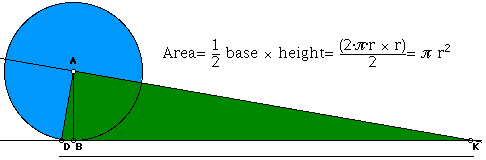
Archimedes was the mathematician who we attribute with finding the area of a circle to be  Where r is the radius and π is the ratio of circumference to diameter of a circle. (Note that Archimedes was not the first to find the area of a circle, but was the first to find π). I would really like to start the class with something along the lines of introducing Archimedes supposed final words “Do not disturb my circles.” And then go into the death of Archimedes and the mystery surrounding his tomb, such as the account of Cicero and the fact that no one knows where the tomb is now. Cicero said that his tomb had a sphere inscribed in a cylinder, which Archimedes considered to be his greatest mathematical proof. From there, the class should have great interest in what is going on. And we can talk about the fact that the area of a circle is the same as the area a triangle with the same base as the circumference and the same height as the radius. ArchimedesCircle

Rorres, Chris. “Tomb of Archimedes – Illustrations”. Courant Institute of Mathematical Sciences. Retrieved 2011-03-15.

green line

Culture

http://newsfeed.time.com/2013/02/02/are-crop-circles-more-than-just-modern-pranks/

I would show this article in class, most likely passing it out to read. I would ask if they thought it was a prank, and then give them a similar picture as presented in the article but mapped out with radiuses. Then I would say that the average person could do so many square feet of crop’s per hour. If it gets dark at 9 pm and the sun comes up at 6 am, could a person pull a prank like this?

After we discussed how to find the area of a circle I would have found one that it was impossible for one person to do. Then I would display this youtube video.

Seeing that there were 2 people working on it could display that it is possible for it to be a hoax. I like this because it gives the students a way to analyze information that they are given. Does it make sense for these things to be aliens? Not really, so let’s find other explanations. It both introduces the concept and teaches some critical thinking skills.

green lineApplications

You could apply the area of a circle to the diameter of a pizza. When you order pizza you order things like an 8 or a 12 inch. These are diameters and do not give the best idea of how much pizza you are actually getting. You can even include this lesson with a pizza party or something similar. This would easily get kids excited since it is something that most kids like, and they would have the possibility of getting pizza afterwards.

pizza

Engaging students: Finding the area of a square or rectangle

In my capstone class for future secondary math teachers, I ask my students to come up with ideas for engaging their students with different topics in the secondary mathematics curriculum. In other words, the point of the assignment was not to devise a full-blown lesson plan on this topic. Instead, I asked my students to think about three different ways of getting their students interested in the topic in the first place.

I plan to share some of the best of these ideas on this blog (after asking my students’ permission, of course).

This student submission comes from my former student Kayla (Koenig) Lambert. Her topic, from Geometry: finding the area of a square or rectangle.

green line

B) Curriculum: How can this topic be used in student’s future courses in math or science?

 Finding the area of a square or rectangle can be applied in many other subjects throughout a student’s school career. This topic is learned around 4th or 5th grade, and around this time students will just be using the formulas to find the areas. In middle school, they might be finding the areas by way of more difficult problems, like word problems. The real fun for this subject, in my opinion, doesn’t start until high school. In high school you can use the area of squares and rectangles to find the solutions to many problems. In high school geometry, the Pythagorean Theorem is taught. The area of squares is related to this depending on how the teacher presents this to the student. The Pythagorean Theorem states that “in any right triangle, the area of the square whose side is the hypotenuse is equal to the sum of the areas of the squares whose sides are the two legs of the right triangle” (Square-geometry).

In college, possibly high school calculus, students will learn to approximate the total area under a curve (or integral) using the Riemann Sum. To approximate the integral, you find the area of each rectangle, and all of the rectangles areas added together give you the approximated integral. The area of rectangles is also used in Statistics. When creating a histogram, you multiply the height (density) and width of the bars (rectangles).  Then adding the areas (relative frequencies) of all of the bars should be equal to one. Students will also need to use the area of squares and rectangles on college placement exams and standardized testing.


green line

C) Culture: How has this topic appeared in high culture (art, classical music, theatre, etc.)?

 In my opinion, anything and everything is a form of art, so the area of squares and rectangles can appear in an infinite amount of high culture. M.C. Escher has used squares and rectangles to create tessellations and “portrayed mathematical relationships among shapes, figures and space” (MC Escher). The area of a rectangle was used to Polykeitos the Elder who was a Greek sculptor. He used the area of a rectangle to create the perfect ratio for the human body. Painters also needed to figure out how to depict 3D scenes onto 2D canvas during the Renaissance (Mathematics and Art).

However, one of the more well-known applications of mathematics in art is the Golden Rectangle, which just so happens to involve the area of squares and rectangles. The Golden Rectangle is the area of the original rectangle to the area of the square, which is also the Golden Ratio. In other words, the Golden Rectangle is a rectangle wherein the ratio of its length to its width is the Golden Ratio (Golden Rectangle). Many ancient art and architecture have incorporated the Golden Rectangle into designs. The Golden Rectangle was used in the floor plans and design of the exterior of The Parthenon, which was a Greek temple dedicated to goddess Athena in 5th century BC (Mathematics and Art). Leonardo DaVinci also used the Golden Rectangle in his work. When painting the Mona Lisa, he used this to “draw attention to the face of the woman in the portrait” (Mathematics and Art). DaVinci also used the Golden Rectangle in the Last Supper using it to create a “perfect harmonic balance between placement of characters in the background” and also used it to arrange the characters around the table (Mathematics and Art).


green line

D) History: Who were some of the people who contributed to the development of this topic?

 Finding the area of squares and rectangles didn’t just come out of the blue; we can thank geometry and ancient mathematics for the development of this topic. One person in particular who contributed to the development of this topic was Euclid, or Euclid of Alexandria, who was a Greek mathematician and known as the “Father of Geometry” (Euclid). He was said to revolutionize geometry and his book The Elements is considered the most influential textbook of all time (History of Mathematics). The collection of his books, all thirteen of them, contain all traditional school geometry (Solomon).

However, Euler wasn’t the only one to contribute to this topic. Pythagoras and his students discovered most of what high school students learn in geometry today (History of Mathematics). In the classical period, Aryabhata wrote a treatise including the computation of areas. From the kingdom of Cao Wei, Liu Hui edited and commented on The Nine Chapters of Mathematics Art in 179 AD (History of Mathematics). There are so many people who contributed to this topic, and people are still contributing and developing to the area of squares and rectangles today!


Works Cited

“Euclid – Wikipedia, the free encyclopedia.” Wikipedia, the free encyclopedia.  20 Feb. 2012. http://en.wikipedia.org/wiki/Euclid.

“Golden Rectangle.” Logicville : Puzzles and Brainteasers.  20 Feb. 2012. http://www.logicville.com/sel26.htm.

“M. C. Escher – Wikipedia, the free encyclopedia.” Wikipedia, the free encyclopedia. 20 Feb. 2012. http://en.wikipedia.org/wiki/M._C._Escher.

“Mathematics and art – Wikipedia, the free encyclopedia.” Wikipedia, the free encyclopedia.  20 Feb. 2012. http://www.en.wikipedia.org/wiki/Mathematics_and_art.

Solomon, Robert. The Little Book Of Mathematical Principals, Theories and Things. New York: Metro Books, 2008.

“Square (geometry) – Wikipedia, the free encyclopedia.” Wikipedia, the free encyclopedia. 20 Feb. 2012. http://en.wikipedia.org/wiki/Square_(geometry).

“History of mathematics – Wikipedia, the free encyclopedia.” Wikipedia, the free encyclopedia. 20 Feb. 2012. http://en.wikipedia.org/wiki/History_of_mathematics.


Area of a circle (Part 4)

Math majors are completely comfortable with the formula A = \pi r^2 for the area of a circle. However, they often tell me that they don’t remember a proof or justification for why this formula is true. And they certainly don’t remember a justification that would be appropriate for showing geometry students.

In this series of posts, I’ll discuss several ways that the area of a circle can be found using calculus. I’ll also discuss a straightforward classroom activity by which students can discover for themselves why A = \pi r^2.green line

In the previous three posts, I discussed various ways that calculus can be used to show that A = \pi r^2. Still, most future high school teachers would like to know a justification for why A = \pi r^2. After all, the definition of \pi is

\pi = \displaystyle \frac{ \hbox{Circumference} }{ \hbox{ Diameter}}, or C = 2\pi r

So there ought to be a reasonable explanation for why \pi reappears in the formula for the area of a circle. Furthermore, this explanation should within the grasp of geometry students — so that the explanation should not explicitly use calculus. Even better, they’d prefer a hands-on classroom activity so that students could discover the formula for themselves.

The video below shows a completely geometric justification for why A = \pi r^2 that meets the above criteria. I have a couple of small quibbles with the narrated text — I’d prefer to say that the each rearrangement of pieces is approximately a parallelogram (as opposed to a rectangle), and that figures get closer and closer to a real parallelogram with area A = \pi r^2.

In other words, I would avoid saying that we ultimately divide the circle into infinitely many wedges of infinitesimal width to get a perfect rectangle, as this promotes a misconception concerning the definition of a limit that they shouldn’t carry into a future calculus course.

However, the graphics are excellent in this video. In my mind, that more than counterbalances the preferred way that I would describe the process of taking a limit to students.

Pedagogically, I would recommend a hands-on activity along these lines. Let the students use a protractor to draw a 5- or 6-inch circle on a piece of paper. Then have them mark 18 points on the circumference of the circle at every 20^o, and then draw the lines connecting these points and the center of the circle. Then have the students cut out these wedges and physically rearrange them as in the video. They should discover for themselves that the wedges approximately form a parallelogram, and they know how to find the area of a parallelogram.

After they do this activity, then I would show the above video to geometry students.

If anyone knows a video that (1) is as visually appealing as the one above and (2) correctly states the principle of limit for geometry students, please let me know.

Area of a circle (Part 3)

Math majors are completely comfortable with the formula A = \pi r^2 for the area of a circle. However, they often tell me that they don’t remember a proof or justification for why this formula is true. And they certainly don’t remember a justification that would be appropriate for showing geometry students.

In this series of posts, I’ll discuss several ways that the area of a circle can be found using calculus. I’ll also discuss a straightforward classroom activity by which students can discover for themselves why A = \pi r^2.green lineIf R denotes a circular region with radius a centered at the origin, then

A = \displaystyle \iint_R 1 \, dx \, dy

This double integral may be computed by converting to polar coordinates. The distance from the origin varies from r=0 to r=a, while the angle varies from \theta = 0 to \theta = 2\pi. Using the conversion dx \, dy = r \, dr \, d\theta, we see that

A = \displaystyle \int_0^{2 \pi} \int_0^a r \, dr \, d \theta

A = \displaystyle \int_0^{2\pi} \left[ \frac{r^2}{2} \right]_0^a \, d\theta

A = \displaystyle \int_0^{2\pi} \frac{a^2}{2} \, d\theta

A = \displaystyle 2 \pi \cdot \frac{a^2}{2}

A = \displaystyle \pi a^2

We note that the above proof uses the fact that calculus with trigonometric functions must be done with radians and not degrees. In other words, we had to change the range of integration to [0,2\pi] and not [0^o, 360^o].

Area of a circle (Part 1)

Math majors are completely comfortable with the formula A = \pi r^2 for the area of a circle. However, they often tell me that they don’t remember a proof or justification for why this formula is true. And they certainly don’t remember a justification that would be appropriate for showing geometry students.

In this series of posts, I’ll discuss several ways that the area of a circle can be found using calculus. I’ll also discuss a straightforward classroom activity by which students can discover for themselves why A = \pi r^2.green lineIn the first few weeks after a calculus class, after students are introduced to the concept of limits, the derivative is introduced for the first time… often as the slope of a tangent line to the curve. Here it is: if $y = f(x)$, then

\displaystyle \frac{dy}{dx} = y' = f'(x) = \lim_{h \to 0} \displaystyle \frac{f(x+h) - f(x)}{h}

From this definition, the first few rules of differentiation are derived in approximately the following order:

1. If f(x) = c, a constant, then \displaystyle \frac{d}{dx} (c) = 0.

2. If f(x) and g(x) are both differentiable, then (f+g)'(x) = f'(x) + g'(x).

3. If f(x) is differentiable and c is a constant, then (cf)'(x) = c f'(x).

4. If f(x) = x^n, where n is a nonnegative integer, then f'(x) = n x^{n-1}. This may be proved by at least two different techniques:

  • The binomial expansion (x+h)^n = x^n + n x^{n-1} h + \displaystyle {n \choose 2} x^{n-2} h^2 + \dots + h^n
  • The Product Rule (derived later) and mathematical induction

5. If f(x) = a_n x^n + a_{n-1} x^{n-1} + \dots + a_1 x + a_0 is a polynomial, then f'(x) = n a_n x^{n-1} + (n-1) a_{n-1} x^{n-2} + a_1. In other words, taking the derivative of a polynomial is easy.

After doing a few examples to help these concepts sink in, I’ll show the following two examples with about 3-4 minutes left in class.

Example 1. Let A(r) = \pi r^2. Notice I’ve changed the variable from x to r, but that’s OK. Does this remind you of anything? (Students answer: the area of a circle.) What’s the derivative? Remember, \pi is just a constant. So A'(r) = \pi \cdot 2r = 2\pi r. Does this remind you of anything? (Students answer: Whoa… the circumference of a circle.)

Example 2. Now let’s try V(r) = \displaystyle \frac{4}{3} \pi r^3. Does this remind you of anything? (Students answer: the volume of a sphere.) What’s the derivative? Again, \displaystyle \frac{4}{3} \pi is just a constant. So V'(r) = \displaystyle \frac{4}{3} \pi \cdot 3r^2 = 4\pi r^2. Does this remind you of anything? (Students answer: Whoa… the surface area of a sphere.)


Hmmm. That’s interesting. The derivative of the area of a circle is the circumference of the circle, and the derivative of the area of a sphere is the surface area of the sphere. I wonder why this works. Any ideas? (Students: stunned silence.)

This is what’s known on television as a cliff-hanger, and I’ll give you the answer at the start of class tomorrow. (Students groan, as they really want to know the answer immediately.)

In the spirit of a cliff-hanger, I offer the following thought bubble before presenting the answer.

green_speech_bubble

By definition, if A(r) = \pi r^2, then

A'(r) = \displaystyle \lim_{h \to 0} \frac{ A(r+h) - A(r) }{h} = 2\pi r

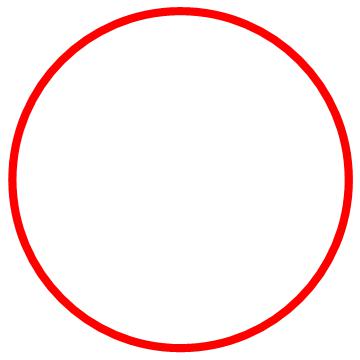
The numerator may be viewed as the area of the ring between concentric circles with radii r and r+h. In other words, imagine starting with a solid red disk of radius r +h and then removing a solid white disk of radius r. The picture would look something like this:
ring

Notice that the ring has a thickness of r+h -r = h. If this ring were to be “unpeeled” and flattened, it would approximately resemble a rectangle. The height of the rectangle would be h, while the length of the rectangle would be the circumference of the circle. So

A(r + h) - A(r) \approx 2 \pi r h

and we can conclude that

A'(r) = \displaystyle \lim_{h \to 0} \frac{ 2 \pi r h}{h} = 2\pi r

By the same reasoning, the derivative of the volume of a sphere ought to be the surface area of the sphere.

Pedagogically, I find that the above discussion helps reinforce the definition of a derivative at a time when students are most willing to forget about the formal definition in favor of the various rules of differentiation.

green line

In the above work, we started with the formula for the area of the circle and then confirmed that its derivative matched the expected result. However, the above logic can be used to derive the formula for the area of a circle from the formula $C(r) = 2\pi r$ for the circumference. We begin with the observation that A'(r) = C(r), as above. Therefore, by the Fundamental Theorem of Calculus,

A(r) - A(0) = \displaystyle \int_0^r C(t) \, dt

A(r) - A(0) = \displaystyle \int_0^r 2\pi t \, dt

A(r) - A(0) = \displaystyle \left[ \pi t^2 \right]_0^r

A(r) - A(0) = \pi r^2

Since the area of a circle with radius 0 is 0, we conclude that A(r) = \pi r^2.

Pedagogically, I don’t particularly recommend this approach, as I think students would find this explanation more confusing than the first approach. However, I can see that this could be useful for reinforcing the statement of the Fundamental Theorem of Calculus.

green line

By the way, the above reasoning works for a square or cube also, but with a little twist. For a square of side length s, the area is A(s) = s^2 and the perimeter is P(s) = 4s, which isn’t the derivative of A(s). The reason this didn’t work is because the side length s of a square corresponds to the diameter of a circle, not the radius of a circle.

But, if we let x denote half the side length of a square, then the above logic works out since

A(x) = s^2 = (2x)^2 = 4x^2

and

P(x) = 4s = 4(2x) = 8x

Written in terms of the half-sidelength x, we see that A'(x) = P(x).

Engaging students: Volume and surface area of pyramids and cones

In my capstone class for future secondary math teachers, I ask my students to come up with ideas for engaging their students with different topics in the secondary mathematics curriculum. In other words, the point of the assignment was not to devise a full-blown lesson plan on this topic. Instead, I asked my students to think about three different ways of getting their students interested in the topic in the first place.

I plan to share some of the best of these ideas on this blog (after asking my students’ permission, of course).

This student submission comes from my former student Angel Pacheco. His topic, from Geometry: finding the volume and surface area of pyramids and cones.

green line

How has this topic appeared in high culture (art, classical music, theatre, etc.)?

Giza

Show an example of the pyramid of Giza, give them dimensions of the pyramid as well as the dimensions of the blocks that were used to build it and have the students guess how many blocks it took to build it. The students can use this as a competitive edge to want to get the correct answer. Students will have to solve for the surface area of the pyramid and the area of the face of the block. There can also be an example where I will tell the students if the pyramid was fill of blocks and they’re given the dimensions of the pyramid and block. They then find the volume of both to determine how many blocks can fill in the pyramid.

Greek_ampitheater

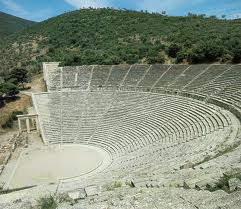
I will then show an image of a Greek amphitheater and explain how it resembles a cone. I will give them dimensions of a Greek amphitheater and have them find the surface area and the volume of cone if the amphitheater was folded into a cylinder.


green line

How can this topic be used in your students’ future courses in mathematics or science?

Students will be reintroduce to the volume of a cone in multivariable calculus when they learn about triple integrals and the different forms of integrals, like Cartesian, Polar, and Spherical coordinates. Surface Area and Volume of both the shapes will be seen in architectural engineering whenever they come across an assignment or job that requires them to find how big the cone or pyramid is in their draft of a monument or building.

This topic can also assist the students in their Geometry class in high school as well as college level. In mathematics, it’s better if there is a stronger foundation build in the early ages. When students face volume and surface area of pyramids and cones, they will gain more knowledge of the concept as time progresses. It’s always good to start early. Talking to students about different shapes and their areas and volumes gives them perspective in geometry.


green line

How have different cultures throughout time used this topic in their society?

In Ancient Greece, there were famous scientists that contained vast amount of knowledge. For example, Thales of Miletus and Democritus were some of the scientists that used surface area and volumes of cones and pyramids. Democritus was one of the first to observe that cones and square pyramids were one third of the volume of a cylinder and prism, respectively if they have similar measurements. I would use this as an engagement because Greek mythology is pretty popular. This could be used to show students that the math they are doing today is similar to the math that was done in the past, ancient past.

In Ancient Egypt, square pyramids were used to create the famous pyramids of Egypt such as the Pyramid of Giza. Pyramids were used to idolize their kings. The Mayan Indians also used pyramids to idolize their leaders. Bringing up different examples of different cultures that talk about the shapes they see in class then it can grab their attention. The link below is a lesson that talks about surface area and volume of cones and pyramids. It seems as an effective tool to assess students if they understand the concepts of SA and Volume.

Source: http://www.cordonline.net/cci_bridges_pdfs/Bridges12_12-5.pdf


Area of a triangle: Pick’s theorem (Part 8)

The following is one of my all-time favorite paragraphs to ever appear in a professional mathematical journal.

Some years ago, the Northwest Mathematics Conference was held in Eugene, Oregon. To add a bit of local flavor, a forester was included on the program, and those who attended his session were introduced to a variety of nice examples which illustrated the important role that mathematics plays in the forest industry. One of his problems was concerned with the calculation of the area inside a polygonal region drawn to scale from field data obtained for a stand of timber by a timber cruiser. The standard method is to overlay a scale drawing with a transparency on which a square dot pattern is printed. Except for a factor dependent on the relative sizes of the drawing and the square grid, the area inside the polygon is computed by counting all of the dots fully inside the polygon, and then adding half of the number of dots which fall on the bounding edges of the polygon. Although the speaker was not aware that he was essentially using Pick’s formula, I was delighted to see that one of my favorite mathematical results was not only beautiful, but even useful.

D. DeTemple, cited in Branko Grunbaum and G. C. Shephard, “Pick’s Theorem,” American Mathematical Monthly, Vol. 100, pp. 150-161 (February 1993).

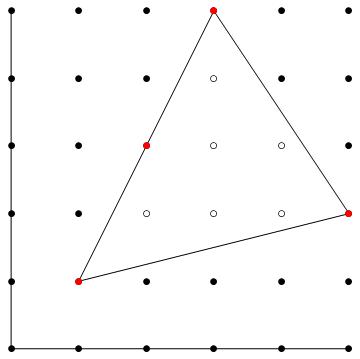
Suppose that the vertices of a triangle are (1,1), (3,5), and (4,2). What is the area of the triangle?

latticetriangleBecause the vertices of the triangle have integer coordinates, Pick’s Theorem offers an exceedingly simple way of finding the area of this triangle.

  1. There are 6 points (marked white) that are inside the triangle.
  2. There are 4 points (marked red) that are on the boundary of the triangle, including the three corners.
  3. Therefore, the area is A = 6 + \frac{1}{2} (4) - 1 = 7.

You can confirm this area by drawing the rectangle with corners at (1,1), (5,1), (5,5), and (1,5) and then taking away the three right triangles, leaving the triangle shown in the figure above.

Amazingly, this theorem is true for any polygonal figure — not just triangles — whose vertices have integer coordinates.

A decent classroom activity so that students can discover Pick’s theorem for themselves has been published by the National Council of Teachers of Mathematics. I modified this activity to teach my daughter and her friends last summer, so I say from first-hand experience that fourth-graders can use inductive reasoning to guess Pick’s theorem.

Additional references:

http://www.cut-the-knot.org/ctk/geoboard.shtml

http://www.cut-the-knot.org/ctk/Pick_proof.shtml