
Source: https://xkcd.com/3041/
Source: https://xkcd.com/3041/
I’m doing something that I should have done a long time ago: collecting a series of posts into one single post. The links below show my series on solving problems submitted to the journals of the Mathematical Association of America.
Part 1: Introduction
Part 2a: Suppose that 

![[0,1]](https://s0.wp.com/latex.php?latex=%5B0%2C1%5D&bg=ffffff&fg=000000&s=0&c=20201002)


Prove that ![{\bf 1}[S]](https://s0.wp.com/latex.php?latex=%7B%5Cbf+1%7D%5BS%5D&bg=ffffff&fg=000000&s=0&c=20201002)

Part 2b: Suppose that 


![[0,X]](https://s0.wp.com/latex.php?latex=%5B0%2CX%5D&bg=ffffff&fg=000000&s=0&c=20201002)
![[X,1]](https://s0.wp.com/latex.php?latex=%5BX%2C1%5D&bg=ffffff&fg=000000&s=0&c=20201002)


Prove that
Part 3: Define, for every non-negative integer 

Consider the sequence of complex polynomials in 


where each 


Part 4: Let 


Parts 5a, 5b, 5c, 5d, and 5e: Evaluate the following sums in closed form:
and

Parts 6a, 6b, 6c, 6d, and 6e: Two points 


Parts 7a, 7b, 7c, 7d, 7e, 7f, 7g, 7h, and 7i: Let 
In the past couple of months, I read a couple of very sobering and depressing articles on how hard it is for talented undergraduates to be admitted into graduate school in 2026. From MAA (Mathematical Association of America) FOCUS:
Hannah’s professors kept telling her she was a shoo-in for grad school. With a published paper in symplectic geometry, another one in combinatorial game theory in the works, and a 4.0 GPA in her math classes, she was a star in her department at Rhodes College. So, when she applied to a dozen PhD programs in math with the strong support of her department, she expected to have some exciting options to weigh as acceptances rolled in. Right on schedule, her first encouraging sign came from a state school in the North. They flew her up to campus to entice her to join their program, and they offered her a nice research assistantship—but with a caveat: funding could only be guaranteed for one year. The offer sounded promising, but only one year of committed funding? That feels odd.
Not long after her campus visit, she heard back from the University of Kentucky. That’s when she really started to sense something was off. According to Hannah, Kentucky told
her, “We are currently waiting to see how things play out. You are one of the top students that we want to admit… if we can admit any students at all. Please stand by.” Her mentors validated that this was unusual, but they were confident nonetheless that more acceptances were on the way. As the April 15 deadline for students to accept offers of admission approached, Hannah heard from another school that she was on the waitlist and a couple more that she would not be receiving an offer. Oddly, she also got an Instagram message from a grad student at one of the schools she applied to. The
grad student told her, in effect, that one of the professors who was reviewing her application was so taken with her research that they were telling the other faculty and students about it. This excitement about her work gave her hope that another
offer was on the horizon—but none materialized.
And from another article from Physics Today (American Institute of Physics):
“Strange and harrowing.” That’s how Sara Earnest describes the process of applying for physics PhD programs this year. She graduated in May from Johns Hopkins University with two and a half years of undergraduate research experience. But just two weeks shy of the 15 April national deadline for prospective students to commit to graduate programs, she had been wait-listed by one, rejected by seven, and was still waiting to hear from three.
In the end, Earnest didn’t get into any of them. She plans to try again next year.
Beyond the anecdotes, the articles suggest a number of factors that have made getting into graduate school in STEM significantly harder than in past years:
Paul Erdős famously said that mathematicians are machines that turn coffee into theorems. A couple of recent articles in the Wall Street Journal revealed the current state-of-the-art for AI to do the same.
In July, Ben Cohen published the article The High-Schoolers Who Just Beat the World’s Smartest AI Models. The focus of the article was the 2025 International Mathematical Olympiad, the pinnacle of the calendar for high school mathematics competitions. In the United States, the pathway to the IMO is first excellng at a sequence of increasing difficult exams: the AMC->12 (or possibly AMC->10), then the American Invitational Mathematics Exam (AIME), and then USA Mathematical Olympiad (USAMO) or USA Junior Mathematical Olympiad (USJAMO). The top USAMO and USJAMO participants then get invited to a special camp from which the participants in that year’s IMO are selected.
My personal story: back in high school, my score on the AMC->12 (then called the AHSME) qualified me for the AIME my sophomore and junior years, where my run in the competition ended with a resounding thud. My senior year, I caught lightning in a bottle and somehow qualified for the USAMO; I’m not sure what the cut-off is these days, but back then only 150 or so high school students qualified for the USAMO each year. My excitement at qualifying for the USAMO gave way to utter humiliation after I actually attempted the exam (to say that I “took” the exam is probably a misuse of the work “took”.) All this to say: I never came close to sniffing the IMO. From the Wall Street Journal article:
The famously grueling IMO exam is held over two days and gives students three increasingly difficult problems a day and more than four hours to solve them. The questions span algebra, geometry, number theory and combinatorics—and you can forget about answering them if you’re not a math whiz. You’ll give your brain a workout just trying to understand them.
Because those problems are both complex and unconventional, the annual math test has become a useful benchmark for measuring AI progress from one year to the next. In this age of rapid development, the leading research labs dreamed of a day their systems would be powerful enough to meet the standard for an IMO gold medal, which became the AI equivalent of a four-minute mile.
But nobody knew when they would reach that milestone or if they ever would—until now.
The unthinkable occurred earlier this month when an AI model from Google DeepMind earned a gold-medal score at IMO by perfectly solving five of the six problems. In another dramatic twist, OpenAI also claimed gold despite not participating in the official event. The companies described their feats as giant leaps toward the future—even if they’re not quite there yet.
In fact, the most remarkable part of this memorable event is that 26 students got higher scores on the IMO exam than the AI systems.

A second article by Ben Cohen, The Math Legend Who Just Left Academic — for an AI Startup Run by a 24-Year-Old, might be a precursor of things to come. One of the two starts of the article is number theorist Dr. Ken Ono. From the article:
In recent years, Ono began tracking AI’s remarkable progress as it rapidly improved. He was intrigued, though not intimidated. AI was astonishing at cognitive tasks and solving problems it had already seen, but it struggled with the creative elements of his field, which require intuition and abstract thinking.
That creativity is so fundamental to pure mathematics that Ono figured his job would be safe for decades.
But last spring, he was one of 30 mathematicians invited to curate research-level problems as a test of the AI models. He left the symposium profoundly shaken by what he’d seen.
“The lead I had on the models was shrinking,” he said. “And in areas of mathematics that were not in my wheelhouse, I felt like the models were already blowing me away.”
For months afterward, Ono felt like he was grieving his identity. He didn’t know what to do next, knowing that AI models would only get smarter.
“Then I had an epiphany,” he said. “I realized what the models were offering was a different way of doing math.”
Dr. Ono is now taking an extended leave from the University of Virginia to join a new AI startup company called Axiom. From Tech Funding News:
Led by Carina Hong, Axiom Math is developing an AI system that not only solves complex math problems but also generates new mathematical knowledge by proposing conjectures: mathematical statements that have yet to be proven.
The model produces rigorous, step-by-step proofs that can be independently verified using proof assistants such as Lean and Coq. This approach aims to transform English-language math from textbooks and research papers into code, enabling the AI to create and validate new problems that push the boundaries of existing knowledge…
Currently, Axiom is working on models that can discover and solve new math problems. The researchers also hope to apply their work in areas like finance, aircraft design, chip design, and quantitative trading.
Beyond pure mathematics, Axiom’s AI tool is being tested for practical applications in fields requiring rigorous computational precision, including finance, aircraft and chip design, and quantitative trading.
Time will tell if the intersection of AI with mathematics can generate a profitable company. What I don’t doubt is that the previously unthinkable — original mathematical work by AI — will eventually happen, given enough time.
Source: https://xkcd.com/3102/
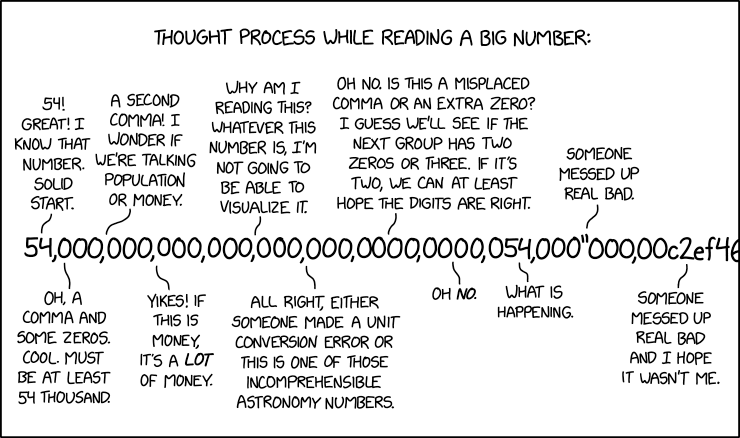
I recently read the article Pipe Dreams about treating wastewater. I’m not an engineer and make no claims of expertise about the accuracy of the article. What did catch my attention, as a mathematician, is how the author chose to express small proportions. For example, the opening sentence:
Wastewater is 99.9 percent water, but boy, that last little bit.
Later in the article:
Orange County’s is an example of indirect potable reuse, where wastewater is cleansed to 99.9999999999 percent free of pathogens before it goes to an environmental buffer like a reservoir or an aquifer for further natural filtering and then to homes.
And later:
After treating the water to even higher standards—demonstrating a 99.999999999999999999 percent removal rate of viruses and similarly high removal rates of protozoa—they may send the cleansed water directly into the water distribution system.
I was struck about the psychology of communicating all those consecutive 9s when expressing these proportions. For example, if the proportion of impurities instead of the proportion of water was given, the previous sentences could be rewritten as:
Only one part per thousand of wastewater is impurities.
Orange County’s is an example of indirect potable reuse, where impurities are reduced to one part per trillion before it goes to an environmental buffer like a reservoir or an aquifer for further natural filtering and then to homes.
After treating the water to even higher standards, reducing impurities to one part per 100 million trillion, they may send the cleansed water directly into the water distribution system.
Of these two different ways of expressing the same information, it seems to me that the author’s original prose is perhaps most psychologically comforting. “One part per trillion” seems a little abstract, as most people don’t have an intuitive notion of just how big a trillion is. The phrase “99.9999999999 percent,” on the other hand, seems at first reading to be ridiculously close to 100 percent (which, of course, it is).
Source: https://xkcd.com/2992/
For the last couple years, one of my favorite sources of entertainment has been the wonderful world of YouTube Golf. Intending no disrespect to any other content creators, my favorite channels are the ones by Grant Horvat, the Bryan Bros (not to be confused with the twin tennis duo), Peter Finch, Bryson DeChambeau (of course), and Golf Girl Games (all of them absolutely, positively should have been in the Internet Invitational… but that’s another story for another day).
In a recent Bryan Bros video, my two interests collided. To make a long story short, a golf simulator projected that a tee shot on a par-3 ended 8 feet, 12 inches from the cup.

Co-host Wesley Bryan, to his great credit, immediately saw the computer glitch — this is an unusual way of saying the tee shot ended 9 feet from the cup. Hilarity ensued as the golfers held a stream-of-consciousness debate on the merits of metric and Imperial units. The video is below: the fun begins at the 21:41 mark and ends around 25:30.
Source: https://xkcd.com/3049/
Q: “Why do mathematicians always confuse Halloween with Christmas?”
A: “Because 31-Oct = 25-Dec.”


