Pedagogical thoughts about sequences and series (Part 2)

After yesterday’s post about arithmetic and geometric sequences, I’d like to contribute some thoughts about teaching this topic, based on my own experience over the years.

1. Some students really resist the subscript notation a_n when encountering it for the first time. To allay these concerns, I usually ask my students, “Why can’t we just label the terms in the sequence as a, b, c, and so on?” They usually can answer: what if there are more than 26 terms? That’s the right answer, and so the a_n is used so that we’re not limited to just the letters of the English alphabet.

Another way of selling the a_n notation to students is by telling them that it’s completely analogous to the f(x) notation used more commonly in Algebra II and Precalculus. For a “regular” function f(x), the number x is chosen from the domain of real numbers. For a sequence a_n, the number n is chosen from the domain of positive (or nonnegative) integers.

2. The formulas in Part 1 of this series (pardon the pun) only apply to arithmetic and geometric sequences, respectively. In other words, if the sequence is neither arithmetic nor geometric, then the above formulas should not be used.

While this is easy to state, my observation is that some students panic a bit when working with sequences and tend to use these formulas on homework and test questions even when the sequence is specified to be something else besides these two types of sequences. For example, consider the following problem:

Find the 10th term of the sequence 1, 4, 9, 16, \dots

I’ve known pretty bright students who immediately saw that the first term was 1 and the difference between the first and second terms was 3, and so they answered that the tenth term is 1 + (10-1)\times 3 = 28… even though the sequence was never claimed to be arithmetic.

I’m guessing that these arithmetic and geometric sequences are emphasized so much in class that some students are conditioned to expect that every series is either arithmetic or geometric, forgetting (especially on tests) that there are sequences other than these two.

3. Regarding arithmetic sequences, sometimes it helps by giving students a visual picture by explicitly make the connection between the terms of an arithmetic sequence and the points of a line. For example, consider the arithmetic sequence which begins

13, 16, 19, 22, \dots

The first term is 13, the second term is 16, and so on. Now imagine plotting the points (1,13), (2,16), (3,19), and (4,22) on the coordinate plane. Clearly the points lie on a straight line. This is not surprising since there’s a common difference between terms. Moreover, the slope of the line is 3. This matches the common difference of the arithmetic sequence.

4. In ordinary English, the words sequence and series are virtually synonymous. For example, if someone says either, “a sequence of unusual events” or “a series of unusual events,” the speaker means pretty much the same thing

However, in mathematics, the words sequence and series have different meanings. In mathematics, an example of an arithmetic sequence are the terms

1, 3, 5, 7, 9, \dots, 99

However, an example of an arithmetic series would be

1 + 3 + 5 + 7 + 9 + \dots + 99

In other words, a sequence provides the individual terms, while a series is a sum of the terms.

When teaching this topic, I make sure to take a minute to emphasize that the words sequence and series will mean something different in my class, even though they basically mean the same thing in ordinary English.

Formulas for arithmetic and geometric sequences (Part 1)

I’m not particularly a fan of memorizing formulas. Apparently, most college students aren’t fans either, because they often don’t have immediate recall of certain formulas from high school when they’re needed in the collegiate curriculum.

While I’m not a fan of making students memorize formulas, I am a fan of teaching students how to derive formulas. Speaking for myself, if I ever need to use a formula that I know exists but have long since forgotten, the ability to derive the formula allows me to get it again.

Which leads me to today’s post: the derivation of the formulas for the nth term of an arithmetic sequence and of a geometric sequence. This topic is commonly taught in Precalculus but, in my experience, is often forgotten by students years later when needed in later classes.

green lineAn arithmetic sequence is specified by two numbers: the first term and the common difference between terms. For example, if the first term is 16 and the common difference is 3, then the sequence begins as

16, 19, 22, 25, 28, 31, 34, \dots

If the first term is 29 and the common difference is -4, then the sequence begins as

29, 25, 21, 17, 13, 9, 5, 1, -3, \dots

For those of us old enough to remember, our favorite arithmetic sequences came from Schoolhouse Rock:

Let’s discuss the first arithmetic sequence, whose first seven terms are:

16, 19, 22, 25, 28, 31, 34, \dots

How do we get the 8th term? That’s easy: we just add 3 to 34 to get 37.

How to we get the 100th term. That’s easy: we just add 3 to the 99th term.

Oops. We don’t know the 99th term. To get the 99th term, we need the 98th term, which in turn requires the 97th term. Et cetera, et cetera, et cetera.

The trouble (so far) is that an arithmetic sequence is recursively defined: to get one term, I add something to the previous term. Mathematically, the arithmetic sequence is defined by

a_n = a_{n-1} + d,

where d is the common difference. This can be very intimidating to students when seeing it for the first time. So, to make this formula less intimidating, I usually read this equation as “Each next term in the sequence is equal to the previous term in the sequence plus the common difference.”


It would be far better to have a closed-form formula, where I could just plug in 100 to get the 100th term, without first figuring out the previous 99 terms.

To this end, we notice the following pattern:

  • Second term: 19 = 16 + 3
  • Third term: 22 = 19 + 3 = 16 + 3 + 3 = 16 + 2 \times 3
  • Fourth term: 25 = 22+ 3 = 16 + (2 \times 3) + 3 = 16 + 3 \times 3
  • Fifth term: 28 = 25+ 3 = 16 + (3 \times 3) + 3 = 16 + 4 \times 3
  • Sixth term: 31 = 28+ 3 = 16+ (4 \times 3) + 3 = 16 + 5 \times 3
  • Seventh term: 34 = 31 + 3 = 16 + (5 \times 3) + 3 = 16 + 6 \times 3

It looks like we have a pattern, so we can guess that:

  • One hundredth term = 16 + (100-1) \times 3 = 313

In general, we have justified the closed-form formula

a_n = a_1 + (n-1)d,

where a_1 is the first term, and d is the common difference.  In words: to get the nth term of an arithmetic sequence, we add d to the first term n-1 times. (This may be formally proven using mathematical induction, though I won’t do so here.)

green lineA closed-form formula for a geometric sequence is similarly obtained. In a geometric sequence, each term is equal to the previous term multiplied by a common ratio. Mathematically, the geometric sequence is recursively defined by

a_n = a_{n-1}r,

where r is the common ratio. For example, if the first term is 3 and the common ratio is 2, then the first few terms of the sequence are

3, 6, 12, 24, 48, dots

By the same logic used above, to get the nth term of an geometric sequence, we multiply r to the first term n-1 times. Thus justifies the formula

a_n = a_1 r^{n-1},

which may be formally proven using mathematical induction.


Engaging students: Deriving the Pythagorean theorem

In my capstone class for future secondary math teachers, I ask my students to come up with ideas for engaging their students with different topics in the secondary mathematics curriculum. In other words, the point of the assignment was not to devise a full-blown lesson plan on this topic. Instead, I asked my students to think about three different ways of getting their students interested in the topic in the first place.

I plan to share some of the best of these ideas on this blog (after asking my students’ permission, of course).

This student submission again comes from my former student Maranda Edmonson. Her topic, from Geometry: deriving the Pythagorean theorem.

green line

D. History: What are the contributions of various cultures to this topic?

Legend has it that Pythagoras was so happy about the discovery of his most famous theorem that he offered a sacrifice of oxen. His theorem states that “the area of the square built upon the hypotenuse of a right triangle is equal to the sum of the areas of the squares upon the remaining sides.” It is likely, though, that the ancient Babylonians and Egyptians knew the result much earlier than Pythagoras, but it is uncertain how they originally demonstrated the proof. As for the Greeks, it is likely that methods similar to Euclid’s Elements were used. Also, though there are many proofs of the Pythagorean Theorem, one came from the contemporary Chinese civilization found in the Arithmetic Classic of the Gnoman and the Circular Paths of Heaven, a Chinese text containing formal mathematical theories.

http://jwilson.coe.uga.edu/emt669/student.folders/morris.stephanie/emt.669/essay.1/pythagorean.html

green line

E. Technology: How can technology be used to effectively engage students with this topic?

The following link is for a video that not only engages students from the very beginning by playing the Mission: Impossible theme and giving students a mission – “should they choose to accept it” – but that has great information. It begins with a short engagement, as stated before, and goes into a little bit of history about Pythagoras and the Pythagoreans. It then briefly describes what the Pythagorean Theorem is before the commentator says, “Does it have applications in our lives today?” At this point (2:43 in the video), it would be beneficial to stop the video and let students discuss where they could use the theorem. The rest of the video simply shows some examples of how the Pythagorean Theorem is used on sailboats, inclined planes, and televisions. It would be up to the teacher whether or not to show the last five minutes of the video to show students these examples, but they could take notes on these examples as they are worked out on the screen.

http://digitalstorytelling.coe.uh.edu/movie_mathematics_02.html

green line

B. Applications: How can this topic be used in your students’ future courses in mathematics or science?

After students learn the Pythagorean Theorem in their Geometry classes, they will use it throughout their mathematical careers. They will use it specifically in Pre-Calculus when they are learning about the unit circle. The theorem is fundamental to proving the basic identities in Trigonometry. It is also used in some of the trigonometric identities, aptly named the Pythagorean Identities based on the nature of their derivation.

In Physics, the kinetic energy of an object is

\displaystyle \frac{1}{2} (\hbox{mass})(\hbox{velocity})^2.

But, in terms of energy, energy at 500 mph = energy at 300 mph + energy at 400 mph. This equation means that, with the energy used to accelerate something at 500 mph, two other objects could use that same energy to be accelerated to 300 mph and 400 mph. Looks like a Pythagorean triple, right? The theorem is also used in Computer Science with processing time. Other examples are found in the link below.

http://betterexplained.com/articles/surprising-uses-of-the-pythagorean-theorem/

Why does 0.999… = 1? (Part 5)

Here’s one more way of convincing students that 0.\overline{9} = 1. Here’s the idea: how far apart are the two numbers?

First off, since 1 \ge 0.\overline{9}, we know that 1 - \overline{9} \ge 0.

Of course, we know that 1-0.9 = 0.1. Since 0.\overline{9} must lie between 0.9 and 1, we know that 1 - 0.\overline{9} must be less than 0.1.

Second, we know that 1-0.99 = 0.01. Since 0.\overline{9} must lie between 0.99 and 1, we know that 1 - 0.\overline{9} must be less than 0.01.

Third, we know that 1-0.999 = 0.001. Since 0.\overline{9} must lie between 0.999 and 1, we know that 1 - 0.\overline{9} must be less than 0.001.

By the same reasoning, we conclude that

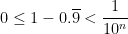
0 \le 1 - 0.\overline{9} < \displaystyle \frac{1}{10^n}

for every integer n. What’s the only number that’s greater than or equal to 0 and less than every decimal of the form 0.00\dots001? Clearly, the only such number is 0. Therefore,

1 - 0.\overline{9} = 0, or 0.\overline{9} = 1.

green lineI like this approach because it really gets at the heart of the difference between integers \mathbb{Z} and real numbers \mathbb{R}. For integers, there is always an integer to the immediate left and to the immediate right. In other words, if you give me any integer (say, 15), I can tell you the largest integer that’s less than your number (in our example, 14) and the smallest integer that’s bigger than your number (16).

Real numbers, however, do not have this property. There is no real number to the immediate right of 0. This is easy to prove by contradiction. Suppose x > 0 is the real number to the immediate left of 0. That means that there are no real numbers between 0 and x. However, x/2 is bigger than 0 and less than x, providing the contradiction.

(For what it’s worth, the above proof doesn’t apply to the set of integers \mathbb{Z} since x/2 doesn’t have to be an integer.)

By the same logic — visually, you can imagine reflecting the number line across the point x = 0.5 — there is no number to the immediate left of 1. So while 0.\overline{9} would appear to be to the immediate left of 1, they are in reality the same point.

Why does 0.999… = 1? (Part 4)

In this series, I discuss some ways of convincing students that 0.999\dots = 1 and that, more generally, a real number may have more than one decimal representation even though a decimal representation corresponds to only one real number. This can be a major conceptual barrier for even bright students to overcome. I have met a few math majors within a semester of graduating — that is, they weren’t dummies — who could recite all of these ways and were perhaps logically convinced but remained psychologically unconvinced.

Method #5. This is a proof by contradiction; however, I think it should be convincing to a middle-school student who’s comfortable with decimal representations. Also, perhaps unlike Methods #1-4, this argument really gets to the heart of the matter: there can’t be a number in between 0.999\dots and 1, and so the two numbers have to be equal.

In the proof below, I’m deliberating avoiding the explicit use of algebra (say, letting x be the midpoint) to make the proof accessible to pre-algebra students.

Suppose that 0.999\dots < 1. Then the midpoint of 0.999\dots and 1 has to be strictly greater than 0.999\dots, since

\displaystyle \frac{0.999\dots + 1}{2} > \displaystyle \frac{0.999\dots + 0.999\dots}{2} = 0.999\dots

Similarly, the midpoint is strictly less than 1:

\displaystyle \frac{0.999\dots + 1}{2} < \displaystyle \frac{1 +1}{2} =1

(For the sake of convincing middle-school students, a number line with three tick marks — for 0.999\dots, 1, and the midpoint — might be more believable than the above inequalities.)

So what is the decimal representation of the midpoint? Since the midpoint is less than 1, the decimal representation has to be 0.\hbox{something} Furthermore, the midpoint does not equal 0.999\dots. That means, somewhere in the decimal representation of the midpoint, there’s a digit that’s not equal to 9. In other words, the midpoint has to have one of the following 9 forms:

midpoint = 0.999\dots 990 \, \_ \, \_ \dots

midpoint = 0.999\dots 991 \, \_ \, \_ \dots

midpoint = 0.999\dots 992 \, \_ \, \_ \dots

midpoint = 0.999\dots 993 \, \_ \, \_ \dots

midpoint = 0.999\dots 994 \, \_ \, \_ \dots

midpoint = 0.999\dots 995 \, \_ \, \_ \dots

midpoint = 0.999\dots 996 \, \_ \, \_ \dots

midpoint = 0.999\dots 997 \, \_ \, \_ \dots

midpoint = 0.999\dots 998 \, \_ \, \_ \dots

In any event, 9 is the largest digit. That means that, no matter what, the midpoint is less than 0.999\dots, contradicting the fact that the midpoint is larger than 0.999\dots (if 0.999\dots < 1).

Why does 0.999… = 1? (Part 3)

In this series, I discuss some ways of convincing students that 0.999\dots = 1 and that, more generally, a real number may have more than one decimal representation even though a decimal representation corresponds to only one real number. This can be a major conceptual barrier for even bright students to overcome. I have met a few math majors within a semester of graduating — that is, they weren’t dummies — who could recite all of these ways and were perhaps logically convinced but remained psychologically unconvinced.

Method #4. This is a direct method using the formula for an infinite geometric series… and hence will only be convincing to students if they’re comfortable with using this formula. By definition,

0.999\dots = \displaystyle \frac{9}{10} + \frac{9}{100} + \frac{9}{1000} + \dots

This is an infinite geometric series. Its first term is \displaystyle \frac{9}{10}, and the common ratio needed to go from one term to the next term is \displaystyle \frac{1}{10}. Therefore,

0.999\dots = \displaystyle \frac{ \displaystyle \frac{9}{10}}{ \quad \displaystyle 1 - \frac{1}{10} \quad}

0.999\dots = \displaystyle \frac{ \displaystyle \frac{9}{10}}{ \quad \displaystyle \frac{9}{10} \quad}

0.999\dots = 1

Why does 0.999… = 1? (Part 2)

In this series, I discuss some ways of convincing students that 0.999\dots = 1 and that, more generally, a real number may have more than one decimal representation even though a decimal representation corresponds to only one real number. This can be a major conceptual barrier for even bright students to overcome. I have met a few math majors within a semester of graduating — that is, they weren’t dummies — who could recite all of these ways and were perhaps logically convinced but remained psychologically unconvinced.

Methods #2 and #3 are indirect methods. We start with a decimal representation that we know and end with 0.999\dots.

Method #2. This technique should be accessible to any student who can do long division. With long division, we know full well that

\displaystyle \frac{1}{3} = 0.333\dots

Multiply both sides by 3:

\displaystyle 3 \times \frac{1}{3} = 3 \times 0.333\dots

\displaystyle 1 = 0.999\dots

Though not logically necessary, this method could be reinforced for students by also considering

\displaystyle 1 = 9 \times \frac{1}{9} = 9 \times 0.111\dots = 0.999\dots

green line

Method #3. With long division, we know full well that

\displaystyle \frac{1}{3} = 0.333\dots \quad and ~ \quad \displaystyle \frac{2}{3} = 0.666\dots

Add them together:

\displaystyle \frac{1}{3} + \frac{2}{3} = 0.333\dots + 0.666\dots

\displaystyle 1 = 0.999\dots

Though not logically necessary, this method could be reinforced for students by also considering any (or all) of the following:

1 = \displaystyle \frac{1}{9} + \frac{8}{9} = 0.111\dots + 0.888\dots = 0.999\dots

1 = \displaystyle \frac{2}{9} + \frac{7}{9} = 0.222\dots + 0.777\dots = 0.999\dots

1 = \displaystyle \frac{4}{9} + \frac{5}{9} = 0.444\dots + 0.555\dots = 0.999\dots

Why does 0.999… = 1? (Part 1)

Our decimal number system is so wonderful that it’s often taken for granted. (If you doubt me, try multiplying 12 and 61 or finding an 18\% tip on a restaurant bill using only Roman numerals.)

However, there’s one little quirk about our numbering system that some students find quite unsettling:

If a number has a terminating decimal representation, then the same number also has a second different terminating decimal representation. (However, a number that does not have a terminating decimal representation does not have a second representation.)

Stated another way, a decimal representation corresponds to a unique real number. However, a real number may not have a unique decimal representation.

Some (perhaps many) students find such equalities to be unsettling at first glance, and for good reason. They’d prefer to think that there is a one-to-one correspondence to the set of real numbers and the set of decimal representations. Stated more simply, students are conditioned to think that if two number look different (like 24 and 25), then they ought to be different.

However, there’s a subtle difference  between a number and a numerical representation. The number 1 is defined to be the multiplicative identity in our system of arithmetic. However, this number has two different representations in our numbering system: 1 and 0.999\dots. (Not to mention its representation in the numbering systems of the ancient Romans, Babylonians, Mayans, etc.)

As usual, let [0,1] be the set of real numbers from 0 to 1 (inclusive), and let D be the set of decimal representations of the form 0.d_1 d_2 d_3 \dots. Then there’s clearly a function f : D \to \mathbb{R}, defined by

f(0.d_1 d_2 d_3\dots) = \displaystyle \sum_{i=1}^\infty \frac{d_n}{10^n}

If I want to give my students a headache, I’ll ask, “In Calculus II, you saw that some series converge and some series diverge. So what guarantee do we have that this series actually converges?” (The convergence of the right series can be verified using the Direct Comparsion Test, the fact that d_i \le 9, and the formula for an infinite geometric series.)

In the language of mathematics: Using the completeness axiom, it can be proven (though no student psychologically doubts this) that f maps D onto [0,1]. In other words, every decimal representation corresponds to a real number, and every real number has a decimal representation. However, the function f is a surjection but not a bijection. In other words, a real number may have more than one decimal representation.

This is a big conceptual barrier for some students — even really bright students — to overcome. They’re not used to thinking that two different decimal expansions can actually represent the same number.

The two most commonly shown equal but different decimal representations are 0.999\dots = 1. Other examples are

0.125 = 0.124999\dots

3.458 = 3.457999 \dots

In this series, I will discuss some ways of convincing students that 0.999\dots = 1. That said, I have met a few math majors within a semester of graduating — that is, they weren’t dummies — who could recite all of these ways and were perhaps logically convinced but remained psychologically unconvinced. The idea that two different decimal representations could mean the same number just remained too high of a conceptual barrier for them to hurdle.

Method #1. This first technique is accessible to any algebra or pre-algebra student who’s comfortable assigning a variable to a number. We convert the decimal representation to a fraction using something out of the patented Bag of Tricks. If students aren’t comfortable with the first couple of steps (as in, “How would I have thought to do that myself?”), I tell my usual tongue-in-cheek story: Socrates gave the Bag of Tricks to Plato, Plato gave it to Aristotle, it passed down the generations, my teacher taught the Bag of Tricks to me, and I teach it to my students.

Let x =0.999\dots. Multiply x by 10, and subtract:

10x = 9.999\dots

x = 0.999\dots

\therefore (10-1)x = 9

x =1

0.999\dots = 1

Factoring the time

factoring_the_time

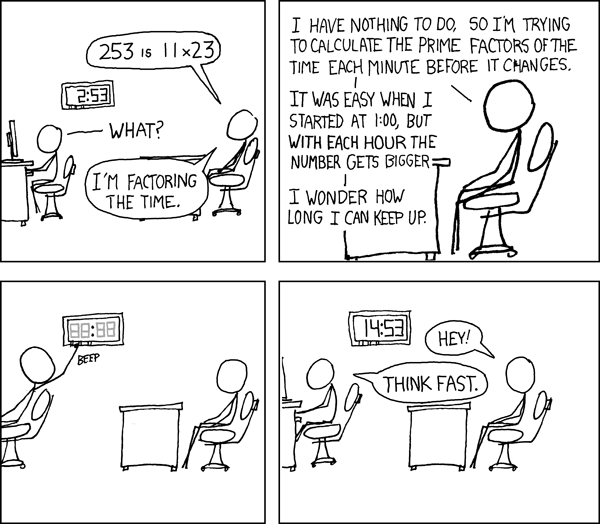
True story: one way that I commit large numbers to (hopefully) short-term memory is by factoring. If I take the time to factor a big number, then I can usually remember it for a little while.

This approach has occasional disadvantages. For example, I now have stuck in my brain the completely useless information that, many years ago, my seat at a Texas Rangers ballgame was somewhere in Section 336 (which is 6 \times 7 \times 8).

Source: http://www.xkcd.com/247/