

This week marks the one-year anniversary of this brilliant bit of tomfoolery.
From Bleacher Report:
Houston Texans quarterback Ryan Fitzpatrick… threw for 358 yards and six touchdowns in a 45-21 victory over the Tennessee Titans on Sunday [November 30, 2014]. However, [his son] Brady was the star of the postgame press conference.
Fitzpatrick put his son on the spot at the end of the press conference. In a matter of seconds, Brady was able to multiply 93 by 97 in his head.
After the thought bubble, I’ll reveal the likely way that young Brady did this.

Here’s a trick for multiplying two numbers in their 90s which is accessible to bright elementary-school students. We begin by multiplying out 
For 


Also, 

Put them together, and we get the product $100 \times 90 + 21 = 9021$.
I don’t expect that young Brady knew all of this algebra, but I expect that he did the above mental arithmetic to put together the product. Well done, young man.
From Bleacher Report:
Houston Texans quarterback Ryan Fitzpatrick… threw for 358 yards and six touchdowns in a 45-21 victory over the Tennessee Titans on Sunday [November 30, 2014]. However, [his son] Brady was the star of the postgame press conference.
Fitzpatrick put his son on the spot at the end of the press conference. In a matter of seconds, Brady was able to multiply 93 by 97 in his head.
I’ll reveal the (likely) way that young Brady Fitzpatrick pulled this off tomorrow. In the meantime, I’ll leave a thought bubble if you’d like to try to figure it out on your own.

Source: http://www.xkcd.com/994/
Every so often, I’ll publicize through this blog an interesting article that I’ve found in the mathematics or mathematics education literature that can be freely distributed to the general public. Today, I’d like to highlight “Creating a Culture of Inquiry in Mathematics Programs,” by Jill Dietz. Here’s the abstract:
We argue that student research skills in mathematics should be honed throughout the curriculum just as such skills are built over time in the natural and physical sciences. Examples used in the mathematics program at St. Olaf College are given.
The full article can be found here: http://dx.doi.org/10.1080/10511970.2012.711804
Full reference:Jill Dietz (2013) Creating a Culture of Inquiry in Mathematics Programs, PRIMUS: Problems, Resources, and Issues in Mathematics Undergraduate Studies, 23:9, 837-859, DOI: 10.1080/10511970.2012.711804
In my capstone class for future secondary math teachers, I ask my students to come up with ideas for engaging their students with different topics in the secondary mathematics curriculum. In other words, the point of the assignment was not to devise a full-blown lesson plan on this topic. Instead, I asked my students to think about three different ways of getting their students interested in the topic in the first place.
I plan to share some of the best of these ideas on this blog (after asking my students’ permission, of course).
This student submission comes from my former student Chelsea Hancock. Her topic, from Precalculus: synthetic division.

The method of synthetic division is an alternative version of long division concerning polynomials. Synthetic division uses the basic mathematical skills of addition, subtraction, multiplication, and negative signs. They must also understand the definitions of polynomial, coefficient, and remainder. A polynomial is an expression with multiple terms, poly meaning “many” and nomial meaning “term.” A coefficient is a number used to multiply a variable. The remainder is the amount left over after division. Synthetic division involves multiplying, then adding or subtracting the coefficients of two polynomials. On some occasions, there will be a remainder after dividing the polynomials.
Mathematicians are lazy. That is a fact of life. One mathematician understood this, so in 1809 he created a cleaner, faster, and much simpler method for division. His name was Paolo Ruffini. In order to more efficiently divide polynomials, Ruffini invented the Ruffini’s Rule, known more commonly as synthetic division in today’s society. In 1783, he entered the University of Modena and he studied mathematics, medicine, philosophy and literature. Then, in 1798 he began teaching mathematics at the University of Modena. He was required to swear an oath of allegiance to the republic, but due to religious purposes, refused to do so. This resulted in the loss of his professorship and was prevented from teaching.
There are several videos on the Internet involving synthetic division, but there are two in particular that I personally think are excellent demonstrations of both the method itself and why it works. I have labeled these clips Video 1 and Video 2. Video 1 is a demonstration of the method in action, using a specific example involving numbers, walking the viewers through the process through the whole video. Video 2 explains why using synthetic division instead of using long division is the more efficient and less complicated method for dividing polynomials. The clip uses the same example used in Video 1, but this time the polynomials are divided using long division, walking the viewers through the process the entire time. As the narrator moves through the process, he makes connections between the synthetic division method and the long division method and draws conclusions between the two. By the end of the video, it is evident which is the cleanest method to use when concerning the division of polynomials. These videos not only give great tutorials on both methods of division, but allows the viewers to see the benefits and uses of synthetic division when it is possible to use it.
Video 1:
Video 2:
References
http://www.mathsisfun.com/algebra/polynomials.html
http://www.mathsisfun.com/definitions/coefficient.html
http://www.mathsisfun.com/definitions/remainder.html
http://www-groups.dcs.st-and.ac.uk/~history/Biographies/Ruffini.html
http://www.personal.psu.edu/djh300/cyhs/trig/unit-e-adv-polyn/06-05-02-synth-div.pdf
In the previous two posts, we considered the use of base-

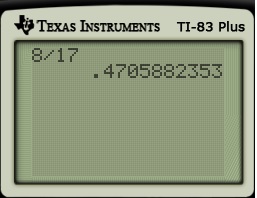
There’s no obvious repeating pattern. But we know that, since 17 has neither 2 nor 5 as a factor, that there has to be a repeating decimal pattern.
So… what is it?
When I ask this question to my students, I can see their stomachs churning a slow dance of death. They figure that the calculator didn’t give the answer, and so they have to settle for long division by hand.
That’s partially correct.
However, using the ideas presented below, we can perform the long division extracting multiple digits at once. Through clever use of the calculator, we can quickly obtain the full decimal representation even though the calculator can only give ten digits at a time.
Let’s now return to where this series began… the decimal representation of 

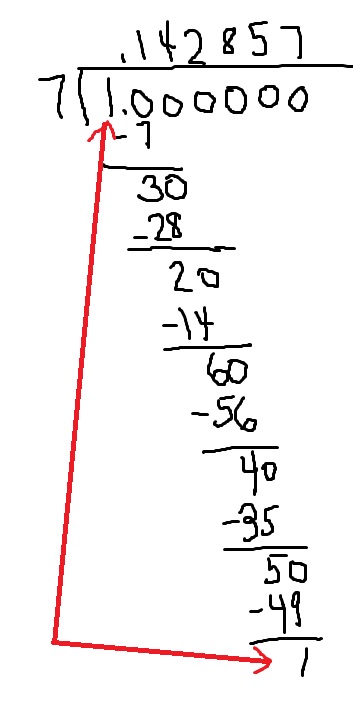
Because we arrived at a repeated remainder, we know that we have found the repeating block. So we can conclude that 
Students are taught long division in elementary school and are so familiar with the procedure that not much thought is given to the logic behind the procedure. The underlying theorem behind long division is typically called the division algorithm. From Wikipedia:
Given two integers
and
, with
, there exist unique integers
and
such that
and $0 \le r < |b|$, where
denotes the absolute value of
The number
Repeated application of this theorem is the basis for long division. For the example above:
Step 1.


Step 2.


Returning to the end of Step 1, we see that
Step 3.


Returning to the end of Step 2, we see that
And so on.
By adding an extra zero and using the division algorithm, the digits in the decimal representation are found one at a time. That said, it is possible (with a calculator) to find multiple digits in a single step by adding extra zeroes. For example:
Alternate Step 1.

Alternate Step 2.


Returning to the end of Alternate Step 1, we see that
So, with these two alternate steps, we arrive at a remainder of 
The big catch is that, if 


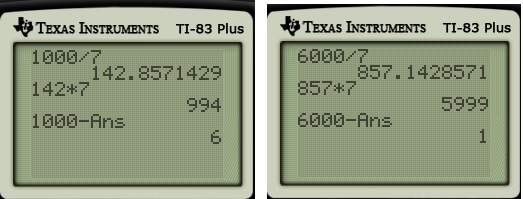
At first blush, it seems silly to use a calculator to find these values of 
Let’s now return to the question posed at the top of this post: finding the decimal representation of 


Here’s the result of the calculator again:
We clearly see from the calculator that the repeating block doesn’t have a length less than or equal to
Now we perform the division algorithm to obtain these digits, as before. This can be done in two steps by multiplying by 
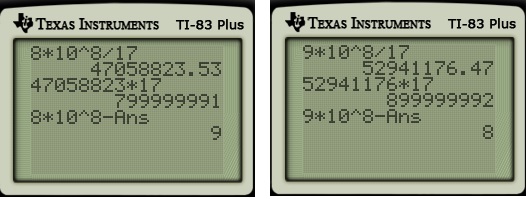
So, by the same logic used above, we can conclude that
In other words, through clever use of the calculator, the full decimal representation can be quickly found even if the calculator itself returns only ten digits at a time… and had rounded the final 

(Note: While this post continues exploring the unorthodox use of a calculator to handle arithmetic problems, it also appeared in a previous series on the decimal expansions of rational numbers.)








