In this series, I’m discussing how ideas from calculus and precalculus (with a touch of differential equations) can predict the precession in Mercury’s orbit and thus confirm Einstein’s theory of general relativity. The origins of this series came from a class project that I assigned to my Differential Equations students maybe 20 years ago.
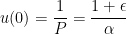
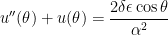
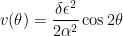
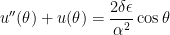
In this part of the series, we will show that if the motion of a planet around the Sun is expressed in polar coordinates , with the Sun at the origin, then under Newtonian mechanics (i.e., without general relativity) the motion of the planet follows the differential equation
,
where and is a certain constant. Deriving this governing differential equation will require some principles from physics. If you’d rather skip the physics and get to the mathematics, we’ll get to solving this differential equations in a few posts.
One principle from physics that we’ll need is the Law of Conservation of Angular Momentum. Mathematically, this is expressed by
,
where is a constant. Of course, this can be written as
;
this will be used a couple times in the derivation below.
As we’ll soon see, we will need to express the second derivative in a form that depends only on . To do this, we use the Chain Rule to obtain
.
This last step used the Chain Rule in reverse:
.
To examine the second derivative , we again use the Chain Rule:
.
While far from obvious now, this will be needed when we rewrite Newton’s Second Law in polar coordinates.
In this series, I’m discussing how ideas from calculus and precalculus (with a touch of differential equations) can predict the precession in Mercury’s orbit and thus confirm Einstein’s theory of general relativity. The origins of this series came from a class project that I assigned to my Differential Equations students maybe 20 years ago.
One technique that will be necessary for this confirmation is the method of successive approximations. This will be needed in the context of a differential equation; however, we can illustrate the concept by finding the roots of a polynomial. Consider the quadratic equation
.
(Naturally, we can solve for using the quadratic formula; more on that later.) To apply the method of successive approximation, we will rewrite this so that appears on the left side and some function of appears on the right side. I will choose
, or
.
Here’s the idea of the method of successive approximations to obtain a recursively defined sequence that (hopefully) convergence to a solution of this equation:
Start with an initial guess .
Plug into the right-hand side to get a new guess, .
And repeat.
For example, suppose that we choose . Then
This sequence can be computed by entering into a calculator, then entering , and then repeatedly hitting the button.
We see that the sequence appears to be converging to something, and that something is a root of the equation , which we now find via the quadratic formula:
.
So it looks like the above sequence is converging to the positive root .
(Parenthetically, you might notice that the Fibonacci sequence appears in the numerators and denominators of this sequence. As you might guess, that’s not a coincidence.)
Like most numerical techniques, this method doesn’t always work like we think it would. Another solution is the negative root . Unfortunately, if we start with a guess near this root, like , the sequence unexpectedly diverges from but eventually converges to the positive root :
I should note that the method of successive approximations generally converges at a slower pace than Newton’s method. However, this method will be good enough when we use it to predict the precession in Mercury’s orbit.
A brief aside from the current series on general relativity — and the mysterious 43 seconds of arc per century in Mercury’s orbit — that turned into further discussion about angle measurement.
A few months ago, I received this clever postcard from someone visiting Spokane, Washington. The sender clearly knew the recipient (me) well: rather than sending me a postcard showing the jaw-dropping beauty of the Spokane area, I was impressed with the mathematical precision given for Spokane’s location.
I started wondering about exactly how precisely the postcard was measuring the location of Spokane — was it the location of City Hall or some other important landmark? — and I went to Google Maps to find out. (For what it’s worth, xkcd had a comic about this some time ago.)
And then it finally hit me, after far longer than it should have taken, that the postcard is utterly nonsensical.
We would never say that someone’s height is 4 feet, 20 inches. There are 12 inches in a foot, and so we would instead say that the height is 5 feet, 8 inches.
Likewise, when specifying an angle with minutes and seconds, there are (just like with ordinary time) 60 seconds in a minute and 60 minutes in a degree (so that there are 3600 seconds in a degree). Therefore, specifying an angle with 67′ or 66″, as in the postcard, makes absolutely no sense.
Furthermore, if converted into standard notation, we obtain a location of north, west, which is about 40 miles NNW of Spokane. (Images made by https://www.gps-coordinates.net/). Note on the conversion into decimal:
and
It’s a shame that the designer of the postcard made this error, as I genuinely thought this was a clever and aesthetically pleasing design idea for a postcard.
While I’m not sure how this mistake happened, my best guess is that the designer used the location of north, west — which is indeed in Spokane — and then misconverted from decimal notation to minutes and seconds.
In this series, I’m discussing how ideas from calculus and precalculus (with a touch of differential equations) can predict the precession in Mercury’s orbit and thus confirm Einstein’s theory of general relativity. The origins of this series came from a class project that I assigned to my Differential Equations students maybe 20 years ago.
In a previous post, we showed that the polar equation
is equivalent to the rectangular equation
as long as . Furthermore, if , then this represents an ellipse with eccentricity whose major axis lies on the axis, with one focus located at the origin.
While not directly related to our discussion of precession, it turns out that this equation represents a hyperbola if . Under this assumption, and , so let me rewrite the previous equation in terms of :
This matches the form of a left-right hyperbola
,
where the center of the hyperbola is located at
Also, for a hyperbola, the distance from the center to the foci satisfies
,
so that
The two foci are located a distance to the left of the right of the center. Since it happened to happen that , this means that the origin is, once again, one of the foci of the hyperbola.
Furthermore, the eccentricity of the hyperbola is easily computed as
,
so that, once again, the well-chosen parameter is the eccentricity.
In this series, I’m discussing how ideas from calculus and precalculus (with a touch of differential equations) can predict the precession in Mercury’s orbit and thus confirm Einstein’s theory of general relativity. The origins of this series came from a class project that I assigned to my Differential Equations students maybe 20 years ago.
In the previous post, we showed that the polar equation
converts to
in rectangular coordinates. Furthermore, if , then this represents an ellipse with eccentricity whose semi-major axis lies along the axis with one focus at the origin.
It turns out that, for different non-negative values of , the same polar equation represents different conic sections. These are not particularly relevant for our study of precession, but I’m including this anyway in this series as a small tangential discussion.
Let’s take a look at the easy case of . With this substitution, the equation in rectangular coordinates simplifies to
.
Of course, this is the equation of a circle that is centered at the origin with radius .
The other easy case is , so that . Then the equation in rectangular coordinates simplifies to
This matches the form of a parabola that opens to the left with a horizontal axis of symmetry:
.
In this case, the vertex of the parabola is located at
,
while the focus of the parabola is located a distance to the left of the vertex. In other words, the origin is the focus of the parabola. (For what it’s worth, the directrix of the parabola would be the vertical line , located to the right of the vertex.)
In this series, I’m discussing how ideas from calculus and precalculus (with a touch of differential equations) can predict the precession in Mercury’s orbit and thus confirm Einstein’s theory of general relativity. The origins of this series came from a class project that I assigned to my Differential Equations students maybe 20 years ago.
As part of our derivation, we’ll need to use the fact that, in polar coordinates, the graph of
turns out to be an ellipse if , with the origin at one focus.
We now prove this. Clearing the denominator, we obtain
.
Switching to rectangular coordinates, this becomes
Since we assumed that , we have so that
.
Therefore, this matches the usual form of an ellipse in rectangular coordinates
,
where the center of the ellipse is located at
,
the semi-major axis is horizontal with length
,
and the semi-minor axis is vertical with length
.
Furthermore, the distance of the foci from the center of the ellipse satisfies the equation
,
so that
From this, we derive two nice properties of the ellipse. First, looking back on previous work, we see that . Therefore, since the foci of the ellipse are distance away from the center along the major axis, we conclude that one focus of the ellipse is located at , or . That is, the origin is one focus of the ellipse. (For the little it’s worth, the other focus is located at .
Second, the eccentricity of the ellipse is defined to be the ratio . This is now easily computed:
.
In other words, the letter was well-chosen to represent the eccentricity of the ellipse.
For what it’s worth, here’s an alternate derivation of the formulas for and . For this ellipse, the planet’s closest approach to the Sun occurs at :
,
and the planet’s further distance from the Sun occurs at :
.
Therefore, the length of the major axis of the ellipse is the sum of these two distances:
In this series, I’m discussing how ideas from calculus and precalculus (with a touch of differential equations) can predict the precession in Mercury’s orbit and thus confirm Einstein’s theory of general relativity. The origins of this series came from a class project that I assigned to my Differential Equations students maybe 20 years ago.
But what is precession? To explore this concept, let’s explore the graph of
for various values of , , and using Desmos. (Note that, in this context, the number does not mean Euler’s constant . The reason for choosing the letter for this parameter will become clear shortly.) Naturally, this demonstration could also be done with other tools like a graphing calculator.
I suggest beginning by setting and and altering the value of . This is the easiest behavior to explain. From the equation, is directly proportional to the distance from the origin . So, not surprisingly, increasing produces a larger graph, and decreasing produces a smaller graph.
Second, I suggest setting and but altering the value of . Starting at , the graph is a circle. This makes complete sense: if , then the equation simply becomes , so the distance from the origin is the same for all angles. However, as increases, the original circle becomes more and more stretched out. We will prove this analytically in a later post, but it turns out that, for , the graph is an ellipse, and the origin is one of the foci of the ellipse. The number is called the eccentricity of the ellipse (hence the letter ).
Again, if the value of is fixed but varies, the graph becomes either larger or smaller as becomes larger or smaller.
We notice that if and , then the denominator of
varies between and . In particular, the denominator is always positive. Therefore, the value of is least positive — the graph is closest to the origin — when the denominator is greatest. This happens when is a multiple of . So, for example, when , then is as close as the graph gets to the origin. Let’s call this closest distance ; in the context of a planet’s orbit around the sun, this represent perihelion. Then we have .
When , the graph switches from an ellipse to a parabola, where the origin is the focus of the parabola. For , the graph becomes a hyperbola. However, since we’re mostly going to be concerned with stable planetary orbits in this series, we won’t dwell too much on the case .
Third, I suggest setting , , and then alter the value of . For , the graph is simply a single ellipse. However, by changing the value of , the graph changes into a spiral.
In the above figure, the spiral stopped “spiraling” because I had asked Desmos only to show the graph between . If I had changed the upper bound to something larger than , the spiral would continue.
The precession in the spiral is defined to be the angular offset between each loop of the spiral. Clearly, this is a function of . To find this function, we again examine the function
Once again, if , then the denominator varies between and . In particular, the denominator is always positive. Therefore, the value of is least positive when the denominator is greatest, and the denominator is greatest when is a multiple of . So, for example, when , then is as close as the graph gets to the origin.
When does the graph return to its closest point to the origin next? This would occur when , or . If , then the angle of closest approach to the origin would , and the graph simply cycles over itself. However, if , then this angle will be larger than , thus producing a spiral. Indeed, the amount of precession would be equal to
.
In the picture above, . Therefore, the amount of precession would be radians . Therefore, after 19 “leafs” of the spiral, the graph would begin to cycle on top of itself.
In this series, I’m discussing how ideas from calculus and precalculus (with a touch of differential equations) can predict the precession in Mercury’s orbit and thus confirm Einstein’s theory of general relativity. The origins of this series came from a class project that I assigned to my Differential Equations students maybe 20 years ago.
This is going to be a very long series, so I’d like to provide a tree-top view of how the argument will unfold.
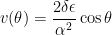
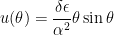
We begin by using three principles from Newtonian physics — the Law of Conservation of Angular Momentum, Newton’s Second Law, and Newton’s Law of Gravitation — to show that the orbit of a planet, under Newtonian physics, satisfies the initial-value problem
,
,
.
In these equations:
The orbit of the planet is in polar coordinates , where the Sun is placed at the origin.
The planet’s perihelion — closest distance from the Sun — is a distance of at angle .
The function is equal to .
is the gravitational constant of the universe.
is the mass of the Sun.
is the mass of the planet.
is the angular momentum of the planet.
The solution of this differential equation is

,
so that
.
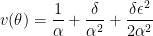
In polar coordinates, this is the graph of an ellipse. Substituting , we see that
.
In the solution for , we have and . The number is the eccentricity of the ellipse, while is proportional to the size of the ellipse.
Under general relativity, the governing initial-value problem changes to
,
,
,
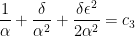
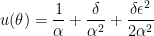
where is the speed of light. We will see that the solution of this new differential equation can be well approximated by
.
This last equation describes a spiral that precesses by approximately
radians per orbit
or
radians per orbit,
where is the length of the semimajor axis of the orbit.
This matches the amount of precession in Mercury’s orbit that is not explained by Newtonian physics, thus confirming Einstein’s theory of general relativity.
To the extent possible, I will take the perspective of a good student who has taken Precalculus and Calculus I. However, I will have to break this perspective a couple of times when I discuss principles from physics and derive the solutions of the above differential equations.
In this series, I’m discussing how ideas from calculus and precalculus (with a touch of differential equations) can predict the precession in Mercury’s orbit and thus confirm Einstein’s theory of general relativity. The origins of this series came from a class project that I assigned to my Differential Equations students maybe 20 years ago.
The figure below shows the (greatly exaggerated) effect of precession on a planet’s otherwise elliptical orbit. In the figure, each perihelion is precessed by an angle of . After nine orbits, the planet returns to its original position. Suppose, for the sake of argument, that each orbit of the planet depicted in the figure is four months, or one third of Earth’s year. Then the amount of precession would be per four months, or per year, or per century.
As I said, the figure above is greatly exaggerated. As we’ll see by the end of this series, Einstein’s general relativity predicts that, on top of the gravitational influences of the other planets, the orbit of Mercury should precess by 43″ of arc per century. That’s a really small angle, since 1 is equal to 60′ (minutes) of arc and each 1′ is equal to 60″ (seconds) of arc, that means 1″ of arc is the same as , so that 43″ of arc per century is about per century. That’s about a million times smaller than the precession of the fictitious planet in the above figure.
How small is , really?
Courtesy of Wikipedia, the pictures below are the Copernicus crater on the Moon as well as an indicator of its location on the Moon. It is visible with binoculars.
The diameter of the crater is 93 km. Since the Moon is 384,400 km from Earth, that means the angle subtended by the crater, as viewed from the Earth, is about
.
So how much is 43″ of arc per century? That’s about the speed as, hypothetically, pointing at the left edge of this lunar crater (which cannot be seen by the naked eye) and then slowly moving your figure so that, about 115 years later, your finger is pointing at the right edge of the crater.
Said another way, the diameter of the Moon is about 3475 km, so that the angle subtended by the Moon, as viewed from the Earth, is about
.
So, at the rate of per century, it would take centuries, or about 43,000 years, to trace the angle subtended by the moon.
Needless to say, 43” of arc per century is really, really slow.
Nevertheless, and remarkably, this itty, bitty precession was observable by careful 19th century astronomers with the telescopes that were available then. At the time, this precession was the great unsolved mystery of Newtonian physics that was only answered after two generations later with the discovery of general relativity.
If the universe consisted of only Mercury and the sun, Mercury’s trajectory would trace the same ellipse over and over again. However, there are seven other planets in the solar system (not to mention the dwarf planets), and these planets tug and nudge the orbit of Mercury ever so slightly. (For what it’s worth, similar nudges in the orbit of Uranus led to the discovery of Neptune in 1846.)
The practical effect of these nudges is that the orbit of Mercury precesses, or rotates like a spiral. The figure below shows the (greatly exaggerated) effect of precession on a planet’s otherwise elliptical orbit. In the figure, each perihelion is precessed by an angle of . After nine orbits, the planet returns to its original position.
Since the planets are much smaller than the sun and are further away from the Sun than Mercury, this precession is very small. However, this effect can be measured. Every century, the perihelion of Mercury precesses by 574” of arc (roughly a sixth of a degree).
Newton’s Law of Gravitation can be used to calculate the amount of the precession of Mercury; however, they predict a precession of only 531” of arc per century. This discrepancy between observation and prediction was first observed in 1845 and was, for a long time, the outstanding unresolved difficulty in Newtonian physics.
Einstein’s general theory of relativity, which was published seventy years later in 1915, exactly accounts for the missing 43” per century (within the tolerances of observational error). This was the first physical confirmation of general relativity. Furthermore, general relativity predicted that the orbit of Venus also precesses, but by only about 9” of arc per century. This small discrepancy was unobservable in 1915 but was confirmed in 1960. (While not logically necessary, that’s certainly indicative of an accurate scientific theory… not that it merely explains the world but it makes a prediction that is currently unobservable.)
In this series, which might take me a few months to complete, I’m going to explore how to predict the precession in Mercury’s orbit — i.e., confirm Einstein’s theory of general relativity — using tools only from calculus and precalculus. I first introduced these ideas as a class project for my Differential Equations students maybe 20 years ago. As we’ll see, in a couple spots, ideas from first-semester differential equations can make the steps more rigorous. However, pretty much this whole series should be accessible to a good calculus student.
I should say at the outset that none of the mathematics in this series is particularly original with me. I gladly acknowledge that I first learned the ideas in this series as an undergraduate, when I took an upper-level physics course in mechanics. In particular, pretty much all of the ideas in this series can be found in the textbook Classical Dynamics of Particles and Systems, by S. T. Thornton and J. B. Marion (Brooks Cole, New York, 2003). If I’ve made any contribution, it’s the scaffolding of these ideas to make them accessible to students who won’t be taking (or haven’t yet taken) physics courses beyond the traditional first-year sequence.