
Where I live, public schools reopen to students next week… which means innumerable back-to-school organizational meetings for our teachers. Last year, the good folks of West Des Moines put together this flash mob at their district-wide back-to-school meeting. After the superintendent’s deliberately dry introductory remarks are cut off, the fun begins at the 1:20 mark. (Be sure to turn on closed captioning to see the lyrics.)
100,000 page views
I’m taking a one-day break from my usual posts on mathematics and mathematics education to note a symbolic milestone: meangreenmath.com has had more than 100,000 total page views since its inception in June 2013. Many thanks to the followers of this blog, and I hope that you’ll continue to find this blog to be a useful resource to you.

Twenty most viewed posts or series (written by me):
- All I want to be is a high school teacher. Why do I have to take Real Analysis?
- Analog clocks
- Another poorly written word problem
- Arithmetic and geometric series
- Common Core, subtraction, and the open number line
- Exponential growth and decay
- Finger trick for multiplying by 9
- Full lesson plan: magic squares
- Full lesson plan: Platonic solids
- Fun with dimensional analysis
- Importance of the base case in a proof by induction
- Infraction
- Inverse Functions
- My “history” of solving cubic, quartic and quintic equations
- My Mathematical Magic Show
- Square roots and logarithms without a calculator
- Student misconceptions about PEMDAS
- Taylor series without calculus
- Was there a Pi Day on 3/14/1592?
- What Happens if the Explanatory and Response Variables Are Sorted Independently?
Twenty most viewed posts (guest presenters):
- Engaging students: Classifying polygons
- Engaging students: Congruence
- Engaging students: Deriving the distance formula
- Engaging students: Distinguishing between axioms, postulates, theorems, and corollaries
- Engaging students: Distinguishing between inductive and deductive reasoning
- Engaging students: Factoring quadratic polynomials
- Engaging students: Finding x- and y-intercepts
- Engaging students: Laws of Exponents
- Engaging students: Multiplying binomials
- Engaging students: Order of operations
- Engaging students: Pascal’s triangle
- Engaging students: Right-triangle trigonometry
- Engaging students: Solving linear systems of equations by either substitution or graphing
- Engaging students: Solving linear systems of equations with matrices
- Engaging students: Solving one-step and two-step inequalities
- Engaging students: Solving quadratic equations
- Engaging students: Square roots
- Engaging students: Translation, rotation, and reflection of figures
- Engaging students: Using right-triangle trigonometry
- Engaging students: Volume and surface area of pyramids and cones
If I’m still here at that time, I’ll make a summary post like this again when this blog has over 200,000 page views.
Why the Math Curriculum Makes No Sense
As a follow-up to yesterday’s post, there’s a lot of wisdom in the Math With Bad Drawings post “Why the Math Curriculum Makes No Sense.” I recommend it highly.
Quantitative Literacy
From http://devlinsangle.blogspot.com/2016/03/the-math-myth-that-permeates-math-myth.html:
March 1 saw the publication of the book The Math Myth: And Other STEM Delusions, by Andrew Hacker. MAA members are likely to recognize the author’s name from an opinion piece he published in the New York Times in 2012, with the arresting headline “Is Algebra Necessary?”
…
On page 48, Hacker presents a question he took from an MCAT paper. It provides some technical data and asks what happens to the ratio of two inverse-square law forces between charges of given masses when the distance between them is halved. The context Hacker provides for this question is that medical professionals needs to be able to read and understand the mathematics used in technical papers. His claim is that this requirement does not extend to the physics of electrical and gravitational forces. In that, he is surely correct… What this question is asking for is, Do you understand what a ratio is? Surely that is something that any medical professional who will have to read and understand journal articles would need to know. Hacker completely misses this simple observation, and presents the question as an example of baroque mathematical testing run amok.
On page 70, he presents a question from an admissions test for selective high schools. A player throws two dice and the same number comes up on both. The question asks the student to choose the probability that the two dice sum to 9 from the list 0, 1/6, 2/9, 1/2, 1/3. Hacker’s problem is that the student is supposed to answer this in 90 seconds. Now, I share Hacker’s disdain for time-limited questions, but in this case the answer can only be 0. It’s not a probability question at all, and no computation is required. It just requires you to recognize that you can never get a sum of 9 when two dice show the same number. As with the MCAT question, the question is simply asking, Do you understand numbers? In this case, do you recognize that the sum of two equal numbers can never be odd…
You get the pattern surely? Hacker’s problem is he is unable to see through the surface gloss of a problem and recognize that in many cases it is just asking the student if she or he has a very basic grasp of number, quantity, and relationships. Yet these are precisely the kinds of abilities he argues elsewhere in the book are crucial in today’s world. He is, I suspect, a victim of the very kind of math teaching he rightly decries—one that concentrates on learning rules and mastering formal manipulations, with little attention to understanding.
My favorite response came from a very perceptive high school students in the New York Times’ letters to the editor (http://www.nytimes.com/2016/02/19/opinion/maths-place-in-the-classroom.html?ref=topics&_r=1):
In “Who Needs Math? Not Everybody” (Education Life, Feb. 7), Andrew Hacker, who teaches quantitative reasoning at Queens College, says that since only 5 percent of people use algebra and/or geometry in their jobs, students don’t need to learn these subjects.
As a high school student, I strongly disagree.
The point of learning is to understand the world. If the only point of learning is job preparation, why should students learn history, or read Shakespeare?
And while your job may never require you to know the difference between a postulate and a theorem, it will almost certainly require other math-based skills, like how to prove something or how to understand a graph. If nothing else, people need math to understand finance, which is a part of everyone’s life.
I also disagree with the logic that if people are failing algebra, then they shouldn’t take algebra. If people approach life that way, they will get nowhere.
Algebra and geometry have a place in the classroom. If students are failing, then the way math is taught may need to change. But what is taught needs no alteration.
Which is crying shame, because Hacker does have good ideas about what a quantitative literacy course should look like (again, from Devlin):
The tragedy of The Math Myth is that Hacker is actually arguing for exactly the kind of life-relevant mathematics education that I and many of my colleagues have been arguing for all our careers. (Our late colleague Lynn Steen comes to mind.) Unfortunately, and I suspect because Hacker himself did not have the benefit of a good math education, his understanding of mathematics is so far off base, he does not recognize that the examples he holds up as illustrations of bad education only seem so to him, because he misunderstands them.
The real myth in The Math Myth is the portrayal of mathematics that forms the basis of his analysis. It’s the same myth you see propagated in Facebook posts from frustrated parents about Common Core math homework their children bring home from school.
How To Email Your Professor Without Being Annoying
I really enjoyed reading this blogpost and have shared it with my students; I’ve also shared with other advisers to share with their students. The opening paragraphs:
Every semester, I see the tweets and Facebook posts. My professor friends, they are annoyed. Their students do not know how to write emails, they say. What they really mean is that their students don’t know how to follow the conventions of email etiquette in the academy. I used to be exasperated by student emails too. Until I realized that there was a simple explanation for why they didn’t know how to write them — they’ve never actually been taught how.*
But now, clueless students have no excuse, because they can read this post. Profs, share it with your students. Students, share it with your friends. Or don’t, and be the one person in the class your prof enjoys receiving email from.
10 Elements of an Effective, Non-Annoying Email
Here’s a template you can follow in constructing your email to a professor. Each element is explained further below.
Dear [1] Professor [2] Last-Name [3],
This is a line that recognizes our common humanity [4].
I’m in your Class Name, Section Number that meets on This Day [5]. This is the question I have or the help I need [6]. I’ve looked in the syllabus and at my notes from class and online and I asked someone else from the class [7], and I think This Is The Answer [8], but I’m still not sure. This is the action I would like you to take [9].
Signing off with a Thank You is always a good idea [10],
Favorite Student
I recommend reading the whole thing at https://medium.com/@lportwoodstacer/how-to-email-your-professor-without-being-annoying-af-cf64ae0e4087#.gpusikv4s
College Success Tips
I really enjoyed reading this blogpost and have shared its contents with my students and friends; I’ve also shared it with other advisers to pass on to their students. Here’s the abbreviated summary; the original post has a lot of good advice for each of these points.
Here’s my best list of what to do to succeed in college:
1. Go to class.
2. First day of every class, get two people’s phone numbers.
3. Take notes in class by hand.
4. Rewrite your notes.
5.College is your job. Your job is to be a student. It is a full-time job.
6. Go see each professor during office hours.
7. Do the reading before the class.
In sum:
– You are a student. That is your job. Spend 40 hours a week on your classes, and you’ll have time for fun.
– Do the reading. Go to class. Talk to your professors. Ask them questions.
– Take responsibility for your life and your education.
My amendment to #5 (which I tell incoming freshmen): for every hour that you spend in class, you should expect to spend 2-3 hours studying/doing homework/etc. outside of class. So going to school is approximately the same as a full-time job, but without the hard upper-limit of 40 hours per week.
As a corollary: this ratio is approximately the reverse of high school, when students spend one hour studying for every 2-3 hours spent in class. That’s because in high school, the learning happens in class. (Some AP courses in high school may be exceptions to this rule of thumb.) However, in college, the learning generally happens outside of class. My math students get me in class for 2.5 hours per week. In that time, I can set up the big picture, lay out a conceptual framework, work out a few illustrative examples, and address a few common misconceptions. Emphasis is on “a few,” because 2.5 hours per week isn’t enough time to get students to the depth of understanding that I expect an A student to possess by the end of the semester. So the deeper understanding is obtained outside of class, not inside.
I recommend reading the whole post at http://leahjackman.com/college-success-tips/.
See also her follow-up post http://leahjackman.com/midsemester-meltdown/
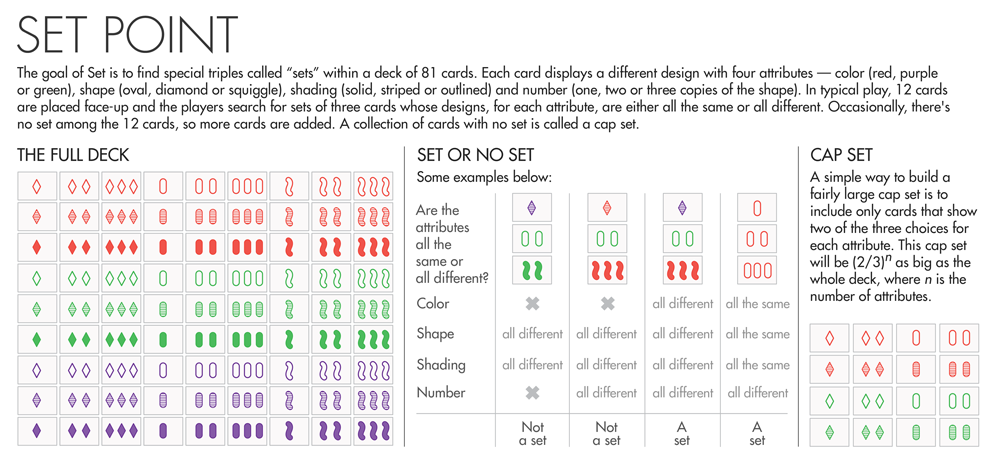
Simple Set Game Proof Stuns Mathematicians
I enjoyed reading this article about recent progress on finding smaller and smaller cap sets in the card game Set.
Source: https://www.quantamagazine.org/20160531-set-proof-stuns-mathematicians/
Danica McKellar from NOVA
I really enjoyed this:
How many ways can you arrange 128 tennis balls?
I found this bit of computational mathematics fascinating. From http://www.joh.cam.ac.uk/how-many-ways-can-you-arrange-128-tennis-balls-researchers-solve-apparently-impossible-problem:
Imagine that you have 128 soft spheres, a bit like tennis balls. You can pack them together in any number of ways. How many different arrangements are possible?
The answer, it turns out, is something like 10250 (1 followed by 250 zeros). The number, also referred to as ten unquadragintilliard, is so huge that it vastly exceeds the total number of particles in the universe.
Far more important than the solution, however, is the fact that the researchers were able to answer the question at all. The method that they came up with can help scientists to calculate something called configurational entropy – a term used to describe how structurally disordered the particles in a physical system are.
An Interview with Randall Munroe
FiveThirtyEight.com interviewed Randall Munroe, the author of the wildly popular xkcd webcomic. I recommend the whole interview, but I thought that the follow few paragraphs were exceptionally insightful.
One thing that bothers me is large numbers presented without context. We’re always seeing things like, “This canal project will require 1.15 million tons of concrete.” It’s presented as if it should mean something to us, as if numbers are inherently informative. So we feel like if we don’t understand it, it’s our fault.
But I have only a vague idea of what one ton of concrete looks like. I have no idea what to think of a million tons. Is that a lot? It’s clearly supposed to sound like a lot, because it has the word “million” in it. But on the other hand, “The Adventures of Pluto Nash” made $7 million at the box office, and it was one of the biggest flops in movie history.
It can be more useful to look for context. Is concrete a surprisingly large share of the project’s budget? Is the project going to consume more concrete than the rest of the state combined? Will this project use up a large share of the world’s concrete? Or is this just easy, space-filling trivia? A good rule of thumb might be, “If I added a zero to this number, would the sentence containing it mean something different to me?” If the answer is “no,” maybe the number has no business being in the sentence in the first place.

