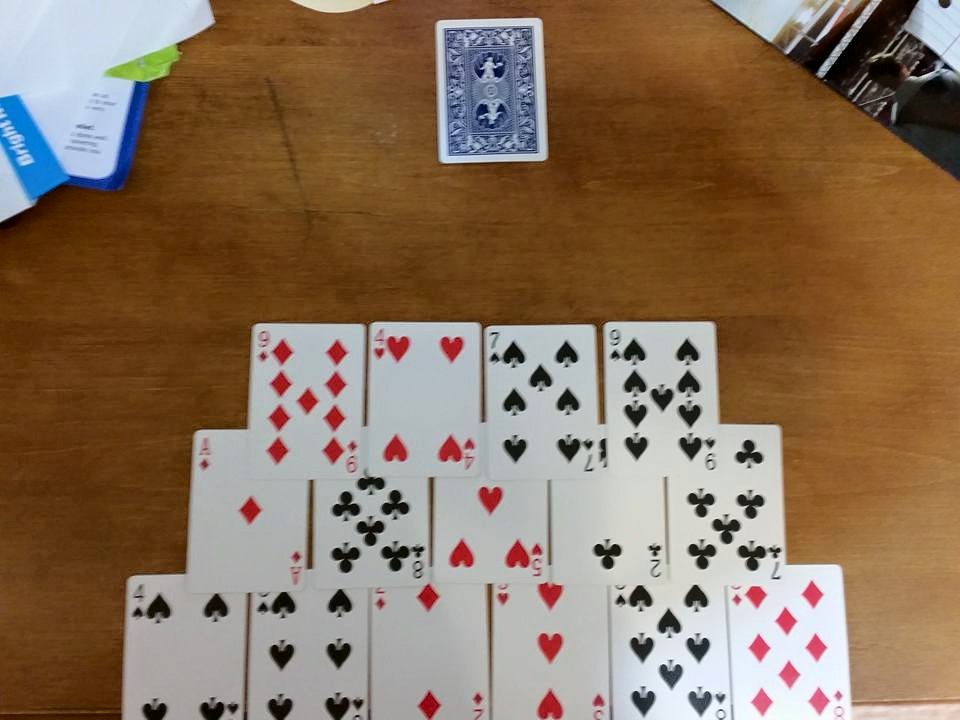
This mathematical trick was not part of my Pi Day magic show but probably should have been. I first read about this trick in one of Martin Gardner‘s books when I was a teenager, and it’s amazing how impressive this appears when performed. I particularly enjoy stumping my students with this trick, inviting them to figure out how on earth I pull it off.
Here’s a video of the trick, courtesy of Numberphile:
Summarizing, there’s a way of quickly determining given the value of if is a positive integer less than 100:
The ones digit of will be the ones digit of .
The tens digit of can be obtained by listening to how big is. This requires a bit of memorization (and I agree with the above video that the hardest ones to quickly determine in a magic show are the ones less than and the ones that are slightly larger than a billion):
Even though I’ve had nothing but good professional relationships with the athletic department at my own university, I still think this is really funny.
Here’s a standard joke involving representing numbers in different bases.
Q: If only DEAD people understand hexadecimal, then how many people understand hexadecimal?
A: 57,005.
The joke, of course, is that can be considered a number written in base 16, using the usual convention , , , , , and . In other words, can be converted to decimal as follows:
.
After I heard this joke, I wondered just how many English words can be formed using only the letters A, B, C, D, E, and F so that I could make a subtle joke on a test. To increase the length of my list, I also allowed words that included the letters O (close enough to a 0), I (close enough to 1), and/or S (close enough to 5). However, I eliminated words that start with O (since a numeral normally doesn’t start with 0) and/or end in S (the plural version of these words are easily formed).
So I wrote a small program to search the dictionary that I have on my computer. The unabridged list follows, with words beginning with a capital letter (such as names or places) listed at the bottom. I emphasize that this list is unabridged, as there are several words on this list that I wouldn’t place on a test for obvious reasons: I would never ask my class to convert the base-10 numeral 721,077 into hexadecimal just so they can obtain the answer of .
I’m doing something that I should have done a long time ago: collecting a series of posts into one single post. The following links comprised my series on an advertisement that I saw in Jason’s Deli.
Part 1: The advertisement for the Jason’s Deli salad bar.
Part 2: Correct calculation of the number of salad bar combinations.
Part 3: Incorrect calculation of how long it would take to eat this many combinations.
Decathlon, which at the Olympics is a men’s event, is composed of 10 events: the 100 meters, long jump, shot put, high jump, 400 meters, 110-meter hurdles, discus throw, pole vault, javelin throw and 1,500 meters. Heptathlon, a women’s event at the Olympics, has seven events: the 100-meter hurdles, high jump, shot put, 200 meters, long jump, javelin throw and 800 meters…
As it stands, each event’s equation has three unique constants — $latex A$, $latex B$ and $latex C$— to go along with individual performance, $latex P$. For running events, in which competitors are aiming for lower times, this equation is: $latex A⋅(B–P)^C$, where $latex P$ is measured in seconds…
is effectively a baseline threshold at which an athlete begins scoring positive points. For performances worse than that threshold, an athlete receives zero points.
For field events, in which competitors are aiming for greater distances or heights, the formula is flipped in the middle: $latex A⋅(P–B)^C$, where $latex P$ is measured in meters for throwing events and centimeters for jumping and pole vault.
Specifically, for the decathlon jumping events ( is measured in centimeters):
High jump:
Pole vault:
Long jump:
For the decathlon throwing events ( is measured in meters):
Shot put: .
Discus: .
Javelin: .
Specifically, for the heptathlon jumping events ( is measured in centimeters):
High jump:
Long jump:
For the heptathlon throwing events ( is measured in meters):
Shot put: .
Javelin: .
I’m sure there are good historical reasons for why these particular constants were chosen, but suffice it to say that there’s nothing “magical” about any of these numbers except for human convention. From FiveThirtyEight:
The [decathlon/heptathlon] tables [devised in 1984] used the principle that the world record performances of each event at the time should have roughly equal scores but haven’t been updated since. Because world records for different events progress at different rates, today these targets for WR performances significantly differ between events. For example, Jürgen Schult’s 1986 discus throw of 74.08 meters would today score the most decathlon points, at 1,384, while Usain Bolt’s 100-meter world record of 9.58 seconds would notch “just” 1,203 points. For women, Natalya Lisovskaya’s 22.63 shot put world record in 1987 would tally the most heptathlon points, at 1,379, while Jarmila Kratochvílová’s 1983 WR in the 800 meters still anchors the lowest WR points, at 1,224.
FiveThirtyEight concludes that, since the exponents in the running events are higher than those for the throwing/jumping events, it behooves the elite decathlete/heptathlete to focus more on the running events because the rewards for exceeding the baseline are greater in these events.
Finally, since all of the exponents are not integers, a negative base (when the athlete’s performance wasn’t very good) would actually yield a complex-valued number with a nontrivial imaginary component. Sadly, the rules of track and field don’t permit an athlete’s score to be a non-real number. However, if they did, scores might look something like this…
I really enjoyed a recent Math With Bad Drawings post on how descriptive statistics can be used to deceive. For example:
See the rest of the post for similar picture for mean, median, mode, and variance (equivalent to standard deviation); I’ll be using these in my future statistics classes.


and the ones that are slightly larger than a billion):
 can be considered a number written in base 16, using the usual convention
  ,
,  ,
,  ,
,  ,
,  , and
, and  . In other words,
  .
. .
.

 is measured in seconds):
 .
. .
. .
. .
. .
. .
. .
.


 .
. .
. .
.

 .
. .
.

 Mean Green Math