
A Mathematician’s New Year’s Resolutions
Let
be the proposition “I want
for Christmas.” Translate the logical statement
,
where the domain is all things.
The clunky way of translating this into English is,”I want you for Christmas, and if something isn’t you, then I don’t want that for Christmas.”

Context: This semester, I taught discrete mathematics for the first time. Part of the discrete mathematics course includes an introduction to predicate and propositional logic for our math majors. As you can probably guess from their names, students tend to think these concepts are dry and uninteresting even though they’re very important for their development as math majors.
In an effort to making these topics more appealing, I spent a few days mining the depths of popular culture in a (likely futile) attempt to make these ideas more interesting to my students. In this series, I’d like to share what I found. Naturally, the sources that I found have varying levels of complexity, which is appropriate for students who are first learning prepositional and predicate logic.
When I actually presented these in class, I either presented the logical statement and had my class guess the statement in actual English, or I gave my students the famous quote and them translate it into predicate logic. However, for the purposes of this series, I’ll just present the statement in predicate logic first.
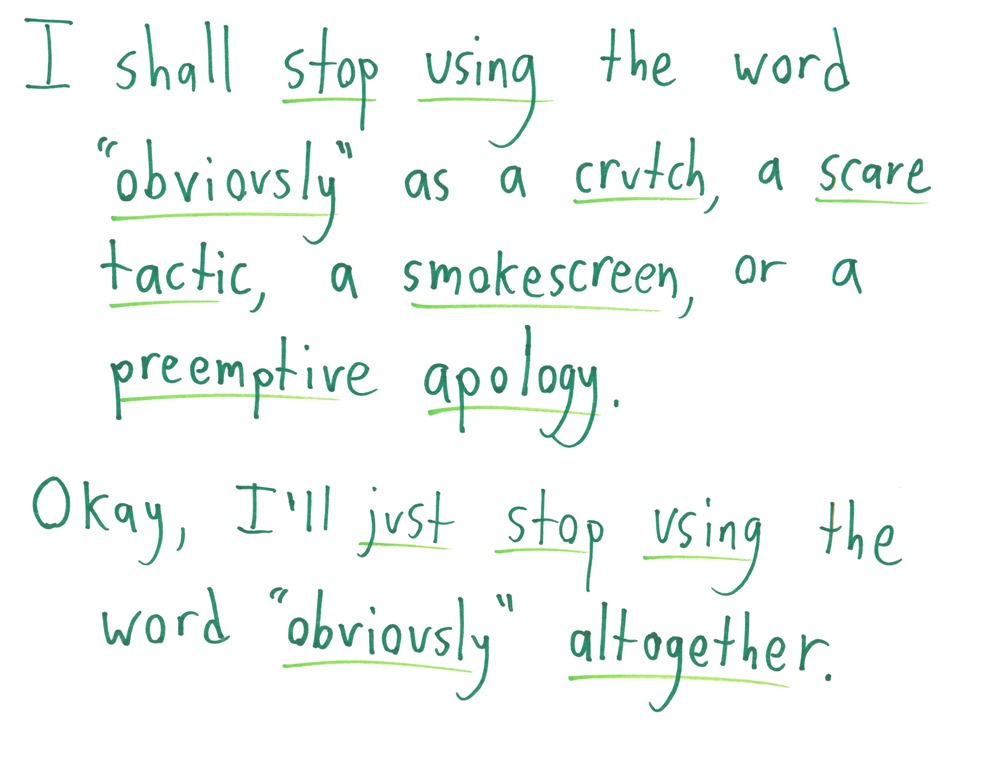
I’m a couple months late with this… after all, school started in August… but nevertheless I recently stumbled on this voiceless video syllabus by Joshua Katz, a mathematics teacher in Florida.
I really enjoyed this.
Well done, sir. Your students are very lucky to have you as a teacher.
Math With Bad Drawings had a nice post about strategies teachers can use to address a student who volunteers an incorrect answer. This is a natural dilemma for teachers who want to encourage class participation but who don’t want to deflate students who make mistakes. I recommend this essay highly: http://mathwithbaddrawings.com/2014/11/05/wrong-but-not-stupid-or-how-to-call-out-mistakes-without-trampling-the-mistaken/
One recent strategy that I’ve employed is quoting the trolls from Frozen: https://meangreenmath.com/2014/06/14/a-bit-of-a-fixer-upper/
I’m taking a one-day break from my usual posts on mathematics and mathematics education to note a symbolic milestone: meangreenmath.com has had more than 50,000 total page views since its inception in June 2013. Many thanks to the followers of this blog, and I hope that you’ll continue to find this blog to be a useful resource to you.
Some other (probably useless) statistics: this blog has been viewed by readers from 167 different countries. Top viewership: the United States, India, the Philippines, Canada, the United Kingdom, Australia, Brazil, the European Union, United Arab Emirates, Germany, Taiwan, and Pakistan.
Twelve most viewed posts or series (written by me):
Twelve most viewed posts (guest presenters):
Top twelve search engine terms that landed people on my blog:
Twelve other search engine terms that caught my attention:
If I’m still here at that time, I’ll make a summary post like this again when this blog has over 100,000 page views.
From the YouTube description:
Almost fifty years ago, Cambridge University Press published the correspondence of Isaac Newton, a seven-volume, 3000-page collection of letters that provides insight into this great, if difficult, genius. William Dunham shares his favorite examples of Newton as correspondent. He ends with Newton’s most-quoted line about standing on the shoulders of giants and how his search for its place of origin led him, improbably, to a library in Philadelphia.

Source: http://www.xkcd.com/1184/
Further comments, from Nicholas Vanserg, “Mathmanship,” The American Scientist, Vol. 46, No. 3 (1958):
In an article published a few years ago, the writer intimated with befitting subtlety that since most concepts of science are relatively simple (once you understand them), any ambitious scientist must, in self-preservation, prevent his colleagues from discovering that his ideas are simple too…
The object of… Mathmanship is to place unsuspected obstacles in the way of the pursuer until he is obliged, by a series of delays and frustrations, to give up the chase and concede his mental inferiority to the author…
[U]se a superscript as a key to a real footnote. The knowledge seeker reads that
is
calories and thinks, “Gee what a whale of a lot of calories,” until he reads to the bottom of the page, finds footnote 14 and says, “oh.”
I’m a couple months late with this, but my colleague Jason Ermer at Collaborative Mathematics has published Challenge 11 on his website: http://www.collaborativemathematics.org/
I’m taking a one-day break from my usual posts on mathematics and mathematics education to note a symbolic milestone: meangreenmath.com has had more than 25,000 total page views since its inception in June 2013. Many thanks to the followers of this blog, and I hope that you’ll continue to find this blog to be a useful resource to you.
Some other (probably useless) statistics: this blog has been viewed by readers from 145 different countries. Top viewership: the United States, India, the Philippines, Canada, the United Kingdom, Australia, Brazil, Pakistan, Singapore, and France.
Ten most viewed posts (written by me):
Ten most viewed posts (guest presenters):
Top five referrals not written by me (thank you!):
Top ten search engine terms that landed people on my blog:
Ten other search engine terms that caught my attention:


 Mean Green Math