Area of a triangle: SAS, ASA, and the Law of Sines (Part 4)

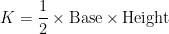
The typical way students remember the area K of a triangle is

K = \displaystyle \frac{1}{2} \times \hbox{Base} \times \hbox{Height}

However, there are other formulas for the area of a triangle which can be helpful if the height is not immediately known.

Case 1: SAS. Suppose that two sides and the angle between the sides — say, b and c and the measure of angle A — are known.

triangle

If \overline{CD} is an altitude for \triangle ABC, then \triangle ACD is a right triangle. Therefore,

\sin A = \displaystyle \frac{\hbox{opposite}}{\hbox{hypotenuse}} = \displaystyle \frac{h}{b}, or h = b \sin A.

Therefore,

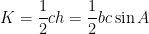
K = \displaystyle \frac{1}{2} ch = \displaystyle \frac{1}{2} bc \sin A.

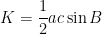
Using the same picture, one can also show that

K = \displaystyle \frac{1}{2} ac \sin B

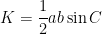
Also, with a different but similar picture, one can show that

K = \displaystyle \frac{1}{2} ab \sin C

green lineAn important consequence of the SAS area formula is the Law of Sines. Since all three formulas must give the same area K, we have

\displaystyle \frac{1}{2} bc \sin A = \displaystyle \frac{1}{2} ac \sin B = \displaystyle \frac{1}{2} ab \sin C

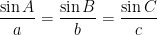
Multiplying by \displaystyle \frac{2}{abc} produces the Law of Sines:

\displaystyle \frac{\sin A}{a} = \displaystyle \frac{\sin B}{b} = \displaystyle \frac{\sin C}{c}

green lineCase 2: ASA. Now suppose that we are given the measures of two angles and the length of the side in between them — say, angles A and B and side c. Naturally, we can also get the measure of angle C since the sum of the measures of the three angles must be 180^o.

From the SAS formula and the Law of Sines, we have

K = \displaystyle \frac{1}{2} bc \sin A \quad \hbox{and} \quad \displaystyle b = \frac{c \sin B}{\sin C}

Combining these, we find

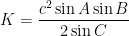
K = \displaystyle \frac{1}{2} \frac{c \sin B}{\sin C} \cdot c \sin A

K = \displaystyle \frac{c^2 \sin A \sin B}{2 \sin C}

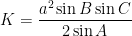
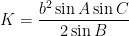
By similar reasoning, we can also find that

K = \displaystyle \frac{a^2 \sin B \sin C}{2 \sin A} ~~ and ~~ K = \displaystyle \frac{b^2 \sin A \sin C}{2 \sin B}

Volume of pyramids, cones, and spheres (Part 3)

I’m in the middle of a series of posts concerning the area of a triangle. Today, however, I want to take a one-post detour using yesterday’s post as a springboard. In yesterday’s post, we discussed a two-dimensional version of Cavalieri’s principle. From Wikipedia:

Suppose two regions in a plane are included between two parallel lines in that plane. If every line parallel to these two lines intersects both regions in line segments of equal length, then the two regions have equal areas.

In other words, if I have any kind of shape that has cross-sections that match those of the triangles above, then the shape has the same area as the triangles. Geometrically, we can think of each triangle a bunch of line segments joined together. So while the positioning of the line segments affects the shape of the region, the positioning does not affect the area of the region.

There is also a three-dimensional statement of Cavalieri’s principle, and this three-dimensional version is much more important than the above two-dimensional version. From MathWorld:

If, in two solids of equal altitude, the sections made by planes parallel to and at the same distance from their respective bases are always equal, then the volumes of the two solids are equal.

Pedagogically, I would recommend introducing Cavalieri’s principle with two-dimensional figures like those from yesterday’s post since cross-sections in triangles are much easier for students to visualize than cross-sections in three-dimensional regions.

This three-dimensional version of Cavalieri’s principle is needed to prove — without calculus — the volume formulas commonly taught in geometry class. Based on my interactions with students, they are commonly taught without proof, as my college students can use these formulas but have no recollection of ever seeing any kind of justification for why they are true. When I teach calculus, I show my students that the volume of a sphere can be found by integration using the volume of a solid of revolution:

V = \displaystyle \int_{-R}^R \pi \left[ \sqrt{R^2 - x^2} \right]^2 \, dx = \frac{4}{3} \pi R^3

Without fail, my students (1) already know this formula from Geometry but (2) do not recall ever being taught why this formula is correct. Curious students also wonder (3) how the volume of a sphere (or a pyramid or a cone) can be obtained only using geometric concepts and without using calculus.

For the sake of brevity, I only give the logical flow for how these volumes can be derived for students without using calculus. I’ll refer to this excellent site for more details about each step.

  • Using a simple foldable manipulative (see also this site), students can see that V = \displaystyle \frac{1}{3} Bh for a certain pyramid — called a yangma — with a square base and a height that is equal to the base length.
  • Enlarging the yangma will not change the ratio of the volume of the pyramid to the volume of the prism.
  • Cavalieri’s principle then shows that V = \displaystyle \frac{1}{3} Bh for any square pyramid.
  • Cavalieri’s principle then shows that V = \displaystyle \frac{1}{3} Bh for any pyramid with a non-square base or even a cone with a circular base.
  • Finally, a clever use of Cavalieri’s principle — comparing a sphere to a cylinder with a cone-shaped region removed — can be used to show that the volume of a sphere is V = \displaystyle \frac{4}{3} \pi R^3.

green line

I note in closing that there are other ways for students to discover these formulas, like filling an empty pyramid with rice, pouring into an empty prism of equal base and height, and repeating until the prism is filled.

Area of a triangle: Equal cross-sections (Part 2)

Let’s take a second look at the familiar formula for the area of a triangle, A = \displaystyle \frac{1}{2}bh.

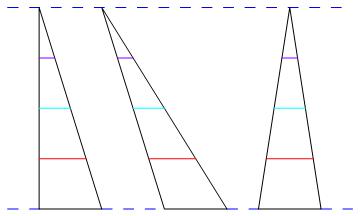
trianglecross1The picture above shows three different triangles: one right, one obtuse, and one acute. The three triangles have bases of equal length and also have the same height. Therefore, even though the triangles have different shapes (i.e., they’re not congruent), they have the same height.

Let’s take a second look at these three triangles. In each triangle, I’ve drawn in three “cross-section” line segments which are parallel to the base. Notice that corresponding cross-sections have equal length. In other words, the red line segments have the same length, the light-blue line segments have the same length, and the purple line segments have the same length.

Why is this true? There are two ways of thinking about this (for the sake of brevity, I won’t write out the details).

  • Algebraically, the length of the cross-section increases linearly as they descend from the top vertex to the bottom base. This linear increase does not depend upon the shape of the triangle. Since the three triangles have bases of equal length, the cross-sections have to have the same length.
  • Geometrically, the length of the cross-sections can be found with similar triangles, comparing the big original triangle to the smaller triangle that has a cross-section as its base. Again, the scale factor between the similar triangles depends only on the height of the smaller triangle and not on the shape of the original triangle. So the cross-sections have to have the same length.

So, since the three triangles share the same height and base length, the three triangles have the same area, and the corresponding cross-sections have the same length.

The reverse principle is also true. This is called Cavalieri’s principle. From Wikipedia:

Suppose two regions in a plane are included between two parallel lines in that plane. If every line parallel to these two lines intersects both regions in line segments of equal length, then the two regions have equal areas.

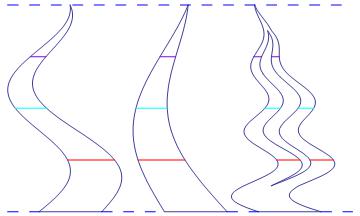
In other words, if I have any kind of shape that has cross-sections that match those of the triangles above, then the shape has the same area as the triangles. Geometrically, we can think of each triangle a bunch of line segments joined together. So while the positioning of the line segments affects the shape of the region, the positioning does not affect the area of the region.

For example, here are three non-triangular regions whose cross-sections match those of the above triangles. The region on the right is especially complex since it has a curvy hole in the middle, so that the cross-sections shown are actually two distinct line segments. Nevertheless, we can say with confidence that, by Cavalieri’s principle, the area of each region matches those of the triangles above.

trianglecross2

Though we wouldn’t expect geometry students to make this connection, Cavalieri’s principle may be viewed as a geometric version of integral calculus. In calculus, we teach that the area between the curves x = f(y) and x = F(y) is equal to

A = \displaystyle \int_{y_1}^{y_2} [F(y) - f(y)] \, dy = \displaystyle \int_{y_1}^{y_2} d(y) \, dy

where $d(y) = F(y) – f(y)$ is the difference in the two curves. In the above formula, I chose integration with respect to y since the $y-$coordinates are constant in the above cross-sections. The difference d(y) is precisely the length of the cross-sections. As with the triangles, the positioning of the cross-sections will affect the shape of the region, but the positioning of the cross-sections does not affect the length d(y) and hence does not affect the area A of the region.

Area of a triangle: Base and height (Part 1)

This begins a series of post concerning how the area of a triangle can be computed. This post concerns the formula that students most often remember:

A = \displaystyle \frac{1}{2} b h

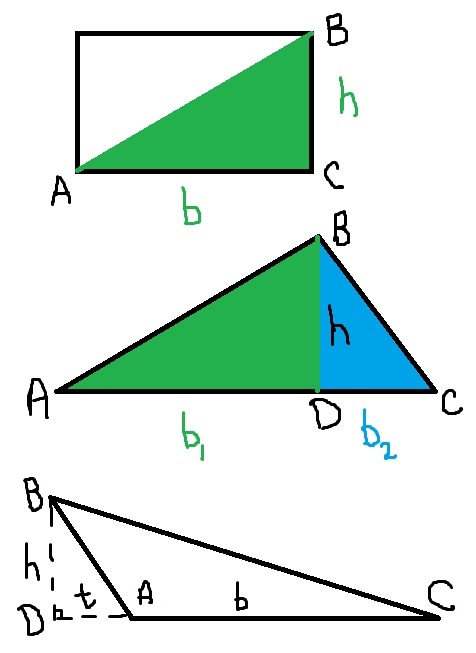
Why is this formula true? Consider \triangle ABC, and form the altitude from B to line AB. Suppose that the length of AC is b and that the altitude has length h. Then one of three things could happen:

triangles

Case 1. The altitude intersects AC at either A or C. Then \triangle ABC is a right triangle, which is half of a rectangle. Since the area of a rectangle is bh, the area of the triangle must be \displaystyle \frac{1}{2} bh.

Knowing the area of a right triangle will be important for Cases 2 and 3, as we will act like a good MIT freshman and use this previous work.

Case 2. The altitude intersects AC at a point D between A and C. Then \triangle ABD and \triangle BCD are right triangles, and so

\hbox{Area of~} \triangle ABC = \hbox{Area of ~} \triangle ABD + \hbox{~Area of~} \triangle BCD

\hbox{Area of~} \triangle ABC = \displaystyle \frac{1}{2} b_1 h + \frac{1}{2} b_2 h

\hbox{Area of~} \triangle ABC = \displaystyle \frac{1}{2} (b_1 + b_2) h

\hbox{Area of~} \triangle ABC = \displaystyle \frac{1}{2} bh

Case 3. The altitude intersects AC at a point D that is not in between A and C. Without loss of generality, suppose that A is between D and C. Then \triangle ABD and \triangle BCD are right triangles, and so

\hbox{Area of~} \triangle ABC = \hbox{Area of ~} \triangle BCD - \hbox{~Area of~} \triangle ACD

\hbox{Area of~} \triangle ABC = \displaystyle \frac{1}{2} (b+t) h + \frac{1}{2} t h

\hbox{Area of~} \triangle ABC = \displaystyle \frac{1}{2} (b+t-t) h

\hbox{Area of~} \triangle ABC = \displaystyle \frac{1}{2} bh

Engaging students: Completing the square

In my capstone class for future secondary math teachers, I ask my students to come up with ideas for engaging their students with different topics in the secondary mathematics curriculum. In other words, the point of the assignment was not to devise a full-blown lesson plan on this topic. Instead, I asked my students to think about three different ways of getting their students interested in the topic in the first place.

I plan to share some of the best of these ideas on this blog (after asking my students’ permission, of course).

This student submission comes from my former student Claire McMahon. Her topic, from Algebra: completing the square.

green line

There were a lot of famous mathematicians that contributed to the notion of completing the square.  The first of the mathematicians was that of the Babylonians.  This culture started the notion of not only solving the quadratics but of arithmetic itself.  The Babylonians started with the equations and then proceeded to solve them algebraically.  Back then; they used pre-calculated tables to help them with solving for the roots.  They were basically solving by the quadratic equation at this point.  The man that came along has a very hard name to not only pronounce but to spell, and I will do my best.  I will refer to him as Muhammad from here on out but his full name, or one of the common names to which he is referred is Muhammad ibn Musa al-Khwarizmi.  He developed the term algorithm, which led to an algorithm for solving quadratic equations, namely completing the square.

The notion of completing the square has gone through a series of transformations throughout the history of mathematics.  As mentioned before the Babylonians started with the notion and increased the knowledge by developing the quadratic formula to find the roots of a given quadratic equation.  This spurred the thought that I can solve any equation and find its solution and roots by completing the square.  Muhammad brought this notion to us, of which was mentioned before.  More specifically the text that he developed was “The Compendious Book of Calculations by Completion and Balancing.”  This book of course has been translated several times over but the general idea is laid out in the title.  Modern mathematicians have developed a less compendious form that is now being taught in the math classes today.  They take on many different forms and can be taught with manipulates as well.


green line

The fabulous part to the story is there are a lot of resources that help the kids of today to deal with this “trick” of the math trade.  There are numerous You Tube videos on the different methods of which show every step along the way with encouraging thoughts.  Another great online resource is any of the math websites.  I find it a little unfair that these resources were not readily available when I was struggling with such concepts.  One of my personal favorites is the PurpleMath.com website.  This website breaks everything down to basically that of a fourth grade level.  They have pictures and fun problems to work out on your own.  My favorite part is that you get your answers checked instantaneously to build the self-confidence and self-efficacy it takes to be a successful student.  These particular websites are great tools for teachers as well, as they have a lot of great examples that can be used in the classroom and different ways that a student might present and calculate a problem.

Engaging students: Measures of the angles in a triangle add to 180 degrees

In my capstone class for future secondary math teachers, I ask my students to come up with ideas for engaging their students with different topics in the secondary mathematics curriculum. In other words, the point of the assignment was not to devise a full-blown lesson plan on this topic. Instead, I asked my students to think about three different ways of getting their students interested in the topic in the first place.

I plan to share some of the best of these ideas on this blog (after asking my students’ permission, of course).

This student submission comes from my former student Claire McMahon. Her topic, from Geometry: the proof that the measures of the angles in a triangle add to 180^o.

green line

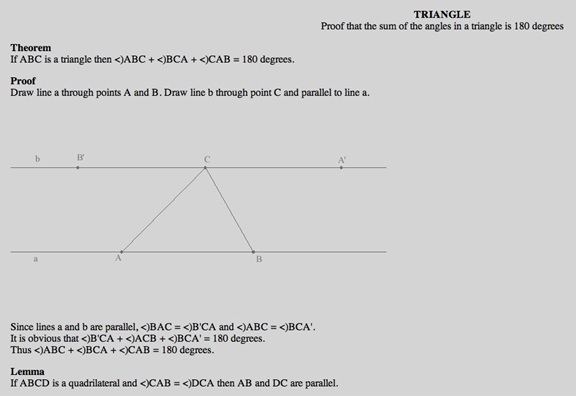
One of the hardest concepts in math is learning how to prove something that is already considered to be correct.  One of the more difficult concepts to teach could also be said on how to prove things that you had already believed and accepted in the first place.  One of these concepts happens to be that a triangle’s angles are always going to add up to 180 degrees.  Here is one of the proofs that I found that is absolutely simplistic and most kids will agree with you on it:

triangle1

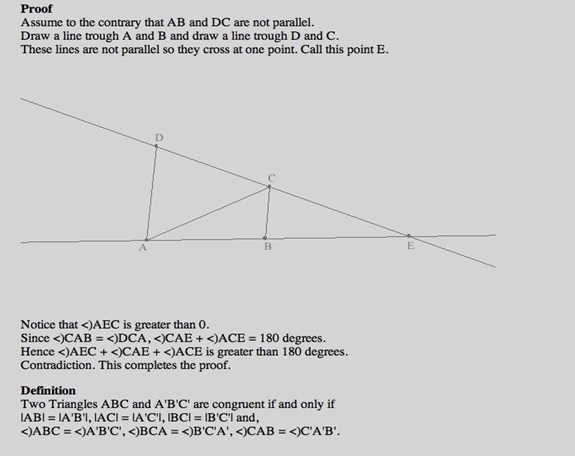
This particular proof is from the website http://www.mathisfun.com.  This is a great website to simply explain most math concepts and give exercises to practice those math facts.  For the more skeptical student, you can use a form of Euclidean and modern fact base to prove this more in depth.  I found this proof on http://www.apronus.com/geometry/triangle.htm.  Here you will see that there is no question as to why the proof above works and how it doesn’t work when you do a proof by contradiction.

triangle3 triangle2

green line

I stumbled across this awesome website that very simply put into context how easy it would be to prove that a triangle’s angles will always add up to 180 degrees.  In this activity you take the same triangle 3 times and then have them place all three of the angles on a straight line.  This proves that the angles in a triangle will always equal 180 degrees, which is a concept that should have already been taught as a straight line having an “angle” measure of 180. The website for this can be found here: http://www.regentsprep.org/Regents/math/geometry/GP5/TRTri.htm.

green line

The triangle is the basis for a lot of math.  There is one very important person that really started playing with the idea of a triangle and how 3 straight lines that close to form a figure has a certain amount of properties and similarities to parallels and other figures like it.  We base a whole unit on special right triangles in geometry in high school and never know exactly where the term right angle is derived.  This man that made the right angle so important in math is none other than Euclid himself.  While Euclid never introduced angle measures, he made it very apparent that 2 right angles are always going to be equal to the interior angles of a triangle.  Not only did Euclid prove this but he did so in a way that relates to all types of triangles and their similar counterparts using only a straight edge and a compass, pretty impressive!!

Thoughts on 1/7 and other rational numbers (Part 9)

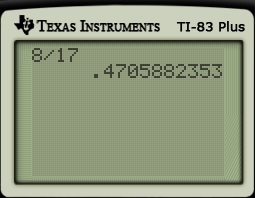
Let’s now consider the decimal representation of \displaystyle \frac{8}{17}.

TI817

There’s no obvious repeating pattern. But we know that, since 17 has neither 2 nor 5 as a factor, that there has to be a repeating decimal pattern.

So… what is it?

When I ask this question to my students, I can see their stomachs churning a slow dance of death. They figure that the calculator didn’t give the answer, and so they have to settle for long division by hand.

That’s partially correct.

However, using the ideas presented below, we can perform the long division extracting multiple digits at once. Through clever use of the calculator, we can quickly obtain the full decimal representation even though the calculator can only give ten digits at a time.

green line

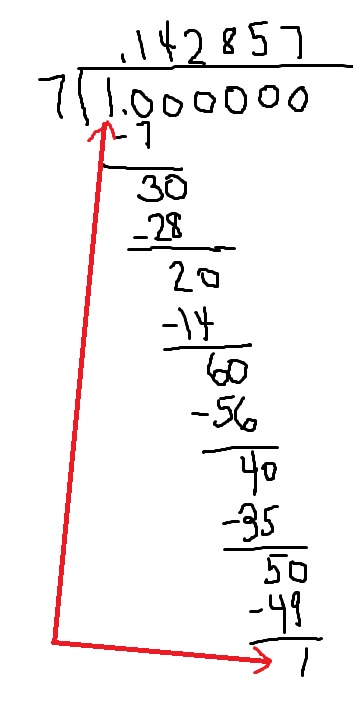
Let’s now return to where this series began… the decimal representation of \displaystyle \frac{1}{7} using long division. As shown below, the repeating block has length 6, which can be found in a few minutes with enough patience. By the end of this post, we’ll consider a modification of ordinary long division that facilitates the computation of really long repeating blocks.

longdivision17

Because we arrived at a repeated remainder, we know that we have found the repeating block. So we can conclude that \displaystyle \frac{1}{7} = 0.\overline{142857}.

Students are taught long division in elementary school and are so familiar with the procedure that not much thought is given to the logic behind the procedure. The underlying theorem behind long division is typically called the division algorithm. From Wikipedia:

Given two integers a and b, with b \ne 0, there exist unique integers q and r such that a = bq+r and $0 \le r < |b|$,  where |b| denotes the absolute value of b.

The number q is typically called the quotient, while the number r is called the remainder.

Repeated application of this theorem is the basis for long division. For the example above:

Step 1.

10 = 1 \times 7 + 3. Dividing by 10, 1 = 0.1 \times 7 + 0.3

Step 2.

30 = 4 \times 7 + 2. Dividing by 100, 0.3 = 0.04 \times 7 + 0.02

Returning to the end of Step 1, we see that

1 = 0.1 \times 7 + 0.3 = 0.1 \times 7 + 0.04 \times 7 + 0.02 = 0.14 \times 7 + 0.02

Step 3.

20 = 2 \times 7 + 6. Dividing by 1000, 0.02 = 0.002 \times 7 + 0.006

Returning to the end of Step 2, we see that

1 = 0.14 \times 7 + 0.02 = 0.14 \times 7 + 0.0002 \times 7 + 0.006 = 0.142 \times 7 + 0.006

And so on.

green line

By adding an extra zero and using the division algorithm, the digits in the decimal representation are found one at a time. That said, it is possible (with a calculator) to find multiple digits in a single step by adding extra zeroes. For example:

Alternate Step 1.

1000 = 142 \times 7 + 6. Dividing by 1000, 1 = 0.142 \times 7 + 0.006

Alternate Step 2.

6000 = 587 \times 7 + 1. Dividing by 100000, 0.006 = 0.000587 \times 7 + 0.000001

Returning to the end of Alternate Step 1, we see that

1 = 0.142 \times 7 + 0.006= 0.142 \times 7 + 0.000587\times 7 + 0.000001 = 0.142857 \times 7 + 0.000001

So, with these two alternate steps, we arrive at a remainder of 1 and have found the length of the repeating block.

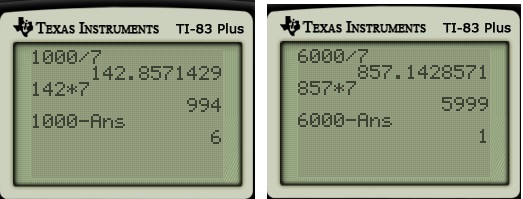
The big catch is that, if a = 1000 or a = 6000 and b = 7, the appropriate values of q and r have to be found. This can be facilitated with a calculator. The integer part of 1000/7 and 6000/7 are the two quotients needed above, and subtraction is used to find the remainders (which must be less than 7, of course).

TI17

At first blush, it seems silly to use a calculator to find these values of q and r when a calculator could have been used to just find the decimal representation of 1/7 in the first place. However, the advantage of this method becomes clear when we consider fractions who repeating blocks are longer than 10 digits.

green lineLet’s now return to the question posed at the top of this post: finding the decimal representation of \displaystyle \frac{8}{17}. As noted in Part 6 of this series, the length of the repeating block must be a factor of \phi(17), where \phi is the Euler toitent function, or the number of integers less than 17 that are relatively prime with 17. Since 17 is prime, we clearly see that \phi(17) = 16. So we can conclude that the length of the repeating block is a factor of 16, or either 1, 2, 4, 8, or 16.

Here’s the result of the calculator again:

TI817

We clearly see from the calculator that the repeating block doesn’t have a length less than or equal to 8. By process of elimination, the repeating block must have a length of 16 digits.

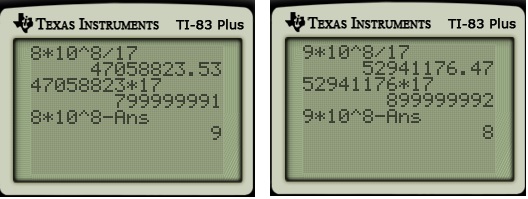
Now we perform the division algorithm to obtain these digits, as before. This can be done in two steps by multiplying by 10^8 = 100,000,000.

TI817b

So, by the same logic used above, we can conclude that

\displaystyle \frac{8}{17} = 0.\overline{4705882352941176}

In other words, through clever use of the calculator, the full decimal representation can be quickly found even if the calculator itself returns only ten digits at a time… and had rounded the final 2941176 of the repeating block up to 3.

Thoughts on 1/7 and other rational numbers (Part 8)

In Part 6 of this series, I mentioned the following fact concerning the decimal representation of \displaystyle \frac{a}{b}: if neither 2 nor 5 is a factor of b, then the repeating block in the decimal representation of \displaystyle \frac{a}{b} has a length k that must be a factor of \phi(b). This function is the Euler toitent function or the number of integers less than b that are relatively prime with b.

In this post, I’d like to provide a justification for this theorem.

As discussed earlier, k is the least integer so that b is a factor of 10^k - 1. In the language of congruence, k is the least integer so that

10^k \equiv 1 (\mod b)

In other words, let G_b be the multiplicative group of numbers less than b that are relatively prime with b. By assumption 10 \in G_b. Then k is the order of 10 in G_b, and there’s a theorem that states that the order of an element of a group must be a factor of the order of the group, or the number of elements in the group. In our case, the order of G_b is the number of integers less than b that are relatively prime with b, or \phi(b).

In other words, using these ideas from group theory, we can prove that k \mid \phi(b).

green line

Naturally, we don’t expect middle school students seeing long division for the first time to appreciate this property of decimal representations. Still, my main purpose in writing this post was to give a concrete example of how ideas from higher-level mathematics — like group theory — actually can shed insight into ideas that are first seen in school — even middle school. In other words, there’s a reason why UNT (and other universities) requires that college students who want to earn mathematics teaching certification with their degrees must have a major in mathematics.

Unsolved problems: the Collatz conjecture

Students at all levels — elementary, middle, secondary, and college — tend to think that either (1) all the problems in mathematics have already been solved, or else (2) some unsolved problems remain but only an expert can understand even the statement of the problem.

There are plenty of famous unsolved problems in mathematics. And the Collatz conjecture is an easily stated unsolved problem that can be understood by most fourth and fifth graders.

Here’s the statement of the problem.

  • Start with any positive integer.
  • If the integer is even, divide it by 2. If it’s odd, multiply it by 3 and then add 1.
  • Repeat until (and if) you reach 1.

That’s it. From Wikipedia:

For instance, starting with 6, one gets the sequence 6, 3, 10, 5, 16, 8, 4, 2, 1.

Starting with 11, for example, takes longer to reach 1: 11, 34, 17, 52, 26, 13, 40, 20, 10, 5, 16, 8, 4, 2, 1.

The sequence for 27 takes 111 steps, climbing to 9232 before descending to 1: 27, 82, 41, 124, 62, 31, 94, 47, 142, 71, 214, 107, 322, 161, 484, 242, 121, 364, 182, 91, 274, 137, 412, 206, 103, 310, 155, 466, 233, 700, 350, 175, 526, 263, 790, 395, 1186, 593, 1780, 890, 445, 1336, 668, 334, 167, 502, 251, 754, 377, 1132, 566, 283, 850, 425, 1276, 638, 319, 958, 479, 1438, 719, 2158, 1079, 3238, 1619, 4858, 2429, 7288, 3644, 1822, 911, 2734, 1367, 4102, 2051, 6154, 3077, 9232, 4616, 2308, 1154, 577, 1732, 866, 433, 1300, 650, 325, 976, 488, 244, 122, 61, 184, 92, 46, 23, 70, 35, 106, 53, 160, 80, 40, 20, 10, 5, 16, 8, 4, 2, 1

The longest progression for any initial starting number less than 100 million is 63,728,127, which has 949 steps. For starting numbers less than 1 billion it is 670,617,279, with 986 steps, and for numbers less than 10 billion it is 9,780,657,630, with 1132 steps.

Here’s the question: Does this sequence eventually reach 1 no matter the starting value? Or is there a number out there that you could use as a starting value that has a sequence that never reaches 1?

Like I said, this is an easily stated problem that most fourth graders could understand. And no one knows the answer. Every number that’s been tried by computer has produced a sequence that eventually reaches 1. But that doesn’t mean that there isn’t a bigger number out there that doesn’t reach 1.

I’ll refer to the above Wikipedia page (and references therein) for further reading about the Collatz conjecture. Pedagogically, I suggest that casually mentioning this unsolved problem in class might inspire students to play with mathematics on their own, rather than think that all of mathematics has already been solved by somebody.

xkcdcollatz_conjecture

Source: http://www.xkcd.com/710/

Reminding students about Taylor series (Part 6)

Sadly, at least at my university, Taylor series is the topic that is least retained by students years after taking Calculus II. They can remember the rules for integration and differentiation, but their command of Taylor series seems to slip through the cracks. In my opinion, the reason for this lack of retention is completely understandable from a student’s perspective: Taylor series is usually the last topic covered in a semester, and so students learn them quickly for the final and quickly forget about them as soon as the final is over.

Of course, when I need to use Taylor series in an advanced course but my students have completely forgotten this prerequisite knowledge, I have to get them up to speed as soon as possible. Here’s the sequence that I use to accomplish this task. Covering this sequence usually takes me about 30 minutes of class time.

I should emphasize that I present this sequence in an inquiry-based format: I ask leading questions of my students so that the answers of my students are driving the lecture. In other words, I don’t ask my students to simply take dictation. It’s a little hard to describe a question-and-answer format in a blog, but I’ll attempt to do this below.

In the previous posts, I described how I lead students to the definition of the Maclaurin series

f(x) = \displaystyle \sum_{k=0}^{\infty} \frac{f^{(k)}(0)}{k!} x^k,

which converges to f(x) within some radius of convergence for all functions that commonly appear in the secondary mathematics curriculum.

green line

Step 7. Let’s now turn to trigonometric functions, starting with f(x) = \sin x.

What’s f(0)? Plugging in, we find f(0) = \sin 0 = 0.

As before, we continue until we find a pattern. Next, f'(x) = \cos x, so that f'(0) = 1.

Next, f''(x) = -\sin x, so that f''(0) = 0.

Next, f'''(x) = -\cos x, so that f''(0) = -1.

No pattern yet. Let’s keep going.

Next, f^{(4)}(x) = \sin x, so that f^{(4)}(0) = 0.

Next, f^{(5)}(x) = \cos x, so that f^{(5)}(0) = 1.

Next, f^{(6)}(x) = -\sin x, so that f^{(6)}(0) = 0.

Next, f^{(7)}(x) = -\cos x, so that f^{(7)}(0) = -1.

OK, it looks like we have a pattern… albeit more awkward than the patterns for e^x and \displaystyle \frac{1}{1-x}. Plugging into the series, we find that

\displaystyle \sin x= x - \frac{x^3}{3!} + \frac{x^5}{5!} - \frac{x^7}{7!} \dots

If we stare at the pattern of terms long enough, we can write this more succinctly as

\sin x = \displaystyle \sum_{n=0}^\infty (-1)^n \frac{x^{2n+1}}{(2n+1)!}

The (-1)^n term accounts for the alternating signs (starting on positive with n=0), while the 2n+1 is needed to ensure that each exponent and factorial is odd.

Let’s see… \sin x has a Taylor expansion that only has odd exponents. In what other sense are the words “sine” and “odd” associated?

In Precalculus, a function f(x) is called odd if f(-x) = -f(x) for all numbers x. For example, f(x) = x^9 is odd since f(-x) = (-x)^9 = -x^9 since 9 is a (you guessed it) an odd number. Also, \sin(-x) = -\sin x, and so \sin x is also an odd function. So we shouldn’t be that surprised to see only odd exponents in the Taylor expansion of \sin x.

A pedagogical note: In my opinion, it’s better (for review purposes) to avoid the \displaystyle \sum notation and simply use the “dot, dot, dot” expression instead. The point of this exercise is to review a topic that’s been long forgotten so that these Taylor series can be used for other purposes. My experience is that the \displaystyle \sum adds a layer of abstraction that students don’t need to overcome for the time being.

green line

Step 8. Let’s now turn try f(x) = \cos x.

What’s f(0)? Plugging in, we find f(0) = \cos 1 = 0.

Next, f'(x) = -\sin x, so that f'(0) = 0.

Next, f''(x) = -\cos x, so that f'(0) = -1.

It looks like the same pattern of numbers as above, except shifted by one derivative. Let’s keep going.

Next, f'''(x) = \sin x, so that f'''(0) = 0.

Next, f^{(4)}(x) = \cos x, so that f^{(4)}(0) = 1.

Next, f^{(5)}(x) = -\sin x, so that f^{(5)}(0) = 0.

Next, f^{(6)}(x) = -\cos x, so that f^{(6)}(0) = -1.

OK, it looks like we have a pattern somewhat similar to that of $\sin x$, except only involving the even terms. I guess that shouldn’t be surprising since, from precalculus we know that \cos x is an even function since \cos(-x) = \cos x for all x.

Plugging into the series, we find that

\displaystyle \cos x= 1 - \frac{x^2}{2!} + \frac{x^4}{4!} - \frac{x^6}{6!} \dots

If we stare at the pattern of terms long enough, we can write this more succinctly as

\cos x = \displaystyle \sum_{n=0}^\infty (-1)^n \frac{x^{2n}}{(2n)!}

green line

As we saw with e^x, the above series converge quickest for values of x near 0. In the case of \sin x and \cos x, this may be facilitated through the use of trigonometric identities, thus accelerating convergence.

For example, the series for \cos 1000^o will converge quite slowly (after converting 1000^o into radians). However, we know that

\cos 1000^o= \cos(1000^o - 720^o) =\cos 280^o

using the periodicity of \cos x. Next, since $\latex 280^o$ is in the fourth quadrant, we can use the reference angle to find an equivalent angle in the first quadrant:

\cos 1000^o = \cos 280^o = \cos(360^o - 80^o) = \cos 80^o

Finally, using the cofunction identity \cos x = \sin(90^o - x), we find

\cos 1000^o = \cos 80^o = sin(90^o - 80^o) = \sin 10^o.

In this way, the sine or cosine of any angle can be reduced to the sine or cosine of some angle between 0^o and $45^o = \pi/4$ radians. Since \pi/4 < 1, the above power series will converge reasonably rapidly.

green line

Step 10. For the final part of this review, let’s take a second look at the Taylor series

e^x = \displaystyle 1 + x + \frac{x^2}{2} + \frac{x^3}{3} + \frac{x^4}{4} + \frac{x^5}{5} + \frac{x^6}{6} + \frac{x^7}{7} + \dots

Just to be silly — for no apparent reason whatsoever, let’s replace x by ix and see what happens:

e^{ix} = \displaystyle 1 - \frac{x^2}{2!} + \frac{x^4}{4!} - \frac{x^6}{6!} \dots + i \left[\displaystyle x - \frac{x^3}{3!} + \frac{x^5}{5!} - \frac{x^7}{7!} \dots \right]

after separating the terms that do and don’t have an i.

Hmmmm… looks familiar….

So it makes sense to define

e^{ix} = \cos x + i \sin x,

which is called Euler’s formula, thus proving an unexpected connected between e^x and the trigonometric functions.