Calculators and complex numbers (Part 7)

In this series of posts, I explore properties of complex numbers that explain some surprising answers to exponential and logarithmic problems using a calculator (see video at the bottom of this post). These posts form the basis for a sequence of lectures given to my future secondary teachers.

To begin, we recall that the trigonometric form of a complex number z = a+bi is

z = r(\cos \theta + i \sin \theta)

where r = |z| = \sqrt{a^2 + b^2} and \tan \theta = b/a, with \theta in the appropriate quadrant. As noted before, this is analogous to converting from rectangular coordinates to polar coordinates.

There’s a shorthand notation for the right-hand side (r e^{i \theta}) that I’ll justify later in this series.

This post builds off the previous two posts by completing the proof of De Moivre’s Theorem.

Theorem. If n is an integer, then \left[ r (\cos \theta + i \sin \theta) \right]^n = r^n (\cos n \theta + i \sin n \theta).

The proof has two parts:

  1. For n \ge 0: proof by induction.
  2. For n < 0: let n = -m, and then use part 1.

In the previous post, I presented how I describe the proof of step 1 to students. Today, I’ll discuss how I present step 2.

My personal opinion is that the proof of step 2 goes easiest when a numerical example is done first. Let n = -5. Students can usually volunteer the successive steps of this special case:

\left[ r (\cos \theta + i \sin \theta) \right]^{-5} = \displaystyle \frac{1}{ \left[ r (\cos \theta + i \sin \theta) \right]^{5} }

= \displaystyle \frac{1}{r^5 (\cos 5 \theta + i \sin 5 \theta)}

At this point, students usually want to multiply by the conjugate of the denominator. There’s nothing wrong with doing that, of course, but it’s more elegant to write the numerator in trigonometric form:

= \displaystyle \frac{1(\cos 0 + i \sin 0)}{r^5 (\cos 5 \theta + i \sin 5 \theta)}

= r^{-5} (\cos [0-5\theta] + i \sin[0-5\theta] )

= r^{-5} (\cos [-5\theta] + i \sin[ - 5\theta]),

which matches what we would have expected. Students are now prepared for the proof, which I try to place alongside the above computation for n = -5.

Proof for n < 0. Let n = -m. I tell students to imagine that n is -5, so that m is equal to (students volunteer) 5. In other words, n is negative and m is positive. Then

\left[ r (\cos \theta + i \sin \theta) \right]^{n} = \displaystyle \frac{1}{ \left[ r (\cos \theta + i \sin \theta) \right]^{-n} }

I again remind everyone that -n = m is positive, and so (like a good MIT freshman) the previous work applies:

= \displaystyle \frac{1}{ \left[ r (\cos \theta + i \sin \theta) \right]^m }

The remaining steps mirror the calculation above:

= \displaystyle \frac{1}{r^m (\cos m \theta + i \sin m \theta)}

= \displaystyle \frac{1(\cos 0 + i \sin 0)}{r^m (\cos m \theta + i \sin m \theta)}

= r^{-m} (\cos [0-m\theta] + i \sin[0-m\theta] )

= r^{-m} (\cos [-m\theta] + i \sin[ - m \theta])

= r^{n} (\cos [n\theta] + i \sin[ n \theta]),

thus ending the proof. green line

For completeness, here’s the movie that I use to engage my students when I begin this sequence of lectures.


Calculators and complex numbers (Part 6)

In this series of posts, I explore properties of complex numbers that explain some surprising answers to exponential and logarithmic problems using a calculator (see video at the bottom of this post). These posts form the basis for a sequence of lectures given to my future secondary teachers.

To begin, we recall that the trigonometric form of a complex number z = a+bi is

z = r(\cos \theta + i \sin \theta)

where r = |z| = \sqrt{a^2 + b^2} and \tan \theta = b/a, with \theta in the appropriate quadrant. As noted before, this is analogous to converting from rectangular coordinates to polar coordinates.

There’s a shorthand notation for the right-hand side (r e^{i \theta}) that I’ll justify later in this series.

In the previous post, I used a numerical example to justify De Moivre’s Theorem:

Theorem. If n is an integer, then \left[ r (\cos \theta + i \sin \theta) \right]^n = r^n (\cos n \theta + i \sin n \theta).

The proof has two parts:

  1. For n \ge 0: proof by induction.
  2. For n < 0: let n = -m, and then use part 1.

In this post, I describe how I present part 1 to students in class. The next post will cover part 2. As noted before, I typically present this theorem and its proof after a numerical example so that students can guess the statement of the theorem on their own.

Proof for n \ge 0.

Base Case: n = 0. This is trivial, as the left-hand side is

\left[ r (\cos \theta + i \sin \theta) \right]^0 = 1,

while the right-hand side is

r^0 (\cos 0 \theta + i \sin 0 \theta) = 1(\cos 0 + i \sin 0) = 1(1 + 0i) = 1.

Assumption. We now assume, for a given integer $latex $n$, that

\left[ r (\cos \theta + i \sin \theta) \right]^n = r^n (\cos n \theta + i \sin n \theta).

Inductive Step. We now use the above assumption to prove the statement for n+1. On the board, I write the left-hand side on the top and the right-hand side on the bottom, leaving plenty of space in between:

\left[ r (\cos \theta + i \sin \theta) \right]^{n+1}

\quad

\quad

\quad

\quad

\quad

= r^{n+1} (\cos [n+1] \theta + i \sin [n+1] \theta).

All we have to do is fill in the space to transform the left-hand side into the target on the right-hand side. (I like to call the right-hand side “the target,” as it suggests the direction in which the proof should aim.) I also tell the class that we’re more than two-thirds done with the proof, since we’ve finished the first two steps and have made some headway on the third. This usually produces knowing laughter since the hardest part of the proof is creatively converting the left-hand side into the target.

The first couple steps of the proof are usually clear to students:

\left[ r (\cos \theta + i \sin \theta) \right]^{n+1} = \left[ r (\cos \theta + i \sin \theta) \right]^n \cdot \left[ r (\cos \theta + i \sin \theta) \right]

= \left[ r^n (\cos n \theta + i \sin n \theta) \right] \cdot \left[ r (\cos \theta + i \sin \theta) \right]

by induction hypothesis. (I’ll also remind students that, as a general rule, when doing a proof by induction, it’s important to actually use the inductive assumption someplace.) At this point, most students want to distribute to get the right answer. This will eventually produce the correct answer using trig identities. However, I again try to encourage them to think like MIT freshmen and use previous work. After all, the distances multiply and the angles add, so the next step can be

=r^n \cdot r (\cos [n \theta + \theta] + i \sin [n \theta + \theta])

= r^{n+1} (\cos [n+1]\theta + i \sin [n+1]\theta).

In tomorrow’s post, I’ll talk about how I present the second part of the proof to my students.

green line

For completeness, here’s the movie that I use to engage my students when I begin this sequence of lectures.


Calculators and complex numbers (Part 5)

In this series of posts, I explore properties of complex numbers that explain some surprising answers to exponential and logarithmic problems using a calculator (see video at the bottom of this post). These posts form the basis for a sequence of lectures given to my future secondary teachers.

To begin, we recall that the trigonometric form of a complex number z = a+bi is

z = r(\cos \theta + i \sin \theta)

where r = |z| = \sqrt{a^2 + b^2} and \tan \theta = b/a, with \theta in the appropriate quadrant. As noted before, this is analogous to converting from rectangular coordinates to polar coordinates.

There’s a shorthand notation for the right-hand side (r e^{i \theta}) that I’ll justify later in this series.

The trigonometric form of a complex number permits a geometric interpretation of multiplication, given in the following theorem.

Theorem. \left[ r_1 (\cos \theta_1 + i \sin \theta_1) \right] \cdot \left[ r_2 (\cos \theta_2 + i \sin \theta_2) \right] = r_1 r_2 (\cos [\theta_1+\theta_2] + i \sin [\theta_1+\theta_2]).

While this theorem doesn’t seem all that helpful — just multiplying complex numbers seems easier — this theorem will be a great help for the following problem:

Compute (\sqrt{3} + i)^{2014}. (When teaching this in class, I usually choose the exponent to be the current year.)

Let’s discuss the options for evaluating this expression.

Method #1: Multiply it out. (Students reflexively wince in pain — or knowing laughter — when I make this suggestion.)

Method #2: Use the 2014th row of Pascal’s triangle. (More pain and/or laughter.)

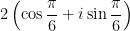
Method #3: Use the above theorem. It’s straightforward to write \sqrt{3} + i as 2 \displaystyle \left( \cos \frac{\pi}{6} + i \sin \frac{\pi}{6} \right)… for reasons that will become apparent later, I tell my students that I’ll use radians and not degrees for this one. Most students can recognize — and this is important, before I formally prove De Moivre’s Theorem — that they need to multiply 2 by itself 2014 times and add \displaystyle \frac{\pi}{6} to itself 2014 times. Therefore,

(\sqrt{3} + i)^{2014} = \displaystyle 2^{2014} \left( \cos \frac{2014\pi}{6} + i \sin \frac{2014\pi}{6} \right) = \displaystyle 2^{2014} \left( \cos \frac{1007\pi}{3} + i \sin \frac{1007\pi}{3} \right)

I then try to coax my students to compute \displaystyle \cos \frac{1007\pi}{3} without a calculator. With some prodding, they’ll recognize that \displaystyle \frac{1007}{3} = \displaystyle {335}\frac{2}{3}, and so they can subtract 334\pi (not 335\pi) without changing the values of sine and cosine. Therefore,

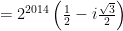
(\sqrt{3} + i)^{2014} = \displaystyle 2^{2014} \left( \cos \frac{5\pi}{3} + i \sin \frac{5\pi}{3} \right)

= 2^{2014} \left( \frac{1}{2} - i \frac{\sqrt{3}}{2} \right)

= 2^{2013} (1-i\sqrt{3})

By this point, students absolutely believe that the trigonometric form of a complex number serves a useful purpose. Also, this numerical example has prepared students for the formal proof of DeMoivre’s Theorem, which will be the subject of the next two posts.

green line

For completeness, here’s the movie that I use to engage my students when I begin this sequence of lectures.


Calculators and complex numbers (Part 4)

In this series of posts, I explore properties of complex numbers that explain some surprising answers to exponential and logarithmic problems using a calculator (see video at the bottom of this post). These posts form the basis for a sequence of lectures given to my future secondary teachers.

To begin, we recall that the trigonometric form of a complex number z = a+bi is

z = r(\cos \theta + i \sin \theta)

where r = |z| = \sqrt{a^2 + b^2} and \tan \theta = b/a, with \theta in the appropriate quadrant. As noted before, this is analogous to converting from rectangular coordinates to polar coordinates.

In the previous post, I proved the following theorem which provides a geometric interpretation for multiplying complex numbers.

Theorem. \left[ r_1 (\cos \theta_1 + i \sin \theta_1) \right] \cdot \left[ r_2 (\cos \theta_2 + i \sin \theta_2) \right] = r_1 r_2 (\cos [\theta_1+\theta_2] + i \sin [\theta_1+\theta_2]).

Perhaps unsurprisingly, there’s also a theorem for dividing complex numbers. Students can using guess the statement of this theorem.

Theorem. \displaystyle \frac{ r_1 (\cos \theta_1 + i \sin \theta_1) }{ r_2 (\cos \theta_2 + i \sin \theta_2) } = \displaystyle \frac{r_1}{r_2} (\cos [\theta_1-\theta_2] + i \sin [\theta_1-\theta_2]).

Proof. The proof begins by separating the r_1 and r_2 terms and then multiplying by the conjugate of the denominator:

\displaystyle \frac{ r_1 (\cos \theta_1 + i \sin \theta_1) }{ r_2 (\cos \theta_2 + i \sin \theta_2) }

= \displaystyle \frac{r_1}{r_2} \cdot \frac{ \cos \theta_1 + i \sin \theta_1 }{ \cos \theta_2 + i \sin \theta_2 } \cdot \frac{ \cos \theta_2 - i \sin \theta_2 }{ \cos \theta_2 - i \sin \theta_2 }

= \displaystyle \frac{r_1}{r_2} \cdot \frac{ (\cos \theta_1 + i \sin \theta_1)( \cos \theta_2 - i \sin \theta_2) } {\cos^2 \theta_2 - i^2 \sin^2 \theta_2}

= \displaystyle \frac{r_1}{r_2} \cdot \frac{ (\cos \theta_1 + i \sin \theta_1)( \cos \theta_2 - i \sin \theta_2) } {\cos^2 \theta_2 + \sin^2 \theta_2}

= \displaystyle \frac{r_1}{r_2} (\cos \theta_1 + i \sin \theta_1)( \cos \theta_2 - i \sin \theta_2)

At this juncture in the proof, there are two legitimate ways to proceed.

Method #1: Multiply out the right-hand side. After all, this is how we proved the theorem yesterday. For this reason, students naturally gravitate toward this proof, and the proof works after recognizing the trig identities for the sine and cosine of the difference of two angles.

However, this isn’t the most elegant proof.

Method #2: I break out my old joke about the entrance exam at MIT and the importance of using previous work. I rewrite the right-hand side as

= \displaystyle \frac{r_1}{r_2} (\cos \theta_1 + i \sin \theta_1)( \cos [-\theta_2] + i \sin [-\theta_2]);

this also serves as a reminder about the odd/even identities for sine and cosine, respectively. Then students observe that the right-hand side is just a product of two complex numbers in trigonometric form, and so the angle of the product is found by adding the angles.

green line

For completeness, here’s the movie that I use to engage my students when I begin this sequence of lectures.


Calculators and complex numbers (Part 3)

In this series of posts, I explore properties of complex numbers that explain some surprising answers to exponential and logarithmic problems using a calculator (see video at the bottom of this post). These posts form the basis for a sequence of lectures given to my future secondary teachers.

To begin, we recall that the trigonometric form of a complex number z = a+bi is

z = r(\cos \theta + i \sin \theta)

where r = |z| = \sqrt{a^2 + b^2} and \tan \theta = b/a, with \theta in the appropriate quadrant. As noted before, this is analogous to converting from rectangular coordinates to polar coordinates.

There’s a shorthand notation for the right-hand side (r e^{i \theta}) that I’ll justify later in this series.

Why is this important? When students first learn to multiply complex numbers like 1+i and 2+i, they are taught to just distribute (or, using the nomenclature that I don’t like, FOIL it out):

(1+i)(1+2i) = 1 + 2i + i + 2i^2 = 1 + 3i - 2 = -1 + 3i.

The trigonometric form of a complex number permits a geometric interpretation of multiplication, given in the following theorem.

Theorem. \left[ r_1 (\cos \theta_1 + i \sin \theta_1) \right] \cdot \left[ r_2 (\cos \theta_2 + i \sin \theta_2) \right] = r_1 r_2 (\cos [\theta_1+\theta_2] + i \sin [\theta_1+\theta_2]).

Proof. As above, we distribute (except for the r_1 and r_2 terms):

\left[ r_1 (\cos \theta_1 + i \sin \theta_1) \right] \cdot \left[ r_2 (\cos \theta_2 + i \sin \theta_2) \right]

= r_1 r_2 (\cos \theta_1 \cos \theta_2 + i \cos \theta_1 \sin \theta_2 + i \sin \theta_1 \cos \theta_2 + i^2 \sin \theta_1 \sin \theta_2

= r_1 r_2 (\cos \theta_1 \cos \theta_2 - \sin \theta_1 \sin \theta_2 + i[ \sin \theta_1 \cos \theta_2 + \cos \theta_1 \sin \theta_2])

= r_1 r_2 (\cos [\theta_1+\theta_2] + i \sin [\theta_1+\theta_2]).

When actually doing this in class, the big conceptual jump for students is the last step. So I make a big song-and-dance routine out of this:

Cosine of the first times cosine of the second minus sine of the first times sine of the second… where have I seen this before?

The idea is for my students to search deep into their mathematical memories until they recall the appropriate trig identity.

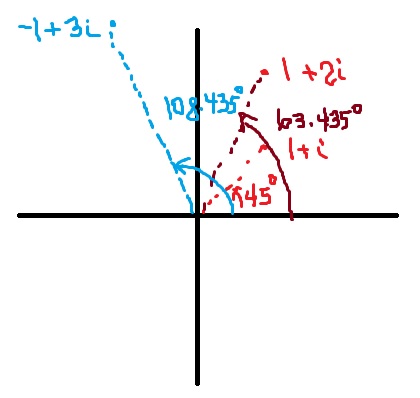
For the original multiplication problem, we see that

1+i = \sqrt{2} \left( \cos 45^\circ + i \sin 45^\circ \right)

1 + 2i = \sqrt{5} \left( \cos[\tan^{-1} 2] + i \sin[\tan^{-1} 2] \right) \approx \sqrt{5} \left( \cos 63.435^\circ + i \sin 63.435^\circ \right)

Therefore, the product of $1+i$ and $1+2i$ will be a distance of $\sqrt{2} \cdot \sqrt{5} = \sqrt{10}$ from the origin, and the angle from the positive real axis will be 45^\circ + \tan^{-1} 2 \approx 45^\circ + 63.435^\circ = 108.435^\circ. Indeed,

-1 + 3i \approx \sqrt{10} \left( \cos 108.435^\circ + i \sin 108.435^\circ \right).

complex plane 3green line

For completeness, here’s the movie that I use to engage my students when I begin this sequence of lectures.


Engaging students: the difference of two squares

In my capstone class for future secondary math teachers, I ask my students to come up with ideas for engaging their students with different topics in the secondary mathematics curriculum. In other words, the point of the assignment was not to devise a full-blown lesson plan on this topic. Instead, I asked my students to think about three different ways of getting their students interested in the topic in the first place.

I plan to share some of the best of these ideas on this blog (after asking my students’ permission, of course).

This student submission comes from my former student Dale Montgomery. His topic, from Algebra II: the difference of two squares.

green line

Application/Future Curriculum (science)-

You can use difference of squares to find a basic formula to be used in any problem where you drop an object and want to find what time it will take to land. This physics concept will be of interest to your students considering any mechanical science and a useful tool to introduce problem solving by manipulating equations.

Take any height h. If you were to drop an object from this height then it could be modeled with a distance over time graph using the equation

(h- 9.8/2) t^2.

By applying difference of squares you get the expression

[\sqrt{h}+\sqrt{4.9}] t) \times ( [\sqrt{h} - \sqrt{4.9}] t).

Then by setting this expression equal to 0 and manipulating you would get that
t = \pm \displaystyle \frac{\sqrt{h}}{\sqrt{4.9}}.

I like a situation like this because it allows you to give them linking knowledge about quadratic equations. Most students may not have been exposed to this type of physics yet.  However, it is a requirement, and having this knowledge will help them in that class. On top of that it helps with equation manipulation and answering the question, “Does my answer make sense.” This question needs to be asked since it is possible for a student to get an answer of negative time. All of these skills combined with the new topic of difference of squares make for a multifaceted problem. This would probably not be great for day 1 of difference of squares, but I could see it as an engage for the continuance of the lesson.

green line

Curriculum:

You can use the idea of graphing to show that difference of squares works. This is a good way to give visual representation to your students who need it. If you compare the factoring of x^2-9 to the graph of y=x^2-9 and finding the roots of that graph, you can show that they have the same solutions. It is not that novel, but this visual can just help the idea click into students’ minds.

ParabolaGraph

green line

Manipulative

A manipulative that I got the idea for from http://www.gbbservices.com/math/squarediff.html is using squares to show the difference of squares. This is done quite easily as shown in the picture below. This could be done along a lesson on difference of squares. Maybe this would follow easily from a factoring using algebra tiles. The image below is fairly self explanatory and would really help if made into a hands-on manipulative that kinesthetic learners could make great use of.
DifferenceOfTwoSquares

Engaging students: Dividing fractions

In my capstone class for future secondary math teachers, I ask my students to come up with ideas for engaging their students with different topics in the secondary mathematics curriculum. In other words, the point of the assignment was not to devise a full-blown lesson plan on this topic. Instead, I asked my students to think about three different ways of getting their students interested in the topic in the first place.

I plan to share some of the best of these ideas on this blog (after asking my students’ permission, of course).

This student submission comes from my former student Dale Montgomery. His topic, from Pre-Algebra: dividing fractions.

green line

Applications

A Short Play On Numbers

By: Dale Montgomery

You see two brothers talking in the playground.

Timmy: (little brother) Gee Jonny, it sure was a good idea to sell Joe our old Pokémon deck. Now he finally has some cards to play with and we have some money to buy some new cards.

Jonny: (older brother) Yeah, I am glad we could help him get started. He has been wanting some cards for so long. Ok, you have the money so give me half.

Timmy: Ummm… (puzzling) Jonny I don’t know how to make half of 6 dollars and fifty cents, can you help?

Jonny: Of course Timmy, I learned how to divide fractions last week… lets see. (Jonny writes on the board 6 and ½ divided by 1/2 and does the division)

Timmy: How is half more than what we started with?

Jonny: I don’t know, this is the way my teacher taught me to do it. I guess you just have to find 13 dollars to give me so I can have half.

End Scene

Teacher: So class, what did Jonny do?

I came up with this idea thinking about the student asked question regarding dividing pie in half. I feel this could be a common misconception that would be addressed if we could teach students to think about math in context, rather than just a process. Dividing fractions is not the easiest thing to conceive. This short skit could be presented in any number of formats. I like the idea of having some sort of recorded show, just because it would make the intro to class go much faster. This skit introduces a situation that is very similar to word problems that children do. Also, the content can easily be modified to fit the majority class interest. For example it could have been an old Nintendo DS game that the brothers no longer play. This puts a problem that could be very real for the students right in front of them to figure out the correct process. It could lead to good discussion and make for a good lesson on dividing fractions.


green line

Manipulative

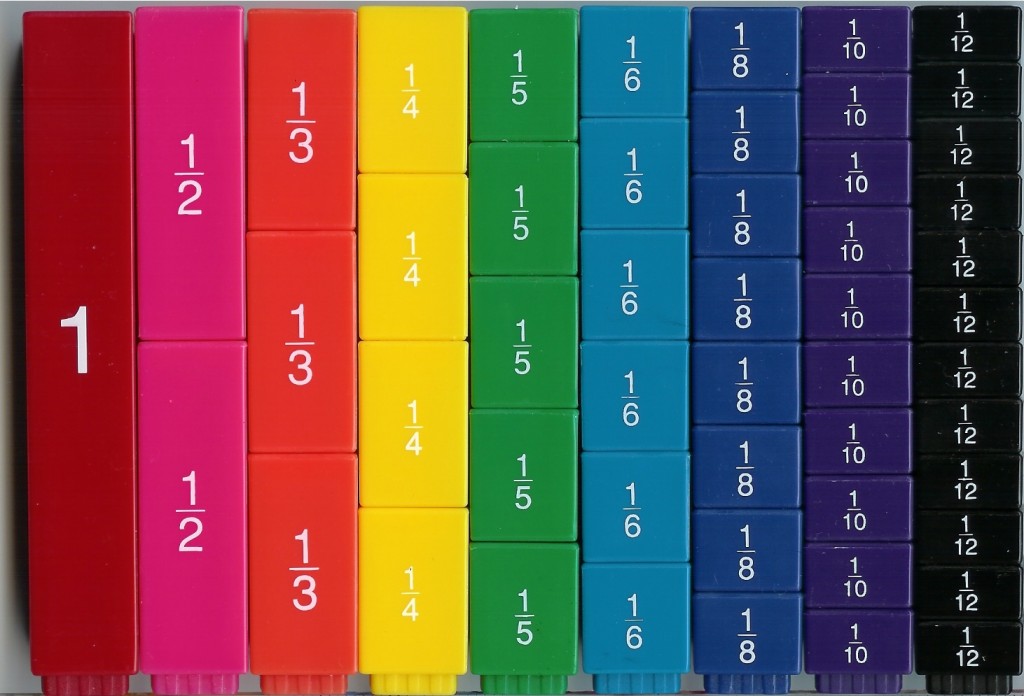
Fraction bars are great tools to help students visualize dividing fractions. For example, if you wanted to divide 2/3 by 1/6 you would line up two of the third bars alongside one of the sixth bar and find out how many times that fraction goes into 2 thirds. In this case it would be four. Fractions themselves are extremely difficult to visualize, and dividing by fractions seems conceptually ridiculous.  It can be difficult to adjust student’s thinking to this area. A manipulative like fraction bars are a good starting point in helping kids understand just how fractions work.

FractionBars


green line

Curriculum, future uses

The topic of dividing fractions has many uses in future courses. Primarily these will be in algebra 1 and 2 for most students. Having a good conceptual knowledge of fractions will help students tremendously in these courses. As an algebra student you would be required to use your knowledge of fractions on an almost daily basis. Being introduced to the concept of multiple variables and canceling them out as you divide polynomials is a very complicated process that gets even more complicated if you do not understand fractions. Laying this conceptual framework is important when you consider all that students must use these concepts for at the higher level math classes. As you consider this in the lessons don’t forget the previous concepts held here such as grouping into equal parts and counting by intervals (3,6,9).


Engaging students: Mathematical induction

In my capstone class for future secondary math teachers, I ask my students to come up with ideas for engaging their students with different topics in the secondary mathematics curriculum. In other words, the point of the assignment was not to devise a full-blown lesson plan on this topic. Instead, I asked my students to think about three different ways of getting their students interested in the topic in the first place.

I plan to share some of the best of these ideas on this blog (after asking my students’ permission, of course).

This student submission comes from my former student Dale Montgomery. His topic, from Precalculus: mathematical induction.

green line

Technology

https://www.khanacademy.org/math/trigonometry/seq_induction/proof_by_induction/v/proof-by-induction

Looking at Khanacademy’s video on mathematical induction, I feel like he has one of the better explanations of mathematical induction that I have heard. This lends itself well to starting class off with a video to engage, and then moving on to an explore where the students test what can or can’t be proved by induction. This quick explanation by Khan gives a good starting point, and the fact that his videos are interesting should be sufficient enough to engage the students. Another possibility is to have the students watch this at home, that way you have more time during class do work on learning how to use the principle of induction.

green line

Application

This problem, and proof (taken from Wikipedia) has flawed logic. In it, it uses the principle of mathematical induction. This would be a good engage because it has supposedly sound logic but it says something that is obviously not true. This will engage the students by showing them something that doesn’t make sense. This will cause a imbalance in their thinking, and make them want to make sense of the situation. I would probably present it as a bell ringer or similar problem, after induction has been introduced.

All horses are the same color

The argument is proof by induction. First we establish a base case for one horse (n = 1). We then prove that if n horses have the same color, then n+1  horses must also have the same color.

Base case: One horse

The case with just one horse is trivial. If there is only one horse in the “group”, then clearly all horses in that group have the same color.

Inductive step

Assume that n  horses always are the same color. Let us consider a group consisting of n+1 horses.

First, exclude the last horse and look only at the first  horses; all these are the same color since  horses always are the same color. Likewise, exclude the first horse and look only at the last  horses. These too, must also be of the same color. Therefore, the first horse in the group is of the same color as the horses in the middle, who in turn are of the same color as the last horse. Hence the first horse, middle horses, and last horse are all of the same color, and we have proven that:

  • If n horses have the same color, then n+1  horses will also have the same color.

We already saw in the base case that the rule (“all horses have the same color”) was valid for n=1 . The inductive step showed that since the rule is valid for n=1 , it must also be valid for n=2 , which in turn implies that the rule is valid for n=3 and so on.

Thus in any group of horses, all horses must be the same color.

(taken from http://en.wikipedia.org/wiki/All_horses_are_the_same_color )

The explanation relies on the fact that a set of a single element cannot have 2 different sets with the same element. Because this assumption cannot be made, the case of n=2 falls apart and tears the argument apart.


green line

Application

Dominoes have been talked about as a way to explain mathematical induction. The idea that if you can prove that the first one falls, and you can prove that in general if a domino falls, the one after it will fall, you can prove that the entire row of dominoes would fall. I think it would be fun to students to actually demonstrate this idea. It would even be fun to illustrate what would happen if you cannot prove that the first one falls by gluing the dominoes to whatever surface that you are using (not the table).

The idea would be to have it set up as the students walked in and ask them what would happen if you pushed over the first domino. After that test the hypothesis with one row (you should probably have multiple rows set up for this). Then introduce the concepts of base case and induction step using the dominos. Then you can ask well what if we cannot push the first domino over, does that mean we cannot show that all of the dominos will fall? After this you can start taking the concept of dominos and applying it to Mathematical induction.

dominoes