My Favorite One-Liners: Part 75

In this series, I’m compiling some of the quips and one-liners that I’ll use with my students to hopefully make my lessons more memorable for them.

The \delta-\epsilon definition of a limit is often really hard for students to swallow:

\forall \epsilon > 0 \exists \delta > 0 \forall x (0 < |x - c| < \delta \Rightarrow |f(x) - L| < \epsilon)

To make this a little more palatable, I’ll choose a simple specific example, like \lim_{x \to 2} x^2 = 4, or

\forall \epsilon > 0 \exists \delta > 0 \forall x (0 < |x - 2| < \delta \Rightarrow |x^2 - 4| < \epsilon)

I’ll use one of the famous lines from “Annie Get Your Gun”:

Anything you can do, I can do better.

In other words, no matter how small a \delta they give me, I can find an \epsilon that meets the requirements of this limit.


My Favorite One-Liners: Part 74

In this series, I’m compiling some of the quips and one-liners that I’ll use with my students to hopefully make my lessons more memorable for them.

After presenting the Fundamental Theorem of Calculus to my calculus students, I make a point of doing the following example in class:

\displaystyle \int_0^4 \frac{1}{4} x^2 \, dx

Hopefully my students are able to produce the correct answer:

\displaystyle \int_0^4 \frac{1}{4} x^2 \, dx = \displaystyle \left[ \frac{x^3}{12} \right]^4_0

= \displaystyle \frac{(4)^3}{12} - \frac{(0)^3}{12}

= \displaystyle \frac{64}{12}

= \displaystyle \frac{16}{3}

Then I tell my students that they’ve probably known the solution of this one since they were kids… and I show them the classic video “Unpack Your Adjectives” from Schoolhouse Rock. They’ll watch this video with no small amount of confusion (“How is this possibly connected to calculus?”)… until I reach the 1:15 mark of the video below, when I’ll pause and discuss this children’s cartoon. This never fails to get an enthusiastic response from my students.

If you have no idea what I’m talking about, be sure to watch the first 75 seconds of the video below. I think you’ll be amused.

My Favorite One-Liners: Part 73

In this series, I’m compiling some of the quips and one-liners that I’ll use with my students to hopefully make my lessons more memorable for them.

Today’s entry is courtesy of Season 1 of The Simpsons. I’ll tell this joke just after introducing derivatives to my calculus students. Here is some dialogue from the episode “Bart The Genius”:

Teacher:  So y = r cubed over 3. And if you determine the rate of change in this curve correctly, I think you’ll be pleasantly surprised.
[The class laughs except for Bart who appears confused.]
Teacher:  Don’t you get it, Bart? Derivative dy = 3 r squared dr over 3, or r squared dr, or r dr r. Har-de-har-har!  Get it?

For a more detailed listing of mathematical references, I highly recommend http://www.simpsonsmath.com (or http://mathsci2.appstate.edu/~sjg/simpsonsmath/), maintained by Dr. Sarah J. Greenwald of Appalachian State University and Dr. Andrew Nestler of Santa Monica College.

My Favorite One-Liners: Part 72

In this series, I’m compiling some of the quips and one-liners that I’ll use with my students to hopefully make my lessons more memorable for them.

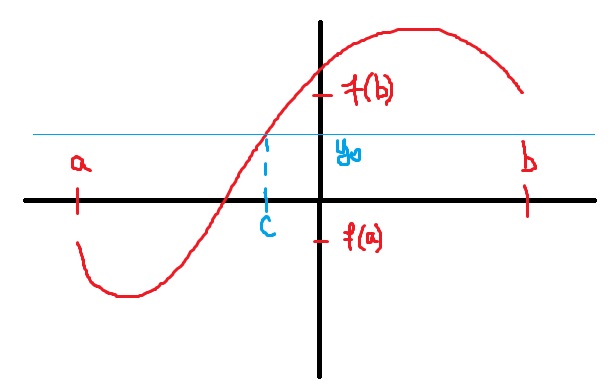
In calculus, the Intermediate Value Theorem states that if f is a continuous function on the closed interval [a,b] and y_0 is any number between f(a) and f(b), then there is at least one point c \in [a,b] so that $f(c) =y_0$.

When I first teach this, I’ll draw some kind of crude diagram on the board:

In this picture, f(a) is less than y_0 while f(b) is greater than y_0. Hence the one-liner:

I call the Intermediate Value Theorem the Goldilocks principle. After all, f(a) is too low, and f(b) is too high, but there is some point in between that is just right.


My Favorite One-Liners: Part 71

In this series, I’m compiling some of the quips and one-liners that I’ll use with my students to hopefully make my lessons more memorable for them.

Some of the algorithms that I teach are pretty lengthy. For example, consider the calculation of a 100(1-\alpha)\% confidence interval for a proportion:

\displaystyle \frac{\hat{p} + \displaystyle \frac{z_{\alpha/2}^2}{2n}}{\displaystyle 1 + \frac{z_{\alpha/2}^2}{n} } - z_{\alpha/2} \frac{\sqrt{\displaystyle \frac{ \hat{p} \hat{q}}{n} + \displaystyle \frac{z_{\alpha/2}^2}{4n^2}}}{\displaystyle 1 + \frac{z_{\alpha/2}^2}{n} } < p < \displaystyle \frac{\hat{p} + \displaystyle \frac{z_{\alpha/2}^2}{2n}}{\displaystyle 1 + \frac{z_{\alpha/2}^2}{n} } + z_{\alpha/2} \frac{\sqrt{\displaystyle \frac{ \hat{p} \hat{q}}{n} + \displaystyle \frac{z_{\alpha/2}^2}{4n^2}}}{\displaystyle 1 + \frac{z_{\alpha/2}^2}{n} }.

Wow.

Proficiency with this formula definitely requires practice, and so I’ll typically give a couple of practice problems so that my students can practice using this formula while in class. After the last example, when I think that my students have the hang of this very long calculation, I’ll give my one-liner to hopefully boost their confidence (no pun intended):

By now, you probably think that this calculation is dull, uninteresting, repetitive, and boring. If so, then I’ve done my job right.

My Favorite One-Liners: Part 70

In this series, I’m compiling some of the quips and one-liners that I’ll use with my students to hopefully make my lessons more memorable for them.

This one really happened in one of my classes back in 1990 or 1991. My differential equations professor had written a very complicated theorem on the board that was true for all functions g(x); unfortunately, thanks to the passage of time, I forget the exact statement of the theorem. I do remember that the theorem was quite complicated, and one of my classmates initially had a hard time understanding it. My instructor tried explaining for a couple of minutes, to no avail.

Finally, with some exasperation, my professor tried a different approach. The theorem was supposed to be true for all functions g(x), so he asked for a specific example to try. So he asked, “Give me a g.”

One of my classmates immediate answered, as if a cheerleader at a football game had made this request instead of a college professor, and yelled out: “GEEEEEEEEEE!”, with his arms raised to the sky.

That definitely broke the tension in the room.

My Favorite One-Liners: Part 69

In this series, I’m compiling some of the quips and one-liners that I’ll use with my students to hopefully make my lessons more memorable for them.

This story, that I’ll share with my Precalculus students, comes from Fall 1996, my first semester as a college professor. I was teaching a Precalculus class, and the topic was vectors. I forget the exact problem (believe me, I wish I could remember it), but I was going over the solution of a problem that required finding \tan^{-1}(7). I told the class that I had worked this out ahead of time, and that the approximate answer was 82^o. Then I used that angle for whatever I needed it for and continued until obtaining the eventual solution.

(By the way, I now realize that I was hardly following best practices by computing that angle ahead of time. Knowing what I know now, I should have brought a calculator to class and computed it on the spot. But, as a young professor, I was primarily concerned with getting the answer right, and I was petrified of making a mistake that my students could repeat.)

After solving the problem, I paused to ask for questions. One student asked a good question, and then another.

Then a third student asked, “How did you know that \tan^{-1}(7) was 82^o?

Suppressing a smile, I answered, “Easy; I had that one memorized.”

The class immediately erupted… some with laughter, some with disbelief. (I had a terrific rapport with those students that semester; part of the daily atmosphere was the give-and-take with any number of exuberant students.) One guy in the front row immediately challenged me: “Oh yeah? Then what’s \tan^{-1}(9)?

I started to stammer, “Uh, um…”

“Aha!” they said. “He’s faking it.” They start pulling out their calculators.

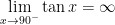
Then I thought as fast as I could. Then I realized that I knew that \tan 82^o \approx 7, thanks to my calculation prior to class. I also knew that \displaystyle \lim_{x \to 90^-} \tan x = \infty since the graph of y = \tan x has a vertical asymptote at x = \pi/2 = 90^o. So the solution to \tan x = 9 had to be somewhere between 82^o and 90^o.
So I took a total guess. “84^o,” I said, faking complete and utter confidence.

Wouldn’t you know it, I was right. (The answer is about 83.66^o.)

In stunned disbelief, the guy who asked the question asked, “How did you do that?”

I was reeling in shock that I guessed correctly. But I put on my best poker face and answered, “I told you, I had it memorized.” And then I continued with the next example. For the rest of the semester, my students really thought I had it memorized.

To this day, this is my favorite stunt that I ever pulled off in front of my students.

My Favorite One-Liners: Part 68

In this series, I’m compiling some of the quips and one-liners that I’ll use with my students to hopefully make my lessons more memorable for them.

When discussing the Laws of Logarithms, I’ll make a big deal of the fact that one law converts a multiplication problem into a simpler addition problem, while another law converts exponentiation into a simpler multiplication problem.

After a few practice problems — and about 3 minutes before the end of class — I’ll inform my class that I’m about to tell the world’s worst math joke. Here it is:

After the flood, the ark landed, and Noah and the animals got out. And God said to Noah, “Go forth, be fruitful, and multiply.” So they disembarked.

Some time later, Noah went walking around and saw the two dogs with their baby puppies and the two cats with their baby kittens. However, he also came across two unhappy, frustrated, and disgruntled snakes. The snakes said to Noah, “We’re having some problems here; would you mind knocking down a tree for us?”

Noah says, “OK,” knocks down a tree, and goes off to continue his inspections.

Some time later, Noah returns, and sure enough, the two snakes are surrounding by baby snakes. Noah asked, “What happened?”

The snakes replied, “Well, you see, we’re adders. We need logs to multiply.”

After the laughter and groans subside, I then dismiss my class for the day:

Go forth, and multiply (pointing to the door of the classroom). For most of you, don’t be fruitful yet, but multiply. You’re dismissed.

My Favorite One-Liners: Part 67

In this series, I’m compiling some of the quips and one-liners that I’ll use with my students to hopefully make my lessons more memorable for them.

Here are a couple of similar problems that arise in Precalculus:

  1. Convert the point (5,-5) from Cartesian coordinates into polar coordinates.
  2. Convert the complex number 5 - 5i into trigonometric form.

For both problems, a point is identified that is 5 steps to the right of the origin and then 5 steps below the x-axis (or real axis). To make this more kinesthetic, I’ll actually walk 5 paces in front of the classroom, turn right face, and then walk 5 more paces to end up at the point.

I then ask my class, “Is there a faster way to get to this point?” Naturally, they answer: Just walk straight to the point. After some work with the trigonometry, we’ll establish that

  1. (5,-5) in Cartesian coordinates is equivalent to (5\sqrt{2}, -\pi/4) in polar coordinates, or
  2. $5-5i$ can be rewritten as 5\sqrt{2} [ \cos(-\pi/4) + i \sin (-\pi/4)] in trigonometric form.

Once this is obtained, I’ll walk it out: I’ll start at the origin, turn clockwise by 45 degrees, and then take 5\sqrt{2} \approx 7 steps to end up at the same point as before.

Continuing the lesson, I’ll ask if the numbers 5\sqrt{2} and -\pi/4, or if some other angle and/or distance could have been chosen. Someone will usually suggest a different angle, like 7\pi/4 or 15\pi/4. I’ll demonstrate these by turning 315 degrees counterclockwise and walking 7 steps and then turning 675 degrees and walking 7 steps (getting myself somewhat dizzy in the process).

Finally, I’ll suggest turning only 135 degrees clockwise and then taking 7 steps backwards. Naturally, when I do this, I’ll do a poor man’s version of the moonwalk:

https://www.youtube.com/watch?v=7lvsBBNV-U4&t=4m12s

For more information, please see my series on complex numbers.

My Favorite One-Liners: Part 66

In this series, I’m compiling some of the quips and one-liners that I’ll use with my students to hopefully make my lessons more memorable for them.

Every once in a while, when I’m expecting my students to use a formula which is so long that I can’t reasonably expect my students to memorize it, I’ll let my students bring a 3-by-5 card to class. When I tell them this, I tell them the ground rules:

  • The units of the card should be in inches (as opposed to 3 meters-by-5 meters)
  • The card can have handwritten notes.
  • No magnifying glasses.

I then related an amazing anecdote that I heard when I was a teenager: for his German final, one of my acquaintances somehow used his Apple IIe computer and his Epson printer to somehow print in microfiche font. He got all of his notes from his thick German notebook onto one side of a 3-by-5 card and half of the other side, leaving half of the back side blank.

Amazing.

Presumably he brought a scanning electron microscope to class so that he could read his notecard.

Anyway, I tell my students, no magnifying glasses are permitted on exams.