Engaging students: Finding x- and y-intercepts

In my capstone class for future secondary math teachers, I ask my students to come up with ideas for engaging their students with different topics in the secondary mathematics curriculum. In other words, the point of the assignment was not to devise a full-blown lesson plan on this topic. Instead, I asked my students to think about three different ways of getting their students interested in the topic in the first place.

I plan to share some of the best of these ideas on this blog (after asking my students’ permission, of course).

This student submission comes from my former student Lissette Molina. Her topic, from Algebra: finding x- and y-intercepts.

green line

What interesting (i.e., uncontrived) word problems using this topic can your students do now?

Using this topic, students can now use word problems that involve two variables in our everyday lives. One problem that many scientists often use is population growth. In population growth, we can usually see a trend of a line and determine the slope. We initially begin with a certain population in a certain year, this is considered the y-intercept, since we start at the initial year that we consider to be at x=0. Using the slope of the line when we are speaking in terms of population decay, we may then set our y=0 to find when a population would be equal to zero. We can also consider other examples such as the depreciation of a car, or when a business’s grows out of debt and begins to profit. Word problems include, but are not limited to, problems that involve a trend and wanting to find where that trend will lead to at a certain point, x, when we are given an initially amount or reverse this operation.


green line

How can this topic be used in your students’ future courses in mathematics or science?

This topic crosses multiple courses in mathematics. In general, knowing the x and y-intercepts of equations help students start outlining what the graph of the function might look like. This gives part of the visual representation needed to complete part of the graph. These intercepts usually also give a prediction of what the shape of the graph may look like. A fun assignment would be giving a student two points on the graph and along with the intercepts of that equation that the points belong to. Along with this, these intercepts give us the solutions of the equations. When there are not x or y-intercepts, we would now know that the solutions do not exist or at least are imaginary. Overall, x and y-intercepts help us get a better understanding of what the graphs of almost all equations must look like. This is essentially especially when we are graphing by hand.

green line

How can technology be used to effectively engage students with this topic?


Graphing calculators is one fun essential way of finding intercepts as well as learning functions on a calculator. When a student graphs a function on a graphing calculator, for example, the sine function, we can ask the student where they believe the graph would intercept with the x-axis. We would then ask them to find the intercepts using the calculator by pressing [2nd][trace][4] function and proceed to find the approximated x-intercepts. The student would then find that the intercepts occur at every npi/2. Essentially, using this function is an interesting way of estimating the intercepts along the graph in an interactive way. Other online graphing calculators may do this as well and give students a better understanding of where the intercepts occur.

Engaging students: Adding and subtracting polynomials

In my capstone class for future secondary math teachers, I ask my students to come up with ideas for engaging their students with different topics in the secondary mathematics curriculum. In other words, the point of the assignment was not to devise a full-blown lesson plan on this topic. Instead, I asked my students to think about three different ways of getting their students interested in the topic in the first place.

I plan to share some of the best of these ideas on this blog (after asking my students’ permission, of course).

This student submission comes from my former student Christian Oropeza. His topic, from Algebra: multiplying polynomials.

green line

How could you as a teacher create an activity or project that involves your topic?

The activity would consist of each student being given a bowl with 20 pieces of candy, which has multiple colors (e.g., Skittles or M&M’s) and a worksheet, which by the end will show students how to add and subtract polynomials(Reference 1). The objective for each student is to group all of the pieces of candy by the same color. Once this has been completed, the students will write down on the worksheet for “Part 1”, how many pieces of candy are in each group. Next, the students would be given 10 more pieces of random colored candy. Then, the students will regroup the new pieces of candy and write down the new number of candies in each group for “Part 2”. For “Part 3”, students will eat(or put away) 10 of their candies randomly. Finally, the students will write down the new number of candies in each group. Then the students would be asked, “What did each one of you do to put the candies in groups?”, “what operation was used for Part 2 of the worksheet”, and “what operation was used for Part 3 of the worksheet”. The students’ responses should be somewhere along the lines of “group the candies by the same color”, “addition”, and “subtraction”. Then the students would be told to relabel each group of colored candies into a different variable. For example, green=x, red=x2, yellow=k, blue=y, etc. Knowing the previous information, the students will next repeat the Part 1, 2, and 3, but using the assigned variables instead of the colors. The purpose of this activity is to show students that each variable in a polynomial must be grouped by like terms when performing addition or subtraction.


green line

How does this topic extend what your students should have learned in previous courses?

This topic relates to previous math classes by activating students’ prior knowledge on the concept of adding and subtracting integers. This means knowing the rules of addition and the rules of subtraction. For example, students should know that a 3+2=5=3+2, but 3-2=1\ne2-3 (i.e., commutative property). Students should also know that the when subtracting a negative integer, the signs cancel out and all that is left is the addition of a positive integer (e.g., -(-2)=2). Students should also be familiar with grouping anything into specific groups. For example, if students were given colored tiles, then the students should be able to group the tiles into different colored groups. The distributive property is a topic the students should have covered before, which helps out when trying to simplify an expression involving parenthesis (e.g., 2(3+a)=6+2a. The idea of closure for integer properties and operations is the key to adding and subtracting polynomials, so students must have understood this concept prior in order to use the operation of addition and subtraction on like terms.
 

green line

How can technology (YouTube, Khan Academy [khanacademy.org], Vi Hart, Geometers Sketchpad, graphing calculators, etc.) be used to effectively engage students with this topic? Note: It’s not enough to say “such-and-such is a great website”; you need to explain in some detail why it’s a great website.

Technology is always a great way to engage students especially with the newer generation of students where technology is part of their everyday life. The website mathisfun.com (Reference 2) is an excellent piece of technology to introduce this topic to the students because the website breaks down the idea of adding and subtracting polynomials piece by piece in easy manner that will help students see patterns and activate prior knowledge. With the inclusion of examples and non-examples students will learn where to minimize their potential errors. Some of the examples are animated with colors to help the more visual students understand and recognize the pattern for each problem. Another example of effective technology is the website Khan Academy (Reference 3,4,5). Khan Academy has great videos that thoroughly explains this topic. Reference 3 defines the word “polynomial” in math language by breaking the word into two words, which will help students remember and recognize this topic more easily. Also, Reference 2 goes over the vocabulary associated with adding and subtracting polynomials (e.g., coefficients, monomial, binomial, trinomial, and degree). Reference 4 goes over an example of adding a polynomial by going through step by step procedures. Reference 5 does the same thing as Reference 4, but over an example of subtracting polynomials.

References:

  1. http://www.cpalms.org/Public/PreviewResourceLesson/Preview/47832
  2. https://www.mathsisfun.com/algebra/polynomials-adding-subtracting.html
  3. https://www.khanacademy.org/math/algebra/introduction-to-polynomial-expressions/introduction-to-polynomials/v/polynomials-intro
  4. https://www.khanacademy.org/math/algebra/introduction-to-polynomial-expressions/adding-and-subtracting-polynomials/v/adding-and-subtracting-polynomials-1
  5. https://www.khanacademy.org/math/algebra/introduction-to-polynomial-expressions/adding-and-subtracting-polynomials/v/subtracting-polynomials


My Favorite One-Liners: Part 114

In this series, I’m compiling some of the quips and one-liners that I’ll use with my students to hopefully make my lessons more memorable for them.

I’ll use today’s one-liner whena step that’s usually necessary in a calculation isn’t needed for a particular example. For example, consider the following problem from probability:

Let X be uniformly distributed on \{-1,0,1\}. Find \hbox{Cov}(X,X^2).

The first step is to write \hbox{Cov}(X,X^2) = E(X \cdot X^2) - E(X) E(X^2) = E(X^3) - E(X) E(X^2). Then we start computing the expectations. To begin,

E(X) = (-1) \cdot \displaystyle \frac{1}{3} + 0 \cdot \displaystyle \frac{1}{3} + 1 \cdot \displaystyle \frac{1}{3} = 0.

Ordinarily, the next step would be computing E(X^2). However, this computation is unnecessary since E(X^2) will be multiplied by E(X), which we just showed was equal to 0. While I might calculate E(X^2) if I thought my class needed the extra practice with computing expectations, the answer will not ultimately affect the final answer. Hence my one-liner:

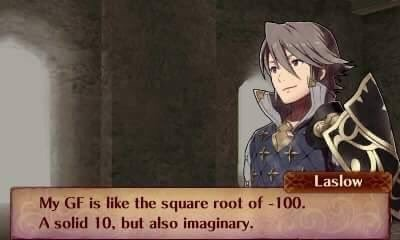
To paraphrase the great philosopher The Rock, it doesn’t matter what E(X^2) is.

P.S. This example illustrates that the covariance of two dependent random variables (X and X^2) can be zero. If two random variables are independent, then the covariance must be zero. But the reverse implication is false.
My Favorite One-Liners: Part 111

I tried a new wise-crack in class recently, and it was a rousing success. My math majors had trouble recalling basic facts about tests for convergent and divergent series, and so I projected onto the front screen the Official Repository of all Knowledge (www.google.com) and searched for “divergent series” to “help” them recall their prior knowledge.

Worked like a charm.

https://www.google.com/search?q=divergent+series

My Favorite One-Liners: Part 109

I tried a new joke in class recently; it worked gloriously.

I wrote on the board a mathematical conjecture that has yet to be proven or disproven. To emphasize that nobody knows the answer yet despite centuries of effort, I told the class, “If you figure this out, call me and call me collect,” writing my office phone number on the board.

To complete the joke, I said, “Yeah, this is crazy. So here’s my number…”

I thoroughly enjoyed my students’ coruscating groans before I could complete the punch line.

Engaging students: Multiplying binomials

In my capstone class for future secondary math teachers, I ask my students to come up with ideas for engaging their students with different topics in the secondary mathematics curriculum. In other words, the point of the assignment was not to devise a full-blown lesson plan on this topic. Instead, I asked my students to think about three different ways of getting their students interested in the topic in the first place.

I plan to share some of the best of these ideas on this blog (after asking my students’ permission, of course).

This student submission again comes from my former student Sarah McCall. Her topic, from Algebra: multiplying binomials.

green line

B2. How does this topic extend what your students should have learned in previous courses?

My hope is that this topic may be easier to understand if student’s can first recall an easier concept that they have already mastered, and then build upon that foundation to learn new skills. For example, at this point students should have already learned the distributive property. To introduce this new concept, I would begin by writing 4(x-5)=4 on the board and asking students what the very first step would be to solve for x. They should know to start by distributing the four to both x and -5, to get 4x-20=4. After completing a few similar examples as a class and/or in groups, then the idea of multiplying binomials would be introduced. This way, students are less intimidated when presented with new material, and they will have a good understanding of how to distribute to each term.


green line

D1. What interesting things can you say about the people who contributed to the discovery and/or the development of this topic?

Teaching students some of the history behind what they are learning can be a great engaging tool. In this case it is helpful to know where the foil method first originated. I would incorporate this by discussing how it first was used in 1929; in William Bentz’ Algebra for Today. In Algebra for Today, Bentz was the first person to mention the “first terms, outer terms, inner terms, last terms” rule. Students should be knowledgeable about the history behind the math they are using, so that they realize the importance of this method. I also believe that it will be cool for students to see how a method developed is still relevant 88 years later. This technique was created in order to provide a memory aid, or “mnemonic device” to help students learn how to multiply binomials. The fact that it is still being used even today proves what an influential concept it was at its time, and throughout the years.


green lineE1. How can technology (YouTube, Khan Academy [khanacademy.org], Vi Hart, Geometers Sketchpad, graphing calculators, etc.) be used to effectively engage students with this topic?

I am a huge fan of incorporating technology in the classroom, and YouTube is especially great because most students already use YouTube outside of school. The following clip (stopped at 1:48) provides a clear, concise explanation and demonstration of the FOIL method for multiplying binomials. It explains how factoring and foiling are related, and shows students which order to distribute in (first, outer, inner, last). The acronym FOIL is easy for students to remember, and gives them something that they can write down each time they complete a problem to help them distribute properly. Additionally, the clip is just under two minutes, which is the perfect time to ensure that students don’t zone out or lose interest before the end of the video. I would choose to follow up this video by completing a few examples as a class, emphasizing the four steps of foiling as mentioned in the video and how to use them.

References

http://pballew.blogspot.com/2011/02/origin-of-foil-for-binomial.html