And the end of every semester, instructors are often asked “What do I need on the final to make a ___ in the course?”, where the desired course grade is given. (I’ve never done a survey, but A appears to be the most desired course grade, followed by C, D, and B.) Here’s the do-it-yourself algorithm that I tell my students, in which the final counts for 20% of the course average.
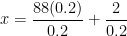
Let be the grade on the final exam, and let be the up-to-date course average prior to the final. Then the course average is equal to .
Somehow, students don’t seem comforted by this simple algebra.
More seriously, here’s a practical tip for students to determine what they need on the final to get a certain grade (hat tip to my friend Jeff Cagle for this idea). It’s based on the following principle:
If the average of is , then the average of is . In other words, if you add a constant to a list of values, then the average changes by that constant.
As an application of this idea, let’s try to guess the average of . A reasonable guess would be something like . So subtract from all four values, obtaining . The average of these four differences is . Therefore, the average of the original four numbers is .
So here’s a typical student question: “If my average right now is an , and the final is worth of my grade, then what do I need to get on the final to get a ?” Answer: The change in the average needs to be , so the student needs to get a grade points higher than his/her current average. So the grade on the final needs to be .
Seen another way, we’re solving the algebra problem
Let me solve this in an unorthodox way:
This last line matches the solution found in the previous paragraph, .
Over the summer, I occasionally teach a small summer math class for my daughter and her friends around my dining room table. Mostly to preserve the memory for future years… and to provide a resource to my friends who wonder what their children are learning… I’ll write up the best of these lesson plans in full detail.
This was a fun activity that took a couple of hours: designing a model Solar System. I chose the scale so that most of the planets would fit on a straight section of sidewalk near my house; of course, the scale could be changed to fit the available space.
For my particular audience of students, I also worked through the basics of the metric system as well as decimals.
This lesson plan is written in a 5E format — engage, explore, explain, elaborate, evaluate — which promotes inquiry-based learning and fosters student engagement.
In my capstone class for future secondary math teachers, I ask my students to come up with ideas for engaging their students with different topics in the secondary mathematics curriculum. In other words, the point of the assignment was not to devise a full-blown lesson plan on this topic. Instead, I asked my students to think about three different ways of getting their students interested in the topic in the first place.
I plan to share some of the best of these ideas on this blog (after asking my students’ permission, of course).
This student submission again comes from my former student Maranda Edmonson. Her topic, from Algebra: finding and intercepts. Unlike most student submissions, Maranda’s idea answers three different questions at once.
Applications: How could you as a teacher create an activity or project that involves your topic?
Culture: How has this topic appeared in pop culture (movies, TV, current music, video games, etc.)?
Technology: How can technology be used to effectively engage students with this topic?
One thing I would not change would be to show the students the above clip of the show where Howard and Sheldon are heatedly discussing crickets at the beginning of the activity. By showing the video at the beginning, students will be engaged and want to figure out what will be done throughout the lesson. Being a clip of a popular show that many probably watch during the week, students will be even more engaged and interested since they are able to watch something that they are already familiar with. Being something that they are already familiar with or can relate to, students have a tendency to remember the material or at least the topic longer than they would remember something that they were unfamiliar with or could not relate.
In the clip, Sheldon argues that the cricket the guys hear while eating dinner is a snowy tree cricket based on the temperature of the room and the frequency of chirps; Howard argues that it is an ordinary field cricket. The beginning of their discussion is as follows:
Sheldon: “Based on the number of chirps per minute, and the ambient temperature in this room, it is a snowy tree cricket.”
Howard: “Oh, give me a frickin’ break. How could you possibly know that?”
Sheldon: “In 1890, Amos Dolbear determined that there was a fixed relationship between the number of chirps per minute of the snowy tree cricket and the ambient temperature – a precise relationship that is not present with ordinary field crickets.”
The whole episode revolves around the guys finding the exact genus and species of the cricket, but that is not the importance here. The importance of this clip is the linear relationship between the temperature and the number of chirps per minute of the cricket, which the activity should then be centered around.
EXPLORE:
After showing the short clip, it could be beneficial to show students the Wikipedia link that discusses Dolbear’s Law. Toward the bottom of the page, the relationship is written out in several formats, but there is a basic linear function that students could focus on for the activity.
Assuming students know how to graph linear functions (as stated above, the link is for a lesson the teacher taught before teaching students about intercepts), I would have students graph Dolbear’s Law on a piece of graph paper. The challenge would be for students to find out what happens when there are variations to the number of chirps of the cricket, the temperature or both to see how the graph changes – specifically where the graph crosses each axis.
EXPLAIN/ELABORATE/EVALUATE:
At this point, students should be able to state what changes they noticed with the graph – specifically where the graph crossed the axes as changes are made to the function. After they have explained what they found, fill in any gaps and correct vocabulary as needed. Basically, teach what little there is left for the lesson. Follow-up by providing extra examples or a worksheet for students to practice before giving them a quiz or test to assess their performance.
Over the summer, I occasionally teach a small summer math class for my daughter and her friends around my dining room table. Mostly to preserve the memory for future years… and to provide a resource to my friends who wonder what their children are learning… I’ll write up the best of these lesson plans in full detail.
This was the first lesson that I taught to this audience: constructing the five regular polyhedra and inductively deriving Euler’s formula. This lesson plan is written in a 5E format — engage, explore, explain, elaborate, evaluate — which promotes inquiry-based learning and fosters student engagement.
This post is not really about finding square roots but continues Part 8 of this series. Continuing the theme of this series, let’s go back in time to when scientific calculators were not invented… say, 1850.
This is a favorite activity that I use when teaching logarithms to precalculus students. I begin by writing the following on the board, in three or four columns:
In other words, I tell the answer to only and . The challenge: fill in the rest without a calculator.
In my classes, we found these logarithms by large-group discussion. However, there’s no reason why this couldn’t be done by dividing a class into small groups and letting the groups collaborate. Indeed, I suggested this idea to a former student who was struggling to come up with an engaging activity involving logarithms for an Algebra II class that she was about to teach. She took this idea and ran with it, and she told me it was a big hit with her students.
I provide a thought bubble if you’d like to think about it before I give the answers.
Step 1. Three of these values — , , and — can be found exactly since they’re powers of .
Step 2. Most of the others can be found by using the laws of logarithms for products, quotients, and powers involving , , and . For example,
.
Of this group, usually is the hardest for students to recognize.
Step 3 (optional). A few of the logarithms, like , cannot be determined in terms of and . But they can be approximated to reasonable accuracy with a little creativity. For example,
.
For a really good approximation, we use the fact that .
.
To approximate , we could use the fact that , or . So
Naturally, any and all of the above results can be confirmed with a scientific calculator.
In my opinion, here are some of the pedagogical benefits of the above activity.
1. This activity solidifies students’ knowledge about the laws of logarithms. The laws of logarithms become less abstract, changing from into something more tangible and comfortable, like positive integers.
2. Hopefully the activity will demystify for students the curious decimal expansions when a calculator returns logarithms. In other words, hopefully the above activity will help
3. The activity should promote some understanding of the values of base-10 logarithms. For example, for and for .
4. Students should see that, for large , is not much larger than . This is another way of saying that the graph of increases very slowly as increases. So this should provide some future intuition for the graphs of logarithmic functions.
5. The values of are used to construct the unevenly-spaced lines and/or tick marks in log-log graphs and log-linear graphs (which are standard plotting options on many scientific calculators).
This story comes from Fall 1996, my first semester as a college professor. I was teaching a Precalculus class, and the topic was vectors. I forget the exact problem (believe me, I wish I could remember it), but I was going over the solution of a problem that required finding . I told the class that I had worked this out ahead of time, and that the approximate answer was . Then I used that angle for whatever I needed it for and continued until obtaining the eventual solution.
(By the way, I now realize that I was hardly following best practices by computing that angle ahead of time. Knowing what I know now, I should have brought a calculator to class and computed it on the spot. But, as a young professor, I was primarily concerned with getting the answer right, and I was petrified of making a mistake that my students could repeat.)
After solving the problem, I paused to ask for questions. One student asked a good question, and then another.
Then a third student asked, “How did you know that was ?
Suppressing a smile, I answered, “Easy; I had that one memorized.”
The class immediately erupted… some with laughter, some with disbelief. (I had a terrific rapport with those students that semester; part of the daily atmosphere was the give-and-take with any number of exuberant students.) One guy in the front row immediately challenged me: “Oh yeah? Then what’s ?
I started to stammer, “Uh, um…”
“Aha!” they said. “He’s faking it.” They start pulling out their calculators.
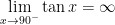
Then I thought as fast as I could. Then I realized that I knew that , thanks to my calculation prior to class. I also knew that since the graph of has a vertical asymptote at . So the solution to had to be somewhere between and .
So I took a total guess. “,” I said, faking complete and utter confidence.
Wouldn’t you know it, I was right. (The answer is about .)
In stunned disbelief, the guy who asked the question asked, “How did you do that?”
I was reeling in shock that I guessed correctly. But I put on my best poker face and answered, “I told you, I had it memorized.” And then I continued with the next example. For the rest of the semester, my students really thought I had it memorized.
To this day, this is my favorite stunt that I ever pulled off in front of my students.
Over the summer, I occasionally teach a small summer math class for my daughter and her friends around my dining room table. Mostly to preserve the memory for future years… and to provide a resource to my friends who wonder what their children are learning… I’ll write up the best of these lesson plans in full detail.
This was perhaps my favorite: fostering algebraic thinking through the use of 3×3 magic squares, which have the property that the numbers in every row, column, and diagonal have the same sum.
This lesson plan is written in a 5E format — engage, explore, explain, elaborate, evaluate — which promotes inquiry-based learning and fosters student engagement.
When teaching my Applied Statistics class, I’ll often use the following xkcd comic to reinforce the meaning of statistical significance.
The idea that’s being communicated is that, when performing an hypothesis test, the observed significance level is the probability that the null hypothesis is correct due to dumb luck as opposed to a real effect (the alternative hypothesis). So if the significance level is really about and the experiment is repeated about 20 times, it wouldn’t be surprising for one of those experiments to falsely reject the null hypothesis.
In practice, statisticians use the Bonferroni correction when performing multiple simultaneous tests to avoid the erroneous conclusion displayed in the comic.
Based on my students’ reactions, I gave my best math joke in years as I went over the proofs for checking that an integer was a multiple of 3 or a multiple of 9. I started by proving a lemma that 9 is always a factor of . I asked my students how I’d write out , and they correctly answered , a numeral with consecutive s. So I said, “Who let the dogs out? Me. See: nines.”
Some of my students laughed so hard that they cried.
There are actually at least three ways of proving this lemma. I love lemmas like these, as they offer a way of, in the words of my former professor Arnold Ross, to think deeply about simple things.
(1) By subtracting, , which is clearly a multiple of 9.
(2) We can use the rule
The conclusion follows by letting and .
From my experience, my senior math majors all learned the rule for factoring the difference of two squares, but very few learned the rule for factoring the difference of two cubes, while almost none of them learned the general factorization rule above. As always, it’s not my students’ fault that they weren’t taught these things when they were younger.
I also supplement this proof with a challenge to connect Proof #2 with Proof #1… why does ?
(3) We can use mathematical induction.
If , then , which is a multiple of 9.
We now assume that is a multiple of 9.
To show that is a multiple of 9, we observe that
,
and both terms on the right-hand side are multiples of 9. (I also challenge my students to connect the right-hand side with the original expression .)

be the grade on the final exam, and let
be the up-to-date course average prior to the final. Then the course average is equal to
.
 More seriously, here’s a practical tip for students to determine what they need on the final to get a certain grade (hat tip to my friend Jeff Cagle for this idea). It’s based on the following principle:
is
, then the average of
is
. In other words, if you add a constant to a list of values, then the average changes by that constant.







 and
and  intercepts. Unlike most student submissions, Maranda’s idea answers three different questions at once.


 and
and  . The challenge: fill in the rest without a calculator.
 ,
,  , and
, and  — can be found exactly since they’re powers of
  ,
,  , and
, and 

 .
. .
. .
. .
. , or
, or  . So
. So
 into something more tangible and comfortable, like positive integers.
 for
for  and
and  for
for  .
. ,
,  is not much larger than
  . This is another way of saying that the graph of
  increases very slowly as
  are used to construct the unevenly-spaced lines and/or tick marks in
  . I told the class that I had worked this out ahead of time, and that the approximate answer was
  . Then I used that angle for whatever I needed it for and continued until obtaining the eventual solution.
 ?
? , thanks to my calculation prior to class. I also knew that
  since the graph of
  has a vertical asymptote at
  . So the solution to
  had to be somewhere between
  .
. ,” I said, faking complete and utter confidence.
 .)
.)

 is the probability that the null hypothesis is correct due to dumb luck as opposed to a real effect (the alternative hypothesis). So if the significance level is really about
  and the experiment is repeated about 20 times, it wouldn’t be surprising for one of those experiments to falsely reject the null hypothesis.
 . I asked my students how I’d write out
  , a numeral with
  consecutive
  s. So I said, “Who let the dogs out? Me. See:
  , which is clearly a multiple of 9.
 and
and  .
. ?
? , then
  , which is a multiple of 9.
 is a multiple of 9, we observe that
 ,
,
 Mean Green Math