My Favorite One-Liners: Part 13

In this series, I’m compiling some of the quips and one-liners that I’ll use with my students to hopefully make my lessons more memorable for them.

Here’s a story that I’ll tell my students when, for the first time in a semester, I’m about to use a previous theorem to make a major step in proving a theorem. For example, I may have just finished the proof of

\hbox{Var}(X+Y) = \hbox{Var}(X) + \hbox{Var}(Y),

where X and Y are independent random variables, and I’m about to prove that

\hbox{Var}(X-Y) = \hbox{Var}(X) + \hbox{Var}(Y).

While this can be done by starting from scratch and using the definition of variance, the easiest thing to do is to write

\hbox{Var}(X-Y) = \hbox{Var}(X+[-Y]) = \hbox{Var}(X) + \hbox{Var}(-Y),

thus using the result of the first theorem to prove the next theorem.

And so I have a little story that I tell students about this principle. I think I was 13 when I first heard this one, and obviously it’s stuck with me over the years.

At MIT, there’s a two-part entrance exam to determine who will be the engineers and who will be the mathematicians. For the first part of the exam, students are led one at a time into a kitchen. There’s an empty pot on the floor, a sink, and a stove. The assignment is to boil water. Everyone does exactly the same thing: they fill the pot with water, place it on the stove, and then turn the stove on. Everyone passes.

For the second part of the exam, students are led one at a time again into the kitchen. This time, there’s a pot full of water sitting on the stove. The assignment, once again, is to boil water. Nearly everyone simply turns on the stove. These students are led off to become engineers. The mathematicians are ones who take the pot off the stove, dump the water into the sink, and place the empty pot on the floor… thereby reducing to the original problem, which had already been solved.

My Favorite One-Liners: Part 12

In this series, I’m compiling some of the quips and one-liners that I’ll use with my students to hopefully make my lessons more memorable for them.

Often in mathematics, one proof is quite similar to another proof. For example, in Precalculus or Discrete Mathematics, students encounter the theorem

\sum_{k=1}^n (a_k + b_k) = \sum_{k=1}^n a_k + \sum_{k=1}^n b_k.

The formal proof requires mathematical induction, but the “good enough” proof is usually convincing enough for most students, as it’s just the repeated use of the commutative and associative properties to rearrange the terms in the sum:

\sum_{k=1}^n (a_k + b_k)= (a_1 + b_1) + (a_2 + b_2) + \dots + (a_n + b_n)

= (a_1 + a_2 + \dots + a_n) + (b_1 + b_2 + \dots + b_n)

= \sum_{k=1}^n a_k + \sum_{k=1}^n b_k.

Next, I’ll often present the new but closely related theorem

\sum_{k=1}^n (a_k - b_k) = \sum_{k=1}^n a_k -\sum_{k=1}^n b_k.

The proof of this would take roughly the same amount of time as the first proof, but there’s often little pedagogical value in doing all the steps over again in class. So here’s the line I’ll use: “At this point, I invoke the second-most powerful word in mathematics…” and then let them guess what this mysterious word is.

After a few seconds, I tell them the answer: “Similar.” The proof of the second theorem exactly parallels the proof of the first except for some sign changes. So I’ll tell them that mathematicians often use this word in mathematical proofs when it’s dead obvious that the proof can be virtually copied-and-pasted from a previous proof.

Eventually, students will catch on to my deliberate choice of words and ask, “What the most powerful word in mathematics?” As any mathematician knows, the most powerful word in mathematics is “Trivial”… the proof is so easy that it’s not necessary to write the proof down. But I warn my students that they’re not allowed to use this word when answering exam questions.

The third most powerful phrase in mathematics is “It is left for the student,” thus saving the professor from writing down the proof in class and encouraging students to figure out the details on their own.


My Favorite One-Liners: Part 11

In this series, I’m compiling some of the quips and one-liners that I’ll use with my students to hopefully make my lessons more memorable for them.

Every once in a while, I’ll cover a theorem in class that looks utterly surprising to students at first glance. For example, in trigonometry, I might state that

\sin^{-1} \left( \sin \pi \right) \ne \pi,

so that the inverse function doesn’t quite behave like it’s supposed to (because of the restricted domain used to define inverse sine.)

Before explaining why \sin^{-1} \left( \sin \pi \right) isn’t equal to \pi, I’ll get the discussion started by saying, “Don’t believe me? Just watch.”… a tip of the cap to this recent hit song (at the time of this writing, the third-most watched video on YouTube).

While on this topic, I have to tip my cap to Kelli Hauser, a sixth-grade teacher in my city who made the following motivational video for students about to take their end-of-year high-stakes test (called, here in Texas, the STAAR exam).

One more parody concerning a recent spacecraft that visited Pluto:

For further reading, here’s my series on inverse functions.

My Favorite One-Liners: Part 10

In this series, I’m compiling some of the quips and one-liners that I’ll use with my students to hopefully make my lessons more memorable for them.

While I can’t take credit for today’s one-liner, I’m more than happy to share it.

A colleague was explaining his expectations for simplifying expressions such as

\displaystyle \frac{\displaystyle ~~~\frac{2x}{x^2+1}~~~}{\displaystyle ~~~\frac{x}{x^2-1}~~~}

Of course, this isn’t yet simplified, but his students were balking about doing the required work. So, on the spur of the moment, he laid down a simple rule:

Not simplifying a fraction in a fraction is an infraction.

Utterly brilliant.

My Favorite One-Liners: Part 9

In this series, I’m compiling some of the quips and one-liners that I’ll use with my students to hopefully make my lessons more memorable for them.

Today, I’d like to discuss a common mistake students make in trigonometry… as well as the one-liner that I use to (hopefully) help students not make this mistake in the future.

Question. Find all solutions (rounded to the nearest tenth of a degree) of \sin x = 0.8.

Erroneous Solution. Plugging into a calculator, we find that x \approx 53.1^o.

arcsine1

The student correctly found the unique angle x between -90^o and 90^o so that \sin x = 0.8. That’s the definition of the arcsine function. However, there are plenty of other angles whose sine is equal to 0.7. This can happen in two ways.

First, if $\sin x > 0$, then the angle x could be in either the first quadrant or the second quadrant (thanks to the mnemonic All Scholars Take Calculus). So x could be (accurate to one decimal place) equal to either 53.1^o or else 180^o - 53.1^o = 126.9^o. Students can visualize this by drawing a picture, talking through each step of its construction (first black, then red, then brown, then green, then blue).arcsin45

However, most students don’t really believe that there’s a second angle that works until they see the results of a calculator.

TIarcsin45

Second, any angle that’s coterminal with either of these two angles also works. This can be drawn into the above picture and, as before, confirmed with a calculator.

So the complete answer (again, approximate to one decimal place) should be 53.1^{\circ} + 360n^o and 126.9 + 360n^{\circ}, where n is an integer. Since integers can be negative, there’s no need to write \pm in the solution.

Therefore, the student who simply answers 53.1^o has missed infinitely many solutions. The student has missed every nontrivial angle that’s coterminal with 53.1^o and also every angle in the second quadrant that also works.

green line

Here’s my one-liner — which never fails to get an embarrassed laugh — that hopefully helps students remember that merely using the arcsine function is not enough for solving problems such as this one.

You’ve forgotten infinitely many solutions. So how many points should I take off?

For further reading, here’s my series on inverse functions.

My Favorite One-Liners: Part 8

In this series, I’m compiling some of the quips and one-liners that I’ll use with my students to hopefully make my lessons more memorable for them.

At many layers of the mathematics curriculum, students learn about that various functions can essentially commute with each other. In other words, the order in which the operations is performed doesn’t affect the final answer. Here’s a partial list off the top of my head:

  1. Arithmetic/Algebra: a \cdot (b + c) = a \cdot b + a \cdot c. This of course is commonly called the distributive property (and not the commutative property), but the essential idea is that the same answer is obtained whether the multiplications are performed first or if the addition is performed first.
  2. Algebra: If a,b > 0, then \sqrt{ab} = \sqrt{a} \sqrt{b}.
  3. Algebra: If a,b > 0 and x is any real number, then (ab)^x = a^x b^x.
  4. Precalculus: \displaystyle \sum_{i=1}^n (a_i+b_i) = \displaystyle \sum_{i=1}^n a_i + \sum_{i=1}^n b_i.
  5. Precalculus: \displaystyle \sum_{i=1}^n c a_i = c \displaystyle \sum_{i=1}^n a_i.
  6. Calculus: If f is continuous at an interior point c, then \displaystyle \lim_{x \to c} f(x) = f(c).
  7. Calculus: If f and g are differentiable, then (f+g)' = f' + g'.
  8. Calculus: If f is differentiable and c is a constant, then (cf)' = cf'.
  9. Calculus: If f and g are integrable, then \int (f+g) = \int f + \int g.
  10. Calculus: If f is integrable and c is a constant, then \int cf = c \int f.
  11. Calculus: If f: \mathbb{R}^2 \to \mathbb{R} is integrable, \iint f(x,y) dx dy = \iint f(x,y) dy dx.
  12. Calculus: For most differentiable function f: \mathbb{R}^2 \to \mathbb{R} that arise in practice, \displaystyle \frac{\partial^2 f}{\partial x \partial y} = \displaystyle \frac{\partial^2 f}{\partial y \partial x}.
  13. Probability: If X and Y are random variables, then E(X+Y) = E(X) + E(Y).
  14. Probability: If X is a random variable and c is a constant, then E(cX) = c E(X).
  15. Probability: If X and Y are independent random variables, then E(XY) = E(X) E(Y).
  16. Probability: If X and Y are independent random variables, then \hbox{Var}(X+Y) = \hbox{Var}(X) + \hbox{Var}(Y).
  17. Set theory: If A, B, and C are sets, then A \cup (B \cap C) = (A \cup B) \cap (A \cup C).
  18. Set theory: If A, B, and C are sets, then A \cap (B \cup C) = (A \cap B) \cup (A \cap C).

However, there are plenty of instances when two functions do not commute. Most of these, of course, are common mistakes that students make when they first encounter these concepts. Here’s a partial list off the top of my head. (For all of these, the inequality sign means that the two sides do not have to be equal… though there may be special cases when equality happens to happen.)

  1. Algebra: (a+b)^x \ne a^x + b^x if x \ne 1. Important special cases are x = 2, x = 1/2, and x = -1.
  2. Algebra/Precalculus: \log_b(x+y) = \log_b x + \log_b y. I call this the third classic blunder.
  3. Precalculus: (f \circ g)(x) \ne (g \circ f)(x).
  4. Precalculus: \sin(x+y) \ne \sin x + \sin y, \cos(x+y) \ne \cos x + \cos y, etc.
  5. Precalculus: \displaystyle \sum_{i=1}^n (a_i b_i) \ne \displaystyle \left(\sum_{i=1}^n a_i \right) \left( \sum_{i=1}^n b_i \right).
  6. Calculus: (fg)' \ne f' \cdot g'.
  7. Calculus \left( \displaystyle \frac{f}{g} \right)' \ne \displaystyle \frac{f'}{g'}
  8. Calculus: \int fg \ne \left( \int f \right) \left( \int g \right).
  9. Probability: If X and Y are dependent random variables, then E(XY) \ne E(X) E(Y).
  10. Probability: If X and Y are dependent random variables, then \hbox{Var}(X+Y) \ne \hbox{Var}(X) + \hbox{Var}(Y).

All this to say, it’s a big deal when two functions commute, because this doesn’t happen all the time.

green lineI wish I could remember the speaker’s name, but I heard the following one-liner at a state mathematics conference many years ago, and I’ve used it to great effect in my classes ever since. Whenever I present a property where two functions commute, I’ll say, “In other words, the order of operations does not matter. This is a big deal, because, in real life, the order of operations usually is important. For example, this morning, you probably got dressed and then went outside. The order was important.”


My Favorite One-Liners: Part 7

In this series, I’m compiling some of the quips and one-liners that I’ll use with my students to hopefully make my lessons more memorable for them.

One of my favorite one-liners is simply stated: “Mathematicians are lazy.” I’ll use this whenever I introduce my students a new piece of mathematical notation or lingo.

For example, in probability, a common notion is a sequence of independent and identically distributed random variables (say, rolling a die repeatedly). However, mathematicians will typically write “i.i.d.” instead of “independent and identically distributed.” Why? That’s when I break out the mantra: “Mathematicians are lazy.” It’s my quick way of saying, “Hey, this is new notation that you’re about to learn, but the whole point of new notation is to make writing mathematical ideas a little quicker.”

Mathematical notation like \displaystyle \int_a^b f(x) \, dx can appear very intimidating when students first encounter them. Hopefully repeating this mantra a few dozen times each semester makes the introduction of new notation a little more palatable for my students.


My Favorite One-Liners: Part 6

In this series, I’m compiling some of the quips and one-liners that I’ll use with my students to hopefully make my lessons more memorable for them.

Sometimes, I’ll expect students to learn and master operations that cancel. For example, in Precalculus, I want my students to know the sum-to-product trigonometric identities

\sin u + \sin v = \displaystyle 2 \sin\left( \frac{u+v}{2} \right) \cos \left( \frac{u-v}{2} \right),

\sin u - \sin v = \displaystyle 2 \cos\left( \frac{u+v}{2} \right) \sin\left( \frac{u-v}{2} \right),

\cos u + \cos v = \displaystyle 2 \cos\left( \frac{u+v}{2} \right) \cos \left( \frac{u-v}{2} \right),

\cos u - \cos v = \displaystyle -2 \sin \left( \frac{u+v}{2} \right) \sin\left( \frac{u-v}{2} \right).

These can be helpful for solving trigonometric equations. For example, to solve \cos 3x + \cos 7x = 0, we have

\cos 3x + \cos 7x = 0

\displaystyle 2 \sin\left( \frac{3x+7x}{2} \right) \cos \left( \frac{3x-7x}{2} \right) = 0

2 \sin 5x \cos (-2x) = 0

2 \sin 5x \cos 2x = 0

\displaystyle x = \frac{n\pi}{5} \qquad  \hbox{or} \qquad \displaystyle x = \left( \frac{n}{2} + \frac{1}{4} \right)\pi for integers n.

However, I also want my students to know the product-to-sum trigonometric identities

\cos x \cos y = \displaystyle \frac{1}{2} [\cos(x+y) + \cos(x-y) ],

\sin x \sin y = \displaystyle \frac{1}{2} [\cos(x-y) - \cos(x+y) ],

\sin x \cos y = \displaystyle \frac{1}{2} [\sin(x+y) + \sin(x-y) ].

These are useful when computing certain definite integrals (especially related to Fourier series). For example, if m \ne n are both integers, then

\displaystyle \int_0^{2\pi} \cos mx \cos nx \, dx = \displaystyle \int_0^{2\pi} \frac{1}{2} \left[\cos([m+n]x) + \cos([m-n])x) \right] \, dx

= \left[ \displaystyle \frac{\sin([m+n]x)}{2(m+n)} +  \frac{\sin([m-n]x)}{2(m-n)} \right]^{2\pi}_0

= \displaystyle \frac{\sin(2[m+n]\pi) - \sin 0}{2(m+n)} +  \frac{\sin(2[m-n]\pi) - \sin 0}{2(m-n)}.

=0

This integral and other similar integrals are necessary to find the formula for the coefficients in a Fourier series.

In other words, sometimes I’ll want my students to convert a product into a sum. Other times, I’ll want my students to convert a sum into a product.

To help this sink in, I’ll tell my students, “To quote the great philosopher: Sometimes you gotta know when to hold ’em, know when to fold them.”

However, when I made this joke recently, a student innocently asked, “What great philosopher said that?” I turned the question back to my class, but not one of my class of millennials knew the answer. One person came close with his answer of “Willie” — wrong answer but correct genre and time frame. (Somebody else answered Socrates.)

So that my students actually learn something important in my class, here’s the cultural reference:

My Favorite One-Liners: Part 5

In this series, I’m compiling some of the quips and one-liners that I’ll use with my students to hopefully make my lessons more memorable for them.

Every once in a while, students encounter a step that seems far from obvious. To give one example, to evaluate the series

\displaystyle \sum_{n=1}^{100} \frac{1}{n^2+n},

the natural first step is to rewrite this as

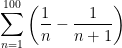
\displaystyle \sum_{n=1}^{100} \left(\frac{1}{n} - \frac{1}{n+1} \right)

and then use the principle of telescoping series. However, students may wonder how they were ever supposed to think of the first step for themselves.

Students often give skeptical, quizzical, and/or frustrated looks about this non-intuitive next step… they’re thinking, “How would I ever have thought to do that on my own?” To allay these concerns, I explain that this step comes from the patented Bag of Tricks. Socrates gave the Bag of Tricks to Plato, Plato gave it to Aristotle, it passed down the generations, my teacher taught the Bag of Tricks to me, and I teach it to my students.

Sadly, there aren’t any videos of Greek philosophers teaching, so I’ll have to settle for this:

My Favorite One-Liners: Part 4

In this series, I’m compiling some of the quips and one-liners that I’ll use with my students to hopefully make my lessons more memorable for them.

During in-class discussions, students often but inadvertently make the same mistakes over and over again… say, thinking that \sqrt{a^2+b^2} = a + b or \displaystyle \frac{d}{dx} (uv) = \displaystyle \frac{du}{dx} \cdot \frac{dv}{dx}. Naturally, such mistakes need to be corrected, but hopefully politely and in a memorable way.

After the third or fourth such repetition of the same mistake during a semester, I’ll try to lighten the mood by saying, “You think that you can do these things, but you just can’t, Nemo!”

Pop culture reference: