What to Expect When You’re Expecting to Win the Lottery

I can’t think of a better way to tease this video than its YouTube description:

Recounting one of the stories included in his book How Not to Be Wrong: The Power of Mathematical Thinking, Jordan Ellenberg (University of Wisconsin-Madison) tells how a group of MIT students exploited a loophole in the Massachusetts State Lottery to win game after game, eventually pocketing more than $3 million.

A personal note: though I haven’t talked with him in years, Dr. Ellenberg and I were actually in the same calculus class about 30 years ago.

Hands on SET

Every so often, I’ll publicize through this blog an interesting article that I’ve found in the mathematics or mathematics education literature that can be freely distributed to the general public. Today, I’d like to highlight “Hands-on SET®,” by Hannah Gordon, Rebecca Gordon, and Elizabeth McMahon. Here’s the abstract:

SET® is a fun, fast-paced game that contains a surprising amount of mathematics. We will look in particular at hands-on activities in combinatorics and probability, finite geometry, and linear algebra for students at various levels. We also include a fun extension to the game that illustrates some of the power of thinking mathematically about the game.

The full article can be found here: http://dx.doi.org/10.1080/10511970.2013.764368

Full reference: Hannah Gordon, Rebecca Gordon & Elizabeth McMahon (2013) Hands-on SET®, PRIMUS: Problems, Resources, and Issues in Mathematics Undergraduate Studies, 23:7, 646-658, DOI: 10.1080/10511970.2013.764368

Lessons from teaching gifted elementary school students (Part 4c)

Every so often, I’ll informally teach a class of gifted elementary-school students. I greatly enjoy interacting with them, and I especially enjoy the questions they pose. Often these children pose questions that no one else will think about, and answering these questions requires a surprisingly depth of mathematical knowledge.

Here’s a question I once received:

What is the chance of winning a game of BINGO after only four turns?

When my class posed this question, I was a little concerned that the getting the answer might be beyond the current abilities of a gifted elementary student. As discussed over the past couple of posts, for a non-standard BINGO game with 44 numbers, the answer is

\displaystyle 4 \times \frac{4}{44} \times \frac{3}{43} \times \frac{2}{42} \times \frac{1}{41} = \displaystyle \frac{4}{135,751}

After we got the answer, I then was asked the question that I had fully anticipated but utterly dreaded:

What’s that in decimal?

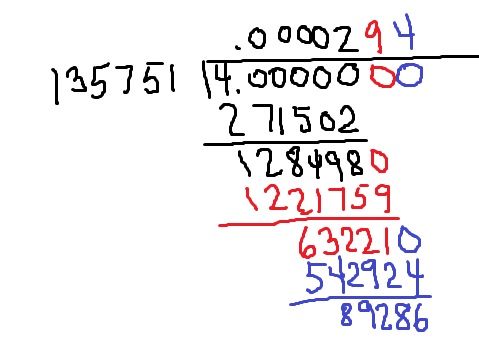
With these gifted students, I encourage thinking as much as possible without a calculator… and they wanted me to provide the answer to this one in like fashion. For my class, this actually did serve a purpose by illustrating a really complicated long division problem so they could reminded about the number of leading zeroes in such a problem.

Gritting my teeth, I started on the answer:

biglongdivisionAt this point, I was asked the other question that I had anticipated but utterly dreaded… motivated by child-like curiosity mixed perhaps with a touch of sadism:

How long do we have before the digits start repeating?

My stomach immediately started churning.

I told the class that I’d have to figure this one later. But I told them that the answer would definitely be less than 135,751 times. My class was surprised that I could even provide this level of (extremely) modest upper limit on the answer. After some prompting, my class saw the reasoning for this answer: there are only 135,751 possible remainders after performing the subtraction step in the division algorithm, and so a remainder has to be repeated after 135,751 steps. Therefore, the digits will start repeating in 135,751 steps or less.

What I knew — but probably couldn’t explain to these elementary-school students, and so I had to work this out for myself and then get back to them with the answer — is that the length of the repeating block n is the least integer so that

135751 \mid 10^n - 1

which is another way of saying that we’ve used the division algorithm enough times so that a remainder repeats. Written in the language of group theory, n is the least integer that satisfies

10^n \equiv 1 \mod 135751

(A caveat:this rule works because neither 2 nor 5 is a factor of 135,751… otherwise, those factors would have to be taken out first.)

Some elementary group theory can now be used to guess the value of n. Let G be the multiplicative group of integers modulo 135,751 which are relatively prime which. The order of this group is denoted by \phi(135751), called the Euler totient function. In general, if m = p_1^{a_1} p_2^{a_2} \dots p_r^{a_r} is the prime factorization of m, then

\phi(m) = n \left( \displaystyle 1 - \frac{1}{p_1} \right) \left( \displaystyle 1 - \frac{1}{p_2} \right) \dots \left( \displaystyle 1 - \frac{1}{p_r} \right)

For the case at hand, the prime factorization of 135,751 can be recovered by examining the product of the fractions near the top of this post:

135751 = 7 \times 11 \times 41 \times 43

Therefore,

\phi(135,751) = 6 \times 10 \times 40 \times 42 = 100,800

Next, there’s a theorem from group theory that says that the order n of an element of a group must be a factor of the order of the group. In other words, the number n that we’re seeking must be a factor of 100,800. This is easy to factor:

100,800 = 2^6 \times 3^2 \times 5^2 \times 7

Therefore, the number n has the form

n = 2^a 3^b 5^c 7^d,

where 0 \le a \le 6, 0 \le b \le 2, 0 \le c \le 2, and 0 \le d \le 1 are integers.

So, to summarize, we can say definitively that n is at most 100,800, and that were have narrowed down the possible values of n to only 7 \times 3 \times 3 \times 2 = 126 possibilities (the product of one more than all of the exponents). So that’s a definite improvement and reduction from my original answer of 135,751 possibilities.

At this point, there’s nothing left to do except test all 126 possibilities. Unfortunately, there’s no shortcut to this; it has to be done by trial and error. Thankfully, this can be done with Mathematica:

biglongdivision2The final line shows that the least such value of n is 210. Therefore, the decimal will repeat after 210 digits. So here are the first 210 digits of \displaystyle \frac{4}{135,751} (courtesy of Mathematica):

0.000029465712959757202525211600651192256410634175807176374391348866675015285338597874048809953517837805983013016478699972744215512224587664\
179269397647162820163387378361853688002298325610861061796966504850792996…

For more on this, see https://meangreenmath.com/2013/08/23/thoughts-on-17-and-other-rational-numbers-part-6/ and https://meangreenmath.com/2013/08/25/thoughts-on-17-and-other-rational-numbers-part-8/.

Lessons from teaching gifted elementary school students (Part 4b)

Every so often, I’ll informally teach a class of gifted elementary-school students. I greatly enjoy interacting with them, and I especially enjoy the questions they pose. Often these children pose questions that no one else will think about, and answering these questions requires a surprisingly depth of mathematical knowledge.

Here’s a question I once received:

What is the chance of winning a game of BINGO after only four turns?

When my class posed this question, I was a little concerned that the getting the answer might be beyond the current abilities of a gifted elementary student.  Still, what I love about this question is that it gave me a way to teach my class some techniques of probabilistic reasoning that probably would not occur in a traditional elementary school setting.

As discussed yesterday, for a non-standard BINGO game with 44 numbers, the answer is

\displaystyle 4 \times \frac{4}{44} \times \frac{3}{43} \times \frac{2}{42} \times \frac{1}{41}

For a standard BINGO board with 75 numbers, the denominators are instead 75, 74, 73, and 72.

Now, for the next challenge: getting my students to simplify this product. I’m always mystified when college students blindly multiply numerators and denominators together without bothering to attempt to cancel common factors. Fortunately, this class already understands how to simplify fractions, and so the next step was easy:

\displaystyle 4 \times \frac{1}{11} \times \frac{3}{43} \times \frac{1}{21} \times \frac{1}{41}

 So I was ready for the next step: cancelling 3 from the numerator and denominator. To my surprise, this was a major stumbling block. I tried probing around to prod them to perform this cancellation, but no luck. Eventually, I guessed the issue that my class was facing: they were familiar with the mechanics of both adding and multiplying fractions and also with writing fractions in lowest terms, but they weren’t yet comfortable enough with fractions to cancel 3 from the numerator of one fraction and the denominator of a different fraction.

So, toward this end, I asked my class if it was OK to shuffle a couple of the numerators and rewrite this product as

\displaystyle 4 \times \frac{1}{11} \times \frac{1}{43} \times \frac{3}{21} \times \frac{1}{41}

It took a moment, but then they agreed that this was OK because the order of multiplication doesn’t matter, even volunteering the word commutative to explain their reasoning. (I’m going to try to remember this technique for future reference as a way to get students new to fractions more comfortable with similar cancellations.) Once they got past this conceptual barrier, it was straightforward to continue the simplification:

\displaystyle 4 \times \frac{1}{11} \times \frac{1}{43} \times \frac{1}{7} \times \frac{1}{41}

= \displaystyle \frac{4}{135,751}

So I explained that if a game of BINGO took one minute, we could play round the clock for 135,751 minutes (about 96 days) and expect to win in the minimal number of turns only four times. Not very likely at all. (Though I didn’t discuss this with my class, the answer is even smaller with a standard BINGO game with 75 numbers: you’d expect to win only once every 211 days.)

Lessons from teaching gifted elementary school students (Part 4a)

Every so often, I’ll informally teach a class of gifted elementary-school students. I greatly enjoy interacting with them, and I especially enjoy the questions they pose. Often these children pose questions that no one else will think about, and answering these questions requires a surprisingly depth of mathematical knowledge.

Here’s a question I once received:

What is the chance of winning a game of BINGO after only four turns?

I leave a thought bubble in case you’d like to think this. One way of answering this question appears after the bubble.

green_speech_bubble

When my class posed this question, I was a little concerned that my class was simply not ready to understand the solution (described below), as it takes more than a little work to get at the answer. Still, what I love about this question is that it gave me a way to teach my class some techniques of probabilistic reasoning that probably would not occur in a traditional elementary school setting. Also, I was reminded that even these gifted students might need a little help with simplifying the answer. So let me discuss how I helped these young students discover the answer. I found the ensuing discussion especially enlightening, and so I’m dividing this discussion into several posts.

Here’s a non-standard BINGO board:

Using the free space in the middle, there are four ways of winning the game in four moves:

  • Horizontally (11-12-13-14)
  • Vertically (3-8-17-22)
  • Diagonally (1-7-18-24)
  • Diagonally (5-9-16-20)

A standard BINGO board has 75 possible numbers (B 1-15, I 16-30, N 31-45, G 46-60, O 61-75). However, the board that I was using with my class (which was being used for pedagogical purposes) only had 44 possibilities. So the solution below assumes these 44 possibilities; the answer for a standard BINGO board is obvious.

My class quickly decided to start by solving the problem for the horizontal case. I began by asking for the chance that the first number will be on the middle row; after some thought, the class correctly answered \displaystyle \frac{4}{44}.

Next, I asked the chance that the next number would also be on the middle row. To my surprise, this wasn’t automatic for my young but gifted students. They felt that they didn’t know where the first number was, and so they felt like they couldn’t know the chance for the second number. To get them over this conceptual barrier (or so I thought), I asked them to pretend that the first number was 11. Then what would be the odds that the next number fell on the middle row? After some discussion, the class agreed that the answer was \displaystyle \frac{3}{43}.

Once that barrier was cleared, then the class saw that the next two fractions were \displaystyle \frac{2}{42} and \displaystyle \frac{1}{41}. I then explained that, to get the answer for the four consecutive numbers on the middle row, these fractions have to be multiplied:

\displaystyle \frac{4}{44} \times \frac{3}{43} \times \frac{2}{42} \times \frac{1}{41}

I didn’t justify why the fractions had to be multiplied; my class just accepted this as the way to combined the fractions to get the answer for all four events happening at once.

Then I asked about the other three possibilities — the middle column and the two diagonals. The class quickly agreed that the answer should be the same for these other possibilities, and so the final answer should just be four times larger:

\displaystyle 4 \times \frac{4}{44} \times \frac{3}{43} \times \frac{2}{42} \times \frac{1}{41}

green lineAt this point, I was ready to go on, but then a student asked something like the following:

Shouldn’t the answer be \displaystyle \frac{1}{44} \times \frac{1}{43} \times \frac{1}{42} \times \frac{1}{41}? I mean, we chose 11 to be the first number so that we can figure out the chance for the second number, and the chance that the first number is 11 is \displaystyle \frac{1}{41}.

Oops. While trying to clear one conceptual hurdle (getting the answer of \displaystyle \frac{3}{43} for the second number), I had inadvertently introduced a second hurdle by making my class wonder if the first number had to be a specific number.

I began by trying to explain that the first number really didn’t have to be 11 after all, but that only seemed to re-introduce the original barrier. Finally, I found an answer that my class found convincing: Yes, the chance that the first number is 11, the second number is 12, the third number is 13, and fourth number is 14 is indeed \displaystyle \frac{1}{44} \times \frac{1}{43} \times \frac{1}{42} \times \frac{1}{41}. But there are other ways that all the numbers could land on the middle row:

  • The first number could be 12, the second number could be 11, the third number could be 13, and the fourth number could be 14.
  • Quickly, light dawned, and my class began volunteering other orderings by which all the numbers land in the middle row.
  • We then enumerated the number of ways that this could happen, and we found that the answer was indeed 24.
  • I then tied the knot by noting that 4 \times 3 \times 2 \times 1 = 24, and so gives another explanation for the numerators in the answer.

green lineHaving found the answer, it was now time to simplify the answer. More on this in tomorrow’s post.

2048 and algebra (Part 10)

In this series of posts, I used algebra to show that 114,795 moves were needed to produce the following final board. This board represents the event horizon of 2048 that cannot be surpassed.

2048-0

I reached after about four weeks of intermittent doodling. It should be noted that the above game board was accomplished in practice mode, and I needed perhaps a couple thousand undos to offset the bad luck of a tile randomly appearing in an unneeded place.

For what it’s worth, my personal best in game mode was reaching the 8192-tile. I’m convinced that, even with the random placements of the new 2-tiles and 4-tiles, the skilled player can reach the 2048-tile nearly every time and should reach the 4096-tile most of the time.  However, reaching the 8192-tile requires more luck than skill, and reaching the 16384-tile requires an extraordinary amount of luck.

So what are the odds of a skilled player reaching the event horizon in game mode, without the benefit of undoing the previous move? I will employ Fermi estimation to approach this question. Of the approximately 100,000 moves, I estimate that about 5% of the moves require a certain 2-tile or 4-tile to appear at a certain location on the board. For example, in the initial stages of the game, the board is wide open and really doesn’t matter a whole lot where the new tiles appear. However, when the board gets quite crowded, it’s essential that new tiles appear in certain places, or else even a highly skilled player will get stuck.

What is the probability of getting the right tile on each of these occasions? Usually it’s quite high (over 90%). But sometimes it’s necessary to get a 4-tile in exactly the right place when there are four blank spaces (estimated probability of 3%). So let’s estimate 10% to be the probability for getting the right tile for all of these occasions. Let’s also assume that the random number generator is indeed random, so that the tiles appear independently of all other tiles.

With these estimates, I can estimate the probability of reaching the event horizon in game as \displaystyle \left( \frac{1}{10} \right)^{5000} = \displaystyle \frac{1}{10^{5000}}. While this analysis isn’t foolproof, it sure beats playing the game about 10^{10,000} times and then dividing by the number of times the event horizon is reached by the total number of attempts!

How small is \displaystyle \frac{1}{10^{5000}}? Since 2^3 \approx 10, this is approximately equal to \displaystyle \frac{1}{2^{15,000}}, and that’s a probability so small that it was reached (and surpassed) when the Heart of Gold spaceship activated the Infinite Improbability Drive in The Hitchhiker’s Guide to the Galaxy. By way of comparison:

  • \displaystyle \frac{1}{2^{276,709}} is the probability that someone stranded in the vacuum of space will be picked up by a starship within 30 seconds.
  • \displaystyle \frac{1}{2^{100,000}} is the probability of skidding down a beam of light… or having a million-gallon vat of custard appearing in the sky and dumping its contents on you without warning.
  • \displaystyle \frac{1}{2^{75,000}} is the probability of a person turning into a penguin.
  • \displaystyle \frac{1}{2^{50,000}} is the probability of having one of your arms suddenly elongate.
  • \displaystyle \frac{1}{2^{20,000}} is the probability of an infinite number of monkeys randomly typing out Hamlet.

These are the events to which the probability of reaching the event horizon in 2048 without any undos should be compared.


A probability problem involving two cards (Part 3)

In yesterday’s post, I gave two solutions that a student gave to the following probability problem. One of the solutions was correct, and one of the solutions was incorrect.
Two cards are dealt from a well-shuffled deck. Find the probability that the first is an ace or the second is a jack.

What follows is the incorrect (but, as we’ll see later, salvageable) solution.

Method #2 (incorrect):There are three ways that either the first or second card could be an a jack:
  1. The first card is an ace and the second card is a jack.
  2. The first card is an ace and the second card is not a jack.
  3. The first card is not an ace and the second card is a jack.
Each of these can be computed using the rule P(A \cap B) = P(A) P(B \mid A) in much the same way as above:
  1. P(first an ace) P(second a jack, given first an ace) = \displaystyle \frac{4}{52} \cdot \frac{4}{51}
  2. P(first an ace) P(second not a jack, given first an ace) = \displaystyle \frac{4}{52} \cdot \frac{47}{51}
  3. P(first not an ace) P(second a jack, given first not an ace) = \displaystyle \frac{48}{52} \cdot \frac{4}{51}

Adding these together, we obtain the answer:

\displaystyle \frac{4}{52} \cdot \frac{4}{51} + \frac{4}{52} \cdot \frac{47}{51} + \frac{48}{52} \cdot \frac{4}{51}

= \displaystyle \frac{4 \times 4 + 4 \times 47 + 48 \times 4}{52 \times 51}

= \displaystyle \frac{4 + 47 + 48}{13 \times 51}

= \displaystyle \frac{99}{663}

When my student presented this to me, I must admit that it took me a couple of minutes before I found the hole in the student’s logic.

This answer is wrong because the second probability in Case 3 above was not calculated correctly. If we only know that the first card is not an ace, then we don’t have enough information to know how many of the remaining 51 cards are jacks. So the conditional probability \displaystyle \frac{4}{51} is incorrect in Step 3.

green lineEven though the above logic is slightly incorrect, it can be salvaged by splitting Case 3 above into two subcases.

Method #2:There are three ways that either the first or second card could be an a jack:
  1. The first card is an ace and the second card is a jack.
  2. The first card is an ace and the second card is not a jack.
  3. The first card is a jack, and the second card is a jack.
  4. The first card is neither an ace nor a jack, and the second card is a jack.
Each of these can be computed using the rule P(A \cap B) = P(A) P(B \mid A):
  1. P(first an ace) P(second a jack, given first an ace) = \displaystyle \frac{4}{52} \cdot \frac{4}{51}
  2. P(first an ace) P(second not a jack, given first an ace) = \displaystyle \frac{4}{52} \cdot \frac{47}{51}
  3. P(first a jack) P(second a jack, given first a jack) = \displaystyle \frac{4}{52} \cdot \frac{3}{51}
  4. P(first neither an ace or a jack) P(second a jack, given first neither an ace or a jack) = \displaystyle \frac{44}{52} \cdot \frac{4}{51}

By splitting the original Case 3 into the new Cases 3 and 4, there is no longer any ambiguity about how many jacks remain when the second card is chosen. Adding these together, we obtain the answer:

\displaystyle \frac{4}{52} \cdot \frac{4}{51} + \frac{4}{52} \cdot \frac{47}{51} + \frac{4}{52} \frac{3}{51} + \frac{44}{52} \cdot \frac{4}{51}

= \displaystyle \frac{4 \times 4 + 4 \times 47 + 4 \times 3 + 44 \times 4}{52 \times 51}

= \displaystyle \frac{4 + 47 + 3 + 44}{13 \times 51}

= \displaystyle \frac{98}{663}

Not surprisingly, this matches the answer obtained when the formula P(A \cup B) = P(A) + P(B) - P(A \cap B) was employed in yesterday’s post.

A probability problem involving two cards (Part 2)

Here is a standard problem that could appear in an elementary probability class.
Two cards are dealt from a well-shuffled deck. Find the probability that the first is an ace or the second is a jack.
In yesterday’s post, I considered two different ways of solving a similar-looking problem, except the final word jack was replaced by ace. Yesterday, I showed that there were two legitimate ways of solving that problem, resulting (of course) in the same answer.
About a year ago, a student came into my office using these two different techniques to solve the ace/jack problem. Except she arrived at two different answers!
Method #1: One law for probability states that
P(A \cup B) = P(A) + P(B) - P(A \cap B)
Another law of probability states that
P(A \cap B) = P(A) P(B \mid A)
Combining these, we find that
P(A \cup B) = P(A) + P(B) - P(A) P(B \mid A)
Written more colloquially,
P(first an ace or second a jack)
= P(first an ace) + P(second a jack) – P(first an ace AND second a jack)
=P(first an ace) + P(second a jack) – P(first an ace) P(second a jack, given first an ace)
Let’s look at these three probabilities on the last line separately.
  1. P(first an ace) is \displaystyle \frac{4}{52}.
  2. P(second a jack) is also \displaystyle \frac{4}{52}. No information about the first card appears between the two parentheses, and so this is similar to pulling a card out of the middle of a deck. Since no information is given about the preceding card(s), the answer is still \displaystyle \frac{4}{52}.
  3. P(second an a jack, given first an ace) is different than the answer to #2 above. For this problem, the first card is known to be an ace, and the question is, given this knowledge, what is the probability that the second card is a jack? Since the first card is known to be an ace, there are still 4 jacks left out of 51 possible cards. Therefore, the answer is \displaystyle \frac{4}{51}.

Putting these together, we find the final solution of

\displaystyle \frac{4}{52} + \frac{4}{52} - \frac{4}{52} \cdot \frac{4}{51}

= \displaystyle \frac{1}{13} + \frac{1}{13} - \frac{1}{13} \cdot \frac{4}{51}

= \displaystyle \frac{51+51-4}{13 \times 51}

= \displaystyle \frac{98}{663}

green lineHere’s was the student’s second solution.

Method #2:There are three ways that either the first or second card could be an a jack:
  1. The first card is an ace and the second card is a jack.
  2. The first card is an ace and the second card is not a jack.
  3. The first card is not an ace and the second card is a jack.
Each of these can be computed using the rule P(A \cap B) = P(A) P(B \mid A) in much the same way as above:
  1. P(first an ace) P(second a jack, given first an ace) = \displaystyle \frac{4}{52} \cdot \frac{4}{51}
  2. P(first an ace) P(second not a jack, given first an ace) = \displaystyle \frac{4}{52} \cdot \frac{47}{51}
  3. P(first not an ace) P(second a jack, given first not an ace) = \displaystyle \frac{48}{52} \cdot \frac{4}{51}

Adding these together, we obtain the answer:

\displaystyle \frac{4}{52} \cdot \frac{4}{51} + \frac{4}{52} \cdot \frac{47}{51} + \frac{48}{52} \cdot \frac{4}{51}

= \displaystyle \frac{4 \times 4 + 4 \times 47 + 48 \times 4}{52 \times 51}

= \displaystyle \frac{4 + 47 + 48}{13 \times 51}

= \displaystyle \frac{99}{663}

green line

So, my student asked me, “Which one is the right answer? And why is the wrong answer wrong?” I must admit that it took me a couple of minutes before I found the student’s mistake.After all, the student’s logic perfectly paralleled the correct logic given in yesterday’s post.

I’ll discuss the mistake in tomorrow’s post. Until then, here’s a green thought cloud so that you also can think about what the student did wrong.

green_speech_bubble

A probability problem involving two cards (Part 1)

Here is a standard problem that could appear in an elementary probability class.
Two cards are dealt from a well-shuffled deck. Find the probability that the first is an ace or the second is a ace.
There are at least two legitimate ways to solve this problem:
Method #1: One law for probability states that
P(A \cup B) = P(A) + P(B) - P(A \cap B)
Another law of probability states that
P(A \cap B) = P(A) P(B \mid A)
Combining these, we find that
P(A \cup B) = P(A) + P(B) - P(A) P(B \mid A)
Written more colloquially,
P(first an ace or second an ace)
= P(first an ace) + P(second an ace) – P(first an ace AND second an ace)
=P(first an ace) + P(second an ace) – P(first an ace) P(second an ace, given first an ace)
Let’s look at these three probabilities on the last line separately.
  1. P(first an ace) is \displaystyle \frac{4}{52}.
  2. P(second an ace) is also \displaystyle \frac{4}{52}. No information about the first card appears between the two parentheses, and so this is similar to pulling a card out of the middle of a deck. Since no information is given about the preceding card(s), the answer is still \displaystyle \frac{4}{52}.
  3. P(second an ace, given first an ace) is different than the answer to #2 above. For this problem, the first card is known to be an ace, and the question is, given this knowledge, what is the probability that the second card is an ace? Since the first card is known to be an ace, there are only 3 aces left out of 51 possible cards. Therefore, the answer is \displaystyle \frac{3}{51}.

Putting these together, we find the final solution of

\displaystyle \frac{4}{52} + \frac{4}{52} - \frac{4}{52} \cdot \frac{3}{51}

= \displaystyle \frac{1}{13} + \frac{1}{13} - \frac{1}{13} \cdot \frac{1}{17}

= \displaystyle \frac{17+17-1}{13 \times 17}

= \displaystyle \frac{33}{221}

green lineHere’s a second legitimate solution, though it does take a little more work.

Method #2:There are three ways that either the first or second card could be an ace:
  1. The first card is an ace and the second card is an ace.
  2. The first card is an ace and the second card is not an ace.
  3. The first card is not an ace and the second card is an ace.
Each of these can be computed using the rule P(A \cap B) = P(A) P(B \mid A) in much the same way as above:
  1. P(first an ace) P(second an ace, given first an ace) = \displaystyle \frac{4}{52} \cdot \frac{3}{51}
  2. P(first an ace) P(second not an ace, given first an ace) = \displaystyle \frac{4}{52} \cdot \frac{48}{51}
  3. P(first not an ace) P(second an ace, given first not an ace) = \displaystyle \frac{48}{52} \cdot \frac{4}{51}

Adding these together, we obtain the answer:

\displaystyle \frac{4}{52} \cdot \frac{3}{51} + \frac{4}{52} \cdot \frac{48}{51} + \frac{48}{52} \cdot \frac{4}{51}

= \displaystyle \frac{4 \times 3 + 4 \times 48 + 48 \times 4}{52 \times 51}

= \displaystyle \frac{3 + 48 + 48}{13 \times 51}

= \displaystyle \frac{1 + 16 + 16}{13 \times 17}

\displaystyle \frac{33}{221}

Not surprisingly, the two answers are the same.

green line

In tomorrow’s post, I’ll describe the time that a student came to me with a similar-looking probability problem, but she obtained two different answers using these two different methods.

Medicine’s Uncomfortable Relationship With Math: Calculating Positive Predictive Value

Taken from: http://archinte.jamanetwork.com/article.aspx?articleid=1861033&utm_source=silverchair+information+systems&utm_medium=email&utm_campaign=archivesofinternalmedicine%3aonlinefirst04%2f21%2f2014

In 1978, Casscells et al1 published a small but important study showing that the majority of physicians, house officers, and students overestimated the positive predictive value (PPV) of a laboratory test result using prevalence and false positive rate. Today, interpretation of diagnostic tests is even more critical with the increasing use of medical technology in health care. Accordingly, we replicated the study by Casscells et al1 by asking a convenience sample of physicians, house officers, and students the same question: “If a test to detect a disease whose prevalence is 1/1000 has a false positive rate of 5%, what is the chance that a person found to have a positive result actually has the disease, assuming you know nothing about the person’s symptoms or signs?”

Approximately three-quarters of respondents answered the question incorrectly (95% CI, 65% to 87%). In our study, 14 of 61 respondents (23%) gave a correct response, not significantly different from the 11 of 60 correct responses (18%) in the Casscells study (difference, 5%; 95% CI, −11% to 21%). In both studies the most common answer was “95%,” given by 27 of 61 respondents (44%) in our study and 27 of 60 (45%) in the study by Casscells et al1 (Figure).