Engaging students: Exponential Growth and Decay

In my capstone class for future secondary math teachers, I ask my students to come up with ideas for engaging their students with different topics in the secondary mathematics curriculum. In other words, the point of the assignment was not to devise a full-blown lesson plan on this topic. Instead, I asked my students to think about three different ways of getting their students interested in the topic in the first place.

I plan to share some of the best of these ideas on this blog (after asking my students’ permission, of course).

This student submission comes from my former student Ashlyn Farley. Her topic, from Precalculus: exponential growth and decay.

green line

The most current example of exponential growth and decay is with the global pandemic, Covid 19. One example is that The Washington Post wrote an article stating that “The spread of coronavirus boils down to a simple math lesson.” The article goes on to explain what exponential growth is and how that applies to Covid 19.  Another website, ourworldindata.org, has a graph of the daily new cases of Covid 19. This graph allows one to see the information for multiple countries, and starts on January 28th 2020 until Today, whatever day that you may be viewing it. Many other news sources also have graphs and information on the growth, and decay in some cases, of the pandemic situation. Teachers can use this information to easily make a connection from math class to the real world.

green line

One idea of teaching graphing exponential functions so that it is engaging is to use a project over the zombie apocalypse. The spread of a disease is a common and great example of exponential functions, so although this disease is pretend, the idea can be applied in the real world, like with a global pandemic. Three examples of projects are:

  • News Reporters
    • This project has the students analyzing data they received to best report to the people who are dealing with the outbreak. It allows students to learn how to read the graphs of exponential functions, understand the functions, integrate technology into the class by creating news reports, and practice an actual career.
  • Government Officials
    • This project has the students running a simulation of their city. They are to use the statistics of a city to see what the impact of a zombie outbreak would be. After finding the best and worst case scenario, they are to write a letter to the mayor of the city that explains the scenarios so that government can implement plans to keep the outbreak to a minimum. This allows the students a chance to practice analyzing exponential functions, modifying exponential functions, and informing others of the meaning of the functions and modifications.
  • Scientists
    • This project has the students predicting the outcome of a zombie outbreak, finding a cure, and determining at what point is the zombie population controlled. The students will get practice with the exponential functions, making changes to the functions, finding the point of “control”, as well as creating an action plan.

Each of these projects can be used separately or can be combined to create one major project to learn about exponential functions and their graphs. The goal is to get students excited about learning math instead of dreading it. Math is used daily, even if the students don’t realize it, so the understanding of real-life implications is very important for a teacher to bring into the classroom.

green line

Of the many websites, one key website for educators trying to make lessons engaging is YouTube. YouTube has songs, such as the Exponential Function Music Video, explanatory videos, such as from Kahn Academy, and allows students to create their own videos about the topics. Explanatory videos may help students get a specific idea they didn’t quite understand in class, music is very catchy allowing quick memorization of information, and creating videos shows that the students truly have an understanding of the material. By giving the students multiple types of representation of the material, allows all types of learners a chance to understand the material. Multiple representations is very important in keeping students engaged in the class and having them truly learn the material.

Resources:

https://www.teacherspayteachers.com/Product/Zombie-Apocalypse-Exponential-Function-Pandemics-21st-Century-Math-Project-767712?epik=dj0yJnU9UnRuNHVLLUxrV0JkTVJQc1ZFY0szb3JJNXRyenQwb2omcD0wJm49aEQ2UjFHVUcyYm5FakE1ZXhSXzhpQSZ0PUFBQUFBR0ZnTWRB

https://medium.com/innovative-instruction/math-mini-project-idea-the-zombie-apocalypse-5ddd0e6af389#.sph1x08k8

https://www.teacherspayteachers.com/Product/Exponential-Growth-and-Decay-Activity-Exponential-Functions-Zombie-Apocalypse-2609226

https://ourworldindata.org/coronavirus/country/united-states

https://www.washingtonpost.com/weather/2020/03/27/what-does-exponential-growth-mean-context-covid-19/

https://www.youtube.com/watch?v=txMFwOLjZjQ

Engaging students: Finding the domain and range of a function

In my capstone class for future secondary math teachers, I ask my students to come up with ideas for engaging their students with different topics in the secondary mathematics curriculum. In other words, the point of the assignment was not to devise a full-blown lesson plan on this topic. Instead, I asked my students to think about three different ways of getting their students interested in the topic in the first place.

I plan to share some of the best of these ideas on this blog (after asking my students’ permission, of course).

This student submission comes from my former student Sydney Araujo. Her topic, from Precalculus: finding the domain and range of a function.

green line

How can this topic be used in your students’ future courses in mathematics or science?

Expanding on finding the domain, this topic is frequently seen in calculus classes. Students need to understand the domain to understand and find limits of functions. Continuity directly expands on domain & range and how it works. We also see domain and range when students are exploring projectile motion. This makes since because when we think about projectile motion, we think about parabolas. With projectile motion there is a definite start, end, and peak height of the projectile. So we can use the domain to show how far the projectile travels and the range to show how high it travels. Looking even further ahead when students start to explore different functions and sets, they start to learn about a codomain and comparing it to the range which is a very valuable concept when you start to learn about injective, surjective, and bijective functions.

green line

How can technology (YouTube, Khan Academy [khanacademy.org], Vi Hart, Geometers Sketchpad, graphing calculators, etc.) be used to effectively engage students with this topic?

Desmos is a great website for students to use when exploring domain and ranges. Desmos has premade inquiry-based lessons for students to explore different topics. Teachers also have the option of creating their own lessons and visuals for their students to interact with. Desmos can also animate functions by showing how they change with a sliding bar or actually animate and show it move. This would be a great tool to use for students to visually understand domain and ranges as well as how they are affected when asymptotes and holes appear. This would also be great for ELLs because instead of focusing on just math vocabulary, they can actually visually see how it connects to the graph and the equation. For example, https://www.desmos.com/calculator/vz4fjtugk9, this ready-made desmos activity actually shows how restricting the domain and range effects the graph and what parts of the graph are actually included with the given domain and range.

green line

How has this topic appeared in pop culture (movies, TV, current music, video games, etc.)?

Like I discussed earlier, domain and range is directly used in calculus. In the movie Stand and Deliver, they directly discuss the domain and range of functions. The movie Stand and Deliver is about a Los Angeles high school teacher, Jaime Escalante, who takes on a troublesome group of students in a not great neighborhood and teaches them math. He gets to the point where he wants to teach them calculus so they can take the advanced placement test. If they pass the advanced placement test then they get college credit which would motivate them to actually go to college and make a better life for themselves. However through great teaching and intensive studying, the students as a whole ace the exam but because of their backgrounds they are accused of cheating and must retake the exam. There is a few scenes, but one in particular where the students are finally understanding key concepts in calculus and Mr. Escalante is having them all say the domain of the function repeatedly.

Parabolic Properties from Pieces of String

I am pleased to announce that my latest paper, “Parabolic Properties from Pieces of String,” has now been published in Math Horizons. This was a really fun project for me. As I describe in the paper, I started wondering if it was possible to convince a student who hadn’t learned calculus yet that string art from two line segments traces a parabola. Not only was I able to come up with a way of demonstrating this without calculus, but I was also able to (1) prove that a quadratic polynomial satisfies the focus-directrix property of a parabola, which is the reverse of the usual logic when students learn conic sections, and (2) prove the reflective property of parabolas. I was really pleased with the final result, and am very happy that this was accepted for publication.

Due to copyright restrictions, I’m not permitted to freely distribute the final, published version of my article. However, I am able to share the following version of the article.

The above PDF file is an Accepted Manuscript of an article published by Taylor & Francis in College Mathematics Journal on February 24, 2022, available online: Full article: Parabolic Properties from Pieces of String (tandfonline.com)

Engaging students: The quadratic formula

In my capstone class for future secondary math teachers, I ask my students to come up with ideas for engaging their students with different topics in the secondary mathematics curriculum. In other words, the point of the assignment was not to devise a full-blown lesson plan on this topic. Instead, I asked my students to think about three different ways of getting their students interested in the topic in the first place.

I plan to share some of the best of these ideas on this blog (after asking my students’ permission, of course).

This student submission again comes from my former student Sydney Araujo. Her topic, from Algebra: the quadratic formula.

green line

D4. What are the contributions of various cultures to this topic?

The quadratic formula can be traced all the way back to the Ancient Egyptians. The ancient Egyptians knew how to calculate the area of different shapes but did not know how to calculate the length of the sides of a shape. Moving forward, it is speculated that the Babylonians developed the completing the square method to solve problems involving areas. The Babylonians used a more similar number system to the one we use today. Instead, they used hexagesimal which made addition and multiplication easier. We can also see a similar method used by the Chinese around the same time. Pythagoras and Euclid were some of the first to attempt to find a more general formula to solve quadratic equations, both using a geometric approach. They’re ideas differ slightly, Pythagoras observed that the value of a square root is not always an integer but he refused to allow for proportions that were not rational. Whereas Euclid proposed that irrational square roots are also possible. At the time, the ancient Greeks did not use the same number system that we use, so it was impossible to calculate square roots by hand. It wasn’t until the Indian mathematician, Brahmagupta, who came up with the solution to the quadratic formula. This is because Indian mathematics used the decimal system as well as zero which had a massive advantage over the Egyptians and Greeks. Brahmagupta was the one that recognized that there are two roots in the solution to the quadratic equation and described the quadratic formula.

green line

A2. How could you as a teacher create an activity or project that involves your topic?

One of my fondest high school memories is from my junior year physics class. It was the famous Punkin’ Chunkin’ project. Students were put in groups and asked to build a trebuchet or catapult that could launch a pumpkin across a field. The only requirement was for the device to work, the distance was just fun extra credit. For this project we had to predict the pumpkins trajectory using different variables like the pumpkin’s weight, force, momentum, etc. However, by the time we were juniors, we had either taken Algebra 2 or were currently in it. So, our physics and algebra teacher were working together so that by the time this project came around we were working on quadratic equations in algebra. As the shape of the trajectory of a pumpkin was a parabola. Because of this experience, I can create an activity or even a similar project with the physics teacher. This way students see the different applications of quadratic equations and have a tangible real world math experience.

green line

B2. How does this topic extend what your students should have learned in previous courses?

As the quadratic formula is taught in Algebra 1, students have only seen linear equations prior to that point. Students recognize that when they are solving these equations, they are looking for one solution, no solution, or infinitely many solutions. The one solution being a singular ordered pair and then they are done. What students then must extend on when they reach quadratic equations, and the quadratic formula is that they’re now looking for two separate solutions. So, at this point they know how to solve for x and understand inverses which is important when it comes to quadratic equations. During the solving process of a quadratic equation, students may have to take the square root of both sides of the equation which will give you a plus or minus sign in front of the square root. Which makes the connection on why there are two solutions to a quadratic equation and the quadratic formula, because a parabola has two roots.

Works Cited:

Brahambhatt, Rupendra. “Quadratic Formula: What, Why, and How It Changed Mathematics.” Interesting Engineering, Interesting Engineering, 16 July 2021, interestingengineering.com/quadratic-formula-what-why-and-how-it-changed-mathematics.

A New Derivation of Snell’s Law without Calculus

Last week, I posted that my latest paper, “A New Derivation of Snell’s Law without Calculus,” has now been published in College Mathematics Journal. In that previous post, I didn’t provide the complete exposition because of my understanding of copyright restrictions at that time.

I’ve since received requests for copies of my paper, which prompted me to carefully read the publisher’s copyright restrictions. In a nutshell, I was wrong: I am allowed to widely distribute preprints that did not go through peer review and, with extra restrictions, the accepted manuscript after peer review.

So, anyway, here it is.

The above PDF file is an Accepted Manuscript of an article published by Taylor & Francis in College Mathematics Journal on January 28, 2022, available online: Full article: A New Derivation of Snell’s Law Without Calculus (tandfonline.com).

A New Derivation of Snell’s Law without Calculus

I’m pleased to say that my latest paper, “A New Derivation of Snell’s Law without Calculus,” has now been published in College Mathematics Journal. The article is now available for online access to anyone who has access to the journal — usually, that means members of the Mathematical Association of America or anyone whose employer (say, a university) has institutional access. I expect that it will be in the printed edition of the journal later this year; however, I’ve not been told yet the issue in which it will appear.

Because of copyright issues, I can’t reproduce my new derivation of Snell’s Law here on the blog, so let me instead summarize the main idea. Snell’s Law (see Wikipedia) dictates the angle at which light is refracted when it passes from one medium (say, air) into another (say, water). If the velocity of light through air is v_1 while its velocity in water is v_2, then Snell’s Law says that

\displaystyle \frac{\sin \theta_1}{v_1} = \displaystyle \frac{\sin \theta_2}{v_2}

From Wikipedia

I was asked by a bright student who was learning physics if there was a way to prove Snell’s Law without using calculus. At the time, I was blissfully unaware of Huygens’s Principle (see OpenStax) and I didn’t have a good answer. I had only seen derivations of Snell’s Law using the first-derivative test, which is a standard optimization problem found in most calculus books (again, see Wikipedia) based on Fermat’s Principle that light travels along a path that minimizes time.

Anyway, after a couple of days, I found an elementary proof that does not require proof. I should warn that the word “elementary” can be a loaded word when used by mathematicians. The proof uses only concepts found in Precalculus, especially rotating a certain hyperbola and careful examining the domain of two functions. So while the proof does not use calculus, I can’t say that the proof is particularly easy — especially compared to the classical proof using Huygens’s Principle.

That said, I’m pretty sure that my proof is original, and I’m pretty proud of it.

Engaging students: Powers and exponents

In my capstone class for future secondary math teachers, I ask my students to come up with ideas for engaging their students with different topics in the secondary mathematics curriculum. In other words, the point of the assignment was not to devise a full-blown lesson plan on this topic. Instead, I asked my students to think about three different ways of getting their students interested in the topic in the first place.

I plan to share some of the best of these ideas on this blog (after asking my students’ permission, of course).

This student submission comes from my former student Ashlyn Farley. Her topic, from Pre-Algebra: powers and exponents.

green line

One class activity that will engage students while reviewing and/or teaching Exponent/Power concepts is “Marshmallow and Toothpicks.” This activity can be used for teaching the basic of exponents, as well as exponent laws. The idea is that the toothpicks are different colors, and the different colors represent different bases, thus the same color means it’s the same base. The marshmallows represent the exponent, i.e. the number of times the student needs to multiply the base. By following a worksheet of questions, the students should be able to solve exponent problems physically, visually, and abstractly. This activity, I believe, is best done with partners or groups so that the students can discuss how they think the exponents/exponent laws work. After the activity, the students are also able to eat their marshmallows, which encourages the students to participate and complete their work.

green line

Exponents are used in functions, equations, and expressions throughout math, thus having a deep understanding of exponents and their laws is very important. By fully mastering exponents and exponent laws, the students will be able to more easily grasp more difficult material that uses these concepts. Some specific ideas that use exponents and/or exponent laws in future math courses are: multiplying polynomials, finding the volume and surface area of prisms and cylinders, as well as computing the composition of two functions. Exponents are also used in many other situations than just math, such as in science or even in careers. Some careers that consistently use exponents and/or exponent laws are: Bankers, Computer Programmers, Mechanics, Plumbers, and many more.

green line

How can technology (YouTube, Khan Academy [khanacademy.org], Vi Hart, Geometers Sketchpad, graphing calculators, etc.) be used to effectively engage students with this topic?

An easy way to introduce students who have never seen exponents or exponential growth before is to use a graphing calculator. By plugging in an exponential function into the calculator and viewing the graph and zooming out, students can easily see how quickly numbers start to get The website Legends of Learning focuses on creating educational games for students in kindergarten through 9th grade. One game that goes over exponents, as well as the exponent laws, is Expodyssey. This game has the students solve problems to “fix” a spaceship to get back to Earth. The problems are built upon each other, so it starts by having the student answer what an exponent is, then what multiplying two exponents same base is, and keeps building from there. Each concept has multiple problems to be solved before moving on so that the students can show their mastery of the content. I believe that this game also helps improve cognitive skills by having the students do various activities simultaneously, such as calculating, reading, maneuvering elements and/or filling answers as required.

References:
Blog: Number Dyslexia
Link: https://numberdyslexia.com/top-7-games-for-understanding-math-exponents/

Engaging students: Computing the determinant of a matrix

In my capstone class for future secondary math teachers, I ask my students to come up with ideas for engaging their students with different topics in the secondary mathematics curriculum. In other words, the point of the assignment was not to devise a full-blown lesson plan on this topic. Instead, I asked my students to think about three different ways of getting their students interested in the topic in the first place.

I plan to share some of the best of these ideas on this blog (after asking my students’ permission, of course).

This student submission again comes from my former student Brendan Gunnoe. His topic: computing the determinant of a matrix.

green line

How can this topic be used in your students’ future courses in mathematics or science?

When students learn about the determinant of a matrix, they only learn about computing it and don’t learn about the applications of the determinant or what they signify. One interesting use of the determinant is finding the eigenvectors of a matrix. A visual understanding of what an eigenvector is can be done by showing what a matrix does to the any generic vector, and what it does to the eigenvectors. For a generic vector that is different from an eigenvector, the matrix knocks the vector off the span of the original vector. What makes an eigenvector special is the fact that the matrix transformation keeps the eigenvector on its span but rescales said eigenvector by its eigenvalue. For example, take the matrix

\left[ \begin{array}{cc} 5 & 3 \\ 3 & 5 \end{array} \right].

This matrix’s eigenvectors are \left[ \begin{array}{c} 1 \\ 1 \end{array} \right] and \left[ \begin{array}{c} 1 \\ -1 \end{array} \right] with eigenvalues 8 and 2 respectively. That is,

\left[ \begin{array}{cc} 5 & 3 \\ 3 & 5 \end{array} \right] \left[ \begin{array}{c} 1 \\ 1 \end{array} \right] = \left[ \begin{array}{c} 8 \\ 8 \end{array} \right] = 8 \left[ \begin{array}{c} 1 \\ 1 \end{array} \right]

and

\left[ \begin{array}{cc} 5 & 3 \\ 3 & 5 \end{array} \right] \left[ \begin{array}{c} 1 \\ -1 \end{array} \right] = \left[ \begin{array}{c} 2 \\ -2 \end{array} \right] = 2 \left[ \begin{array}{c} 1 \\ -1 \end{array} \right].

Eigenvectors have many useful applications in future math and science classes including electronics, linear algebra, differential equations and mechanical engineering.

green line

How can technology (YouTube, Khan Academy [khanacademy.org], Vi Hart, Geometers Sketchpad, graphing calculators, etc.) be used to effectively engage students with this topic? Note: It’s not enough to say “such-and-such is a great website”; you need to explain in some detail why it’s a great website.

The YouTube channel 3Blue1Brown has a fantastic video on determinates and linear transformations. Grant, the channel owner, uses animations to visualize what a matrix transformation does to the plane . He starts by showing what a transformation does to a single square then shows why the change of change of that one area shows what happens to the area of any region. He also gives multiple explanations for what a negative determinate means in terms of orientation of the axes. Then he explains what happens when the determinate is 0. All of this is already extremely useful for understanding what a 2×2 matrix does, but Grant continues and extends all the same things for 3×3 transformations. Lastly, Grant gives a few explanations on why the formula for the determinate is what it is and poses a small puzzle for the viewer to contemplate. This video explains what and why we use determinates and how they can be useful all while showing pleasing visual examples and other explanations.

green line

What interesting word problems using this topic can your students do now?

Using determinates to see if a set of vectors is a basis.

The determinant can tell you when a matrix squishes space into a lower dimensional space like a line or a plane. Thus, taking the determinate of a matrix composed of a set of vectors tells you if those vectors are a basis for the matrix’s dimension.

Part 1. A 3D printer’s axes are set up in such a way that the print head can only travel in the direction \left[ \begin{array}{c} 1 \\ 1 \end{array} \right] and \left[ \begin{array}{c} -1 \\ 1 \end{array} \right]. Assume that the place where the print head is right now is the origin \left[ \begin{array}{c} 0 \\ 0 \end{array} \right]. Can you move the print head to the location \left[ \begin{array}{c} x \\ y \end{array} \right] and \left[ \begin{array}{c} 1 \\ -1 \end{array} \right] by only moving in the directions of \left[ \begin{array}{c} 1 \\ 1 \end{array} \right] and \left[ \begin{array}{c} -1 \\ 1 \end{array} \right]?

Hint: Try to solve \left[ \begin{array}{cc} 1 & -1 \\ 1 & 1 \end{array} \right] \left[ \begin{array}{c} a \\ b \end{array} \right] = \left[ \begin{array}{c} x \\ y \end{array} \right] . Does this always have a solution \left[ \begin{array}{c} a \\ b \end{array} \right]?

Part 2. Next time you turn on your 3D printer, one of the motor’s broke and now the print head can only move in the direction of \left[ \begin{array}{c} 1 \\ 0 \end{array} \right]. Assume that the place where the print head is right now is the origin \left[ \begin{array}{c} 0 \\ 0 \end{array} \right]. Can you move the print head to the location  by only moving in the direction of \left[ \begin{array}{c} 1 \\ 0 \end{array} \right]?

Hint: Try to solve \left[ \begin{array}{cc} 1 & 0 \\ 0 & 0 \end{array} \right] \left[ \begin{array}{c} a \\ b \end{array} \right] = \left[ \begin{array}{c} x \\ y \end{array} \right] . Does this always have a solution \left[ \begin{array}{c} a \\ b \end{array} \right]?

Part 3. You buy a new 3D printer that it can move in all three directions: up/down, left/right, forward/backwards. When you test out the movement of the print head, you see that each axis moves in the directions of \left[ \begin{array}{c} 1 \\ 0 \\ 0 \end{array} \right], \left[ \begin{array}{c} 0 \\ 1 \\ 0 \end{array} \right], and \left[ \begin{array}{c} 0 \\ 0 \\ 1 \end{array} \right]. Can you use your new 3D printer to go to any location \left[ \begin{array}{c} x \\ y \\ z \end{array} \right], inside the printing space?

Hint: Think about solving \left[ \begin{array}{ccc} 1 & 0 & 0 \\ 0 & 1 & 0 \\ 0 & 0 & 1 \end{array} \right] \left[ \begin{array}{c} a \\ b \\ c \end{array} \right] = \left[ \begin{array}{c} x \\ y \\ z \end{array} \right] . Does this always have a solution \left[ \begin{array}{c} a \\ b \\ c \end{array} \right]? How do you know?

Part 4. Your little sibling messed around with your new 3D printer and now it moves in the directions \left[ \begin{array}{c} 1 \\ 0 \\ 1 \end{array} \right], \left[ \begin{array}{c} 1 \\ 1 \\ 0 \end{array} \right], and \left[ \begin{array}{c} 2 \\ 1 \\ 1 \end{array} \right]. Is your 3D printer able to get to some point \left[ \begin{array}{c} x \\ y \\ z \end{array} \right] inside the printing space as is, or do you need to fix your printer?

Hint: Think about solving \left[ \begin{array}{ccc} 1 & 1 & 2 \\ 0 & 1 & 1 \\ 1 & 0 & 1 \end{array} \right] \left[ \begin{array}{c} a \\ b \\ c \end{array} \right] = \left[ \begin{array}{c} x \\ y \\ z \end{array} \right]. Does this always have a solution \left[ \begin{array}{c} a \\ b \\ c \end{array} \right]? How do you know?

Engaging students: Finding the equation of a circle

In my capstone class for future secondary math teachers, I ask my students to come up with ideas for engaging their students with different topics in the secondary mathematics curriculum. In other words, the point of the assignment was not to devise a full-blown lesson plan on this topic. Instead, I asked my students to think about three different ways of getting their students interested in the topic in the first place.

I plan to share some of the best of these ideas on this blog (after asking my students’ permission, of course).

This student submission comes from my former student Noah Mena. His topic, from Precalculus: finding the equation of a circle.

green line

The equation of a circle relies on knowing the definition of a circle, knowing the radius and deciding where the circle is centered at. All of these come into play when a student has to find the equation of a circle. It takes basic understanding of the cartesian grid and understanding the coordinate system.  The equation of a circle also builds on students being able to manipulate the equation to get it into standard form and identifying the equation of a circle when it is expanded out. The shape of a circle should also be known, which means with the equation of a circle, students should be able to construct the perfect circle according to the given specifications in the equation.

green line

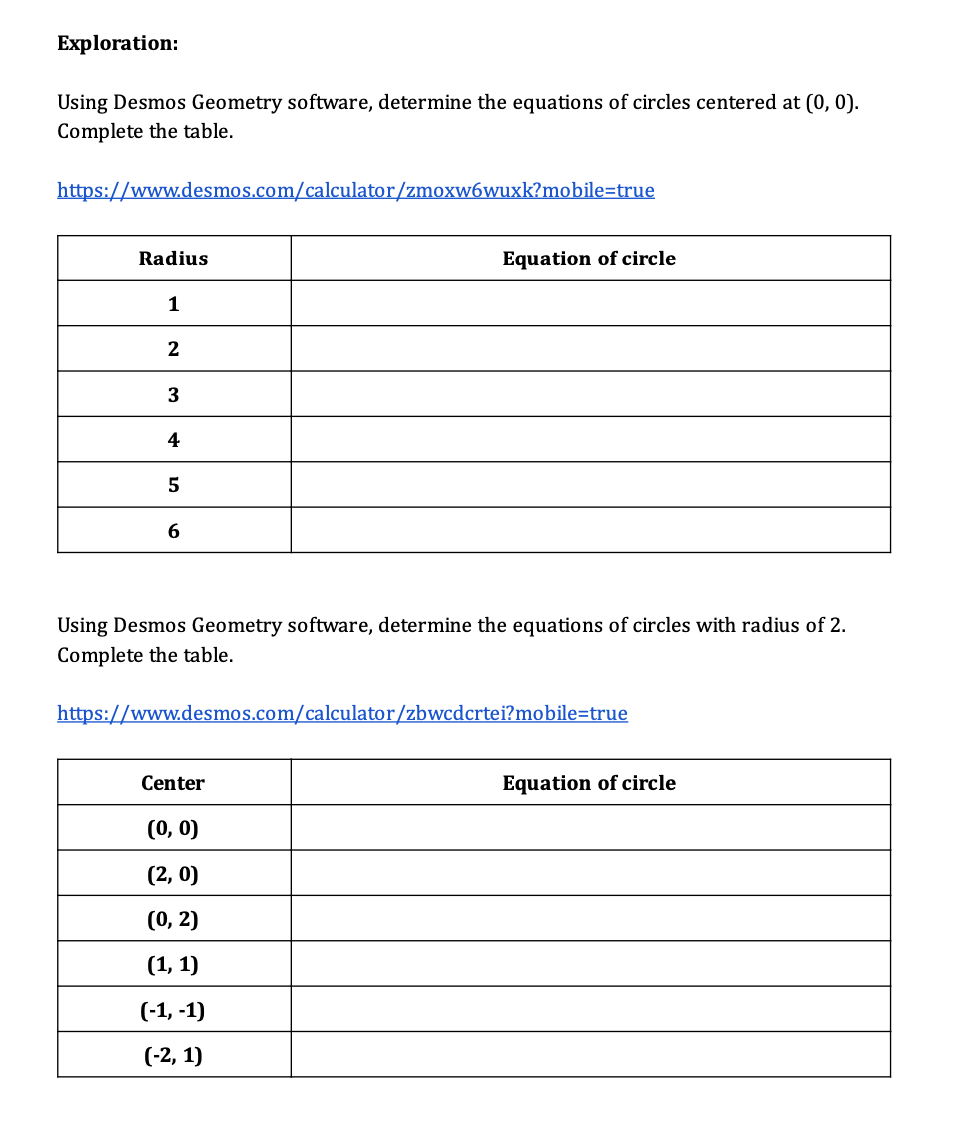
Learning to write the equation of a circle can be difficult. For one of my teaches last semester my mentor teacher suggested the use of a desmos paired with a worksheet to allow the students to explore what changes the standard equation of a circle. The worksheet had the students enter certain coordinates into the graphing calculator and write down what they thought was the equation of a circle. The next part of the assignment was student driven by having them share their conclusions on what the equation for a circle would be when it is centered at the origin vs. centered at (h,k). The worksheet shows that the students drove their own learning and came to their own conclusions which enhanced engagement through the lesson.

green line

This topic can come up again in trigonometry, upper level calculus and in math modeling. In my TNTX math modeling course, we took a closer look at the derivation of this equation and the subtleties of the standard form. This topic may also be used in physics calculations or in general, science labs.  For a physics word problem, it may ask you to calculate the net force and acceleration of a moving object around a circle. In this instance, it would suffice to just know the definition and general shape of a circle to complete these calculations. The definition of a circle is also needed to calculate centripetal force.