In my capstone class for future secondary math teachers, I ask my students to come up with ideas for engaging their students with different topics in the secondary mathematics curriculum. In other words, the point of the assignment was not to devise a full-blown lesson plan on this topic. Instead, I asked my students to think about three different ways of getting their students interested in the topic in the first place.
I plan to share some of the best of these ideas on this blog (after asking my students’ permission, of course).
This student submission again comes from my former student Allison Myers. Her topic, from Algebra II: inverse functions.

CURRICULUM
How can this topic be used in your students’ future courses in mathematics or science?
Functions are a composition of one or more actions that maps one object onto another (each input maps to one output). Inverse functions are a composition of reverse actions that “undo” the actions of the original function.
Inverse functions have real-world applications, but also students will use this concept in future math classes such as Pre-Calculus, where students will find inverse trigonometric functions. Inverse trigonometric functions have a whole new set of real-world applications, such as finding the angle of elevation of the sun, or anything which models harmonic motion.
Students will also see this concept again in Calculus, where they will differentiate inverse trigonometric functions to solve real-world applications involving rate of angular rotation or the rate of change of angular size.
TECHNOLOGY
How can technology be used to effectively engage students with this topic?
In the past, I taught a lesson where the Explore portion of the lesson utilized dry erase markers and transparency sheets to allow students to discover what happens graphically when computing an inverse (trigonometric) function. My goal was for my students to understand why we compute inverses the way we do. To my horror, my theoretical 15-minute, super insightful Explore became messy, full of problems, and confusing to my students.
While reflecting after the lesson, I began to consider how using technology would have better served my students (in their understanding) and myself (in my goals for the lesson). I found Glencoe’s directions for using the TI-Nspire to compute inverse functions (see image below). Using the TI-Nspire, I would start the lesson with a real-world example and data and have my students complete Step 1. Next, I would explain our need to “undo/reverse” the data, and allow the students to come up with different ways to do so. After that, I would ask the students to make conjectures about possible formulas. Using the TI-Nspire would be less messy and time-consuming (as compared to my experience with markers and transparencies), and would also allow the teacher to be within the context of a real-world problem. I believe if we used this (or similar) technology, combined with the constructivist-style teaching, students would come away with not only a better understanding for computing inverse functions but also their real-world applications.
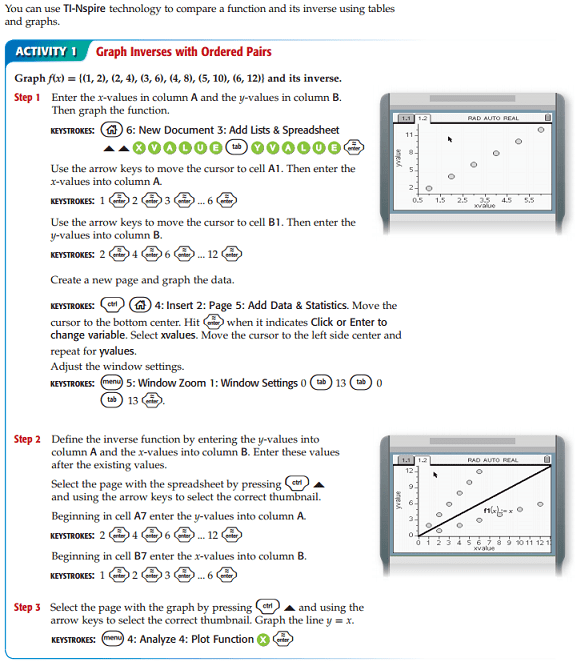 Source: http://glencoe.com/sites/common_assets/mathematics/alg2_2010/other_cal_keystrokes/TI-Nspire/Nspire_423_424_C07L2B_888482.pdf
CULTURE
How has this topic appeared in pop culture (movies, TV, current music, video games, etc.)?
Inverse functions are used every day in real life. For example, when a computer reads a number you type in, it converts the number to binary for internal storage, then it prints the number out again onto the screen that you see – it’s utilizing an inverse function. A basic example involves converting temperature from Fahrenheit to Celsius.
Another example, if one considers music notes on paper to be a function of the sound produced, then the software Sibelius can be considered the inverse function, as it takes a musician’s music and converts it back to music notes.






![\left[ r_1 (\cos \theta_1 + i \sin \theta_1) \right] \cdot \left[ r_2 (\cos \theta_2 + i \sin \theta_2) \right] = r_1 r_2 (\cos [\theta_1+\theta_2] + i \sin [\theta_1+\theta_2])](https://s0.wp.com/latex.php?latex=%5Cleft%5B+r_1+%28%5Ccos+%5Ctheta_1+%2B+i+%5Csin+%5Ctheta_1%29+%5Cright%5D+%5Ccdot+%5Cleft%5B+r_2+%28%5Ccos+%5Ctheta_2+%2B+i+%5Csin+%5Ctheta_2%29+%5Cright%5D+%3D+r_1+r_2+%28%5Ccos+%5B%5Ctheta_1%2B%5Ctheta_2%5D+%2B+i+%5Csin+%5B%5Ctheta_1%2B%5Ctheta_2%5D%29&bg=ffffff&fg=000000&s=0&c=20201002)
![\displaystyle \frac{ r_1 (\cos \theta_1 + i \sin \theta_1) }{ r_2 (\cos \theta_2 + i \sin \theta_2) } = \displaystyle \frac{r_1}{r_2} (\cos [\theta_1-\theta_2] + i \sin [\theta_1-\theta_2])](https://s0.wp.com/latex.php?latex=%5Cdisplaystyle+%5Cfrac%7B+r_1+%28%5Ccos+%5Ctheta_1+%2B+i+%5Csin+%5Ctheta_1%29+%7D%7B+r_2+%28%5Ccos+%5Ctheta_2+%2B+i+%5Csin+%5Ctheta_2%29+%7D+%3D+%5Cdisplaystyle+%5Cfrac%7Br_1%7D%7Br_2%7D+%28%5Ccos+%5B%5Ctheta_1-%5Ctheta_2%5D+%2B+i+%5Csin+%5B%5Ctheta_1-%5Ctheta_2%5D%29&bg=ffffff&fg=000000&s=0&c=20201002)





![= \displaystyle \frac{r_1}{r_2} (\cos \theta_1 + i \sin \theta_1)( \cos [-\theta_2] + i \sin [-\theta_2])](https://s0.wp.com/latex.php?latex=%3D+%5Cdisplaystyle+%5Cfrac%7Br_1%7D%7Br_2%7D+%28%5Ccos+%5Ctheta_1+%2B+i+%5Csin+%5Ctheta_1%29%28+%5Ccos+%5B-%5Ctheta_2%5D+%2B+i+%5Csin+%5B-%5Ctheta_2%5D%29&bg=ffffff&fg=000000&s=0&c=20201002)
 ) that I’ll justify later in this series.
 and
and  , they are taught to just distribute (or, using the nomenclature that I don’t like, FOIL it out):
 .
.![\left[ r_1 (\cos \theta_1 + i \sin \theta_1) \right] \cdot \left[ r_2 (\cos \theta_2 + i \sin \theta_2) \right]](https://s0.wp.com/latex.php?latex=%5Cleft%5B+r_1+%28%5Ccos+%5Ctheta_1+%2B+i+%5Csin+%5Ctheta_1%29+%5Cright%5D+%5Ccdot+%5Cleft%5B+r_2+%28%5Ccos+%5Ctheta_2+%2B+i+%5Csin+%5Ctheta_2%29+%5Cright%5D+&bg=ffffff&fg=000000&s=0&c=20201002)

![= r_1 r_2 (\cos \theta_1 \cos \theta_2 - \sin \theta_1 \sin \theta_2 + i[ \sin \theta_1 \cos \theta_2 + \cos \theta_1 \sin \theta_2])](https://s0.wp.com/latex.php?latex=%3D+r_1+r_2+%28%5Ccos+%5Ctheta_1+%5Ccos+%5Ctheta_2+-+%5Csin+%5Ctheta_1+%5Csin+%5Ctheta_2+%2B+i%5B+%5Csin+%5Ctheta_1+%5Ccos+%5Ctheta_2+%2B+%5Ccos+%5Ctheta_1+%5Csin+%5Ctheta_2%5D%29&bg=ffffff&fg=000000&s=0&c=20201002)
![= r_1 r_2 (\cos [\theta_1+\theta_2] + i \sin [\theta_1+\theta_2])](https://s0.wp.com/latex.php?latex=%3D+r_1+r_2+%28%5Ccos+%5B%5Ctheta_1%2B%5Ctheta_2%5D+%2B+i+%5Csin+%5B%5Ctheta_1%2B%5Ctheta_2%5D%29&bg=ffffff&fg=000000&s=0&c=20201002) .
.
![1 + 2i = \sqrt{5} \left( \cos[\tan^{-1} 2] + i \sin[\tan^{-1} 2] \right) \approx \sqrt{5} \left( \cos 63.435^\circ + i \sin 63.435^\circ \right)](https://s0.wp.com/latex.php?latex=1+%2B+2i+%3D+%5Csqrt%7B5%7D+%5Cleft%28+%5Ccos%5B%5Ctan%5E%7B-1%7D+2%5D+%2B+i+%5Csin%5B%5Ctan%5E%7B-1%7D+2%5D+%5Cright%29+%5Capprox+%5Csqrt%7B5%7D+%5Cleft%28+%5Ccos+63.435%5E%5Ccirc+%2B+i+%5Csin+63.435%5E%5Ccirc+%5Cright%29&bg=ffffff&fg=000000&s=0&c=20201002)
 . Indeed,
 .
.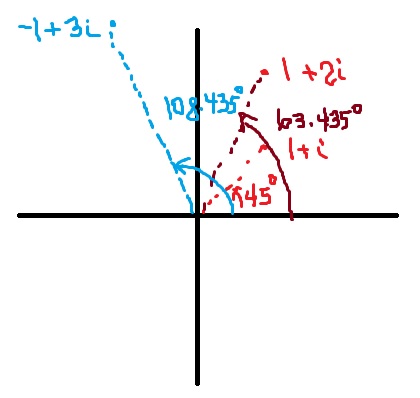
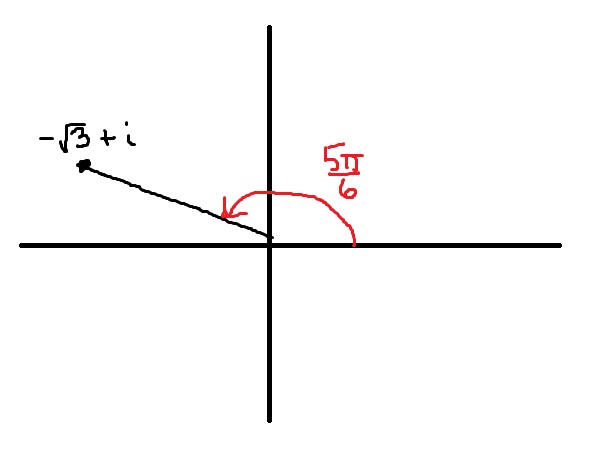
 is in the second quadrant of the complex plane. The modulus is
 .
. , and not
  , appears in the above expression.) Also,
 , so that
 is in the second quadrant, we choose
 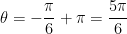 . Therefore,

 would also have worked. For example,

 . After all, the arctangent of an angle must lie between
  and
and  , which won’t work for complex numbers in either the second or third quadrant. That said, it is true that
 , and take two steps to arrive at the point
  , and take two steps to arrive at the same point.
 (getting more than a little dizzy while doing so), and take two steps to arrive at the same point.
 , and take two steps backwards (while doing the moonwalk) to arrive at the same point.
 ? Or
? Or  ? Easy, right? Well, let’s plug into a calculator and find out. (Click anywhere in the image below to start the movie. The important stuff is the screen at the top; you can see the keystrokes that I used if you following the mouse arrow toward the bottom.)
 ):
):


 ,
, Mean Green Math