How I Impressed My Wife: Part 4h

So far in this series, I have used three different techniques to show that

Q = \displaystyle \int_0^{2\pi} \frac{dx}{\cos^2 x + 2 a \sin x \cos x + (a^2 + b^2) \sin^2 x} = \displaystyle \frac{2\pi}{|b|}.

For the third technique, a key step in the calculation was showing that the residue of the function

f(z) = \displaystyle \frac{1}{z^2 + 2\frac{S}{R}z + 1} = \displaystyle \frac{1}{(z-r_1)(z-r_2)}

at the point

r_1 = \displaystyle \frac{-S + \sqrt{S^2 -R^2}}{R}

was equal to

\displaystyle \frac{R}{ 2 \sqrt{S^2-R^2} }.

Initially, I did this by explicitly computing the Laurent series expansion about z = r_1 and identifying the coefficient for the term (z-r_1)^{-1}.

In this post, I’d like to discuss another way that this residue could have been obtained.
green line

Notice that the function f(z) has the form \displaystyle \frac{g(z)}{(z-r) h(z)}, where g and h are differentiable functions so that g(r) \ne 0 and h(r) \ne 0. Therefore, we may rewrite this function using the Taylor series expansion of \displaystyle \frac{g(z)}{h(z)} about z = r:

f(z) = \displaystyle \frac{1}{z-r} \left[ \frac{g(z)}{h(z)} \right]

f(z) = \displaystyle \frac{1}{z-r} \left[ a_0 + a_1 (z-r) + a_2 (z-r)^2 + a_3 (z-r)^3 + \dots \right]

f(z) = \displaystyle \frac{a_0}{z-r} + a_1 + a_2 (z-r) + a_3 (z-r)^2 + \dots

Clearly,

\displaystyle \lim_{z \to r} (z-r) f(z) = \displaystyle \lim_{z \to r} \left[ a_0 + a_1 (z-r) + a_2 (z-r)^2 + a_3 (z-r)^3 + \dots \right] = a_0

Therefore, the residue at z = r can be found by evaluating the limit \displaystyle \lim_{z \to r} (z-r) f(z). Notice that

\displaystyle \lim_{z \to r} (z-r) f(z) = \displaystyle \lim_{z \to r} \frac{(z-r) g(z)}{(z-r) h(z)}

= \displaystyle \lim_{z \to r} \frac{(z-r) g(z)}{H(z)},

where H(z) = (z-r) h(z) is the original denominator of f(z). By L’Hopital’s rule,

a_0 = \displaystyle \lim_{z \to r} \frac{(z-r) g(z)}{H(z)} = \displaystyle \lim_{z \to r} \frac{g(z) + (z-r) g'(z)}{H'(z)} = \displaystyle \frac{g(r)}{H'(r)}.

For the function at hand, g(z) \equiv 1 and H(z) = z^2 + 2\frac{S}{R}z + 1, so that H'(z) = 2z + 2\frac{S}{R}. Therefore, the residue at z = r_1 is equal to

\displaystyle \frac{1}{2r_1+2 \frac{S}{R}} = \displaystyle \frac{1}{2 \displaystyle \frac{-S + \sqrt{S^2 -R^2}}{R} + 2 \frac{S}{R}}

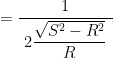
= \displaystyle \frac{1}{ ~ 2 \displaystyle \frac{\sqrt{S^2 -R^2}}{R} ~ }

= \displaystyle \frac{R}{2 \sqrt{S^2-R^2}},

matching the result found earlier.


How I Impressed My Wife: Part 4g

So far in this series, I have used three different techniques to show that

Q = \displaystyle \int_0^{2\pi} \frac{dx}{\cos^2 x + 2 a \sin x \cos x + (a^2 + b^2) \sin^2 x} = \displaystyle \frac{2\pi}{|b|}.

For the third technique, a key step in the calculation was showing that the residue of the function

f(z) = \displaystyle \frac{1}{z^2 + 2\frac{S}{R}z + 1} = \displaystyle \frac{1}{(z-r_1)(z-r_2)}

at the point

r_1 = \displaystyle \frac{-S + \sqrt{S^2 -R^2}}{R}

was equal to

\displaystyle \frac{R}{ 2 \sqrt{S^2-R^2} }.

Initially, I did this by explicitly computing the Laurent series expansion about z = r_1 and identifying the coefficient for the term (z-r_1)^{-1}.

In this post and the next post, I’d like to discuss alternate ways that this residue could have been obtained.
green line

Notice that the function f(z) has the form \displaystyle \frac{g(z)}{(z-r) h(z)}, where g and h are differentiable functions so that g(r) \ne 0 and h(r) \ne 0. Therefore, we may rewrite this function using the Taylor series expansion of \displaystyle \frac{g(z)}{h(z)} about z = r:

f(z) = \displaystyle \frac{1}{z-r} \left[ \frac{g(z)}{h(z)} \right]

f(z) = \displaystyle \frac{1}{z-r} \left[ a_0 + a_1 (z-r) + a_2 (z-r)^2 + a_3 (z-r)^3 + \dots \right]

f(z) = \displaystyle \frac{a_0}{z-r} + a_1 + a_2 (z-r) + a_3 (z-r)^2 + \dots

Therefore, the residue at z = r is equal to a_0, or the constant term in the Taylor expansion of \displaystyle \frac{g(z)}{h(z)} about z = r. Therefore,

a_0 = \displaystyle \frac{g(r)}{h(r)}

For the function at hand g(z) \equiv 1 and h(z) = z-r_2. Therefore, the residue at z = r_1 is equal to \displaystyle \frac{1}{r_1 - r_2}, matching the result found earlier.


How I Impressed My Wife: Part 4f

Previously in this series, I have used two different techniques to show that

Q = \displaystyle \int_0^{2\pi} \frac{dx}{\cos^2 x + 2 a \sin x \cos x + (a^2 + b^2) \sin^2 x} = \displaystyle \frac{2\pi}{|b|}.

Originally, my wife had asked me to compute this integral by hand because Mathematica 4 and Mathematica 8 gave different answers. At the time, I eventually obtained the solution by multiplying the top and bottom of the integrand by \sec^2 x and then employing the substitution u = \tan x (after using trig identities to adjust the limits of integration).
But this wasn’t the only method I tried. Indeed, I tried two or three different methods before deciding they were too messy and trying something different. So, for the rest of this series, I’d like to explore different ways that the above integral can be computed.

green linePreviously in this series, I have used two different techniques to show that

Q = \displaystyle \int_0^{2\pi} \frac{dx}{\cos^2 x + 2 a \sin x \cos x + (a^2 + b^2) \sin^2 x} = \displaystyle \frac{2\pi}{|b|}.

Originally, my wife had asked me to compute this integral by hand because Mathematica 4 and Mathematica 8 gave different answers. At the time, I eventually obtained the solution by multiplying the top and bottom of the integrand by \sec^2 x and then employing the substitution u = \tan x (after using trig identities to adjust the limits of integration).
But this wasn’t the only method I tried. Indeed, I tried two or three different methods before deciding they were too messy and trying something different. So, for the rest of this series, I’d like to explore different ways that the above integral can be computed.
green lineHere’s my progress so far:

Q = \displaystyle \int_0^{2\pi} \frac{dx}{\cos^2 x + 2 a \sin x \cos x + (a^2 + b^2) \sin^2 x}

= \displaystyle \int_0^{2\pi} \frac{2 \, dx}{1+\cos 2x + 2 a \sin 2x + (a^2 + b^2)(1-\cos 2x)}

= 2 \displaystyle \int_0^{2\pi} \frac{d\theta}{(1+a^2+b^2) + 2 a \sin \theta + (1 - a^2 - b^2) \cos \theta}

= 2 \displaystyle \int_{0}^{2\pi} \frac{d\theta}{S + R \cos (\theta - \alpha)}

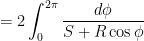
= 2 \displaystyle \int_{0}^{2\pi} \frac{d\phi}{S + R \cos \phi}

= \displaystyle -\frac{4i}{R} \oint_C \frac{dz}{z^2 + 2\frac{S}{R}z + 1},

where this last integral is taken over the complex plane on the unit circle, a closed contour oriented counterclockwise. In these formulas, R = \sqrt{(2a)^2 + (1-a^2-b^2)^2} and S = 1 + a^2 + b^2. (Also, \alpha is a certain angle that is now irrelevant at this point in the calculation).

This contour integral looks complicated; however, it’s an amazing fact that integrals over closed contours can be easily evaluated by only looking at the poles of the integrand. In recent posts, I established that there was only one pole inside the contour, and the residue at this pole was equal to \displaystyle \frac{R}{ 2 \sqrt{S^2-R^2} }.

This residue can be used to evaluate the contour integral. Ordinarily, integrals are computed by subtracting the values of the antiderivative at the endpoints. However, there is an alternate way of computing a contour integral using residues. It turns out that the value of the contour integral is 2\pi i times the sum of the residues within the contour; see Wikipedia and Mathworld for more information.

Therefore,

Q = \displaystyle -\frac{4i}{R} \oint_C \frac{dz}{(z - r_1)(z- r_2)}

= \displaystyle -\frac{4i}{R} \cdot 2\pi i \cdot \frac{R}{ 2 \sqrt{S^2-R^2} }

= \displaystyle \frac{4\pi}{\sqrt{S^2-R^2}}

Next, I use some algebra to simplify the denominator:

S^2 - R^2 = (1+a^2+b^2)^2 - (1-a^2-b^2)^2 - (2a)^2

S^2 - R^2 = [(1 + a^2 + b^2) + (1-a^2-b^2)][(1 + a^2 + b^2) - (1 - a^2 -b^2)] - 4a^2

S^2 - R^2 = 2[2 a^2 + 2b^2] - 4a^2

S^2 - R^2 = 4b^2

Therefore,

Q = \displaystyle \frac{4\pi}{\sqrt{4b^2}} = \displaystyle \frac{4\pi}{2|b|} = \frac{2\pi}{|b|}

Once again, this matches the solution found with the previous methods… and I was careful to avoid a common algebraic mistake.

green lineIn tomorrow’s post, I’ll discuss an alternative way of computing the residue.

How I Impressed My Wife: Part 4e

Previously in this series, I have used two different techniques to show that

Q = \displaystyle \int_0^{2\pi} \frac{dx}{\cos^2 x + 2 a \sin x \cos x + (a^2 + b^2) \sin^2 x} = \displaystyle \frac{2\pi}{|b|}.

Originally, my wife had asked me to compute this integral by hand because Mathematica 4 and Mathematica 8 gave different answers. At the time, I eventually obtained the solution by multiplying the top and bottom of the integrand by \sec^2 x and then employing the substitution u = \tan x (after using trig identities to adjust the limits of integration).
But this wasn’t the only method I tried. Indeed, I tried two or three different methods before deciding they were too messy and trying something different. So, for the rest of this series, I’d like to explore different ways that the above integral can be computed.
green lineHere’s my progress so far:

Q = \displaystyle \int_0^{2\pi} \frac{dx}{\cos^2 x + 2 a \sin x \cos x + (a^2 + b^2) \sin^2 x}

= \displaystyle \int_0^{2\pi} \frac{2 \, dx}{1+\cos 2x + 2 a \sin 2x + (a^2 + b^2)(1-\cos 2x)}

= 2 \displaystyle \int_0^{2\pi} \frac{d\theta}{(1+a^2+b^2) + 2 a \sin \theta + (1 - a^2 - b^2) \cos \theta}

= 2 \displaystyle \int_{0}^{2\pi} \frac{d\theta}{S + R \cos (\theta - \alpha)}

= 2 \displaystyle \int_{0}^{2\pi} \frac{d\phi}{S + R \cos \phi}

= \displaystyle -\frac{4i}{R} \oint_C \frac{dz}{z^2 + 2\frac{S}{R}z + 1}

= \displaystyle -\frac{4i}{R} \oint_C \frac{dz}{(z - r_1)(z- r_2)}

where this last integral is taken over the complex plane on the unit circle, a closed contour oriented counterclockwise. Also,
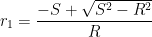
r_1 = \displaystyle \frac{-S + \sqrt{S^2 -R^2}}{R}

and

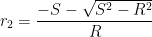
r_2 = \displaystyle \frac{-S - \sqrt{S^2 -R^2}}{R},

are the two distinct roots of the denominator (as long as b \ne 0). In these formulas,R = \sqrt{(2a)^2 + (1-a^2-b^2)^2} and S = 1 + a^2 + b^2. (Also, \alpha is a certain angle that is now irrelevant at this point in the calculation).

This contour integral looks complicated; however, it’s an amazing fact that integrals over closed contours can be easily evaluated by only looking at the poles of the integrand. In yesterday’s post, I established that r_1 lies inside the contour, but r_2 lies outside of the contour.

The next step of the calculation is finding the residue at r_1; see Wikipedia and Mathworld for more information. This means rewriting the rational function

\displaystyle \frac{1}{(z - r_1)(z - r_2)}

as a power series (technically, a Laurent series) about the point z = r_1. This can be done by using the formula for an infinite geometric series (see here, here, and here):

\displaystyle \frac{1}{(z - r_1)(z - r_2)} = \displaystyle \frac{1}{z-r_1} \times \frac{1}{z-r_2}

= \displaystyle \frac{-1}{z-r_1} \times \frac{1}{r_2-z}

= \displaystyle \frac{-1}{z-r_1} \times \frac{1}{(r_2-r_1) - (z-r_1)}

= \displaystyle \frac{-1}{z-r_1} \times \frac{1}{r_2-r_1} \times \frac{ 1}{ 1 - \displaystyle \frac{z-r_1}{r_2-r_1} }

= \displaystyle \frac{-1}{z-r_1} \times \frac{1}{r_2-r_1} \left[ 1 + \left( \displaystyle \frac{z-r_1}{r_2-r_1} \right) + \left( \displaystyle \frac{z-r_1}{r_2-r_1} \right)^2 + \left( \displaystyle \frac{z-r_1}{r_2-r_1} \right)^3 + \dots \right]

= \displaystyle \frac{-1}{z-r_1} \times \frac{1}{r_2-r_1} - \frac{1}{(r_2-r_1)^2} - \frac{z-r_1}{(r_2-r_1)^3} - \frac{(z-r_1)^2}{(r_2-r_1)^4} \dots

The residue of the function at z = r_1 is defined to be the constant multiplying the \displaystyle \frac{1}{z-r_1} term in the above series. Therefore,

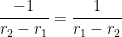
The residue at x = r_1 is \displaystyle \frac{-1}{r_2-r_1} = \displaystyle \frac{1}{r_1-r_2}

From the definitions of r_1 and r_2 above,

\displaystyle \frac{1}{r_1-r_2} = \displaystyle \frac{1}{\displaystyle \frac{-S + \sqrt{S^2 -R^2}}{R} - \frac{-S - \sqrt{S^2 -R^2}}{R}}

= \displaystyle \frac{1}{ ~ 2 \displaystyle \frac{\sqrt{S^2-R^2}}{R} ~ }

= \displaystyle \frac{R}{ 2 \sqrt{S^2-R^2} }

green lineNow that I’ve identified the residue of the only root that lies inside of the contour, we are in position to evaluate the contour integral above. I’ll discuss this in tomorrow’s post.

How I Impressed My Wife: Part 4d

Previously in this series, I have used two different techniques to show that

Q = \displaystyle \int_0^{2\pi} \frac{dx}{\cos^2 x + 2 a \sin x \cos x + (a^2 + b^2) \sin^2 x} = \displaystyle \frac{2\pi}{|b|}.

Originally, my wife had asked me to compute this integral by hand because Mathematica 4 and Mathematica 8 gave different answers. At the time, I eventually obtained the solution by multiplying the top and bottom of the integrand by \sec^2 x and then employing the substitution u = \tan x (after using trig identities to adjust the limits of integration).
But this wasn’t the only method I tried. Indeed, I tried two or three different methods before deciding they were too messy and trying something different. So, for the rest of this series, I’d like to explore different ways that the above integral can be computed.
green lineHere’s my progress so far:

Q = \displaystyle \int_0^{2\pi} \frac{dx}{\cos^2 x + 2 a \sin x \cos x + (a^2 + b^2) \sin^2 x}

= \displaystyle \int_0^{2\pi} \frac{2 \, dx}{1+\cos 2x + 2 a \sin 2x + (a^2 + b^2)(1-\cos 2x)}

= 2 \displaystyle \int_0^{2\pi} \frac{d\theta}{(1+a^2+b^2) + 2 a \sin \theta + (1 - a^2 - b^2) \cos \theta}

= 2 \displaystyle \int_{0}^{2\pi} \frac{d\theta}{S + R \cos (\theta - \alpha)}

= 2 \displaystyle \int_{0}^{2\pi} \frac{d\phi}{S + R \cos \phi}

= \displaystyle -\frac{4i}{R} \oint_C \frac{dz}{z^2 + 2\frac{S}{R}z + 1}

= \displaystyle -\frac{4i}{R} \oint_C \frac{dz}{(z - r_1)(z- r_2)}

where this last integral is taken over the complex plane on the unit circle, a closed contour oriented counterclockwise. Also,

r_1 = \displaystyle \frac{-S + \sqrt{S^2 -R^2}}{R}

and

r_2 = \displaystyle \frac{-S - \sqrt{S^2 -R^2}}{R},

are the two distinct roots of the denominator (as long as b \ne 0). In these formulas,R = \sqrt{(2a)^2 + (1-a^2-b^2)^2} and S = 1 + a^2 + b^2. (Also, \alpha is a certain angle that is now irrelevant at this point in the calculation).

This contour integral looks more complicated; however, it’s an amazing fact that integrals over closed contours can be easily evaluated by only looking at the poles of the integrand. For this integral, that means finding the values of z where the denominator is equal to 0, and then determining which of those values lie inside of the closed contour.

Let’s now see if either of the two roots of the denominator lies inside of the unit circle in the complex plane. In other words, let’s determine if |r_1| < 1 and/or |r_2| < 1.

I’ll begin with r_1. Clearly, the numbers R, \sqrt{S^2-R^2}, and S are the lengths of three sides of a right triangle with hypotenuse S. So, since the hypotenuse is the longest side,

S > \sqrt{S^2-R^2}

or

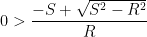
0 > -S + \sqrt{S^2-R^2}

so that

0 > \displaystyle \frac{-S + \sqrt{S^2-R^2}}{R}.

Also, by the triangle inequality,

R + \sqrt{S^2 - R^2} > S

-S + \sqrt{S^2 - R^2} > -R

\displaystyle \frac{-S + \sqrt{S^2-R^2}}{R} > -1

Combining these inequalities, we see that

-1 < \displaystyle \frac{-S + \sqrt{S^2-R^2}}{R} < 0,

and so I see that |r_1| < 1, so that r_1 does lie inside of the contour C.

The second root r_2 is easier to handle:

|r_2| = \left| \displaystyle \frac{-S - \sqrt{S^2 -R^2}}{R} \right| = \left| \displaystyle \frac{S + \sqrt{S^2 -R^2}}{R} \right| > \displaystyle \frac{S}{R} > 1.

Therefore, since r_2 lies outside of the contour, this root is not important for the purposes of computing the above contour integral.

green lineNow that I’ve identified the root that lies inside of the contour, I now have to compute the residue at this root. I’ll discuss this in tomorrow’s post.

How I Impressed My Wife: Part 4c

Previously in this series, I have used two different techniques to show that

Q = \displaystyle \int_0^{2\pi} \frac{dx}{\cos^2 x + 2 a \sin x \cos x + (a^2 + b^2) \sin^2 x} = \displaystyle \frac{2\pi}{|b|}.

Originally, my wife had asked me to compute this integral by hand because Mathematica 4 and Mathematica 8 gave different answers. At the time, I eventually obtained the solution by multiplying the top and bottom of the integrand by \sec^2 x and then employing the substitution u = \tan x (after using trig identities to adjust the limits of integration).
But this wasn’t the only method I tried. Indeed, I tried two or three different methods before deciding they were too messy and trying something different. So, for the rest of this series, I’d like to explore different ways that the above integral can be computed.
green lineHere’s my progress so far:

Q = \displaystyle \int_0^{2\pi} \frac{dx}{\cos^2 x + 2 a \sin x \cos x + (a^2 + b^2) \sin^2 x}

= \displaystyle \int_0^{2\pi} \frac{2 \, dx}{1+\cos 2x + 2 a \sin 2x + (a^2 + b^2)(1-\cos 2x)}

= 2 \displaystyle \int_0^{2\pi} \frac{d\theta}{(1+a^2+b^2) + 2 a \sin \theta + (1 - a^2 - b^2) \cos \theta}

= 2 \displaystyle \int_{0}^{2\pi} \frac{d\theta}{S + R \cos (\theta - \alpha)}

= 2 \displaystyle \int_{0}^{2\pi} \frac{d\phi}{S + R \cos \phi}

= \displaystyle -\frac{4i}{R} \oint_C \frac{dz}{z^2 + 2\frac{S}{R}z + 1},

where this last integral is taken over the complex plane on the unit circle, a closed contour oriented counterclockwise. Also, R = \sqrt{(2a)^2 + (1-a^2-b^2)^2} and S = 1 + a^2 + b^2 (and \alpha is a certain angle that is now irrelevant at this point in the calculation).

This contour integral looks more complicated; however, it’s an amazing fact that integrals over closed contours can be easily evaluated by only looking at the poles of the integrand. For this integral, that means finding the values of z where the denominator is equal to 0, and then determining which of those values lie inside of the closed contour. In this case, that means finding which root(s) of the denominator lie inside the unit circle in the complex plane.

To begin, we use the quadratic formula to find the roots of the denominator:

z^2 + 2\frac{S}{R}z + 1 = 0

Rz^2 + 2Sz + R = 0

z = \displaystyle \frac{-2S \pm \sqrt{4S^2 - 4R^2}}{2R}

z = \displaystyle \frac{-S \pm \sqrt{S^2 -R^2}}{R}.

So we have the two roots r_1 = \displaystyle \frac{-S + \sqrt{S^2 -R^2}}{R} and r_2 = \displaystyle \frac{-S - \sqrt{S^2 -R^2}}{R}. Earlier in this series, I showed that S > R > 0 as long as b \ne 0, and so the denominator has two distinct real roots. So the integral Q may be rewritten as

Q = \displaystyle -\frac{4i}{R} \oint_C \frac{dz}{(z - r_1)(z- r_2)}

green line

Next, we have to determine if either r_1 or r_2 (or both) lies inside of the contour. I’ll discuss this in tomorrow’s post.

How I Impressed My Wife: Part 4b

Previously in this series, I have used two different techniques to show that

Q = \displaystyle \int_0^{2\pi} \frac{dx}{\cos^2 x + 2 a \sin x \cos x + (a^2 + b^2) \sin^2 x} = \displaystyle \frac{2\pi}{|b|}.

Originally, my wife had asked me to compute this integral by hand because Mathematica 4 and Mathematica 8 gave different answers. At the time, I eventually obtained the solution by multiplying the top and bottom of the integrand by \sec^2 x and then employing the substitution u = \tan x (after using trig identities to adjust the limits of integration).
But this wasn’t the only method I tried. Indeed, I tried two or three different methods before deciding they were too messy and trying something different. So, for the rest of this series, I’d like to explore different ways that the above integral can be computed.
green lineLet me backtrack to a point in the middle of the previous solution:

Q = \displaystyle \int_0^{2\pi} \frac{dx}{\cos^2 x + 2 a \sin x \cos x + (a^2 + b^2) \sin^2 x}

= \displaystyle \int_0^{2\pi} \frac{2 \, dx}{1+\cos 2x + 2 a \sin 2x + (a^2 + b^2)(1-\cos 2x)}

= 2 \displaystyle \int_0^{2\pi} \frac{d\theta}{(1+a^2+b^2) + 2 a \sin \theta + (1 - a^2 - b^2) \cos \theta}

= 2 \displaystyle \int_{0}^{2\pi} \frac{d\theta}{S + R \cos (\theta - \alpha)}

= 2 \displaystyle \int_{0}^{2\pi} \frac{d\phi}{S + R \cos \phi},

where R = \sqrt{(2a)^2 + (1-a^2-b^2)^2} and S = 1 + a^2 + b^2 (and \alpha is a certain angle that is now irrelevant at this point in the calculation).

Earlier in this series, I used the magic substitution u = \tan \displaystyle \frac{\phi}{2} to evaluate this last integral. Now, I’ll instead use contour integration; see Wikipedia for more details. I will use Euler’s formula as a substitution (see here and here for more details):

z = e^{i \phi} = \cos \phi + i \sin \phi,

so that the integral Q is transformed to a contour integral in the complex plane. Under this substitution, as discussed in yesterday’s post,

\cos \phi = \displaystyle \frac{1}{2} \left[z + \displaystyle \frac{1}{z} \right]

and

d\phi = \displaystyle -\frac{i}{z} dz

Employing this substitution, the region of integration changes from 0 \le \phi \le 2\pi to a the unit circle C, a closed counterclockwise contour in the complex plane:

Q = 2 \displaystyle \oint_C \frac{\displaystyle -\frac{i}{z} dz}{S + \displaystyle \frac{R}{2} \left[z + \displaystyle \frac{1}{z} \right]}

= -4i \displaystyle \oint_C \frac{dz}{Rz^2 + 2Sz + R}

= \displaystyle -\frac{4i}{R} \oint_C \frac{dz}{z^2 + 2\frac{S}{R}z + 1}

green lineWhile this looks integral in the complex plane looks a lot more complicated than a regular integral, it’s actually a lot easier to compute using residues. I’ll discuss the computation of this contour integral in tomorrow’s post.

How I Impressed My Wife: Part 4a

Previously in this series, I have used two different techniques to show that

Q = \displaystyle \int_0^{2\pi} \frac{dx}{\cos^2 x + 2 a \sin x \cos x + (a^2 + b^2) \sin^2 x} = \displaystyle \frac{2\pi}{|b|}.

Originally, my wife had asked me to compute this integral by hand because Mathematica 4 and Mathematica 8 gave different answers. At the time, I eventually obtained the solution by multiplying the top and bottom of the integrand by \sec^2 x and then employing the substitution u = \tan x (after using trig identities to adjust the limits of integration).
But this wasn’t the only method I tried. Indeed, I tried two or three different methods before deciding they were too messy and trying something different. So, for the rest of this series, I’d like to explore different ways that the above integral can be computed.
green lineLet me backtrack to a point in the middle of the previous solution:

Q = \displaystyle \int_0^{2\pi} \frac{dx}{\cos^2 x + 2 a \sin x \cos x + (a^2 + b^2) \sin^2 x}

= \displaystyle \int_0^{2\pi} \frac{2 \, dx}{1+\cos 2x + 2 a \sin 2x + (a^2 + b^2)(1-\cos 2x)}

= 2 \displaystyle \int_0^{2\pi} \frac{d\theta}{(1+a^2+b^2) + 2 a \sin \theta + (1 - a^2 - b^2) \cos \theta}

= 2 \displaystyle \int_{0}^{2\pi} \frac{d\theta}{S + R \cos (\theta - \alpha)}

= 2 \displaystyle \int_{0}^{2\pi} \frac{d\phi}{S + R \cos \phi},

where R = \sqrt{(2a)^2 + (1-a^2-b^2)^2} and S = 1 + a^2 + b^2 (and \alpha is a certain angle that is now irrelevant at this point in the calculation).

In the previous solution, I used the “magic substitution” u = \tan \displaystyle \frac{\phi}{2} to convert the last integrand to a simple rational function. Starting today, I’ll use a completely different technique to compute this last integral.

The technique that I’ll use is contour integration; see Wikipedia for more details. I will use Euler’s formula as a substitution (see here and here for more details):

z = e^{i \phi} = \cos \phi + i \sin \phi,

so that the integral Q is transformed to a contour integral in the complex plane.

Under this substitution,

\displaystyle \frac{1}{z} = e^{-i\phi} = \cos(-\phi) + i \sin(-\phi) = \cos \phi - i \sin \phi

Using these last two equations, I can solve for \cos \phi and \sin \phi in terms of z and \displaystyle \frac{1}{z}. I’ll begin with \cos \phi:

z + \displaystyle \frac{1}{z} = \cos \phi + i \sin \phi + \cos \phi - i \sin \phi

z + \displaystyle \frac{1}{z} = 2 \cos \phi

\displaystyle \frac{1}{2} \left[z + \displaystyle \frac{1}{z} \right] = \cos \phi

Though not necessary for this particular, let me solve for \sin \phi for completeness:

z - \displaystyle \frac{1}{z} = \cos \phi + i \sin \phi - [ \cos \phi - i \sin \phi]

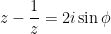
z - \displaystyle \frac{1}{z} = 2i \sin \phi

\displaystyle \frac{1}{2i} \left[z - \displaystyle \frac{1}{z} \right] = \sin\phi

 Finally, let me solve for the differential d\phi:

z = e^{i \phi}

dz = i e^{i \phi} d\phi

\displaystyle \frac{1}{i} e^{-i \phi} dz = d\phi

-i e^{-i \phi} dz = d\phi

\displaystyle -\frac{i}{z} dz = d\phi

green line I’ll continue with this different method of evaluating this integral in tomorrow’s post.

How I Impressed My Wife: Part 3i

Previously in this series, I showed that

Q = \displaystyle \int_0^{2\pi} \frac{dx}{\cos^2 x + 2 a \sin x \cos x + (a^2 + b^2) \sin^2 x} = \displaystyle \frac{2\pi}{|b|}.

My wife had asked me to compute this integral by hand because Mathematica 4 and Mathematica 8 gave different answers. At the time, I eventually obtained the solution by multiplying the top and bottom of the integrand by \sec^2 x and then employing the substitution u = \tan x (after using trig identities to adjust the limits of integration).
But this wasn’t the only method I tried. Indeed, I tried two or three different methods before deciding they were too messy and trying something different. So, for the rest of this series, I’d like to explore different ways that the above integral can be computed.
green line

So far, I have shown that

Q = \displaystyle \int_0^{2\pi} \frac{dx}{\cos^2 x + 2 a \sin x \cos x + (a^2 + b^2) \sin^2 x}

= \displaystyle \int_0^{2\pi} \frac{2 \, dx}{1+\cos 2x + 2 a \sin 2x + (a^2 + b^2)(1-\cos 2x)}

= 2 \displaystyle \int_0^{2\pi} \frac{d\theta}{(1+a^2+b^2) + 2 a \sin \theta + (1 - a^2 - b^2) \cos \theta}

= 2 \displaystyle \int_{0}^{2\pi} \frac{d\theta}{S + R \cos (\theta - \alpha)}

= 2 \displaystyle \int_{0}^{2\pi} \frac{d\phi}{S + R \cos \phi}

= 2 \displaystyle \int_{-\pi}^{\pi} \frac{d\phi}{S + R \cos \phi}

= 4 \displaystyle \int_{-\infty}^{\infty} \frac{du}{(S + R) + u^2 (S - R)}

= \displaystyle \frac{2}{|b|} \int_{-\infty}^{\infty} \frac{dv}{1 + v^2},

as long as b \ne 0. (In the above calculations, the constants R, S, and \alpha depend on a and b but are no longer necessary at this point in the calculation.)

We can now directly compute this final integral using an antiderivative derived earlier in this series:

Q = \displaystyle \frac{2}{|b|} \left[ \tan^{-1} v \right]^{\infty}_{-\infty}

Q = \displaystyle \frac{2}{|b|} \left[ \displaystyle \frac{\pi}{2} - \displaystyle \frac{-\pi}{2} \right]

Q = \displaystyle \frac{2\pi}{|b|}

green line And so, with this completely different technique, we arrive at the same answer for the integral Q.

However, there are still different ways of computing Q. I’ll start on another method of attack with tomorrow’s post.

How I Impressed My Wife: Part 3h

Previously in this series, I showed that

Q = \displaystyle \int_0^{2\pi} \frac{dx}{\cos^2 x + 2 a \sin x \cos x + (a^2 + b^2) \sin^2 x} = \displaystyle \frac{2\pi}{|b|}.

My wife had asked me to compute this integral by hand because Mathematica 4 and Mathematica 8 gave different answers. At the time, I eventually obtained the solution by multiplying the top and bottom of the integrand by \sec^2 x and then employing the substitution u = \tan x (after using trig identities to adjust the limits of integration).
But this wasn’t the only method I tried. Indeed, I tried two or three different methods before deciding they were too messy and trying something different. So, for the rest of this series, I’d like to explore different ways that the above integral can be computed.
green line

So far, I have shown that

Q = \displaystyle \int_0^{2\pi} \frac{dx}{\cos^2 x + 2 a \sin x \cos x + (a^2 + b^2) \sin^2 x}

= \displaystyle \int_0^{2\pi} \frac{2 \, dx}{1+\cos 2x + 2 a \sin 2x + (a^2 + b^2)(1-\cos 2x)}

= 2 \displaystyle \int_0^{2\pi} \frac{d\theta}{(1+a^2+b^2) + 2 a \sin \theta + (1 - a^2 - b^2) \cos \theta}

= 2 \displaystyle \int_{0}^{2\pi} \frac{d\theta}{S + R \cos (\theta - \alpha)}

= 2 \displaystyle \int_{0}^{2\pi} \frac{d\phi}{S + R \cos \phi}

= 2 \displaystyle \int_{-\pi}^{\pi} \frac{d\phi}{S + R \cos \phi}

= 4 \displaystyle \int_{-\infty}^{\infty} \frac{du}{(S + R) + u^2 (S - R)}

where R = \sqrt{(2a)^2 + (1-a^2-b^2)^2} and S = 1 + a^2 + b^2 (and \alpha is a certain angle that is now irrelevant at this point in the calculation).

We now employ the substitution

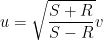
u = \displaystyle \sqrt{ \frac{S+R}{S-R} } v,

so that

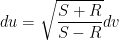
du = \displaystyle \sqrt{ \frac{S+R}{S-R} } dv.

Before going much further, let’s take a closer look at R and S to make sure that \displaystyle \frac{S+R}{S-R} is positive (so that the square root is defined).

First, both S and $R$ are clearly positive, and so S+R > 0.

Next, notice that

S^2 - R^2 = (1+a^2+b^2)^2 - (1-a^2-b^2)^2 - (2a)^2

S^2 - R^2 = [(1 + a^2 + b^2) + (1-a^2-b^2)][(1 + a^2 + b^2) - (1 - a^2 -b^2)] - 4a^2

S^2 - R^2 = 2[2 a^2 + 2b^2] - 4a^2

S^2 - R^2 = 4b^2

So S^2 - R^2 > 0 as long as b > 0. Therefore, since S + R > 0:

S^2 - R^2 > 0

(S+R)(S-R) > 0

S - R > 0

So, since S + R > 0 and S - R > 0, we have \displaystyle \frac{S+R}{S-R} > 0, and so the above substitution is well-defined.

We now employ the above substitution. The endpoints of integration remain unchanged, and so

Q = 4 \displaystyle \int_{-\infty}^{\infty} \frac{\displaystyle \sqrt{ \frac{S+R}{S-R} } dv}{(S + R) + \left[ \displaystyle \sqrt{ \frac{S+R}{S-R} } v \right]^2 (S - R)}

= 4 \displaystyle \int_{-\infty}^{\infty} \frac{\displaystyle \sqrt{ \frac{S+R}{S-R} } dv}{(S + R) + (S + R) v^2}

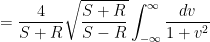
= \displaystyle \frac{4}{S+R} \sqrt{ \frac{S+R}{S-R}} \int_{-\infty}^{\infty} \frac{dv}{1 + v^2}

= \displaystyle 4 \sqrt{ \frac{1}{(S+R)(S-R)}} \int_{-\infty}^{\infty} \frac{dv}{1 + v^2}

= \displaystyle 4 \sqrt{ \frac{1}{S^2-R^2}} \int_{-\infty}^{\infty} \frac{dv}{1 + v^2}

= \displaystyle 4 \sqrt{ \frac{1}{4b^2}} \int_{-\infty}^{\infty} \frac{dv}{1 + v^2}

= \displaystyle \frac{4}{2|b|} \int_{-\infty}^{\infty} \frac{dv}{1 + v^2}

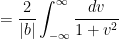
= \displaystyle \frac{2}{|b|} \int_{-\infty}^{\infty} \frac{dv}{1 + v^2}

In the above calculation, I used the fact that S^2 - R^2 = 4b^2, which was derived above. Also, I was careful to avoid a common algebraic mistake.

green line I’ll complete this different method of evaluating this integral in tomorrow’s post.