Engaging students: Laws of Exponents

In my capstone class for future secondary math teachers, I ask my students to come up with ideas for engaging their students with different topics in the secondary mathematics curriculum. In other words, the point of the assignment was not to devise a full-blown lesson plan on this topic. Instead, I asked my students to think about three different ways of getting their students interested in the topic in the first place.

I plan to share some of the best of these ideas on this blog (after asking my students’ permission, of course).

This student submission comes from my former student Lyndi Mays. Her topic, from Pre-Algebra: the Laws of Exponents (with integer exponents) green lineWhile thinking about different activities that I could do with Laws of Exponents I decided to try making a bingo card. I like this idea because it’s a way for students practice on different problems while playing a game. The way I have it set up to use in a classroom, I have questions that I would ask. One example is . I would put this up on the board and the student has to solve it and see if they have the answer on their card. I would tell the students what the answers were until after we were done with the activity so that they’re not just waiting to hear the answer instead of doing the work. If a student got a “bingo” then I would check their answers and if they got them all right then I would have an incentive like 5 extra points on a homework assignment of their choice or something along those lines.

So, if I wrote on the board the equations x^4(x), x^0 y^5, (2x^2-3y^5)^0, and x^5 y^{-2} . If a student received this card, then on these questions they would get a “bingo” on the descending diagonal from left to right. You’ll also notice that I included some wrong answers in a few of the spots. Hopefully the students would notice they were not all the way simplified and would know they couldn’t use those.

green line

Students can use Laws of Exponents to help them understand Laws of Logarithms. They will use the Laws of Exponents throughout Calculus courses when taking the derivatives or integrals of different problems. It’s important for students to understand these laws so that they can simplify problems and use them to their advantage. One example is when the student is asked to solve \int x^{-4} \, dx. If the student has a good understanding of the Laws of Exponents, then their first reaction will be to change it to \int dx/x^4 = -1/3 x^3 + C. Having this understanding is necessary for this problem and helps when students already know the Laws of Exponents so that they’re not having to learn extra material basically.

green line

Archimedes is the one that discovered the Laws of Exponents. He did this by breaking everything down as much as possible. To show an example,

3^4 \times 3^2 = (3×3×3×3) (3×3)  We can do this just by know the definition of exponents

= 3×3×3×3×3×3     Once we remove the parentheses we see we’re just multiplying 3 together 6 times.

= 3^6                         This is just the definition of exponents again

Teaching the students the Laws of Exponents this way can show them how a mathematician discovers all these rules that we follow and gives them a better understanding of the laws. Opening up this interest might help the students become more interested in math. Another example that I would show students would be y^5/y^3. From here I would show the students that we could break it down to (y \times y \times y \times y \times y)/(y \times y \times y). Hopefully, then the students would see that you could divide and get rid of the denominator, y×y=y^2, and this is why it is ok to subtract when a term with an exponent is being divided by something with the same base. This is also a really good way to show students why they can NOT use these laws when they’re working with terms with different bases.

References:

Exponentiation. (2017, September 1). In Wikipedia, The Free Encyclopedia. Retrieved

23:05, September 1, 2017, from https://en.wikipedia.org/w/index.php?title=Exponentiation&oldid=798388543

Engaging students: Adding a mixture of positive and negative numbers

In my capstone class for future secondary math teachers, I ask my students to come up with ideas for engaging their students with different topics in the secondary mathematics curriculum. In other words, the point of the assignment was not to devise a full-blown lesson plan on this topic. Instead, I asked my students to think about three different ways of getting their students interested in the topic in the first place.

I plan to share some of the best of these ideas on this blog (after asking my students’ permission, of course).

This student submission comes from my former student Rachel Delflache. Her topic, from Pre-Algebra: adding a mixture of positive and negative numbers.

green line

How could you as a teacher create an activity or project that involves your topic?

An activity that could be helpful for engaging students in engaging in addition and subtraction would be Snakes and Humans. The activity is done using red and black counting tiles—the red representing humans (positive integers) and the black representing snakes (negative Integers). The activity begins by letting the students know that whenever one snake meets one human they leave together (i.e. cancel each other out). After the introduction is given, a series of addition problems can be given. After the student are comfortable with the addition problems, more challenging problems can be given such as 5- (-3) or 5 humans minus 3 snakes. From this point, the students have to figure out how to take away three snakes when they are only given 5 humans to begin with. The trick is that they have to add three human/snake pairs to the original group of humans before they can take away the three snakes, which results in them ending with 8 humans. This activity is beneficial in engaging students because it allows them to explore addition and subtraction of negative and positive integers without the anxiety that seeing traditional math problems may cause students.


green line

How does this topic extend what your students should have learned in previous courses?

This topic builds on students prior understanding of addition and subtraction of positive integers. Adding a negative integer can be introduced as subtracting a positive integer, which is something students should already be comfortable with. By equating it to something the students already know, it allows the students to have more confidence in their abilities going into the lesson After the students have mastered adding a negative number, the lesson would be able to move onto subtracting a negative number, a more unfamiliar topic to the students. For this part of the lesson, an activity like the one above could be use to allow the students to discover that subtracting a negative integer is the same as adding a positive integer and why. The benefit to building on a procedure that the students are already comfortable with is that it allows the students to be more comfortable going into the lesson.


green line

How can technology be used to engage students with this topic?

One website that can be used to help engage students is http://www.coolmath-games.com/. While this website does not have instructional aspects, it does have games that are centered around math. One such game was Sum Points, in which the player tries to make the total points on the board equal to zero by adding and subtracting different numbers. The benefit of this website is that it allows students to sharpen their abilities in adding and subtracting integers without feeling like they are doing math. Students tend to enjoy using computers, and playing games on the computer tends to be a favorite for students. This tool gives them the pleasure of playing on the internet, while also allowing them to stay on task with learning.


Engaging students: Solving one-step algebra problems

In my capstone class for future secondary math teachers, I ask my students to come up with ideas for engaging their students with different topics in the secondary mathematics curriculum. In other words, the point of the assignment was not to devise a full-blown lesson plan on this topic. Instead, I asked my students to think about three different ways of getting their students interested in the topic in the first place.

I plan to share some of the best of these ideas on this blog (after asking my students’ permission, of course).

This student submission again comes from my former student Deetria Bowser. Her topic, from Algebra: solving one-step algebra problems.

green line

What interesting (i.e., uncontrived) word problems using this topic can your students do now? (You may find resources such as http://www.spacemath.nasa.gov to be very helpful in this regard; feel free to suggest others.)

To create a successful word problem that would both interest, and engage students, the teacher must “know his class.” Knowing one’s class involves knowing the many different students your students have. For example, if one knows that there are a lot of baseball players in the classroom, then creating word problems that involve baseball would be engaging for these students.

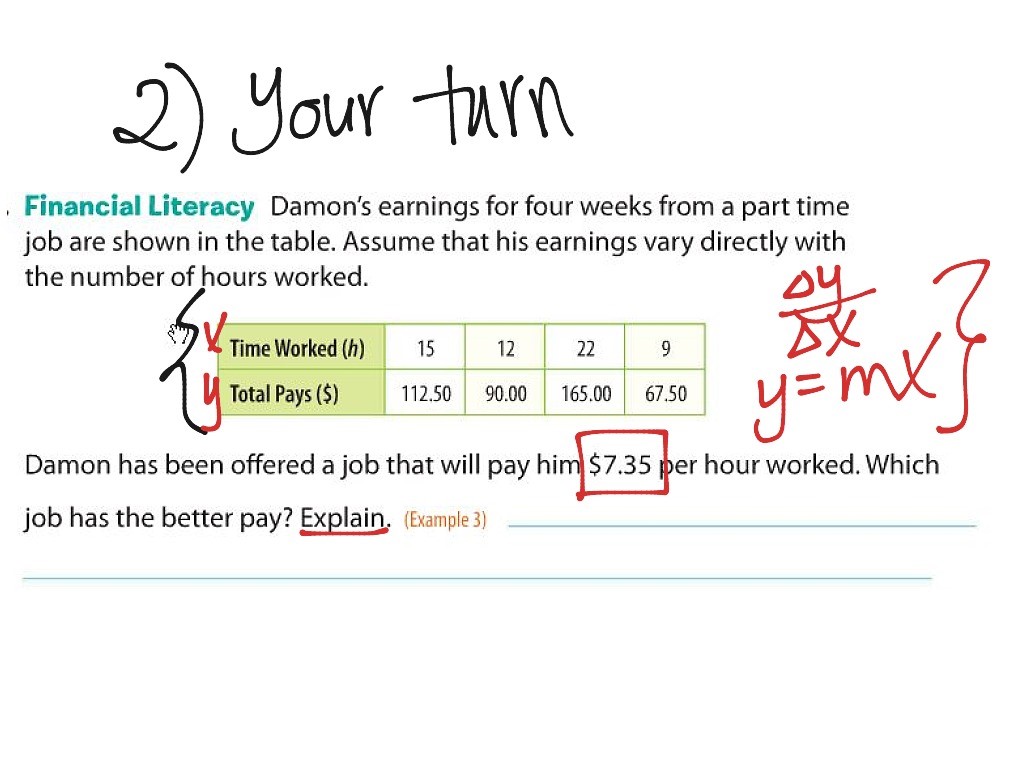
Additionally, to benefit all students you could do problems that involve finances. Including more “finance problems” will help students realize the importance of math, and how they can apply it in everyday life. An example of such problem would be “Damon’s earnings for four weeks from a part time are shown in the table. Assume his earnings vary directly with the number of hours worked. Damon has been offered a job that will pay him $7.35 per hour worked. Which job is better pay (Tucker, A.)? Including word problems that students can relate to now or in the future can help students stay engaged while learning, and answer the question that is most commonly asked by students: “When will I ever use this in real life?”

green line

How could you as a teacher create an activity or project that involves your topic?

As a teacher, creating engaging activities and/or projects can prove to be quite difficult for word problems that are one- or two-step algebra problems, due to the fact that most students completely shut down once a word problem is presented to them. To combat this I have found that making it into a cooperative game can help soothe the anxiety caused by word problems. One game that is great to play with one or two step algebra problems is called rally coach. In this game, students are paired off. Student A is expected to work on solving the problem, while Student B is expected to watch, listen, check, and praise just as a coach would. Once the students think they have the correct answer, they will raise their hand so that the teacher may check it. If they get the answer correct, then the teacher will give them another problem (this time Student A and Student B switch roles). If the answer is incorrect, they must continue working on the problem. The end goal of the game is to answer as many questions as possible before time runs out. By playing this game students are able to help each other solve one or two step word problems.


green line

How can this topic be used in your students’ future courses in mathematics or science?

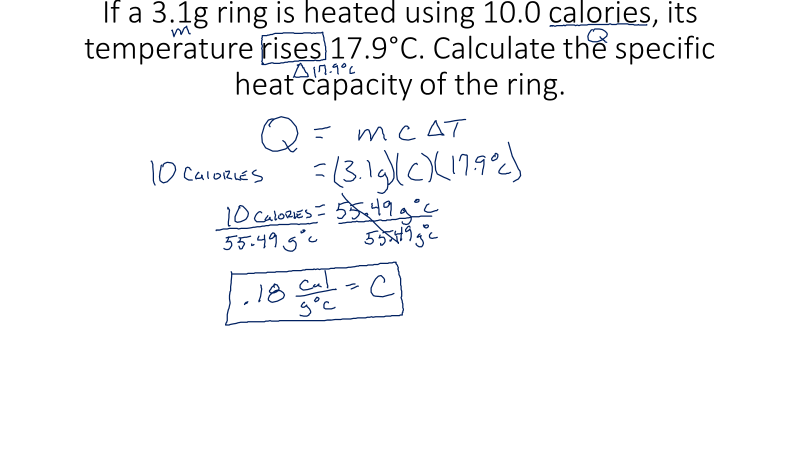
In future courses many problems will involve one or two step algebra problems. For instance, in science courses like chemistry and physics, one will need to know how to solve for different variables of equations. For example, if one is in a chemistry course and is given a word problem (i.e If a 3.1g ring is heated using 10.0 calories, its temperature rises 17.9°C. Calculate the specific heat capacity of the ring) that provides heat energy (Q) mass of a substance (m) and change in temperature (deltaT), but is asked to solve for the specific heat, students will need to know how to solve for the specific heat either by isolating the variable in the beginning (Cp=Q/mdeltaT) or plugging in the givens and isolating the variable (Daniell, B).

References

Daniell, B. (n.d.). Energy Slides 3 [Powerpoint that contains Specific Heat problem].

Tucker, A. (2016). Direct Variation. Retrieved September 01, 2017, from

http://www.showme.com/sh/?h=PQvPbm4


Engaging students: Absolute value

In my capstone class for future secondary math teachers, I ask my students to come up with ideas for engaging their students with different topics in the secondary mathematics curriculum. In other words, the point of the assignment was not to devise a full-blown lesson plan on this topic. Instead, I asked my students to think about three different ways of getting their students interested in the topic in the first place.

I plan to share some of the best of these ideas on this blog (after asking my students’ permission, of course).

This student submission again comes from my former student Deanna Cravens. Her topic, from Pre-Algebra: absolute value.

green line

How could you as a teacher create an activity or project that involves your topic?

A great way to teach absolute value is to do a discovery activity. A blogger and teacher, Rachel, posted on her blog, called Idea Galaxy, a great step by step on how to do a discovery activity for absolute value of integers. First the students will start out by showing the distance between two numbers on a number line, such as the distance between one and three.


They will do a few of these examples to build upon the prior knowledge of the students. Then the class will transition to another page. This one will also have number lines and will ask them problems like ‘what does negative four and four have in common?’ Some scaffolding can also be used like asking them to mark both numbers on the number line and look for similarities related to distance. After completion, students will discuss with one another about the observations they noticed. Lastly, the teacher will give them the term of absolute value and then ask students to rewrite it and put it into their own words.

green line

How can technology (YouTube, Khan Academy [khanacademy.org], Vi Hart, Geometers Sketchpad, graphing calculators, etc.) be used to effectively engage students with this topic?

This short video YouTube video discusses absolute value and then explains one standard way that absolute value is used in real world applications. First it explains absolute value in terms of distance away from zero. It gives a few concrete examples to display, for instance -4 and 4 both have a distance from zero that is 4. So the absolute value bars will always make the number positive. Next, the video uses an example that shows a real world example. It shows a student, Lucy, who is traveling to go to a tuba lesson. She accidentally drops her sheet music and has to go back to get it. This video does a great job of showing what it would the distance would be in terms of number of blocks walked, and how far she is from where she started or her displacement. This can easily be shown at the beginning of class either as an introduction or a review. It can spark more discussion by asking for other real world examples to help show that math really is relevant and needed for every day use.


green line

How can this topic be used in your students’ future courses in mathematics or science?

Absolute value can show up in many areas of future math classes. It comes up when learning about the absolute value function, working with inequalities, proofs and so much more. One specific way that absolute value is used, is in calculus. After students have learned how to take derivatives, they will learn how to take antiderivatives. If a student is given ∫1/x dx, they need to find the antiderivative. Students will know that the derivative of ln x is 1/x, however this is not the case when you take the antiderivative of 1/x. The domain of 1/x is everything except zero, so negative numbers must be taken into consideration. However, if one was to say the antiderivative is lnx, it only accounts for positive numbers. Thus, in order to make the domain match 1/x, the absolute value must be brought in. Therefore, the ∫1/x dx = ln|x|+c. Thus a very basic concept becomes for important within calculations at higher level mathematics.

References:

Teaching Absolute Value Through Discovery


https://www.youtube.com/watch?v=wrof6Dw63Es
https://www.khanacademy.org/math/ap-calculus-ab/ab-antiderivatives-ftc/ab-common-indefinite-int/v/antiderivative-of-x-1

Engaging students: Finding prime factorizations

In my capstone class for future secondary math teachers, I ask my students to come up with ideas for engaging their students with different topics in the secondary mathematics curriculum. In other words, the point of the assignment was not to devise a full-blown lesson plan on this topic. Instead, I asked my students to think about three different ways of getting their students interested in the topic in the first place.

I plan to share some of the best of these ideas on this blog (after asking my students’ permission, of course).

This student submission comes from my former student Brittnee Lein. Her topic, from Pre-Algebra: finding prime factorizations.

green line

• How has this topic appeared in the news?

Prime factorization is key to protecting many aspects of modern convenience. The Fundamental Theorem of Arithmetic states that every number can be broken down into a sum of two prime numbers. For relatively small numbers, this is no big deal; but for very large numbers, not even computers can easily break these down. Many online security systems rely on this principle. For example, if you shop online and enter your credit card information, websites protect that information from hackers through a process of encryption.

Something for students to think about in the classroom: Can you come up with any formula to break down numbers into their prime factors?

Answer: No! That’s why encryption is considered a secure form of cryptography. To this date, there is no confirmed algorithm for prime factorization.

Prime factorization is a classic example of a problem in the NP class. An NP class problem can be thought of as a problem whose solution is easily verified once it is found but not necessarily easily or quickly solved by either humans or computers. The P vs. NP problem is one that has perplexed computer scientists and mathematicians since it was first formulated in 1971. Most recently, a German scientist Norbert Blum has claimed to solve the P vs. NP problem in this article: https://motherboard.vice.com/en_us/article/evvp34/p-vs-np-alleged-solution-nortbert-blum

Also in recent years, A Texas student has been featured on Dallas County Community Colleges Blog for his work to find an algorithm for prime numbers: http://blog.dcccd.edu/2015/07/%E2%80%8Btexas-math-student-strives-to-solve-the-unsolvable/

green line

• How could you as a teacher create an activity or project that involves your topic?

An activity for inquiry based learning of prime numbers and prime factorization utilizes pop cubes. Students will start out with a single color-coded cube representative of the number two (the first prime), they will then move up the list of natural numbers with each prime number having its own color of cube. The composite numbers will have the same colors as their prime factors. The idea is that students will visually see that prime numbers are only divisible by themselves (each being a lone cube) and that composite numbers are simply composed of primes (multiple cubes). A good point of discussion is the meaning of the word “composite’. You could ask students what they think the word ‘composite’ means and what word it reminds them of. This leads into the idea that every composite number is composed of prime numbers. This idea comes from online vlogger Thom Gibson and the RL Moore Inquiry Based Learning Conference. Below is a picture demonstrating the cube idea:

This foundational idea can be segued into The Fundamental Theorem of Arithmetic and then into prime factorization.
One of the most practical real-world applications of prime factorization is encryption. This activity I found makes use of prime factorization in a way that is interesting and different from simply making factor trees. This worksheet would be a good assessment and challenge for students and mimics a real –world application.

https://www.tes.com/teaching-resource/prime-factors-cryptography-6145275

green line

• How does this topic extend what your students should have learned in previous courses?


Though not actually ‘reducing’ the value of a number, prime factorization is the equivalency of numbers broken down into their smallest parts and then multiplied together. The idea of reducing numbers goes all the way back to elementary school when students are learning about fractions. Subconsciously they use a similar process to prime factorization when reducing fractions to simplest form. When reducing fractions to simplest form, the numerators and denominators themselves may not both necessarily be prime, but when put into simplest form, they are relatively prime. Being able to pick out factors of numbers –another relatively early grade school concept (going back to multiplication and division) — plays a huge deal in both fractions and prime factorization.

Engaging students: Negative and zero exponents

In my capstone class for future secondary math teachers, I ask my students to come up with ideas for engaging their students with different topics in the secondary mathematics curriculum. In other words, the point of the assignment was not to devise a full-blown lesson plan on this topic. Instead, I asked my students to think about three different ways of getting their students interested in the topic in the first place.

I plan to share some of the best of these ideas on this blog (after asking my students’ permission, of course).

This student submission again comes from my former student Austin DeLoach. His topic, from Algebra: negative and zero exponents.

green line

B1. How can this topic be used in your students’ future courses in mathematics or science?

The topic of negative and zero exponents is very important when or if the students get to calculus. Although that will be several years down the line, having a solid fundamental grasp on the idea of negative and zero exponents will help them understand derivatives a lot better. Because derivatives of “simple” functions just multiply the coefficient by the exponent and then subtract one from the exponent, it is important for the students to have a good understanding of what negative and zero exponents are. If they do not understand already, they will be confused about why, for example, the derivative of 3x is just 3. It also greatly simplifies derivatives of things like 4/x2, as the students will simply be able to recognize that that is the same thing as 4x-2 and follow standard rules instead of needing to think about the quotient rule and waste time with that. It will also help them in the more near future when they work with simplifying expressions with the exponents written in different terms (i.e. with a positive exponent or with a negative exponent in the denominator), as it will help them recognize what simplifications mean the same thing. Explaining that understanding negative exponents will thoroughly help them in the future may be enough for some students to want to solidify their grasp on the topic.

green line

D2. How was this topic adopted by the mathematical community?

Although this is not about the early adoption of negative and zero exponents in the mathematical community, Geoffrey D. Dietz points out more recent bias for or against the use of negative exponents in textbooks in his Journal of Humanistic Mathematics (linked at the bottom of this answer). Dietz brings up the idea of what is considered “simplified” when it comes to negative exponents vs exponents in denominators. He rated over 20 mathematics textbooks from 1825 to 2012 from “very tolerant” of negative denominators in simplified answers to “very intolerant”. Interestingly, his first encounter with an “intolerant” textbook was not until the 20th century, and textbooks began getting more polarized as very tolerant or very intolerant closer to the end of the 20th century and getting closer to today. This is interesting when it comes to adoption by the mathematical community, as there is a significant inconsistency, even today, about whether negative exponents can be considered “simplified” or not. It will be important to point this out to your students so they can be prepared for their future teachers who may have different preferences on simplification from you, as that will help them understand the polarity in the mathematical community on this topic, as well as hopefully make them want to understand what negative exponents really mean. Dietz recommends giving your students practice with not only converting negative exponents to positive exponents, but also from positive to negative, in order to make sure they are prepared for whatever preferences come up as well as solidifying their understanding of what negative exponents mean.

http://scholarship.claremont.edu/cgi/viewcontent.cgi?article=1110&context=jhm

green line

E1. How can technology be used to effectively engage students with this topic?
This video from Khan Academy does a good job at explaining why negative and zero exponents are what they are. Although Khan Academy videos will likely not be the most engaging for all students, this video is short enough to maintain the attention of the class, and it the logic in it is helpful for the students who don’t understand how the definition of negative and zero exponents was decided on. The presenter does well explaining the idea of “going backwards” and dividing by the number when you decrease the exponent. It’s a good way to explain the “why” for students who ask about it, and it also is a good way to change up the pace for students, as playing videos during class could prevent it from becoming stale for the students, keeping them engaged for longer.

https://www.khanacademy.org/math/pre-algebra/pre-algebra-exponents-radicals/pre-algebra-negative-exponents/v/negative-exponent-intuition


Engaging students: Solving two-step algebra problems

In my capstone class for future secondary math teachers, I ask my students to come up with ideas for engaging their students with different topics in the secondary mathematics curriculum. In other words, the point of the assignment was not to devise a full-blown lesson plan on this topic. Instead, I asked my students to think about three different ways of getting their students interested in the topic in the first place.

I plan to share some of the best of these ideas on this blog (after asking my students’ permission, of course).

This student submission again comes from my former student Jessica Bonney. Her topic, from Pre-Algebra: solving two-step algebra problems.

green line

How could you as a teacher create an activity or project that involves your topic?

A great activity to use in the classroom with students for this topic would have to be algebra tiles. The tiles are a good manipulative that can be used to improve the students’ understanding and offer contact to representative manipulation for students that are more kinesthetic learners. The algebra tiles can be used to help justify and explain the process of solving two-step equations. They were developed on the basis of two ideas: (1) we can isolate variables by using “zero pairs” and (2) equations don’t change when equal amounts of tiles are used on both sides of the equation. Algebra tiles come in different colors and sizes, which can be used to represent different parts of an equation that can help students solve two-step algebra problems.  I think this would be a fun and interactive activity to help students learn and understand how to go about solving these types of problems.


green line

How can this topic be used in your students’ future courses in mathematics or science?

Once a student gets to a certain grade level, they constantly start building upon what they learn. This material can be carried into high school and even college level courses.  Before a student learns two-step equations, they must master one-step equations, and even before that they need to understand basic arithmetical operations. Once mastery has been achieved, students will move onto solving larger polynomials, which can later be used in future algebra, geometry, and calculus courses. Another interesting use for two-step algebra problems is for future science and even computer science courses. In science, let’s say physics or chemistry, the students can use the two-step method for solving how fast a ball fell from a rooftop or for solving how fast a chemical evaporated at a certain temperature. Now in computer science students can learn how to develop algebraic functions in a computerized setting.


green line

What interesting things can you say about the people who contributed to the discovery and/or the development of this topic?

Rene’ Descartes, born in March of 1596, was a French mathematician, philosopher, and scientist. He is widely known for the statement, “I think, therefore I am,” deriving it from the foundation of intuition that, when he thinks, he exists. After obtaining a degree in law, his father wanted him to join Parliament, but sadly he was only 20 and the minimum age to join was 27. In turn, he moved to the Netherlands where he was influenced to study science and mathematics. During this time he formulated a common method of logical reasoning, centered on mathematics, which can be related to all sciences. This method is discussed in Discourse on Method, and is comprised of four rules: “(1) accept nothing as true that is not self-evident, (2) divide problems into their simplest parts, (3) solve problems by proceeding from simple to complex, and (4) recheck the reasoning.” We use these rules everyday when directly apply them to mathematical procedures.


References:

“Rene Descartes”. Encyclopædia Britannica. Encyclopædia Britannica Online. Encyclopædia

Britannica Inc., 2016. Web. 07 Sep. 2016 <https://www.britannica.com/biography/Rene-

Descartes>.


My Favorite One-Liners: Part 21

In this series, I’m compiling some of the quips and one-liners that I’ll use with my students to hopefully make my lessons more memorable for them.

Sometimes, just every once in a blue moon, something in mathematics doesn’t appear right to students at first glance. For example, take the common notation

(a,b)

What does this symbol mean? Sadly, it depends on the context.

Sometimes, it means a point in the Cartesian plane whose first coordinate is a and whose second coordinate is b.

Other times, it could mean the set \{x : a < x < b\}, or the interval between a and b that does not contain the endpoints.

You’d think that, by now, mathematicians would’ve figure out a way to not denote these two completely different things with the same symbol. Indeed, I’ve seen textbooks that use ]a,b[ to denote the open interval between a and b to avoid this duplication; however, this notation hasn’t been widely adopted by the mathematical community.

So here’s my quip when something like this comes up. Sometimes, a young child will come crying to her parents to complain about the injustices in the world, and the child may be right. But all the parent can say is, “Sorry, sweetheart, but sometimes life isn’t fair.” And I’ll act this out, talking to an imaginary child as I look down to the floor.

To complete the quip, I’ll then turn to my class and conclude, “Sorry, sometimes life isn’t fair.” It doesn’t make much sense, but we’re stuck with it.

My Favorite One-Liners: Part 18

In this series, I’m compiling some of the quips and one-liners that I’ll use with my students to hopefully make my lessons more memorable for them. This is a quip that I’ll use when a theoretical calculation can be easily confirmed with a calculator.

Sometimes I teach my students how people converted decimal expansions into fractions before there was a button on a calculator to do this for them. For example, to convert  x = 0.\overline{432} = 0.432432432\dots into a fraction, the first step (from the Bag of Tricks) is to multiply by 1000: How do we change this into a decimal? Let’s call this number x.

1000x = 432.432432\dots

x = 0.432432\dots

Notice that the decimal parts of both x and 1000x are the same. Subtracting, the decimal parts cancel, leaving

999x = 432

or

x = \displaystyle \frac{432}{999} = \displaystyle \frac{16}{37}

In my experience, most students — even senior math majors who have taken a few theorem-proof classes and hence are no dummies — are a little stunned when they see this procedure for the first time.

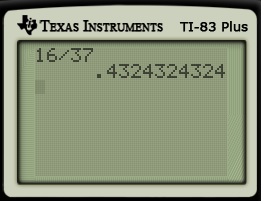
To make this more real and believable to them, I then tell them my one-liner: “I can see that no one believes me. OK, let’s try something that you will believe. Pop out your calculators. Then punch in 16 divided by 37.”

Indeed, my experience many students really do need this technological confirmation to be psychologically sure that it really did work. Then I’ll tease them that, by pulling out their calculators, I’m trying to speak my students’ language.

TI1637

See also my fuller post on this topic as well as the index for the entire series.