Square roots and logarithms without a calculator (Part 1)

This post begins a series of posts concerning the elementary operation of computing a square root. This is such an elementary operation because nearly every calculator has a \sqrt{~~} button, and so students today are accustomed to quickly getting an answer without giving much thought to (1) what the answer means or (2) what magic the calculator uses to find square roots.

I like to show my future secondary teachers a brief history on this topic… partially to deepen their knowledge about what they likely think is a simple concept, but also to give them a little appreciation for their elders.

To begin, let’s go back to a time before the advent of pocket calculators… say, 1955. (When actually teaching this in class, I find the movie clip to be a great and brief way to get students into the mindset of going back in time.)

How did people in 1955 figure out \sqrt{4213}? After all, plenty of marvelous feats of engineering were made before the advent of calculators. So was this computed back then?

green lineOne rudimentary method is simply by trapping the solution. In other words, let’s try guessing the answer to x^2 = 4213 and see if we get it right.

1. First, the tens digit.

  • 60^2 = 3600. Too small.
  • 70^2 = 4900. Too big.
  • Since 3600 < 4213 < 4900, the answer has to be somewhere between 60 and 70.

2. Next, the ones digit. Since 4213 is about halfway between 3600 and 4900, let’s start by guessing 65.

  • 65^2 = 4225. Too big, but not much too big. So let’s try 64 next, as opposed to 62 or 63.
  • 64^2 = 4096. Too small.
  • So the answer has to be somewhere between 64 and 65.

3. Next, the tenth digit. Since 4213 is so close to 4225, let’s start closer to 65 than to 64.

  • 64.8^2 = 4199.04
  • 64.9^2 = 4212.01
  • We already know that 65.0^2 = 4225
  • So the answer has to be somewhere between 64.9 and 65.

And we keep repeating this procedure, obtaining one digit at a time. (My next guess, for the hundredths digit, would be 64.91 or 64.92.) Back in 1955, all of the above squaring was done by hand, without a calculator. With enough patience, \sqrt{4213} can be obtained to as many digits as required.

I distinctly remember using this procedure, just for the fun of it, when I was 7 or 8 years old (with the help of calculator, however). This exercise was far more cumbersome that simply hitting the \sqrt{~~} button, but it really developed my number sense as a young child, not to mention internalizing the true meaning of what a square root actually was. Little insights like “let’s start closer to 65 than to 64 just don’t come naturally without this kind of trial-and-error practice.

For what it’s worth, the above procedure is the essence of the binary search algorithm (from computer science) or the method of successive bisections (from numerical analysis), with a little human intuition thrown in for good measure.

Full lesson plan: magic squares

Over the summer, I occasionally teach a small summer math class for my daughter and her friends around my dining room table. Mostly to preserve the memory for future years… and to provide a resource to my friends who wonder what their children are learning… I’ll write up the best of these lesson plans in full detail.

This was perhaps my favorite: fostering algebraic thinking through the use of 3×3 magic squares, which have the property that the numbers in every row, column, and diagonal have the same sum.

6a00d83542d51e69e2016304a977c0970d-500wi

This lesson plan is written in a 5E format — engage, explore, explain, elaborate, evaluate — which promotes inquiry-based learning and fosters student engagement.

Magic Squares Lesson Plan

Post Assessment 1

Post Assessment 2

Vocabulary Sheet

Magic Squares Examples


A great algebra question. (Or is it?)

I absolutely love the following algebra question:

Mrs. Ortiz made a batch of cookies for Carlos, Maria, Tina, and Joe. The children shared the cookies equally and finished them all right away.

Then Mrs. Ortiz made another batch of cookies, twice as big as the first. When she took the cookies off the cookie sheet, 6 of them crumbled, so she didn’t serve them to the children. She gave the children the rest of the cookies.

Just then, Mr. Ortiz came home and ate 2 cookies from the children’s tray. Each of the children ate 3 more cookies along with a glass of milk. They were stuffed, so they decided to leave the last 4 cookies on the tray.

1. How many cookies were in the first batch?

2. How many cookies did each of the children eat?

The reason I love this algebra question is that it wasn’t an algebra question. It was a question that was posed to upper elementary students. (Here are the Google results for this question; most of the results are brain-teaser type questions for students ranging from 4th grade to 6th grade.)

As a math person, my first instinct probably would be to let x represent the number of cookies that each child ate on the first day and then set up an equation for x based on the information from the second day. There may be other algebraic ways of solving this problem that are just as natural (or even better than my approach.)

So try to think about this problem from the perspective of a child who hasn’t learned algebra yet.  How would you even start tackling a complex problem like this if you didn’t know you could introduce an x someplace?

I encourage you to take a few minutes and try to solve this problem as a 4th or 5th grader might try to solve it.

While this problem doesn’t require the use of algebra, it does require the use of algebraic thinking. That’s what I love about this problem: even a 9-year-old child can be reasonably expected to think through a solution to this problem, even if the methods that they might choose may not be those chosen by students with more mathematical training.

My observation is that math majors in college — even those that have good teaching instincts and want to teach in high schools after graduating — have a difficult time thinking that far back in time. Of course, putting themselves in the place of students who have not learned algebra yet is a good exercise for anyone who wants to teach algebra. So that’s a major reason that I love this problem; it’s a good vehicle for forcing college students who are highly trained in mathematics to think once again like a pre-algebra student.


More on divisibility

Based on my students’ reactions, I gave my best math joke in years as I went over the proofs for checking that an integer was a multiple of 3 or a multiple of 9. I started by proving a lemma that 9 is always a factor of 10^k - 1. I asked my students how I’d write out 10^k - 1, and they correctly answered 99{\dots}9, a numeral with k consecutive 9s. So I said, “Who let the dogs out? Me. See: k nines.”

Some of my students laughed so hard that they cried.

There are actually at least three ways of proving this lemma. I love lemmas like these, as they offer a way of, in the words of my former professor Arnold Ross, to think deeply about simple things.

(1) By subtracting, 10^k - 1 = 99{\dots}9 = 9 \times 11{\dots}1, which is clearly a multiple of 9.

(2) We can use the rule

a^k - b^k = (a-b) \left(a^{k-1} + a^{k-2} b + \dots + a b^{k-2} + b^{k-1} \right)

The conclusion follows by letting a = 10 and b =1.

From my experience, my senior math majors all learned the rule for factoring the difference of two squares, but very few learned the rule for factoring the difference of two cubes, while almost none of them learned the general factorization rule above. As always, it’s not my students’ fault that they weren’t taught these things when they were younger.

I also supplement this proof with a challenge to connect Proof #2 with Proof #1… why does 11{\dots}1 = \left(a^{k-1} + a^{k-2} b + \dots + a b^{k-2} + b^{k-1} \right)?

(3) We can use mathematical induction.

If k = 0, then 10^k - 1 = 0, which is a multiple of 9.

We now assume that 10^k - 1 is a multiple of 9.

To show that 10^{k+1}-1 is a multiple of 9, we observe that

10^{k+1}-1 = \left(10^{k+1} - 10^k \right) + \left(10^k - 1\right) = 10^k (10-1) + \left(10^k - 1\right),

and both terms on the right-hand side are multiples of 9. (I also challenge my students to connect the right-hand side with the original expression 99{\dots}9.)

\hbox{QED}

Divisibility tricks

Based on personal experience, about half of our senior math majors never saw the basic divisibility rules (like adding the digits to check if a number is a multiple of 3 or 9) when they were children. I guess it’s also possible that some of them just forgot the rules, but I find that hard to believe since they’re so simple and math majors are likely to remember these kinds of tricks from grade school. Some of my math majors actually got visibly upset when I taught these rules in my Math 4050 class; they had been part of gifted and talented programs as children and would have really enjoyed learning these tricks when they were younger.

Of course, it’s not my students’ fault that they weren’t taught these tricks, and a major purpose of Math 4050 is addressing deficiencies in my students’ backgrounds so that they will be better prepared to become secondary math teachers in the future.

My guess that the divisibility rules aren’t widely taught any more because of the rise of calculators. When pre-algebra students are taught to factor large integers, it’s no longer necessary for them to pre-check if 3 is a factor to avoid unnecessary long division since the calculator makes it easy to do the division directly. Still, I think that grade-school students are missing out if they never learn these simple mathematical tricks… if for no other reason than to use these tricks to make factoring less dull and more engaging.

A mathematical magic trick

In case anyone’s wondering, here’s a magic trick that I did my class for future secondary math teachers while dressed as Carnac the Magnificent. I asked my students to pull out a piece of paper, a pen or pencil, and (if they wished) a calculator. Here were the instructions I gave them:

  1. Write down just about any number you want. Just make sure that the same digit repeated (not something like 88,888). You may want to choose something that can be typed into a calculator.
  2. Scramble the digits of your number, and write down the new number. Just be sure that any repeated digits appear the same number of times. (For example, if your first number was 1,232, your second number could be 2,231 or 1,322.)
  3. Subtract the smaller of the two numbers from the bigger, and write down the difference. Use a calculator if you wish.
  4. Pick any nonzero digit in the difference, and scratch it out.
  5. Add up the remaining digits (that weren’t scratched out).

I asked my students one at a time what they got after Step 5, and I responded, as the magician, with the number that they had scratched out. One student said 34, and I answered 2. Another said 24, and I answered 3. After doing this a couple more times, one student simply stated, “My mind is blown.”

This is actually a simple trick to perform, and the mathematics behind the trick is fairly straightforward to understand. Based on personal experience, this is a great trick to show children as young as 2nd or 3rd grade who have figured out multiple-digit subtraction and single-digit multiplication.

I offer the following thought bubble if you’d like to think about it before looking ahead to find the secret to this magic trick.

green_speech_bubbleWhat the magician does: the magician finds the next multiple of 9 greater than the volunteer’s number, and answers with the difference. For example, if the volunteer answers 25, the magician figures out that the next multiple of 9 after 25 is 27. So 27-25 = 2 was the digit that was scratched out.

This trick works because of two important mathematical facts.

(1) The difference D between the original number and the scrambled number is always a multiple of 9. For example, suppose the volunteer chooses 3417, and suppose the scrambled number is 7431. Then the difference is


7431 - 3417 = (7000 + 400 + 30 + 1) - (3000 + 400 + 10 + 7)

= (7000 - 7) + (400 - 400) + (30 - 3000) + (1 - 10)

= 7 \times (1000-1) + 4 \times (100-100) + 3 \times (10-1000) + 1 \times (1-10)

= 7 \times (999) + 1 \times (0) + 4 \times (-990) + 3 \times (-9)

Each of the numbers in parentheses is a multiple of 9, and so the difference D must also be a multiple of 9.

A more algebraic proof of (1) is set apart in the block quote below; feel free to skip it if the above numerical example is convincing enough.

More formally, suppose that the original number is a_n a_{n-1} \dots a_1a_0 in base-10 notation, and suppose the scrambled number is a_{\sigma(n)} a_{\sigma(n-1)} \dots a_{\sigma(1)} a_{\sigma(0)}, where \sigma is a permutation of the numbers \{0, 1, \dots, n\}. Without loss of generality, suppose that the original number is larger. Then the difference D is equal to

D = a_n a_{n-1} \dots a_1a_0 - a_{\sigma(n)} a_{\sigma(n-1)} \dots a_{\sigma(1)} a_{\sigma(0)}

D = \displaystyle \sum_{i=0}^n a_i 10^i - \sum_{i=0}^n a_{\sigma(i)} 10^i

D = \displaystyle \sum_{i=0}^n a_{\sigma(i)} 10^{\sigma(i)} - \sum_{i=0}^n a_{\sigma(i)} 10^i

D = \displaystyle \sum_{i=0}^n a_{\sigma(i)} \left(10^{\sigma(i)} - 10^i \right)

The transition from the second to the third line work because the terms of the first sum are merely rearranged by the permutation \sigma.

To show that D is a multiple of 9, it suffices to show that each term 10^{\sigma(i)} - 10^i is a multiple of 9.

  • If \sigma(i) > i, then 10^{\sigma(i)} - 10^i = 10^i \left( 10^{\sigma(i) - i} - 1 \right), and the term in parentheses is guaranteed to be a multiple of 9.
  • If \sigma(i) < i, then 10^{\sigma(i)} - 10^i = 10^{\sigma(i)} \left( 1-10^{i-\sigma(i)} \right) = -10^{\sigma(i)} \left( 10^{i-\sigma(i)} - 1 \right), and the term in parentheses is guaranteed to be a (negative) multiple of 9.
  • If \sigma(i) = i, then 10^{\sigma(i)} - 10^i = 0, a multiple of 9.

\hbox{QED}

Because the difference D is a multiple of 9, we use the important fact (2) that a number is a multiple of 9 exactly when the sum of its digits is a multiple of 9. Therefore, when the volunteer offers the sum of all but one of the digits of D, the missing digit is found by determining the nonzero number that has to be added to get the next multiple of 9. (Notice that the trick specifies that the volunteer scratch out a nonzero digit. Otherwise, there would be an ambiguity if the volunteer answered with a multiple of 9; the missing digit could be either 0 or 9.)

As I mentioned earlier, I showed this trick (and the proof of why it works) to a class of senior math majors who are about to become secondary math teachers. I think it’s a terrific and engaging way of deepening their content knowledge (in this case, base-10 arithmetic and the rule of checking that a number is a multiple of 9.)

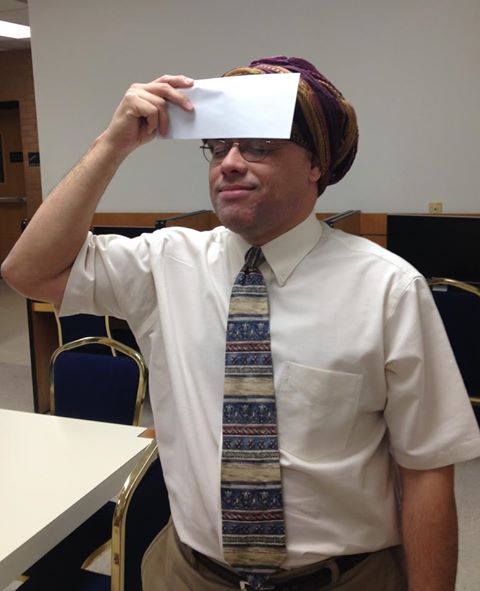
As thanks for reading this far, here’s a photo of me dressed as Carnac as I performed the magic trick. Sadly, most of the senior math majors of 2013 were in diapers when Johnny Carson signed off the Tonight Show in 1992, so they didn’t immediately get the cultural reference.
542597_10200255338162345_209138628_n

Math emporium

It took some convincing, but I’m now a supporter of this novel way of using technology to teach lower-level mathematics courses at the collegiate level. The results speak for themselves.

http://www.washingtonpost.com/local/education/at-virginia-tech-computers-help-solve-a-math-class-problem/2012/04/22/gIQAmAOmaT_story.html?hpid=z4

http://www.emporium.vt.edu/emporium/home.html

http://www.thencat.org/R2R/AcadPrac/CM/MathEmpFAQ.htm

Acceleration

The following two questions came from a middle-school math textbook. The first is reasonable, while the second is a classic example of an author being overly cute when writing a homework problem.

  1.  A car slams on its brakes, coming to a complete stop in 4 seconds.  The car was traveling north at 60mph. Calculate the acceleration.
  2. A rocket blasts off. At 10 seconds after blast off, it is at 10,000 feet, traveling at 3600mph.  Assuming the direction is up, calculate the acceleration.

For the first question, we’ll assume constant deceleration (after all, this comes from a middle-school textbook). First, let’s convert from miles per hour to feet per second:

60 ~ \frac{\hbox{mile}}{\hbox{hour}} = 60 ~ \frac{\hbox{mile}}{\hbox{hour}} \times \frac{1 ~ \hbox{hour}}{3600 ~ \hbox{second}} \times \frac{5280 ~ \hbox{feet}}{1 ~ \hbox{mile}} = 88~ \frac{\hbox{feet}}{\hbox{second}}

The deceleration is therefore equal to the change in velocity over time, or

\frac{-88 ~ \hbox{feet/second}}{4 ~ \hbox{second}} = -22 ~\hbox{ft/s}^2

Now notice the word north in the statement of the first question. This bit of information is irrelevant to the problem. I presume that the writer of the problem wants students to practice picking out the important information of a problem from the unimportant… again, a good skill for students to acquire.

green line

Let’s now turn to the second question. At first blush, this also has irrelevant information…  it is at 10,000 feet. So I presume that the author wants students to solve this in exactly the same way:

3600 ~ \frac{\hbox{mile}}{\hbox{hour}} = 3600 ~ \frac{\hbox{mile}}{\hbox{hour}} \times \frac{1 ~ \hbox{hour}}{3600 ~ \hbox{second}} \times \frac{5280 ~ \hbox{feet}}{1 ~ \hbox{mile}} = 5280 ~ \frac{\hbox{feet}}{\hbox{second}}

for an acceleration of

\frac{5280 ~ \hbox{feet/second}}{10 ~ \hbox{second}} = 528 ~\hbox{ft/s}^2

The major flaw with this question is that the acceleration of the rocket completely determines the distance that the rocket travels. While middle-school students would not be expected to know this, we can use calculus to determine the distance. Since the initial position and velocity are zero, we obtain

x''(t) = 528

x'(t) = \int 528 \, dt = 528t + C

x'(0) = 528(0) + C

0 = C

\therefore x'(t) = 528t + 0 = 528t

x(t) = \int 528t \, dt = 264t^2 + C

x(0) = 264(0)^2 + C

\therefore x(t) = 264t^2 + 0 = 264t^2

Therefore, the rocket travels a distance of 264 ~ \hbox{feet/second}^2 \times (10 ~ \hbox{second})^2 = 26400 ~ \hbox{feet}. In other words, not 10,000 feet.

As a mathematician, this is the kind of error that drives me crazy, as I would presume that the author of this textbook should know that he/she just can’t make up a distance in the effort of making a problem more interesting to students.

Student misconceptions about PEMDAS

Simplify 6/2*(1+2).

A Common Incorrect Answer. According to PEMDAS, we should handle the parentheses first. So 6/2*(1+2) = 6/2*3. Next, there are no exponents, so we should proceed to multiplication. So 6/2*3 = 6/(2*3) = 6/6. Finally, we move to division, and we obtain the answer 6/6 =1.

The above answer is incorrect and (even worse) arises from a natural but unfortunate misconception of the way that children are commonly taught order of operations. If you don’t see the misconception, please give it some thought before continuing.

green line

The mnemonic PEMDAS, commonly taught in the United States, stands for

Parentheses

Exponents

Multiplication

Division

Addition

Subtraction

I personally never learned this memorization trick when I was in school. What I do remember, from learning BASIC computer programming around 1980, was the mnemonic My Dear Aunt Sally. I’m told that in the United Kingdom (and perhaps elsewhere in the English-speaking world) schoolchildren are taught BIMDAS, where B stands for Brackets and I stands for Indices.

Unfortunately, all of these memorization devices suffer from a common flaw: they do not indicate that multiplication and divison have equal precedence, and that addition and subtraction have equal precedence. In other words, the order of operations really are

Parentheses

Exponents

Multiplication and Divison (left to right)

Addition and Subtraction (left to right)

Therefore, the correct answer to the above problem is

6/2*(1+2) = 6/2*3 = (6/2)*3 = 3*3 = 9.

In brief, though not intended by teachers, PEMDAS and BIMDAS perhaps promote the misconception that multiplication takes precedence over division and addition takes precedence over subtraction. To avoid this misconception, one of my colleagues suggests that PEMDAS be taught more visually as

P
E
MD
AS

so that students will have a better chance of remembering that MD and AS should have equal precedence.