Engaging students: Order of operations

In my capstone class for future secondary math teachers, I ask my students to come up with ideas for engaging their students with different topics in the secondary mathematics curriculum. In other words, the point of the assignment was not to devise a full-blown lesson plan on this topic. Instead, I asked my students to think about three different ways of getting their students interested in the topic in the first place.

I plan to share some of the best of these ideas on this blog (after asking my students’ permission, of course).

This student submission comes from my former student Alyssa Dalling. Her topic, from Pre-Algebra: order of operations.

green line

C. How has this topic appeared in pop culture (movies, TV, current music, video games, etc.)?

Hannah Montana is a Disney series that aired from 2006-2011. On this episode titled “Sleepwalk This Way”, Miley’s dad writes her a new song which she reads and doesn’t like. She decides to keep her dislike of the new song to herself causing her to start sleepwalking. In order to not tell her dad what she thinks of the song while sleepwalking, Miley stops sleeping which causes her many problems. One such problem occurs when Miley gets dressed in the wrong order causing her to get an unwanted result.

I would start out the class by showing the first 46 seconds of this Hannah Montana scene. (Editor’s note: Trust me, this is hilarious.) This scene is perfect for the engage because it is a way to relate the order of operations to getting dressed. After watching the scene, the teacher would explain that just like getting dressed in the proper order is important, the order of operations when doing math is as well. The students would learn PEMDAS (parenthesis, exponents, multiplication, division, addition, and subtraction) and try different problems to get them better acquainted with the concept.

green line

B. How can this topic be used in your students’ future courses in mathematics or science?

The order of operations will be used in almost every math class following Pre-Algebra. One example is in Algebra II when students start working with problems involving simplifying numbers and multiple variables. One example is

\left( \displaystyle \frac{18a^{4x} b^2}{-6 a^x b^5} \right)^3

Start out the class by asking students how the order of operations says to answer this question.  Most students will follow method two below. Upon completion of this lesson, students will learn multiple methods of problem solving which expand their previous knowledge of order of operations.

The first method students can use is to raise the numerator and denominator to the third power before simplifying. By raising each variable to the third power, no rules in the order of operations will be broken showing the student there is more than one way to use the order of operations. (Reference Method One below).

The method most students will originally think of is simplifying the fraction before raising it to the third power. The student would follow their previous knowledge of PEMDAS in order to simplify the equation to the reduced form. (Reference Method Two below). In either case, the students will see that the solution can be found by using a variety of different means that all fall under the order of operations.

Method One:

Alyssa_order1

Method Two:

Alyssa_order2

Resources: http://www.glencoe.com/sec/math/algebra/algebra2/algebra2_05/extra_examples/chapter5/lesson5_1.pdf

green line

B. How can this topic be used in your students’ future courses in mathematics or science?

An understanding of the order of operations is relied upon in Calculus as well. One application is when learning the chain rule. The following YouTube video does a fun job at explaining the chain rule by using a catchy song. The students are able to learn the rule and see examples that they can use to help them with this concept. Start it at 1:32 and end it at 2:10 (shown below).

The chain rule is used to find the derivative of the composition of two functions. So if f and g are functions, then the derivative of f(g(x)) can be found using the chain rule. Using the example F(x) = (x^3+5x)^2 , the chain rule states that the derivative will be F'(x) = f'(z) g'(x). Following this definition, the student finds the derivative to be 2(x^3+5x)(3x^2+5) . This is where the order of operations comes in. The student must use their previously acquired skills from Pre-Algebra as well as Algebra II to simplify the expression. From their previously acquired knowledge, the student would know they would have to multiply the 2 by each expression in f'(z). Also, if a question asked the student to find the derivative when x=3, the student would have to use their knowledge of the order of operations to find the solution after applying the chain rule.

Resources: http://archives.math.utk.edu/visual.calculus/2/chain_rule.4/index.html


Engaging students: Finding x- and y-intercepts

In my capstone class for future secondary math teachers, I ask my students to come up with ideas for engaging their students with different topics in the secondary mathematics curriculum. In other words, the point of the assignment was not to devise a full-blown lesson plan on this topic. Instead, I asked my students to think about three different ways of getting their students interested in the topic in the first place.

I plan to share some of the best of these ideas on this blog (after asking my students’ permission, of course).

This student submission again comes from my former student Maranda Edmonson. Her topic, from Algebra: finding x- and y-intercepts. Unlike most student submissions, Maranda’s idea answers three different questions at once.

green lineApplications: How could you as a teacher create an activity or project that involves your topic?

Culture: How has this topic appeared in pop culture (movies, TV, current music, video games, etc.)?

Technology: How can technology be used to effectively engage students with this topic?

This link is to a reflection by a mathematics teacher who used the popular TV show “The Big Bang Theory” to teach linear functions. She taught this lesson prior to teaching students about finding y-intercepts of linear functions, but it can be adapted in order to teach how to find the intercepts themselves.

ENGAGE:

One thing I would not change would be to show the students the above clip of the show where Howard and Sheldon are heatedly discussing crickets at the beginning of the activity. By showing the video at the beginning, students will be engaged and want to figure out what will be done throughout the lesson. Being a clip of a popular show that many probably watch during the week, students will be even more engaged and interested since they are able to watch something that they are already familiar with. Being something that they are already familiar with or can relate to, students have a tendency to remember the material or at least the topic longer than they would remember something that they were unfamiliar with or could not relate.

In the clip, Sheldon argues that the cricket the guys hear while eating dinner is a snowy tree cricket based on the temperature of the room and the frequency of chirps; Howard argues that it is an ordinary field cricket.  The beginning of their discussion is as follows:

Sheldon: “Based on the number of chirps per minute, and the ambient temperature in this room, it is a snowy tree cricket.”

Howard: “Oh, give me a frickin’ break. How could you possibly know that?”

Sheldon: “In 1890, Amos Dolbear determined that there was a fixed relationship between the number of chirps per minute of the snowy tree cricket and the ambient temperature – a precise relationship that is not present with ordinary field crickets.”

The whole episode revolves around the guys finding the exact genus and species of the cricket, but that is not the importance here. The importance of this clip is the linear relationship between the temperature and the number of chirps per minute of the cricket, which the activity should then be centered around.

EXPLORE:

After showing the short clip, it could be beneficial to show students the Wikipedia link that discusses Dolbear’s Law. Toward the bottom of the page, the relationship is written out in several formats, but there is a basic linear function that students could focus on for the activity.

Assuming students know how to graph linear functions (as stated above, the link is for a lesson the teacher taught before teaching students about y-intercepts), I would have students graph Dolbear’s Law on a piece of graph paper. The challenge would be for students to find out what happens when there are variations to the number of chirps of the cricket, the temperature or both to see how the graph changes – specifically where the graph crosses each axis.

 EXPLAIN/ELABORATE/EVALUATE:

At this point, students should be able to state what changes they noticed with the graph – specifically where the graph crossed the axes as changes are made to the function. After they have explained what they found, fill in any gaps and correct vocabulary as needed. Basically, teach what little there is left for the lesson. Follow-up by providing extra examples or a worksheet for students to practice before giving them a quiz or test to assess their performance.

Engaging students: Deriving the Pythagorean theorem

In my capstone class for future secondary math teachers, I ask my students to come up with ideas for engaging their students with different topics in the secondary mathematics curriculum. In other words, the point of the assignment was not to devise a full-blown lesson plan on this topic. Instead, I asked my students to think about three different ways of getting their students interested in the topic in the first place.

I plan to share some of the best of these ideas on this blog (after asking my students’ permission, of course).

This student submission again comes from my former student Maranda Edmonson. Her topic, from Geometry: deriving the Pythagorean theorem.

green line

D. History: What are the contributions of various cultures to this topic?

Legend has it that Pythagoras was so happy about the discovery of his most famous theorem that he offered a sacrifice of oxen. His theorem states that “the area of the square built upon the hypotenuse of a right triangle is equal to the sum of the areas of the squares upon the remaining sides.” It is likely, though, that the ancient Babylonians and Egyptians knew the result much earlier than Pythagoras, but it is uncertain how they originally demonstrated the proof. As for the Greeks, it is likely that methods similar to Euclid’s Elements were used. Also, though there are many proofs of the Pythagorean Theorem, one came from the contemporary Chinese civilization found in the Arithmetic Classic of the Gnoman and the Circular Paths of Heaven, a Chinese text containing formal mathematical theories.

http://jwilson.coe.uga.edu/emt669/student.folders/morris.stephanie/emt.669/essay.1/pythagorean.html

green line

E. Technology: How can technology be used to effectively engage students with this topic?

The following link is for a video that not only engages students from the very beginning by playing the Mission: Impossible theme and giving students a mission – “should they choose to accept it” – but that has great information. It begins with a short engagement, as stated before, and goes into a little bit of history about Pythagoras and the Pythagoreans. It then briefly describes what the Pythagorean Theorem is before the commentator says, “Does it have applications in our lives today?” At this point (2:43 in the video), it would be beneficial to stop the video and let students discuss where they could use the theorem. The rest of the video simply shows some examples of how the Pythagorean Theorem is used on sailboats, inclined planes, and televisions. It would be up to the teacher whether or not to show the last five minutes of the video to show students these examples, but they could take notes on these examples as they are worked out on the screen.

http://digitalstorytelling.coe.uh.edu/movie_mathematics_02.html

green line

B. Applications: How can this topic be used in your students’ future courses in mathematics or science?

After students learn the Pythagorean Theorem in their Geometry classes, they will use it throughout their mathematical careers. They will use it specifically in Pre-Calculus when they are learning about the unit circle. The theorem is fundamental to proving the basic identities in Trigonometry. It is also used in some of the trigonometric identities, aptly named the Pythagorean Identities based on the nature of their derivation.

In Physics, the kinetic energy of an object is

\displaystyle \frac{1}{2} (\hbox{mass})(\hbox{velocity})^2.

But, in terms of energy, energy at 500 mph = energy at 300 mph + energy at 400 mph. This equation means that, with the energy used to accelerate something at 500 mph, two other objects could use that same energy to be accelerated to 300 mph and 400 mph. Looks like a Pythagorean triple, right? The theorem is also used in Computer Science with processing time. Other examples are found in the link below.

http://betterexplained.com/articles/surprising-uses-of-the-pythagorean-theorem/

Why does 0.999… = 1? (Part 5)

Here’s one more way of convincing students that 0.\overline{9} = 1. Here’s the idea: how far apart are the two numbers?

First off, since 1 \ge 0.\overline{9}, we know that 1 - \overline{9} \ge 0.

Of course, we know that 1-0.9 = 0.1. Since 0.\overline{9} must lie between 0.9 and 1, we know that 1 - 0.\overline{9} must be less than 0.1.

Second, we know that 1-0.99 = 0.01. Since 0.\overline{9} must lie between 0.99 and 1, we know that 1 - 0.\overline{9} must be less than 0.01.

Third, we know that 1-0.999 = 0.001. Since 0.\overline{9} must lie between 0.999 and 1, we know that 1 - 0.\overline{9} must be less than 0.001.

By the same reasoning, we conclude that

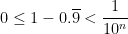
0 \le 1 - 0.\overline{9} < \displaystyle \frac{1}{10^n}

for every integer n. What’s the only number that’s greater than or equal to 0 and less than every decimal of the form 0.00\dots001? Clearly, the only such number is 0. Therefore,

1 - 0.\overline{9} = 0, or 0.\overline{9} = 1.

green lineI like this approach because it really gets at the heart of the difference between integers \mathbb{Z} and real numbers \mathbb{R}. For integers, there is always an integer to the immediate left and to the immediate right. In other words, if you give me any integer (say, 15), I can tell you the largest integer that’s less than your number (in our example, 14) and the smallest integer that’s bigger than your number (16).

Real numbers, however, do not have this property. There is no real number to the immediate right of 0. This is easy to prove by contradiction. Suppose x > 0 is the real number to the immediate left of 0. That means that there are no real numbers between 0 and x. However, x/2 is bigger than 0 and less than x, providing the contradiction.

(For what it’s worth, the above proof doesn’t apply to the set of integers \mathbb{Z} since x/2 doesn’t have to be an integer.)

By the same logic — visually, you can imagine reflecting the number line across the point x = 0.5 — there is no number to the immediate left of 1. So while 0.\overline{9} would appear to be to the immediate left of 1, they are in reality the same point.

Why does 0.999… = 1? (Part 1)

Our decimal number system is so wonderful that it’s often taken for granted. (If you doubt me, try multiplying 12 and 61 or finding an 18\% tip on a restaurant bill using only Roman numerals.)

However, there’s one little quirk about our numbering system that some students find quite unsettling:

If a number has a terminating decimal representation, then the same number also has a second different terminating decimal representation. (However, a number that does not have a terminating decimal representation does not have a second representation.)

Stated another way, a decimal representation corresponds to a unique real number. However, a real number may not have a unique decimal representation.

Some (perhaps many) students find such equalities to be unsettling at first glance, and for good reason. They’d prefer to think that there is a one-to-one correspondence to the set of real numbers and the set of decimal representations. Stated more simply, students are conditioned to think that if two number look different (like 24 and 25), then they ought to be different.

However, there’s a subtle difference  between a number and a numerical representation. The number 1 is defined to be the multiplicative identity in our system of arithmetic. However, this number has two different representations in our numbering system: 1 and 0.999\dots. (Not to mention its representation in the numbering systems of the ancient Romans, Babylonians, Mayans, etc.)

As usual, let [0,1] be the set of real numbers from 0 to 1 (inclusive), and let D be the set of decimal representations of the form 0.d_1 d_2 d_3 \dots. Then there’s clearly a function f : D \to \mathbb{R}, defined by

f(0.d_1 d_2 d_3\dots) = \displaystyle \sum_{i=1}^\infty \frac{d_n}{10^n}

If I want to give my students a headache, I’ll ask, “In Calculus II, you saw that some series converge and some series diverge. So what guarantee do we have that this series actually converges?” (The convergence of the right series can be verified using the Direct Comparsion Test, the fact that d_i \le 9, and the formula for an infinite geometric series.)

In the language of mathematics: Using the completeness axiom, it can be proven (though no student psychologically doubts this) that f maps D onto [0,1]. In other words, every decimal representation corresponds to a real number, and every real number has a decimal representation. However, the function f is a surjection but not a bijection. In other words, a real number may have more than one decimal representation.

This is a big conceptual barrier for some students — even really bright students — to overcome. They’re not used to thinking that two different decimal expansions can actually represent the same number.

The two most commonly shown equal but different decimal representations are 0.999\dots = 1. Other examples are

0.125 = 0.124999\dots

3.458 = 3.457999 \dots

In this series, I will discuss some ways of convincing students that 0.999\dots = 1. That said, I have met a few math majors within a semester of graduating — that is, they weren’t dummies — who could recite all of these ways and were perhaps logically convinced but remained psychologically unconvinced. The idea that two different decimal representations could mean the same number just remained too high of a conceptual barrier for them to hurdle.

Method #1. This first technique is accessible to any algebra or pre-algebra student who’s comfortable assigning a variable to a number. We convert the decimal representation to a fraction using something out of the patented Bag of Tricks. If students aren’t comfortable with the first couple of steps (as in, “How would I have thought to do that myself?”), I tell my usual tongue-in-cheek story: Socrates gave the Bag of Tricks to Plato, Plato gave it to Aristotle, it passed down the generations, my teacher taught the Bag of Tricks to me, and I teach it to my students.

Let x =0.999\dots. Multiply x by 10, and subtract:

10x = 9.999\dots

x = 0.999\dots

\therefore (10-1)x = 9

x =1

0.999\dots = 1

Factoring the time

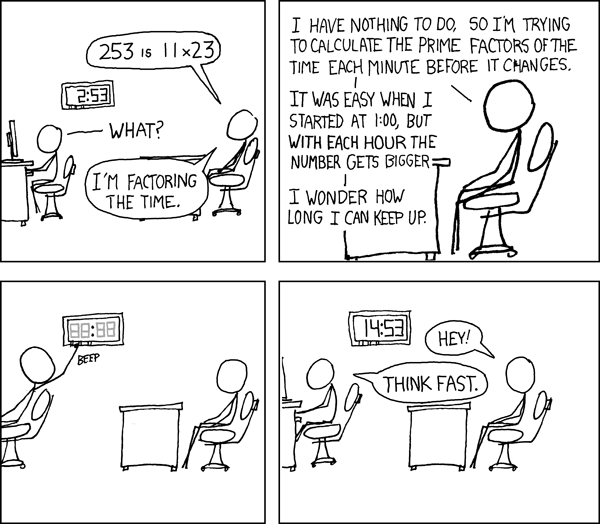
factoring_the_time

True story: one way that I commit large numbers to (hopefully) short-term memory is by factoring. If I take the time to factor a big number, then I can usually remember it for a little while.

This approach has occasional disadvantages. For example, I now have stuck in my brain the completely useless information that, many years ago, my seat at a Texas Rangers ballgame was somewhere in Section 336 (which is 6 \times 7 \times 8).

Source: http://www.xkcd.com/247/

Engaging students: Introducing variables and expressions

In my capstone class for future secondary math teachers, I ask my students to come up with ideas for engaging their students with different topics in the secondary mathematics curriculum. In other words, the point of the assignment was not to devise a full-blown lesson plan on this topic. Instead, I asked my students to think about three different ways of getting their students interested in the topic in the first place.

I plan to share some of the best of these ideas on this blog (after asking my students’ permission, of course).

This student submission again comes from my former student Caitlin Kirk. Her topic, from Pre-Algebra: introducing variables and expressions.

green line

To keep track of some of the coldest things in the universe, scientist use the Kelvin temperature scale that begins at 0 Kelvin, or Absolute Zero. Nothing can ever be colder than Absolute Zero because at this temperature, all motion stops. The table below shows some typical temperatures of different systems in the universe.

Table of Cold Places

Temp.(K)

Location

 183

Vostok, Antarctica

160

Phobos- a moon of Mars

128

Europa in the summer

120

Moon at night

88

Miranda surface temp.

81

Enceladus in the summer

70

Mercury at night

55

Pluto in the summertime

50

Dwarf Planet Quaoar

33

Pluto in the wintertime

1

Boomerang Nebula

0

ABSOLUTE ZERO

You are probably already familiar with the Celsius (C) and Fahrenheit (F) temperature scales. The two formulas below show how to switch from degrees-C to degrees-F.

C = \frac{5}{9} (F-32)

F = \frac{9}{5} C + 32

Because the Kelvin scale is related to the Celsius scale, we can also convert from Celsius to Kelvin (K) using the equation:

K = 273 + C

Problems

Use these three equations to convert between the three temperature scales:

Problem 1: 212 F converted to K

Problem 2: 0 K converted to F

Problem 3: 100 C converted to K

Problem 4: Two scientists measure the daytime temperature of the moon using two different instruments. The first instrument gives a reading of +107 C while the second instrument gives +221 F.

a. What are the equivalent temperatures on the Kelvin scale?

b. What is the average daytime temperature on the Kelvin scale?

Problem 5: Humans can survive without protective clothing in temperatures ranging from 0 F to 130 F. In what, if any, locations from the table above can humans survive?

Solutions

Problem 1: First convert to C:  C = 5/9 (212-32) = +100 C. Then convert from C to K: K = 273 + 100 = 373 Kelvin.

Problem 2: First convert to Celsius:    0 = 273 + C so C = -273. Then convert from C to F: F = 9/5 (-273) + 32 = -459 Fahrenheit.

Problem 3: K = 273 – 100 = 173 Kelvin.

Problem 4:

a. 107 C becomes K = 273 + 107 = 380 Kelvin.  221 F becomes C = 5/9(221-32) = 105 C, and so K = 273 + 105 = 378 Kelvin.

b. (380 + 378)/2 = 379 Kelvin

Problem 5:

First convert 0 F and 130 F to Celsius so that the conversion to Kelvin is quicker. 0 F becomes C = 5/9(0-32) = -18 C (rounded to the nearest degree) and 130 F becomes C = 5/9 (130-32) = 54 C (rounded to the nearest degree).

Next, convert -18 C and 54 C to Kelvin. -18 C becomes K = 273-18 = 255 and 54 C becomes k = 273 + 54 = 327 K.

None of the locations on the table have temperatures between 255 K and 327 K, therefore humans could not survive in any of these space locations.

green line

A. How can this topic be used in your students’ future courses in mathematics or science?

This topic is one of the first experiences students have with algebra. Since algebra is the point from which students dive into more advanced mathematics, this topic will be used in many different areas of future mathematics. After mastering the use of one variable, with the basic operations of addition, subtraction, multiplication, and division, students will be introduced to the use of more than one variable. They may be asked to calculate the area of a solid whose perimeter is given and whose side lengths are unknown variables. Or in a more advanced setting, they may be asked to calculate how much money will be in a bank account after five years of interest compounded continuously. In fact, the use of variables is present and important in every mathematics class from Algebra I through Calculus and beyond. There very well may never be a day in a mathematics students’ life where they will not see a variable after variables have been introduced.

green line

B.  How does this topic extend what your students should have learned in previous courses?

 In basic arithmetic, probably in elementary or early middle school math classes, students learn how to do calculations with numbers using the four basic operations of addition, subtraction, multiplication and division. They also learn simple applications of these basic operations by calculating the area and perimeter of a rectangle, for example. Introducing variables and expressions is a continuation of those same ideas except that one or more of the numbers is now an unknown variable. Students can rely on the arithmetic skills they already possess when learning this introduction to algebra with variables and expressions.

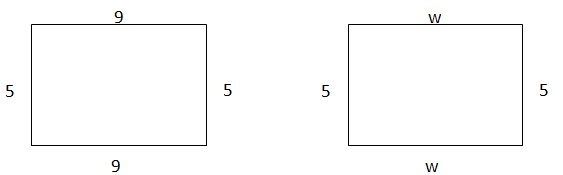
Students are familiar with calculating the area and perimeter of figures like the one on the left before they are introduced to variables. Later, they may see the same figure with the addition of a variable, as shown on the right. The addition of the variable will come with new instructions as well.

caitlin3

The difficulty of problems using variables is determined by the information given in the problems. For instance, the problem on the right can be a one step equation if an area and perimeter are given so that students only need to solve for w. The difficulty can be increased by giving only a perimeter so that students must solve for w and then for the area.

Thoughts on 1/7 and other rational numbers (Part 10)

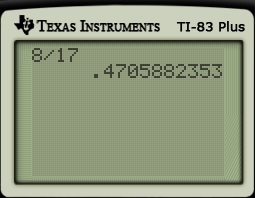
In the previous post, I showed a quick way of obtaining a full decimal representation using a calculator that only displays ten digits at a time. To review: here’s what a TI-83 Plus returns as the (approximate) value of 8/17:

TI817

Using this result and the Euler totient function, we concluded that the repeating block had length 16. So we multiply twice by 10^8 (since 10^8 \times 10^8 = 10^{16}) to deduce the decimal representation, concluding that
\displaystyle \frac{8}{17} = 0.\overline{4705882352941176}

TI817b

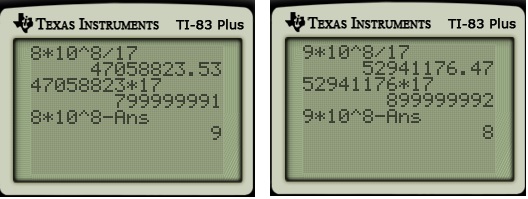
Though this is essentially multi-digit long division, most students are still a little suspicious of this result on first exposure. So here’s a second way of confirming that we did indeed get the right answer. The calculators show that

8 \times 10^8 = 17 \times 47058823 + 9 and 9 \times 10^8 = 17 \times 52941176 + 8

Therefore,

8 \times 10^{16} = 17 \times (47058823 \times 10^8) + 9 \times 10^8 and 9 \times 10^8 = 17 \times 52941176 + 8

so that

8 \times 10^{16} = 17 \times (47058823 \times 10^8) + 17 \times 52941176 + 8

8 \times 10^{16} = 17 \times 4705882352941176 + 8

8 \times 10^{16} - 8 = 17 \times 4705882352941176

8 (10^{16}-1) = 17 \times 4705882352941176

\displaystyle \frac{8}{17} = \displaystyle \frac{4705882352941176}{10^{16}-1}

Using the rule for dividing by 10^k -1, we conclude that

\displaystyle \frac{8}{17} = 0.\overline{4705882352941176}

Thoughts on 1/7 and other rational numbers (Part 9)

Let’s now consider the decimal representation of \displaystyle \frac{8}{17}.

TI817

There’s no obvious repeating pattern. But we know that, since 17 has neither 2 nor 5 as a factor, that there has to be a repeating decimal pattern.

So… what is it?

When I ask this question to my students, I can see their stomachs churning a slow dance of death. They figure that the calculator didn’t give the answer, and so they have to settle for long division by hand.

That’s partially correct.

However, using the ideas presented below, we can perform the long division extracting multiple digits at once. Through clever use of the calculator, we can quickly obtain the full decimal representation even though the calculator can only give ten digits at a time.

green line

Let’s now return to where this series began… the decimal representation of \displaystyle \frac{1}{7} using long division. As shown below, the repeating block has length 6, which can be found in a few minutes with enough patience. By the end of this post, we’ll consider a modification of ordinary long division that facilitates the computation of really long repeating blocks.
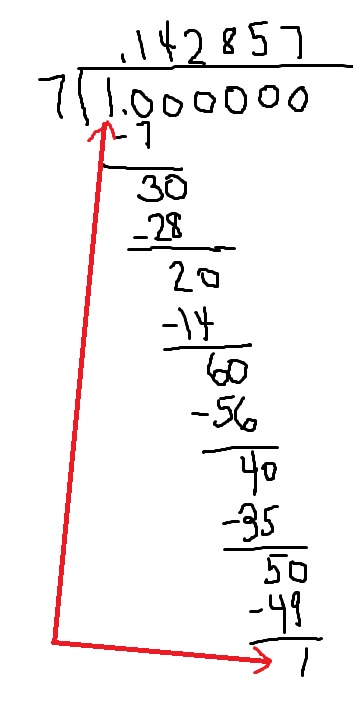
longdivision17

Because we arrived at a repeated remainder, we know that we have found the repeating block. So we can conclude that \displaystyle \frac{1}{7} = 0.\overline{142857}.

Students are taught long division in elementary school and are so familiar with the procedure that not much thought is given to the logic behind the procedure. The underlying theorem behind long division is typically called the division algorithm. From Wikipedia:

Given two integers a and b, with b \ne 0, there exist unique integers q and r such that a = bq+r and $0 \le r < |b|$,  where |b| denotes the absolute value of b.

The number q is typically called the quotient, while the number r is called the remainder.

Repeated application of this theorem is the basis for long division. For the example above:

Step 1.

10 = 1 \times 7 + 3. Dividing by 10, 1 = 0.1 \times 7 + 0.3

Step 2.

30 = 4 \times 7 + 2. Dividing by 100, 0.3 = 0.04 \times 7 + 0.02

Returning to the end of Step 1, we see that

1 = 0.1 \times 7 + 0.3 = 0.1 \times 7 + 0.04 \times 7 + 0.02 = 0.14 \times 7 + 0.02

Step 3.

20 = 2 \times 7 + 6. Dividing by 1000, 0.02 = 0.002 \times 7 + 0.006

Returning to the end of Step 2, we see that

1 = 0.14 \times 7 + 0.02 = 0.14 \times 7 + 0.0002 \times 7 + 0.006 = 0.142 \times 7 + 0.006

And so on.

green line

By adding an extra zero and using the division algorithm, the digits in the decimal representation are found one at a time. That said, it is possible (with a calculator) to find multiple digits in a single step by adding extra zeroes. For example:

Alternate Step 1.

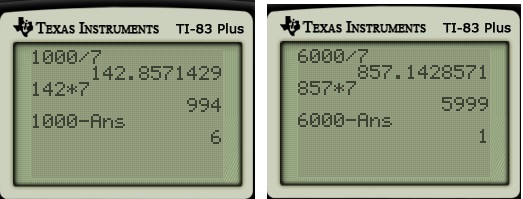
1000 = 142 \times 7 + 6. Dividing by 1000, 1 = 0.142 \times 7 + 0.006

Alternate Step 2.

6000 = 587 \times 7 + 1. Dividing by 100000, 0.006 = 0.000587 \times 7 + 0.000001

Returning to the end of Alternate Step 1, we see that

1 = 0.142 \times 7 + 0.006= 0.142 \times 7 + 0.000587\times 7 + 0.000001 = 0.142857 \times 7 + 0.000001

So, with these two alternate steps, we arrive at a remainder of 1 and have found the length of the repeating block.

The big catch is that, if a = 1000 or a = 6000 and b = 7, the appropriate values of q and r have to be found. This can be facilitated with a calculator. The integer part of 1000/7 and 6000/7 are the two quotients needed above, and subtraction is used to find the remainders (which must be less than 7, of course).

TI17

At first blush, it seems silly to use a calculator to find these values of q and r when a calculator could have been used to just find the decimal representation of 1/7 in the first place. However, the advantage of this method becomes clear when we consider fractions who repeating blocks are longer than 10 digits.

green lineLet’s now return to the question posed at the top of this post: finding the decimal representation of \displaystyle \frac{8}{17}. As noted in Part 6 of this series, the length of the repeating block must be a factor of \phi(17), where \phi is the Euler toitent function, or the number of integers less than 17 that are relatively prime with 17. Since 17 is prime, we clearly see that \phi(17) = 16. So we can conclude that the length of the repeating block is a factor of 16, or either 1, 2, 4, 8, or 16.

Here’s the result of the calculator again:

TI817

We clearly see from the calculator that the repeating block doesn’t have a length less than or equal to 8. By process of elimination, the repeating block must have a length of 16 digits.

Now we perform the division algorithm to obtain these digits, as before. This can be done in two steps by multiplying by 10^8 = 100,000,000.

TI817b

So, by the same logic used above, we can conclude that

\displaystyle \frac{8}{17} = 0.\overline{4705882352941176}

In other words, through clever use of the calculator, the full decimal representation can be quickly found even if the calculator itself returns only ten digits at a time… and had rounded the final 2941176 of the repeating block up to 3.

Thoughts on 1/7 and other rational numbers (Part 8)

In Part 6 of this series, I mentioned the following fact concerning the decimal representation of \displaystyle \frac{a}{b}: if neither 2 nor 5 is a factor of b, then the repeating block in the decimal representation of \displaystyle \frac{a}{b} has a length k that must be a factor of \phi(b). This function is the Euler toitent function or the number of integers less than b that are relatively prime with b.

In this post, I’d like to provide a justification for this theorem.

As discussed earlier, k is the least integer so that b is a factor of 10^k - 1. In the language of congruence, k is the least integer so that

10^k \equiv 1 (\mod b)

In other words, let G_b be the multiplicative group of numbers less than b that are relatively prime with b. By assumption 10 \in G_b. Then k is the order of 10 in G_b, and there’s a theorem that states that the order of an element of a group must be a factor of the order of the group, or the number of elements in the group. In our case, the order of G_b is the number of integers less than b that are relatively prime with b, or \phi(b).

In other words, using these ideas from group theory, we can prove that k \mid \phi(b).

green line

Naturally, we don’t expect middle school students seeing long division for the first time to appreciate this property of decimal representations. Still, my main purpose in writing this post was to give a concrete example of how ideas from higher-level mathematics — like group theory — actually can shed insight into ideas that are first seen in school — even middle school. In other words, there’s a reason why UNT (and other universities) requires that college students who want to earn mathematics teaching certification with their degrees must have a major in mathematics.