Engaging students: Adding and subtracting decimals

In my capstone class for future secondary math teachers, I ask my students to come up with ideas for engaging their students with different topics in the secondary mathematics curriculum. In other words, the point of the assignment was not to devise a full-blown lesson plan on this topic. Instead, I asked my students to think about three different ways of getting their students interested in the topic in the first place.

I plan to share some of the best of these ideas on this blog (after asking my students’ permission, of course).

This student submission comes from my former student Elizabeth (Markham) Atkins. Her topic, from Pre-Algebra: adding and subtracting decimals.

green line

Applications

Adding and subtracting decimals is a fun subject to learn about. Decimals are everywhere in the world! Sports use decimals when timing people. Let’s try this problem: “Billy Joe ran a lap in 61.7 seconds the first time and 59.3 seconds the second time. How long did both laps take Billy Joe?” We use decimals to measure rainfall. “On Monday it rained a total of 1.27 inches, measured in a rain gauge. By Tuesday .23 inches had evaporated. Tuesday night’s big storm gave us another 3.58 inches. How much rain was in the rain gauge after Tuesday’s big storm?” We also use decimals with money! “Let’s say you found a lost cat. You return it to its owner for a reward of $50.00.Then you receive your allowance of $50.00. You then get your pay check from work which states you earned $108.75 for a week after taxes were taken out. It’s been a good week! You decide to spend a little money. You put $10.03 of gas in your car. You then by three items: Shoes ($51.99), jeans ($71.27) and gun ($0.97). How much do you have left?”


green line

Technology

 Technology is an awesome tool that we have to use to engage your students. On YouTube there is a song called the decimal song about how to add, subtract, multiply, and divide decimals. There is also a website where you can buy mathematical songs like his YouTube hit the Rappin’ Mathematician Decimals. He has a catchy way to grab student’s attention and they still learn. Technology can be used to enhance a lesson, an anchor video for example. Many website provide games. Mathgamesfun.net is a good example. Calculators are not a good enhancement tool because students can simply have the calculator do all the work for them. Calculators are a good technology to use to check a student’s work! Math.harvard.edu provides examples of math in movies. This way a student can see how math is used in the world. Learnalberta.ca/content/mesg.html/math6web/index.html?page=lessons&lesson=m6lessonshell01.swf is a website devoted to fractions. Another good technology for the teacher’s advantage is kaganonline.com. It is a website of different tools to use when teaching mathematics!


green line

Curriculum

Decimals, along with fractions, numbers, and other basics, are a key foundational mathematical stepping stone to schooling and in life. Students will use math every day of their lives. In their science classes students will use decimals in measurement, weights, and time. Also when the student learns about scientific notation, they will use decimals. Students will use decimals to answer half-life questions. Decimals are used in economy. All of economy deals with money. Money deals with decimals. When learning about the stock market they use decimals. When looking at the mileage on their car, they use decimals. Students will have to learn decimals to help with percentages, sales, interest, sales tax, loans, and any sort of measurements in everyday life. Percentages are just decimals with a fancy symbol. If the students want to save money they need to know how to add and subtract decimals. Decimals are all around us we just have to teach the students how to see and use them!

Factors

I thought my daughter would have been a little older than 7 before she asked me a math question that I couldn’t immediately answer. I was wrong. Here was her question, asked innocently over breakfast one morning:
72 has 12 factors, and 12 is also a factor of 72. How many numbers are there that are like that?
It took me about 15 minutes before I could definitely give her an answer.
Rather than spoiling the fun for my readers, I’ll just leave this one unanswered and let you think about it.
green_speech_bubble

Engaging students: Finding points in the coordinate plane

In my capstone class for future secondary math teachers, I ask my students to come up with ideas for engaging their students with different topics in the secondary mathematics curriculum. In other words, the point of the assignment was not to devise a full-blown lesson plan on this topic. Instead, I asked my students to think about three different ways of getting their students interested in the topic in the first place.

I plan to share some of the best of these ideas on this blog (after asking my students’ permission, of course).

This student submission comes from my former student Derek Skipworth. His topic, from Pre-Algebra: finding points in the coordinate plane.

green line

A. Applications – How could you as a teacher create an activity or project that involves your topic?

When I think of the coordinate plane, one of the first things that come to mind is mapping.  When I think of my teenage years, I think of how I always wanted more money.  By using these two ideas together, an activity could easily be created to get the students involved in the lesson: a treasure map!

The first part of the activity would be providing the students with a larger grid.  Then provide them with a list of landmarks/items at different locations (i.e. skull cave at (3,2)) that would then be mapped onto the grid.  By starting out with one landmark, you could also build off previously identified landmarks, such as “move 3 units East and 4 units North to find the shipwreck.  The shipwreck is located at what coordinates?”   These steps could also be based off generic formulas with solutions for x and y.  After all landmarks were identified, there would be a guide below that would trace out a path to find the treasure, which is only discovered after the full path is completed.

treasuremapCourtesy of paleochick.blogspot.com

green line

B. Curriculum: How can this topic be used in your students’ future courses in mathematics or science?

One of the good things about the exercise above is that it integrates several different ideas into one. A big one that stands out to me is following procedures.  This is vital once you get into high school sciences.  By building the map step-by-step, which each one building off the previous step, you cannot find the treasure without replicating the map exactly if you miss/misinterpret a step along the way.

As far as the coordinate plane, finding locations on the plane is important when graphing functions.  Being able to find the intercepts and any asymptotes gives you starting points to work with.  From there you generally only need a few more points to create a line of the function based off plotted points.  This also has applications in science/math when creating bar graphs/line graphs and similar graphs.

green line

D.  How was this topic adopted by the mathematical community?

As discussed in my Geometry class this semester (Krueger), the Cartesian plane opened up a lot of doors in the world of Geometry.  Euclid had already established a great working knowledge of a vast amount of Geometric ideas and figures.  One thing he did not establish was length.  In his teachings, there were relative terms such as “smaller than” or “larger than”.  No values were ever assigned to his figures though.  By introducing the Cartesian plane (and in effect, being able to plot points on said plane), we were able to actually assign values to these figures and advance our mathematical knowledge.  The Cartesian plane acts as a bridge between Algebra and Geometry that did not exist before.  Because of this, we can know solve problems based in Geometry without ever even needing to draw the figure in the first place (example: Pythagorean Theorem).

8th grade exam from 1912

An 8th grade exam from Bullitt County, Kentucky. I’m not sure about the other subject areas, but it seems to me that the standards for arithmetic for those 8th grades are approximately in line with what we expect of pre-algebra students today.

Of course, the students of 1912 didn’t have access to scientific calculators.

Source: http://www.bullittcountyhistory.com/bchistory/schoolexam1912.html

Solutions: http://www.bullittcountyhistory.com/bchistory/schoolexam1912ans.html

bcschoolexam1912sm

Engaging students: Powers and exponents

In my capstone class for future secondary math teachers, I ask my students to come up with ideas for engaging their students with different topics in the secondary mathematics curriculum. In other words, the point of the assignment was not to devise a full-blown lesson plan on this topic. Instead, I asked my students to think about three different ways of getting their students interested in the topic in the first place.

I plan to share some of the best of these ideas on this blog (after asking my students’ permission, of course).

This student submission comes from my former student Kelsie Teague. Her topic, from Pre-Algebra: powers and exponents.

green line

What interesting word problem using this topic can your students do now?

For the topic of powers and exponents I want to bring in the idea of money, and doubling a salary. The word problem I would give them to start with and to get them thinking would be this:

Two companies were offering you a job. Company A is offering you a salary of $1,000 a day for 30 days and Company B is offering you a salary of $2 the first day and it doubles each day after that for 30 days. Which job is the better offer?

Since this is just my engage problem I’m not expecting them to be able to tell me that the answer is Company B because the answer is 2^{31}-2, but I am hoping they can get to the point of at least knowing that Company B will be paying the most. I want to get his or her attention and everyone loves money.

green line

How can this topic be used in your students’ future courses in Mathematics or Science?

I believe powers and exponents are important knowledge because students will be using them for the rest of their math career. This comes up when teaching functions, learning the graphs of functions, trig, pre-calculus, Calculus and etc. Powers and exponents are used extensively in algebra and it is important that students have a strong understand of how and why they work before continuing onto those higher classes. For example, when you have x^3, and talking about graphing a cubic function or x^2 and how it makes a parabola, and also when talking about factoring. If you have (x-2)^2 = (x-2)(x-2) =(x^2 -4x +4), students need to understand what it means to ^2 something.  Once students get to calculus that also use exponents and powers when doing derivatives and integrals. This isn’t a topic that is only based in math, it is also something used in science, engineering, and physics. Once students start college, no matter their major they will be taking at least one class that require some sort of knowledge with exponents and powers.
green line

What interesting things can you say about the people who contributed to the discovery and/or the development of this topic?

The earliest exponents came from the Babylonians. The number system was extremely different from modern mathematics. The earliest known mention of Babylon was mentioned on a tablet found around 23rd century BC. Even then they were messing with the concept of exponents.

I would show my students this picture and explain to them what the symbols mean and ask them if they feel any better about doing math in modern times rather than working with these symbols to add, subtract, divide, exponents, power and doing equations. This also shows that this concept has been around for many thousands of years and something that is obviously very important if we still use it in modern math. I might also bring up the website least below that talks about modern exponents and works backwards and talks about where they came from to give the students more depth in this knowledge.

Babylonian square

http://www.ehow.com/about_5134780_history-exponents.html

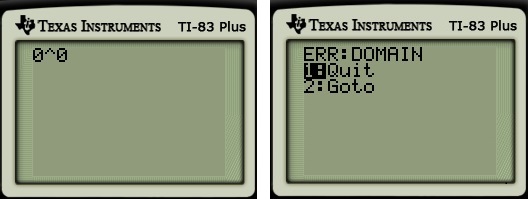
Why 0^0 is undefined

TI00

Here’s an explanation for why 0^0 is undefined that should be within the grasp of pre-algebra students:

Part 1.

  • What is 0^3? Of course, it’s 0.
  • What is 0^2? Again, 0.
  • What is 0^1? Again, 0.
  • What is 0^{1/2}, or \sqrt{0}? Again, 0.
  • What is 0^{1/3}, or \sqrt[3]{0}? In other words, what number, when cubed, is 0? Again, 0.
  • What is 0^{1/10}, or \sqrt[10]{0}? In other words, what number, when raised to the 10th power, is 0. Again, 0.

So as the exponent gets closer to 0, the answer remains 0. So, from this perspective, it looks like 0^0 ought to be equal to 0.

Part 2.

  • What is 3^0. Of course, it’s 1.
  • What is 2^0. Again, 1.
  • What is 1^0. Again, 1.
  • What is \left( \displaystyle \frac{1}{2} \right)^0? Again, 1
  • What is \left( \displaystyle \frac{1}{3} \right)^0. Again, 1
  • What is \left( \displaystyle \frac{1}{10} \right)^0? Again, 1

So as the base gets closer to 0, the answer remains 1. So, from this perspective, it looks like 0^0 ought to be equal to 1.

In conclusion: looking at it one way, 0^0 should be defined to be 0. From another perspective, 0^0 should be defined to be 1.

Of course, we can’t define a number to be two different things! So we’ll just say that 0^0 is undefined — just like dividing by 0 is undefined — rather than pretend that 0^0 switches between two different values.

green line

Here’s a more technical explanation about why 0^0 is an indeterminate form, using calculus.

Part 1. As before,

\displaystyle \lim_{x \to 0^+} 0^x = \lim_{x \to 0^+} 0 = 0.

The first equality is true because, inside of the limit, x is permitted to get close to 0 but cannot actually equal 0, and there’s no ambiguity about 0^x = 0 if x >0. (Naturally, 0^x is undefined if x < 0.)

The second equality is true because the limit of a constant is the constant.

Part 2. As before,

\displaystyle \lim_{x \to 0} x^0 = \lim_{x \to 0} 1 = 1.

Once again, the first equality is true because, inside of the limit, x is permitted to get close to 0 but cannot actually equal 0, and there’s no ambiguity about x^0 = 1 if x \ne 0.

As before, the answers from Parts 1 and 2 are different. But wait, there’s more…

Part 3. Here’s another way that 0^0 can be considered, just to give us a headache. Let’s evaluate

\displaystyle \lim_{x \to 0^+} x^{1/\ln x}

Clearly, the base tends to 0 as x \to 0. Also, \ln x \to \infty as x \to 0^+, so that \displaystyle \frac{1}{\ln x} \to 0 as x \to 0^+. In other words, this limit has the indeterminate form 0^0.

To evaluate this limit, let’s take a logarithm under the limit:

\displaystyle \lim_{x \to 0^+} \ln x^{1/\ln x} = \displaystyle \lim_{x \to 0^+} \frac{1}{\ln x} \cdot \ln x

\displaystyle \lim_{x \to 0^+} \ln x^{1/\ln x} = \displaystyle \lim_{x \to 0^+} 1

\displaystyle \lim_{x \to 0^+} \ln x^{1/\ln x} = 1

Therefore, without the extra logarithm,

\displaystyle \lim_{x \to 0^+} x^{1/\ln x} = e^1 = e

Part 4. It gets even better. Let k be any positive real number. By the same logic as above,

\displaystyle \lim_{x \to 0^+} x^{\ln k/\ln x} = e^{\ln k} = k

So, for any k \ge 0, we can find a function f(x) of the indeterminate form 0^0 so that \displaystyle f(x) = k.

In other words, we could justify defining 0^0 to be any nonnegative number. Clearly, it’s better instead to simply say that 0^0 is undefined.

P.S. I don’t know if it’s possible to have an indeterminate form of 0^0 where the answer is either negative or infinite. I tend to doubt it, but I’m not sure.

Engaging students: Finding prime factorizations

In my capstone class for future secondary math teachers, I ask my students to come up with ideas for engaging their students with different topics in the secondary mathematics curriculum. In other words, the point of the assignment was not to devise a full-blown lesson plan on this topic. Instead, I asked my students to think about three different ways of getting their students interested in the topic in the first place.

I plan to share some of the best of these ideas on this blog (after asking my students’ permission, of course).

This student submission comes from my former student Roderick Motes. His topic, from Pre-Algebra: finding prime factorizations.

green line

A) How could you as a teacher create an activity or project that involves your topic?

 “The magic words are squeamish ossifage”

-Plaintext decode of the RSA-196 challenge in the 1994 issue of Scientific American

Prime factorizations are an interesting topic. Being that prime factorization was a part of number theory which was, for several hundred years, considered the “last bastion of pure mathematics” we can often find it a struggle to relate the problem to students. But prime factorizations have found a use very recently.

In 1977 a paper was published submitting a possible encryption algorithm for computers that takes two very large prime numbers, multiplies them, and uses this to generate a key-value pair to make your information more secure. This encryption algorithm is currently the backbone of internet data exchange.

For students you can craft an activity around this ideas, framing them as being secret agents trying to hide data, that uses a naïve version of the RSA algorithm in order to generate keys. Even if you didn’t want the RSA algorithm you could use the idea of multiplying primes to generate some kind of cipher scheme which is not complex, and then use that. Students could be put into groups for the project and given a message which is encoded, and then they need to try and break it.

Clearly it would be untenable to give the students exceedingly large numbers but as a consequence of the fundamental theorem of arithmetic you can use smaller primes and still have unique cipher keys (2*5 is a perfectly valid key in RSA, as is 5*7, you can extend things to be 2*3*2 even.) You don’t have to use RSA cryptography, but it’s a good talking point. This could be an excellent project I think, but you as a teacher would need to take much time carefully building up everything to make sure students can do it.

green line

B) How can this topic be used in your student’s future math and science courses?

This is a pretty difficult question for anything involving number theory but prime factorizations, as discussed above, are of particular interest to students who plan to take computer science. Understanding how things become cryptographically secure and implementation of the RSA algorithm and various cracking algorithms would not be out of place in an upper level high school comp. sci. course.

green line

C) What interesting things can you say about the people who contributed to the discovery and/or development of this topic over time?

Number theory is hugely important to the history of mathematics as one of the oldest and most accessible areas of mathematical study. To look into the history of number theory is to look into the history of math itself. Prime factorization is an interesting part of number theory because primes are an interesting part of number theory.

In 300 BCE Euclid wrote Elements, largely considered to be one of in not the most important math book ever published. In Elements Euclid compiled what he knew to be the modern understanding of geometry, but he went a bit further as well. He discusses at length and eventually gives formal proof of, the fundamental theorem of arithmetic. The whole basis of the fundamental theorem is that numbers are either prime or composite, and if a number is composite we can break it down into primes (through Prime Factorization!)

For thousands of years number theory was considered a lofty subject, and finding prime factorizations would have been a mental workout akin to our doing Sudoku or Crossword puzzles. It wasn’t until we started creating machines that could count (and eventually machines that could connect us to countless videos of small, fluffy animals sneezing) that we found a practical use for prime factorization.

We noted that factoring big primes takes a while, students should have cursory familiarity with this idea, and created RSA cryptography based on this. Every now and again the RSA foundation would offer prize money for people to attempt to factorize some really big numbers. Prime factorization is even worth money (the RSA challenge in 1997 offered a $200k prize for factoring something around RSA-380.)

Engaging students: Laws of Exponents

In my capstone class for future secondary math teachers, I ask my students to come up with ideas for engaging their students with different topics in the secondary mathematics curriculum. In other words, the point of the assignment was not to devise a full-blown lesson plan on this topic. Instead, I asked my students to think about three different ways of getting their students interested in the topic in the first place.

I plan to share some of the best of these ideas on this blog (after asking my students’ permission, of course).

This student submission comes from my former student Claire McMahon. Her topic, from Pre-Algebra: the Laws of Exponents (with integer exponents) green line

These laws are essential not only in math classes but in science classes as well.  The laws of exponents are essential when learning scientific notation and important facts like Avogadro’s constant.  This is just one of the important facts that students will encounter as they enter the world of exponents.  There is a really awesome lesson plan devoted to finding this enormous number at the following website here.  I implemented this in a classroom that called for an interdisciplinary lesson plan and had great success with it.

green line

There are some really cool videos that deal with the laws of exponents and I love to incorporate music wherever I can in my math classes.  This is one of my favorite videos that I came across as I was trying to reach for things to help engage my students in the middle of math class.  Watch this YouTube video and see if you think you would enjoy showing this to your class.  Even better for your class would be to create a video like this in a project.

green line

I love to also find some great online activities that I can give to my students that are not too intensive but give them some great confidence in understanding.  There are a few different websites that I have found to be very useful and somewhat cute!!  I do want my students to have a basic understanding on how the laws of exponents work but we all get better at math by DOING math.  This website gives you some great practice on laws of exponents with the same base and has a cute little monster to cheer you on along the activity!  I am also a big fan of foldables and have found a great one on the internet to utilize for your class.  It’s always fun to create something in math class that you would normally do in kindergarten!!  Cutting and folding and making something your own is an awesome way to drive a topic and even to make a homework assignment fun.  A foldable for the laws of exponents can be found here.

Engaging students: The field axioms

In my capstone class for future secondary math teachers, I ask my students to come up with ideas for engaging their students with different topics in the secondary mathematics curriculum. In other words, the point of the assignment was not to devise a full-blown lesson plan on this topic. Instead, I asked my students to think about three different ways of getting their students interested in the topic in the first place.

I plan to share some of the best of these ideas on this blog (after asking my students’ permission, of course).

This student submission again comes from my former student Maranda Edmonson. Her topic, from Pre-Algebra: the field axioms of arithmetic (the distributive law, the commutativity and associativity of addition and multiplication, etc.).

green line

B. Curriculum: How can this topic be used in your students’ future courses in mathematics or science?

It is safe to say that the field axioms are used in all mathematics classes once they are introduced. As students, we know them to be rules for how to simplify or expand expressions, solving equations, or just manipulating numbers and expressions. As instructors, we know them to be a solid foundation for further mathematical understanding. “In mathematics or logic, [an axiom is] an unprovable rule or first principle accepted to be true because it is self-evident or particularly useful” (Merriam-Webster.com). Is the distributive property not useful? Isn’t the associative property self-evident? We learn these axioms, master them during the first lesson we encounter them, and they stick with us. Why? Because they are obvious “rules” that we use and apply to all aspects of mathematics. They are a foundation on which we, as instructors, wish to build upon a greater mathematical understanding.

green line

B. Curriculum: How does this idea extend what your students should have learned in previous courses?

When students first begin to learn addition they are learning the associative property as well. Think about it – when kids learn about the expanded form of a number, they are already seeing that when you add more than two numbers together they equal the same thing, no matter what order they are being added in. For example:

1,458 = 1,000 + 400 + 50 + 8 = (1,000 + 400) + (50 + 8) = (1,000 + 50) + (400 + 8)

and so on. Kids tend to add numbers in the order that they are given. However, when they start learning little tricks (say, their tens facts), then they will start seeing how the numbers work together. For example: 3 + 4 + 7 soon becomes (3 + 7) + 4. Then, when students get into higher grades and begin learning multiplication, the commutative property becomes a real focus. When they are learning their multiplication facts, students are faced with $5 \times 7$ one minute, then 7 \times 5 the next. They start seeing that it does not matter what order the numbers are in, but that when two numbers are being multiplied together, they will equal the same product each time.

green line

E. Technology: How can technology be used to effectively engage students with this topic?

Math and music are always a good combination. Honestly, who doesn’t hum “Pop! Goes the Weasel” every time they need to use the quadratic formula? This YouTube video (the link is below) is of some students singing a song about the associative, commutative and distributive properties. The video is difficult to hear unless you turn the volume up, and the quality is not the greatest. However, the students in the video get the point across about what the axioms are and that they only apply to addition and multiplication.  Note that you only need to watch the first three minutes of the video. The last minute and a half or so is irrelevant to the axioms themselves.

Full lesson plan: Designing a model solar system

Over the summer, I occasionally teach a small summer math class for my daughter and her friends around my dining room table. Mostly to preserve the memory for future years… and to provide a resource to my friends who wonder what their children are learning… I’ll write up the best of these lesson plans in full detail.

This was a fun activity that took a couple of hours: designing a model Solar System. I chose the scale so that most of the planets would fit on a straight section of sidewalk near my house; of course, the scale could be changed to fit the available space.

For my particular audience of students, I also worked through the basics of the metric system as well as decimals.

This lesson plan is written in a 5E format — engage, explore, explain, elaborate, evaluate — which promotes inquiry-based learning and fosters student engagement.

Model Solar System Handout

Model Solar System Lesson

Post Assessment

P.S. For what it’s worth, the world’s largest model solar system can be found in Sweden.