Poorly worded homework problems

A personal pet peeve of mine are grade-school homework problems that are extremely poorly worded, thus leading to unnecessary confusion and bewilderment in students who (sadly) are already confused and bewildered more often than they (or we) would like. Here are two examples that I’ve seen recently.

(1) A worksheet gives the numbers 144 and 300 with the instructions “Find all of the ways to multiply to make each product. First, find the ways with two factors, and then find ways to multiply with more than two factors.”

The second half of the instructions can easily be interpreted by a child to mean “Find all of the ways to write 144 and 300 as a product with more than two factors.” This reading of the question (probably not intended by the author) will take even a gifted child a really, really long time to complete. Furthermore, I’m a professional mathematician, and even I have no idea off the top of my head if there’s an easy formula for the number of ways that a number can be expressed with an arbitrary number of factors greater than 1.

(2) A rocket blasts off. At 10.0 seconds after blast off, it is at 10,000 feet, traveling at 3600 mph. Assuming the direction is up, calculate the acceleration.

I assume that the author was trying to be cute by adding the “it is at 10,000 feet” part of the problem. Or the author wants the student to develop skill at weeding out unnecessary information (like the height) and identifying just the important information (the final velocity and the time) to calculate the quantity of interest.

But it’s aggravating that the information in the problem is not consistent, so there is no solution. In other words, it’s impossible for a rocket to travel with constant acceleration at travel 10000 feet at 3600 mph 10 seconds later.

To begin,

3600 \displaystyle \frac{\hbox{mile}}{\hbox{hour}} = 3600 \displaystyle \frac{\hbox{mile}}{\hbox{hour}} \times \displaystyle \frac{\hbox{5280 feet}}{\hbox{1 mile}} \times \displaystyle \frac{\hbox{1 hour}}{\hbox{3600 seconds}} = 5280\displaystyle \frac{\hbox{feet}}{\hbox{second}}.

Therefore, the (presumably constant) acceleration is

\displaystyle \frac{5280 \hbox{~feet/second}}{10 \hbox{~seconds}} = 528 \hbox{~feet/second}^2.

However, using calculus, we can compute the height of the rocket by integrating twice:

v(t) = \int 528 \, dt = 528t + v_0 = 528t

y(t) = \int 528t \, dt = 264t^2 + y_0 = 264t^2

Therefore, the height of the rocket after 10 seconds is y(10) = 26,400, not the 10,000 feet given in the problem.

Engaging students: Square Roots

In my capstone class for future secondary math teachers, I ask my students to come up with ideas for engaging their students with different topics in the secondary mathematics curriculum. In other words, the point of the assignment was not to devise a full-blown lesson plan on this topic. Instead, I asked my students to think about three different ways of getting their students interested in the topic in the first place.

I plan to share some of the best of these ideas on this blog (after asking my students’ permission, of course).

This student submission again comes from my student Allison Metzler. Her topic, from Pre-Algebra: square roots.

green line

A2. How could you as a teacher create an activity or project that involves your topic?

The following activity, http://ispeakmath.org/2012/05/03/square-roots-with-cheez-its-and-a-graphic-organizer/, effectively engages students because it’s hands-on and allows the students to work together. The students would start with their own cheez-its, creating the smaller squares (1, 4,9). Then, they would work in groups by combining their cheez-its to make bigger squares. Eventually, they would come together as a class to see how big of a square they could create. This involves square roots because each time the student would create a square (assuming they know the properties of a square), they would see that the square root would equal the base of the square. Also, they would see that the base of a square could be any of its four sides because they are all congruent or equal. Thus, the reasoning behind the name, “square root”, would become more apparent. Because they wouldn’t have a calculator as a resource, this visual method of teaching would give the students a more efficient way of calculating square roots. This activity is an effective way to get the students to remember the concept of square roots because it involves food, it’s hands-on, and they’ll learn a visual method of calculating square roots.

green line

D4. What are the contributions of various cultures to this topic?

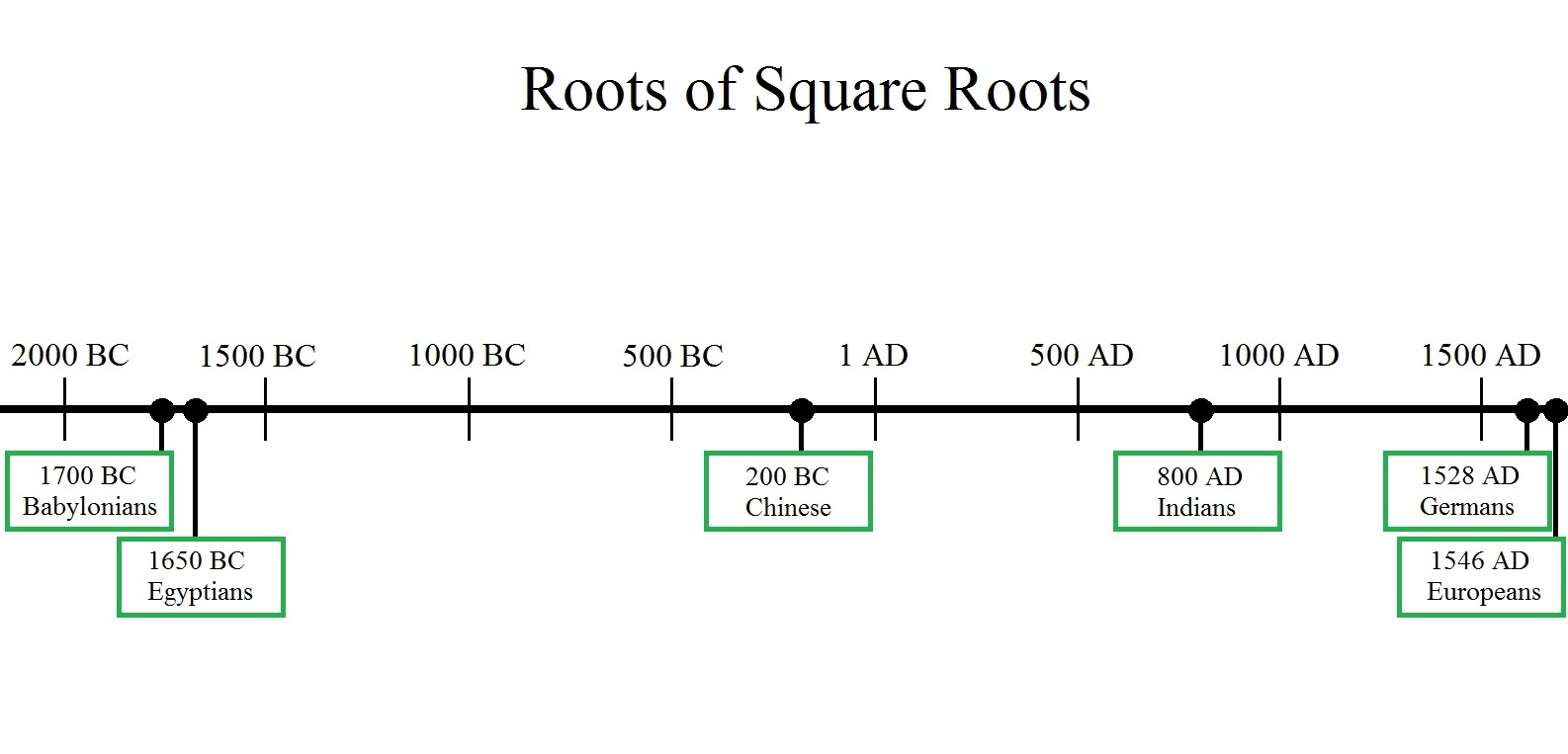
Many cultures have contributed to the concept of square roots. From 1800 BC to 1600 BC, the Babylonians created a clay tablet proving 2^1/2 and 30*2^1/2 using a square crossed by two diagonals. Within that time (1650 BC), a copy of an earlier work showed how the Egyptians extracted square roots. From 202 BC to 186 BC, the Chinese text Writings on Reckoning described a means to approximate the square roots of two and three. In the 9th century, the Indian mathematician Mahāvīra stated that square roots of negative numbers do not exist. Then, in 1546, Cantaneo introduced the idea of square roots to Europeans. The last major contribution to the concept of square roots was in 1528 when the German mathematician, Christoph Rudolff, introduced the modern root symbol in print for the first time.

To present this to the students, I would use the following timeline and proceed to briefly mention what each culture contributed to the topic of square roots.

Square Root Timelinegreen line

E1. How can technology (YouTube, Khan Academy [khanacademy.org], Vi Hart, Geometers Sketchpad, graphing calculators, etc.) be used to effectively engage students with this topic?

The video, https://www.youtube.com/watch?v=AfBQGLowyKU, uses Elvis’s (You’re So Square) Baby I Don’t Care and recreates it with lyrics relating to square roots. This video not only accurately describes the main components of square roots, but also includes actual examples of perfect squares and square roots. It points out that the square root is the inverse of the square of a number. It also describes the base and the exponent which are directly related to the square root. Because the video is based off an actual song, it should effectively engage students and help them remember it since it’s catchy. Also, it is a great way to introduce the topic to the students where they want to know more, but aren’t overwhelmed with the amount of new information.

green lineReferences:

Banta, Willy, prod. Think I’m a Square, Baby I Don’t Care. Perf. Elvis Presley. YouTube, 2011. Web. <http://www.youtube.com/watch?v=AfBQGLowyKU&gt;.

Reulbach, Julie. “Square Roots with Cheez-Its and a Graphic Organizer.” I Speak Math., 3 May 2012. Web. <http://ispeakmath.org/2012/05/03/square-roots-with-cheez-its-and-a-graphic-organizer/&gt;.

“Square Root.” Wikipedia. Wikipedia Foundation Inc., 10 Jan. 2014. Web. <http://en.wikipedia.org/wiki/Square_root#History&gt;.

For your enjoyment:

HungerGamesSquareRoot

Checking if a number is a multiple of 7

I just read a couple of nice tricks for checking if a number is divisible by 7. There are standard divisibility tests for 2, 3, 4, 5, 6, 8, 9, 10, 11, and 12, but checking a number is divisible by 7 is somewhat more difficult. But these two tricks make the task more manageable. The proofs for these tricks can be found in the given links.

Method #1, from http://www.arscalcula.com/mental_math_divisibility_tests.shtml: Add multiples of 7 to get a multiple of 10, and then lop off the 0.

Here’s how it goes: You want to see whether, say, 11352 is divisible by 7 . To do this, first you either add or subtract a mutiple of 7 until you get a number ending in 0 . So in the case of 11352 , I would add 28 to get 11380 .

Now whack off the last zero, and repeat! So 11380 goes to 1138 . From that I subtract 28 to get 1110 , which goes to 111 . To that I add 49 to get 160 , which goes to 16 .Finally: 16 is not divisible by 7 and thus (this is the statement of the test), neither is 11352.

Method #2, from http://www.arscalcula.com/mental_math_divisibility.shtml: Separate the number into two parts: the ones digit, and everything else but the ones digit. Multiply the ones digit by 5, and add to the the second number.

It’s hard to understand what this means without seeing an example. Let n=434. Then 5 \cdot 4+43=63 . Since 63 is divisible by 7 , so is 434.

Engaging students: Finding least common multiples

In my capstone class for future secondary math teachers, I ask my students to come up with ideas for engaging their students with different topics in the secondary mathematics curriculum. In other words, the point of the assignment was not to devise a full-blown lesson plan on this topic. Instead, I asked my students to think about three different ways of getting their students interested in the topic in the first place.

I plan to share some of the best of these ideas on this blog (after asking my students’ permission, of course).

This student submission comes from my former student Theresa (Tress) Kringen. Her topic, from Pre-Algebra: finding least common multiples.

green line

What interesting word problems using this topic can your students do now?

While having students working on finding the least common multiples I could engage them by having them solve some word problems that would bring up real world problems in a way that they can relate what they learned to problems that deal more than with just numbers. One problem that could be presented ot the students is the following:

If you’re given packages of notebooks that contain 6 each and you are required to repackage them to send them to a school in need in groups of 22, what it the least amount of groups and original packages of notebooks that you can get without any notebooks left over?

In this problem, the students would be required to find the least common multiple of both 6 and 21. Since six doesn’t not go into 22 without a remainder, they would have to find lcm(6,22). Since the least common multiple of both 6 and 22 is 66, the students would have to apply what they know about least common multiples of numbers to figure out the word problem.

To continue with this, the students could then be asked to do the same thing for three numbers.

green line

How does this topic extend what your students should have learned in previous courses?

Students should have covered factors and multiples of numbers around fifth grade. Therefore finding the least common multiple of a number extends the topic from these previous topics. Since students can figure out the factors of a number, they should also know if one number is a factor of the second. If it is, then they will know that the second number is the least common multiple of the two given numbers. Say the students are given 3 and 9. The students should be able to tell right away that 3 goes into 9. Since 3×3=9 and 9×1=9 and since no number smaller than 9 can also be a multiple of nine, the least common multiple of 3 and 9 is 9.

When also looking at the least common multiples of a number, students know what multiples of a number are from previous courses. They will know that 18 is a multiple of nine as well as 27, 36, and 45. Students know that 3 times 9 is 27, but they will also know that since the multiples of 3 are 3, 6, 9, 12, 15, 18, 21, 24, 27, and 30, etc. they will also know that even though 3 times 9 is 27, that there is a number smaller than 27 that is also a common multiple of 3 and 9.

green line

How can technology be used to effectively engage students with this topic?

Students like games and it’s even better for the teacher if they are able to play while they learn or practice a given subject that they have learned. In order to engage each student, there a number of online games students can play to help them practice finding the least common multiples of given numbers. I have found a number of online games that students could go to for an activity. It pushes them, allows the students to go at their own pace, and allows students to be less worried about how fast or slow they are compared to other students.

One game is a timed game that gives the students two numbers to find the least common multiple of. They are given two minutes to see how many they can compute in that amount of time. They are still permitted to go at their own pace, but they are also pushing themselves to do better than the time before.

http://www.basic-mathematics.com/least-common-multiple-game.html

 A second game give the students two numbers and asks for the least common multiple. It is basically multiple choice since they are to select a number our of five or six different numbers. If they select the correct answer, they are permitted to “throw a snowball.” Each correct response helps them win the snowball fight.

http://www.fun4thebrain.com/beyondfacts/lcmsnowball.html


Engaging students: Order of operations

In my capstone class for future secondary math teachers, I ask my students to come up with ideas for engaging their students with different topics in the secondary mathematics curriculum. In other words, the point of the assignment was not to devise a full-blown lesson plan on this topic. Instead, I asked my students to think about three different ways of getting their students interested in the topic in the first place.

I plan to share some of the best of these ideas on this blog (after asking my students’ permission, of course).

This student submission comes from my former student Theresa (Tress) Kringen. Her topic, from Pre-Algebra: order of operations.

green line

How can this topic be used in your students’ future courses in mathematics or science?

Order of operations is commonly used in most mathematics problem that involve more than one operation or when parenthesis are involved. It would be easy to show the students what the answer to a given problem, say 5+20/5, would be when using the proper order of operations, then solve the problem by solving left to right as you would read a book. It is clear, to a math major, that the answer is 9. For someone who does not know the order of operations, they most likely would come up with the answer of 5. The difference in the correct answer and the incorrect answer is only 4, but the problem is only working with numbers less than or equal to twenty. It would then be beneficial to point out that when dealing with more complex problems, that this answer may become even larger.  If the class was working on given problems, I would give them a few word problems to solve. Once they solved them on their own, I would show them that the difference between the correct way to answer the given problem and the incorrect way to answer the problem to help them connect the concept to why it is important to compute answers in the way.

green lineHow does this topic extend what your students should have learned in previous courses?

This topic extends what students should have previously learned by allowing them to use their skills of multiplication, division, exponents, addition, and subtraction to solve more complex problems. When learning how to solve problems more complicated than what they have been given in the past, they use this topic to guide them through to the next step. They must already be familiar with all of the operations by themselves prior to using the order of operations to solve a problem. Once they are accustomed to using the order of operations, the will be given more challenging problems and their math skills will build upon itself. It is clear that if a student is unable to solve a simple problem, such as an exponent problem or a more complicated division problem, they will not be able to use the order of operations for problems that contain what they have not learned.

green line

How did people’s conception of this topic change over time?

It is believed that the idea of using multiplication before addition became a concept adopted around the 1600s and was not disagreed about. The other operations took their place in the order over time, beginning in the 1600s. It seems that although it was not documented well, most mathematicians agreed upon the same order. It wasn’t until books stated being published that it was important to document the order of operations. The notation may have been different depending on who was writing on the subject, but the concept was the same. It seems that although it was not documented well, most mathematicians agreed upon the same order. Once books were being published, the order, PEMDAS (Parenthesis, Exponents, Multiplication, Division, Addition, and Subtraction), was put into print. Now, teachers use the phrase Please Excuse My Dear Aunt Sally as a way for students to remember the acronym and are able to put it to use.

http://jeff560.tripod.com/operation.html

http://mathforum.org/library/drmath/view/52582.html

Engaging students: Powers and exponents

In my capstone class for future secondary math teachers, I ask my students to come up with ideas for engaging their students with different topics in the secondary mathematics curriculum. In other words, the point of the assignment was not to devise a full-blown lesson plan on this topic. Instead, I asked my students to think about three different ways of getting their students interested in the topic in the first place.

I plan to share some of the best of these ideas on this blog (after asking my students’ permission, of course).

This student submission comes from my former student Kayla (Koenig) Lambert. Her topic, from Pre-Algebra: powers and exponents.

green line

A) Applications: What interesting word problems using this topic can your students do now?


I chose the problem below from http://www.purplemath.com because I think that solving a problem that deals with disease would be interesting to my students. People have to deal with sickness and disease everyday and I think that solving a real world problem would entice the students into wanting to learn more.

A biologist is researching a newly-discovered species of bacteria. At time t = 0 hours, he puts one hundred bacteria into what he has determined to be a favorable growth medium. Six hours later, he measures 450 bacteria. Assuming exponential growth, what is the growth constant “k” for the bacteria? (Round k to two decimal places.)

For this exercise, the units on time t will be hours, because the growth is being measured in terms of hours. The beginning amount P is the amount at time t = 0, so, for this problem, P = 100. The ending amount is A = 450 at t = 6. The only variable I don’t have a value for is the growth constant k, which also happens to be what I’m looking for. So I’ll plug in all the known values, and then solve for the growth constant:

A = Pe^{kt}

450 = 100 e^{6k}

4.5 = e^{6k}

\ln(4.5) = 6k

k = \displaystyle \frac{\ln(4.5)}{6} = 0.250679566129\dots

The growth constant is 0.25/hour.

I think this kind of problem would be beneficial to students because it would help them understand how bacteria grows and how easily they can get catch something and get sick.


green line

C) Culture: How has this topic appeared in pop culture?

Exponents and powers are everywhere around us without the students knowledge. Many movies and video games have ideas related to powers and exponents. Take, for example, the movie Contagion that was released in September 2011. This movie is about “the threat posed by a deadly disease and an international team of doctors contracted by the CDC to deal with the outbreak” (http://www.imdb.com/title/tt1598778). In this movie, there is a scene where the doctors are using mathematical equations with exponents to find out how fast the disease spreads and how much time they have left to save the majority of the population. There are many movies like this that involve powers and exponents, Contagion is just one example. There are also popular video games that deal with the spread of disease. For example, in the video game Call Of Duty: World At War the player is a soldier in WWII and his mission is to kill zombies, and zombie populations grow exponentially. Now, my brother plays this game and I know for a fact that he doesn’t think about the mathematics behind it, but I think talking about pop culture while teaching would really bring some excitement to the classroom and get the students thinking.


green line

D) History: Who were some of the people who contributed to the discovery of this topic?

Exponents and powers have been among humans since the time of the Babylonians in Egypt. “Babylonians already knew the solution to quadratic equations and equations of the second degree with two unknowns and could also handle equations to the third and fourth degree” (Mathematics History). The Egyptians also had a good idea about powers and exponents around 3400 BC. They used their “hieroglyphic numeral system” which was based on the scale of 10. When using their system, the Egyptians expressed any number using their symbols, with each symbol being “repeated the required number of times” (Mathematics History). However, the first actual recorded use of powers and exponents was in a book called “Artihmetica Integra” written by English author and Mathematician Michael Stifel in 1544 (History of Exponents). In the 14th century Nicole Oresme used “numbers to indicate powering”(Jeff Miller Pages). Also, James Hume used Roman Numerals as exponents in the book L’Algebre de Viete d’vne Methode Novelle in 1636. Exponents were used in modern notation be Rene Descartes in 1637. Also, negative integers as exponents were “first used in modern notation” by Issac Newton in 1676 (Jeff Miller Pages).


Works Cited

Ayers, Chuck. “The History of Exponents | eHow.com.” eHow | How to Videos, Articles & More – Discover the expert in you. | eHow.com. N.p., n.d. Web. 25 Jan. 2012. http://www.ehow.com/about_5134780_history-exponents.html.

“Contagion (2011) – IMDb.” The Internet Movie Database (IMDb). N.p., n.d. Web. 25 Jan. 2012. http://www.imdb.com/title/tt1598778/.

“Exponential Word Problems.” Purplemath. N.p., n.d. Web. 25 Jan. 2012. http://www.purplemath.com/modules/expoprob2.htm.

“Mathematics History.” ThinkQuest : Library. N.p., n.d. Web. 25 Jan. 2012. http://library.thinkquest.org/22584/.

juxtaposition.. “Earliest Uses of Symbols of Operation.” Jeff Miller Pages. N.p., n.d. Web. 25 Jan. 2012. http://jeff560.tripod.com/operation.html.


Engaging students: Solving proportions

In my capstone class for future secondary math teachers, I ask my students to come up with ideas for engaging their students with different topics in the secondary mathematics curriculum. In other words, the point of the assignment was not to devise a full-blown lesson plan on this topic. Instead, I asked my students to think about three different ways of getting their students interested in the topic in the first place.

I plan to share some of the best of these ideas on this blog (after asking my students’ permission, of course).

This student submission comes from my former student Kayla (Koenig) Lambert. Her topic, from Pre-Algebra: solving proportions.

green line

C. Culture: How has this topic appeared in the news?

Solving proportions, or the idea of a proportion being solved, appears in the news more often than not. One specific example that can be used is the effect of the economy on real estate companies. Say we are given 25% of 16 real estate companies that have closed their businesses due to poor economy. We can use proportions to determine the number of real estate companies that closed. We know that the percent is 25 and that the whole is 16. Therefore 25/100 = x/16 which gives us 4 real estate companies that closed (Review of Proportions). Proportions can also be used to determine how many miles we can drive on a certain amount of gas, and gas prices are constantly on the news. Also, this will be relevant to high school students who drive and need to find how much money they need to buy gas for the week, etc.

We can also use proportions to find the unit price of an item at a grocery store, or if an item costs a certain amount, you can find out how many of those items you can buy with a fixed amount of money you have. Buying items and saving money are also all over the news. If you find the unit price you can compare items therefore saving money by buying the item that you get the most out of your money.  Another way solving proportions can appear on the news is by the stock market. You can use proportions to find out how much the stock market will rise in a given amount of days given the current amount of points it has raised in a certain amount of days. Making a proportion problem for students to solve is relatively easy and can be related to anything that is on the news. We can use this to our advantage to get the students to be a little more interested in proportions (and mathematics) so they can see different ways it is related to real life.


green line

D. History: How was this topic adopted by the mathematical community?

The idea of proportions was adopted and used by many in the mathematical community. Proportions were used by Greek writers, including one named Nicomachus, who include proportions and ratios in arithmetic (Math Forum). Proportions were also adopted by Exodus who used them in geometry and by Theon of Smyrna who used proportions in music (Math Forum). In 2000 B.C., the Babylonians adopted proportions to represent place value notation (Pythagoras – Geometrical Algebra). Using proportions was accepted by mathematicians and was used to solve so many different equations used for so many different ideas, and is still used today. Early proportions were adopted by the Egyptians and were used to calculate fractions and measurement of farmland (Mathematics History). Later, proportions were adopted by so many more in the mathematical community like in Greece, China, India, and Babylonia in order to learn geometry. Greeks, like Plato, adopted proportions in order to study them with the Egyptians. I think that proportions were well liked by mathematicians and were adopted by many because you can use proportions to solve so many things.


green line

D. History: How did people’s conception of proportions change over time?

From the beginning, people have used proportions. Early humans used proportions to see if one tribe was twice as large as another or if one leather strap is only half as long as another (Math Forum). It is obvious that the idea solving proportions hasn’t really changed that much, but what we can use proportions to solve has changed. In 2000 B.C. Babylonians used proportions to evolve place value notation by allowing arbitrarily large numbers and fractions to be represented (An Overview of Egyptian Mathematics). Around 1600 B.C. in Egypt, proportions were used to calculate the fraction and superficial measure of farmland (Mathematics History). Egyptians then used proportions to find volumes of cylinders and areas of triangles.

Vitruvius thought of proportions in terms of unit fractions for their architecture calculations (Proportion (architecture)). Also, scribes used “unit fractions” for their calculations in Egypt and Mesopotamia. Egyptians based proportions on parts of their body and their symmetrical relation to each other; like fingers, palms, hands, etc. Multiples of body proportions would be found in the arrangement of fields and buildings people lived in (Proportion (architecture)) and from here, proportions evolved. In 600 B.C., the idea of using proportions evolved and was then used for geometry (Mathematics History). Proportions are still used in geometry, like in architecture and land, like it was 3000 years ago. When you think about it, proportions have evolved, but the use of proportions has evolved even greater. There are so many topics we can now solve using proportions!

Works Cited

“Math Forum – Ask Dr. Math.” The Math Forum @ Drexel University. 7 Mar. 2012. <http://www.mathforum.org/library/drmath/view/64539.html&gt;.

“Mathematics History.” ThinkQuest : Library. 7 Mar. 2012. <http://library.thinkquest.org/22584/&gt;.

“Proportion (architecture).” Wikipedia, the free encyclopedia. 7 Mar. 2012. <http://en.wikipedia.org/wiki/Proportion_%28architecture%29&gt;.

“Review of Proportions.” Self Instructional Mathematics Tutorials. 7 Mar. 2012. <http://www.cstl.syr.edu/fipse/decunit/ratios/revprop.htm&gt;.

“An Overview of Egyptian Mathematics.”  7 Mar. 2012. < http://www-groups.dcs.st-and.ac.uk/~history/HistTopics/Egyptian_mathematics.html >


The Scale of the Universe

My former student Matt Wolodzko tipped me off about this excellent website that shows the scale of the universe, from the very large to the very small: http://htwins.net/scale2/. I recommend it highly for engaging students with the concept of scientific notation.

While I’m on the topic, here are two videos that describe the scale of the universe. The first was a childhood favorite of mine — I vividly remember watching it at the Smithsonian National Air and Space Museum when I was a boy — while the second is more modern.