Let be the proposition “You take a breath at time ,” let be the proposition “You make a move at time ,” let be the proposition “You break a bond at time ,” let be the proposition “You take a step at time ,” and let be the proposition “I watch you at time .” Translate the logical statement
.
This matches the opening lines of this iconic song by The Police.
Context: This semester, I taught discrete mathematics for the first time. Part of the discrete mathematics course includes an introduction to predicate and propositional logic for our math majors. As you can probably guess from their names, students tend to think these concepts are dry and uninteresting even though they’re very important for their development as math majors.
In an effort to making these topics more appealing, I spent a few days mining the depths of popular culture in a (likely futile) attempt to make these ideas more interesting to my students. In this series, I’d like to share what I found. Naturally, the sources that I found have varying levels of complexity, which is appropriate for students who are first learning prepositional and predicate logic.
When I actually presented these in class, I either presented the logical statement and had my class guess the statement in actual English, or I gave my students the famous quote and them translate it into predicate logic. However, for the purposes of this series, I’ll just present the statement in predicate logic first.
Let $p$ be the proposition “I am around you,” and let be the proposition “ will harm you.” Translate the logical statement
.
This matches the opening lines of this wonderful song from the musical Sweeney Todd.
Context: This semester, I taught discrete mathematics for the first time. Part of the discrete mathematics course includes an introduction to predicate and propositional logic for our math majors. As you can probably guess from their names, students tend to think these concepts are dry and uninteresting even though they’re very important for their development as math majors.
In an effort to making these topics more appealing, I spent a few days mining the depths of popular culture in a (likely futile) attempt to make these ideas more interesting to my students. In this series, I’d like to share what I found. Naturally, the sources that I found have varying levels of complexity, which is appropriate for students who are first learning prepositional and predicate logic.
When I actually presented these in class, I either presented the logical statement and had my class guess the statement in actual English, or I gave my students the famous quote and them translate it into predicate logic. However, for the purposes of this series, I’ll just present the statement in predicate logic first.
Let be the proposition “ is a business,” and let be the proposition “ is like .” Translate the logical statement
.
This matches the showstopper from Annie Get Your Gun:
Context: This semester, I taught discrete mathematics for the first time. Part of the discrete mathematics course includes an introduction to predicate and propositional logic for our math majors. As you can probably guess from their names, students tend to think these concepts are dry and uninteresting even though they’re very important for their development as math majors.
In an effort to making these topics more appealing, I spent a few days mining the depths of popular culture in a (likely futile) attempt to make these ideas more interesting to my students. In this series, I’d like to share what I found. Naturally, the sources that I found have varying levels of complexity, which is appropriate for students who are first learning prepositional and predicate logic.
When I actually presented these in class, I either presented the logical statement and had my class guess the statement in actual English, or I gave my students the famous quote and them translate it into predicate logic. However, for the purposes of this series, I’ll just present the statement in predicate logic first.
This was right up my alley: a mash-up of mathematical physics and musical theater to pay tribute to William Rowan Hamilton, developer of quaterions and one of the founders of quantum physics.
Decathlon, which at the Olympics is a men’s event, is composed of 10 events: the 100 meters, long jump, shot put, high jump, 400 meters, 110-meter hurdles, discus throw, pole vault, javelin throw and 1,500 meters. Heptathlon, a women’s event at the Olympics, has seven events: the 100-meter hurdles, high jump, shot put, 200 meters, long jump, javelin throw and 800 meters…
As it stands, each event’s equation has three unique constants — $latex A$, $latex B$ and $latex C$— to go along with individual performance, $latex P$. For running events, in which competitors are aiming for lower times, this equation is: $latex A⋅(B–P)^C$, where $latex P$ is measured in seconds…
is effectively a baseline threshold at which an athlete begins scoring positive points. For performances worse than that threshold, an athlete receives zero points.
For field events, in which competitors are aiming for greater distances or heights, the formula is flipped in the middle: $latex A⋅(P–B)^C$, where $latex P$ is measured in meters for throwing events and centimeters for jumping and pole vault.
Specifically, for the decathlon jumping events ( is measured in centimeters):
High jump:
Pole vault:
Long jump:
For the decathlon throwing events ( is measured in meters):
Shot put: .
Discus: .
Javelin: .
Specifically, for the heptathlon jumping events ( is measured in centimeters):
High jump:
Long jump:
For the heptathlon throwing events ( is measured in meters):
Shot put: .
Javelin: .
I’m sure there are good historical reasons for why these particular constants were chosen, but suffice it to say that there’s nothing “magical” about any of these numbers except for human convention. From FiveThirtyEight:
The [decathlon/heptathlon] tables [devised in 1984] used the principle that the world record performances of each event at the time should have roughly equal scores but haven’t been updated since. Because world records for different events progress at different rates, today these targets for WR performances significantly differ between events. For example, Jürgen Schult’s 1986 discus throw of 74.08 meters would today score the most decathlon points, at 1,384, while Usain Bolt’s 100-meter world record of 9.58 seconds would notch “just” 1,203 points. For women, Natalya Lisovskaya’s 22.63 shot put world record in 1987 would tally the most heptathlon points, at 1,379, while Jarmila Kratochvílová’s 1983 WR in the 800 meters still anchors the lowest WR points, at 1,224.
FiveThirtyEight concludes that, since the exponents in the running events are higher than those for the throwing/jumping events, it behooves the elite decathlete/heptathlete to focus more on the running events because the rewards for exceeding the baseline are greater in these events.
Finally, since all of the exponents are not integers, a negative base (when the athlete’s performance wasn’t very good) would actually yield a complex-valued number with a nontrivial imaginary component. Sadly, the rules of track and field don’t permit an athlete’s score to be a non-real number. However, if they did, scores might look something like this…
Under the category of “Somebody Had To Figure It Out,” Dr. Andrew Simoson of King University (Bristol, Tennessee) used calculus to determine the shape of the island of Utopia in the 500-year-old book by Sir Thomas More based on the description of island given in the book’s introduction.
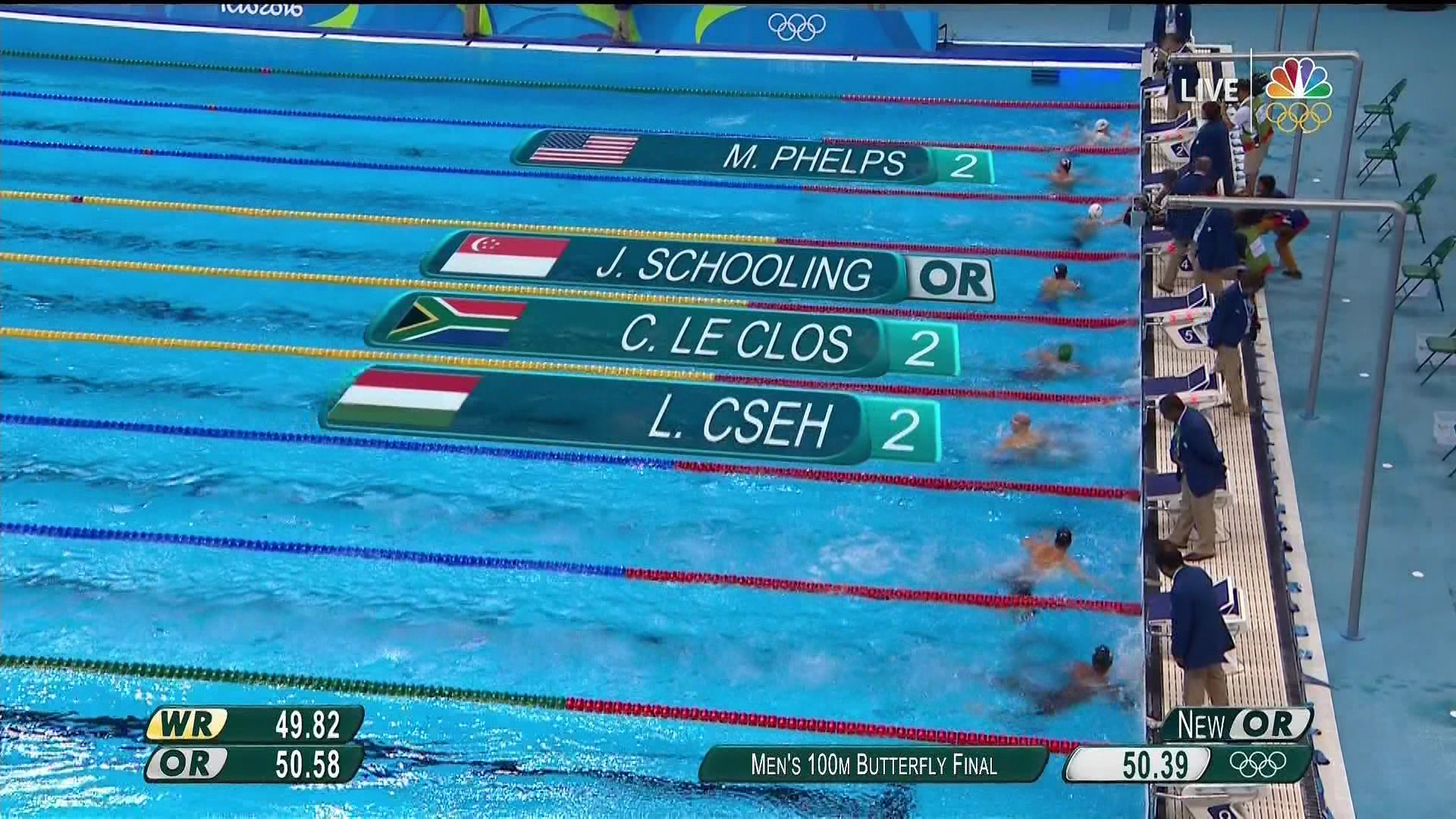
In 1972, Sweden’s Gunnar Larsson beat American Tim McKee in the 400m individual medley by 0.002 seconds. That finish led the governing body to eliminate timing by a significant digit. But why?
In a 50 meter Olympic pool, at the current men’s world record 50m pace, a thousandth-of-a-second constitutes 2.39 millimeters of travel. FINA pool dimension regulations allow a tolerance of 3 centimeters in each lane, more than ten times that amount. Could you time swimmers to a thousandth-of-a-second? Sure, but you couldn’t guarantee the winning swimmer didn’t have a thousandth-of-a-second-shorter course to swim. (Attempting to construct a concrete pool to any tighter a tolerance is nearly impossible; the effective length of a pool can change depending on the ambient temperature, the water temperature, and even whether or not there are people in the pool itself.)

be the proposition “You take a breath at time
,” let
be the proposition “You make a move at time
be the proposition “You break a bond at time
be the proposition “You take a step at time
be the proposition “I watch you at time
.

 be the proposition “
 will harm you.” Translate the logical statement
 .
. be the proposition “
 be the proposition “
 .” Translate the logical statement
 .
.
 is measured in seconds):
 .
. .
. .
. .
. .
. .
. .
.


 .
. .
. .
.

 .
. .
.