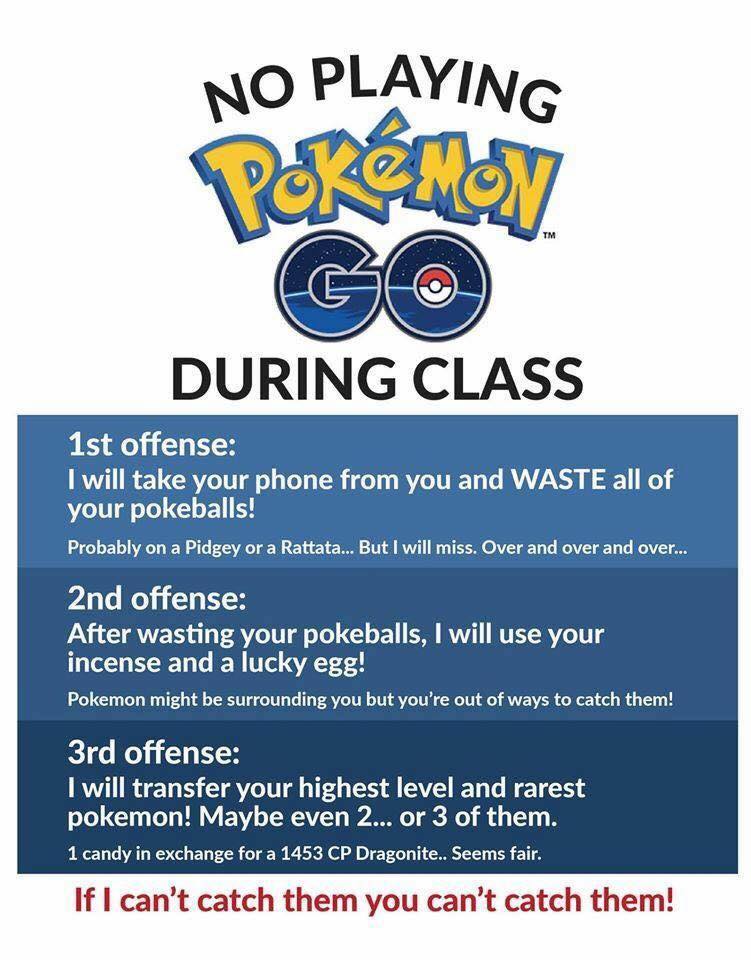
This is definitely going on my course syllabus this semester:
Source: https://www.facebook.com/PokeGoMemePage/photos/a.249688652081224.1073741827.249683562081733/260297621020327/?type=3&theater
This is definitely going on my course syllabus this semester:
Source: https://www.facebook.com/PokeGoMemePage/photos/a.249688652081224.1073741827.249683562081733/260297621020327/?type=3&theater
Let
measure how well
can do
. Translate the logical statement
.
This needs no further introduction:
Context: This semester, I taught discrete mathematics for the first time. Part of the discrete mathematics course includes an introduction to predicate and propositional logic for our math majors. As you can probably guess from their names, students tend to think these concepts are dry and uninteresting even though they’re very important for their development as math majors.
In an effort to making these topics more appealing, I spent a few days mining the depths of popular culture in a (likely futile) attempt to make these ideas more interesting to my students. In this series, I’d like to share what I found. Naturally, the sources that I found have varying levels of complexity, which is appropriate for students who are first learning prepositional and predicate logic.
When I actually presented these in class, I either presented the logical statement and had my class guess the statement in actual English, or I gave my students the famous quote and them translate it into predicate logic. However, for the purposes of this series, I’ll just present the statement in predicate logic first.
Let
be the proposition “
happens at time
,” let
be the proposition “
is a valley,” let
be the proposition “
is a mountain,” let
be the proposition “
must scale
at time
,” let
be the proposition “
are perilous waters,” and let
be the proposition “
must sail
at time
.” Translate the logical statement
.
This matches the second half of the opening verse of the showstopper “Into The Fire” from the musical The Scarlet Pimpernel.
I also recommend Steve Amerson’s rendition:
Context: This semester, I taught discrete mathematics for the first time. Part of the discrete mathematics course includes an introduction to predicate and propositional logic for our math majors. As you can probably guess from their names, students tend to think these concepts are dry and uninteresting even though they’re very important for their development as math majors.
In an effort to making these topics more appealing, I spent a few days mining the depths of popular culture in a (likely futile) attempt to make these ideas more interesting to my students. In this series, I’d like to share what I found. Naturally, the sources that I found have varying levels of complexity, which is appropriate for students who are first learning prepositional and predicate logic.
When I actually presented these in class, I either presented the logical statement and had my class guess the statement in actual English, or I gave my students the famous quote and them translate it into predicate logic. However, for the purposes of this series, I’ll just present the statement in predicate logic first.
Let
be the proposition “You need $latex x.” Translate the logical statement

.
This matches the title of one of the Beatles’ greatest hits.
Context: This semester, I taught discrete mathematics for the first time. Part of the discrete mathematics course includes an introduction to predicate and propositional logic for our math majors. As you can probably guess from their names, students tend to think these concepts are dry and uninteresting even though they’re very important for their development as math majors.
In an effort to making these topics more appealing, I spent a few days mining the depths of popular culture in a (likely futile) attempt to make these ideas more interesting to my students. In this series, I’d like to share what I found. Naturally, the sources that I found have varying levels of complexity, which is appropriate for students who are first learning prepositional and predicate logic.
When I actually presented these in class, I either presented the logical statement and had my class guess the statement in actual English, or I gave my students the famous quote and them translate it into predicate logic. However, for the purposes of this series, I’ll just present the statement in predicate logic first.
Let
be the proposition “
is on your side” and let
be the proposition “
is alone.” Translate the logical statement
.
Of course, this matches the last two lines of “No One Is Alone,” which was released as a movie in 2014.
I’m personally partial to Steve Amerson’s rendition of this song:
Context: This semester, I taught discrete mathematics for the first time. Part of the discrete mathematics course includes an introduction to predicate and propositional logic for our math majors. As you can probably guess from their names, students tend to think these concepts are dry and uninteresting even though they’re very important for their development as math majors.
In an effort to making these topics more appealing, I spent a few days mining the depths of popular culture in a (likely futile) attempt to make these ideas more interesting to my students. In this series, I’d like to share what I found. Naturally, the sources that I found have varying levels of complexity, which is appropriate for students who are first learning prepositional and predicate logic.
When I actually presented these in class, I either presented the logical statement and had my class guess the statement in actual English, or I gave my students the famous quote and them translate it into predicate logic. However, for the purposes of this series, I’ll just present the statement in predicate logic first.
Let
be the proposition “You have
,” let
be the proposition “You have
to lose,” let $p$ be the proposition “You’re invisible now,” and let
be the proposition “
is a secret to conceal.” Translate the logical statement
.
This matches the last two lines of the closing verse of this classic from Bob Dylan.
Context: This semester, I taught discrete mathematics for the first time. Part of the discrete mathematics course includes an introduction to predicate and propositional logic for our math majors. As you can probably guess from their names, students tend to think these concepts are dry and uninteresting even though they’re very important for their development as math majors.
In an effort to making these topics more appealing, I spent a few days mining the depths of popular culture in a (likely futile) attempt to make these ideas more interesting to my students. In this series, I’d like to share what I found. Naturally, the sources that I found have varying levels of complexity, which is appropriate for students who are first learning prepositional and predicate logic.
When I actually presented these in class, I either presented the logical statement and had my class guess the statement in actual English, or I gave my students the famous quote and them translate it into predicate logic. However, for the purposes of this series, I’ll just present the statement in predicate logic first.
Let
be the proposition “
needs a place to rest,” let
be the proposition “
wants to have a home,” and let
be the proposition “
wants to be alone.” Translate the logical statement
.
This matches three of the lines in the closing verse of one Bruce Springsteen’s great hits from the 1980s.
Context: This semester, I taught discrete mathematics for the first time. Part of the discrete mathematics course includes an introduction to predicate and propositional logic for our math majors. As you can probably guess from their names, students tend to think these concepts are dry and uninteresting even though they’re very important for their development as math majors.
In an effort to making these topics more appealing, I spent a few days mining the depths of popular culture in a (likely futile) attempt to make these ideas more interesting to my students. In this series, I’d like to share what I found. Naturally, the sources that I found have varying levels of complexity, which is appropriate for students who are first learning prepositional and predicate logic.
When I actually presented these in class, I either presented the logical statement and had my class guess the statement in actual English, or I gave my students the famous quote and them translate it into predicate logic. However, for the purposes of this series, I’ll just present the statement in predicate logic first.
Let
be the proposition “
is at night” and let
be the proposition “I could have danced at time
.” Translate the logical statement
.
This needs no further introduction:
I also really enjoyed this (she made the finals of Britain’s Got Talent in 2009):
Context: This semester, I taught discrete mathematics for the first time. Part of the discrete mathematics course includes an introduction to predicate and propositional logic for our math majors. As you can probably guess from their names, students tend to think these concepts are dry and uninteresting even though they’re very important for their development as math majors.
In an effort to making these topics more appealing, I spent a few days mining the depths of popular culture in a (likely futile) attempt to make these ideas more interesting to my students. In this series, I’d like to share what I found. Naturally, the sources that I found have varying levels of complexity, which is appropriate for students who are first learning prepositional and predicate logic.
When I actually presented these in class, I either presented the logical statement and had my class guess the statement in actual English, or I gave my students the famous quote and them translate it into predicate logic. However, for the purposes of this series, I’ll just present the statement in predicate logic first.
Let
be the proposition “Jeremiah was a bullfrog,” let
be the proposition “Jeremiah was a good friend of mine,” let
be the proposition “
is a word,” let
be the proposition “Jeremiah said
at time
,” let
be the proposition “I understood
at time
,” let
be the proposition “I helped Jeremiah drink his wine,” let
be the proposition “
is mighty fine wine,” and let
be the proposition “Jeremiah had
at time
.” Translate the logical statement
,
where time 0 is now.
Of course, this matches the opening verse of one of the classics of the 1970s.
Context: This semester, I taught discrete mathematics for the first time. Part of the discrete mathematics course includes an introduction to predicate and propositional logic for our math majors. As you can probably guess from their names, students tend to think these concepts are dry and uninteresting even though they’re very important for their development as math majors.
In an effort to making these topics more appealing, I spent a few days mining the depths of popular culture in a (likely futile) attempt to make these ideas more interesting to my students. In this series, I’d like to share what I found. Naturally, the sources that I found have varying levels of complexity, which is appropriate for students who are first learning prepositional and predicate logic.
When I actually presented these in class, I either presented the logical statement and had my class guess the statement in actual English, or I gave my students the famous quote and them translate it into predicate logic. However, for the purposes of this series, I’ll just present the statement in predicate logic first.
Let
be the proposition “You said at time
that we’d still be friends at time
.” Translate the logical statement
.
This matches the last line of the first chorus from “If You Leave.”
For what it’s worth, this was the opening song on the Pretty in Pink soundtrack, which remains for my money the best movie soundtrack ever made.
Context: This semester, I taught discrete mathematics for the first time. Part of the discrete mathematics course includes an introduction to predicate and propositional logic for our math majors. As you can probably guess from their names, students tend to think these concepts are dry and uninteresting even though they’re very important for their development as math majors.
In an effort to making these topics more appealing, I spent a few days mining the depths of popular culture in a (likely futile) attempt to make these ideas more interesting to my students. In this series, I’d like to share what I found. Naturally, the sources that I found have varying levels of complexity, which is appropriate for students who are first learning prepositional and predicate logic.
When I actually presented these in class, I either presented the logical statement and had my class guess the statement in actual English, or I gave my students the famous quote and them translate it into predicate logic. However, for the purposes of this series, I’ll just present the statement in predicate logic first.