Snell’s Law and a mystery novel

Lately, for my own leisure reading, I’ve been enjoying the murder-mystery novels of Dorothy Sayers. Her books are an enjoyable trip back in time, as she paints a very vivid portrait of English life of during the interwar years of the 1920s and 1930s. (Of course, at the time she was writing, no one had any idea that the Great War would not actually be the war to end all wars, as was the popular sentiment of the time.) Indeed, her first novel was published literally a century ago in 1923. The lead character, Lord Peter Wimsey (back then, the aristocracy was still part of English culture), has a distinctive way of speaking that makes the novels so delightful. A hallmark of the Sayers novels is that she didn’t merely write whodunit stories; instead, she strove to write novels in which a detective story happens to happen.

As an aside, I learned in her novel Gaudy Night that the adjective Oxonian means “related to Oxford,” which led me to further learn that my hometown of Oxon Hill, Maryland was so named because somebody, centuries ago, thought that the landscape of that part of the state reminded him of Oxford, England. While that comparison might have been reasonable centuries ago, it certainly would raise eyebrows today.

Anyway, with all that as background, in her story Unnatural Death, the following figure depicts an aerial view of a witness’s testimony at a key point in the story. I think I can describe this much of the scene without giving away the plot: the witnesses stood just inside the door of elderly Miss Dawson’s bedroom. A screen blocked direct observation of Miss Dawson as she lay in bed, but the witnesses could see Miss Dawson in the mirror.
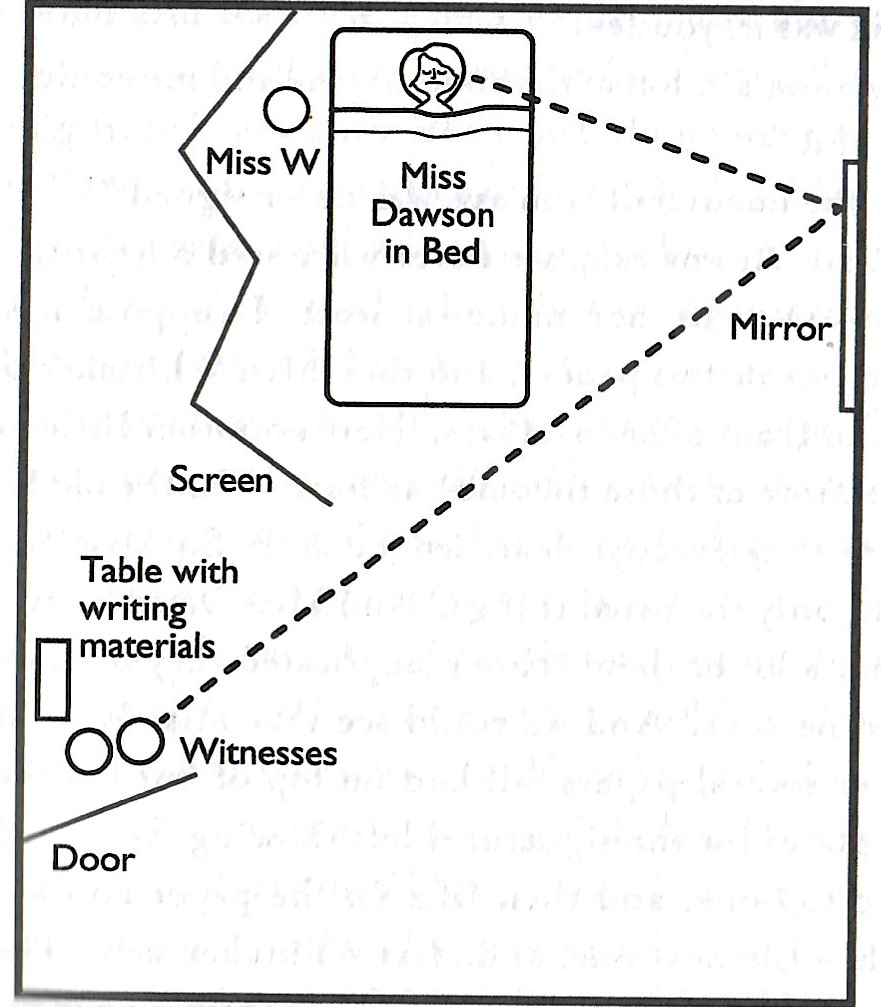
As I read the novel, I immediately noticed that the mirror in the figure was not a perfect reflector… at the mirror, the angles of reflection of the dashed path of light are quite different. Indeed, I pulled out my protractor: the angle where the word “Mirror” is located has a measure of about 52 degrees, while the opposite reflected angle has a measure of about 72 degrees.

As this is was part of a murder-mystery novel, I thought: what could be the cause of this disparity? To be a good detective, any explanation, no matter how implausible, must be thought of and reasoned out.

One explanation of the different angles is that, somehow, the speed of light changed in the room. This is the same principle behind Snell’s Law, which explains the refraction of light as it travels between air and water. Since the speed of light in air (c_1) is different than the speed of light in water (c_2), the angle of incidence (\theta_1) is different from the angle of refraction (\theta_2), but they are related through the formula

\displaystyle \frac{\sin \theta_1}{c_1} = \frac{\sin \theta_2}{c_2}.

This relationship occurs because of Fermat’s principle, which says that light always travels in a path that requires the least amount of time. Ordinarily, this means that light travels in a straight line. However, if the speed of light should change (say, when traveling through both air and water), then the path of the light is refracted.

Fermat’s principle also explains why light reflects at equal angles if the speed of light is constant (as amusingly illustrated in this PBS video by Dianna Cowern, a.k.a. Physics Girl). However, if the speed of light should somehow change in the room at the point where the light reflects, then the light would bounce at a different angle for the same reason that Snell’s Law works.

In this case, the angles \theta_1 and \theta_2 are complementary to the 52-degree and 72-degree angles, respectively. By the cofunction trigonometric identities, this means that

\sin \theta_1 = \cos 52^\circ \quad and \quad \sin \theta_2 = \cos 72^\circ,

so that Snell’s Law can be rewritten as
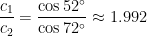
\displaystyle \frac{c_1}{c_2} = \frac{\cos 52^\circ}{\cos 72^\circ} \approx 1.992.

In other words, one explanation for the unusual path of light is that the speed of light was almost exactly twice as fast in one part of room than in the other part… and the exact threshold of this change occurred at the point where the light hit the mirror. Perhaps there was some kind of fog, mist, or other contaminant in the air near poor Miss Dawson that was so thick that light slowed to half its usual speed. So that’s one explanation.

The other explanation, of course, is that the artist who drew the picture just did a lousy job depicting the reflected light.

As this was part of a murder-mystery, both options are still open to investigation. (Yes, that was tongue-in-cheek.)

For what it’s worth, the figure in my book was not exactly the same as Sayers’ original drawing — clearly, modern word processing was used that was unavailable in the 1930s. One of these days, I may visit the Wade Center in Wheaton, Illinois, which has an impressive collection of Sayers’ works, to peruse a first-run printing of Unnatural Death to see if the figure in my book is faithful to the one that appeared when the novel was first published.
An algebra and trigonometry–based proof of Kepler’s First Law

The proofs of Kepler’s Three Laws are usually included in textbooks for multivariable calculus. So I was very intrigued when I saw, in the Media Reviews of College Mathematics Journal, that somebody had published a proof of Kepler’s First Law that only uses algebra and trigonometry. Let me quote from the review:

Kepler’s first law states that bounded planetary orbits are elliptical. This law is presented in introductory textbooks, but the proof typically requires intricate integrals or vector analysis involving an accidental degeneracy. Simha offers an elementary proof of Kepler’s first law using algebra and trigonometry at the high school level.

https://doi.org/10.1080/07468342.2022.2026089

Once upon a time, I taught Precalculus for precocious high school students. I wish I had known of this result back then, as it would have been a wonderful capstone to their studies of trigonometry and the conic sections.

The preprint of this result can be found on arXiv. (The proof only addresses Kepler’s First Law and not the Second and Third Laws.) The actual article, for those with institutional access, was published in American Journal of Physics Vol. 89 No. 11 (2021): 1009-1011.

Engaging students: Vectors in two dimensions

In my capstone class for future secondary math teachers, I ask my students to come up with ideas for engaging their students with different topics in the secondary mathematics curriculum. In other words, the point of the assignment was not to devise a full-blown lesson plan on this topic. Instead, I asked my students to think about three different ways of getting their students interested in the topic in the first place.

I plan to share some of the best of these ideas on this blog (after asking my students’ permission, of course).

This student submission comes from my former student Fidel Gonzales. His topic, from Precalculus: vectors in two dimensions.

green line

How can this topic be used in your students’ future courses in mathematics?

When a student learns about vectors in two dimensions, they worry about the magnitude of the vector and the direction that it goes. The direction is kept within its limitations which are up, down, left, and right. A student might be curious as to how this topic can be extended further. The way it extends further is by extending vectors into higher dimensions. It is even possible to extend vectors to the sixth dimension! However, for the sake of showing how vectors in two dimensions extend to future courses in math, we will stick to three-dimensions. Learning about vectors in the second dimension creates groundwork to learn about vectors in the third dimension. With the third dimension, vectors could be seen from our point of view compared to seeing it in the two dimensions on paper. The new perspective of the third dimension in vectors includes up, down, left, right, forward, and backwards. Having the new dimension to account for will give students a bigger tie into how mathematics applies into the real world.

green line

How has this topic appeared in pop culture (movies, TV, current music, video games, etc.)?

Vectors in the two dimension is used all around our everyday life and we as people rarely notice it. The most common use of vectors in our culture is a quantity displaying a magnitude and direction. This is normally done on a x and y graph. Now you might be asking yourself, I do not play any types of games that sound like this. I am here to tell you that you do. One game that iPhone users play without noticing this would be a game on gamepigeon called knockout. The game appears to be an innocent game of knocking out your friends’ penguins while keeping yours in the designated box. However, math is involved, and you probably didn’t notice. First you must anticipate where the enemy is going. Then you must decide how strong you want to launch your penguin troopers without making them fall out of the ring. Does that sound familiar? Having to apply a force (magnitude) and direction to a quantity. Congratulations, you have now had fun doing math. Next time you are playing a game, try to see if there is any involvement of vectors in two dimensions involved.green line

How could you as a teacher create an activity or project that involves your topic?

Vectors in two dimensions has many ways to be incorporated in the classroom. A way to do so while connecting to the real world would be having an activity where the students tell a robot where to go using vectors. The students will have a robot that can walk around and in need of directions. The students will be given maps and asked to create a path for the robot to end up in its destination. Essentially, programming the robot to navigate though a course solely using vectors. If the robot falls or walks too far, then the student will realize that either the magnitude was wrong or the direction. Some students might seem to think this would be impractical to the real world, however, there is always a way to show relevance to students. Towards the end of the activity, the students will be asked to guide me to around the class using vectors. Then to sweeten the deal, they will also be asked to show me on a map being projected to them how to get to McDonald’s. Students will realize that vectors in the second dimension could be used to give directions to somewhere and can be applied to everyday life.  They will walk outside of the classroom seeing math in the real world from a different perspective.

References:

https://www.khanacademy.org/science/physics/two-dimensional-motion/two-dimensional-projectile-mot/v/visualizing-vectors-in-2-dimensions

Engaging students: Computing the cross product of two vectors

In my capstone class for future secondary math teachers, I ask my students to come up with ideas for engaging their students with different topics in the secondary mathematics curriculum. In other words, the point of the assignment was not to devise a full-blown lesson plan on this topic. Instead, I asked my students to think about three different ways of getting their students interested in the topic in the first place.

I plan to share some of the best of these ideas on this blog (after asking my students’ permission, of course).

This student submission comes from my former student Chi Lin. Her topic, from Precalculus: computing the cross product of two vectors.

green line

How could you as a teacher create an activity or project that involves your topic?

I found one of the real-life examples of the cross product of two vectors on a website called Quora. One person shares an example that when a door is opened or closed, the angular momentum it has is equal to r \times p, where p is the linear momentum of the free end of the door being opened or closed, and r is the perpendicular distance from the hinges on which the door rotates and the free end of the door. This example gives me an idea to create an example about designing a room. I try to find an example that closes to my idea and I do find an example. Here is the project that I will design for my students. “If everyone here is a designer and belongs to the same team. The team has a project which is to design a house for a client. Your manager, Mr. Johnson provides a detail of the master room to you and he wants you to calculate the area of the master room to him by the end of the day. He will provide every detail of the master room in three-dimension design paper and send it to you in your email. In the email, he provides that the room ABCD with \vec{AB} = \langle -2,2,5 \rangle and \vec{AD} = \langle 5,6,3 \rangle. Find the area of the room  (I will also draw the room (parallelogram ABCD) in three dimensions and show students).”

Reference:

https://www.quora.com/What-are-some-daily-life-examples-of-dot-and-cross-vector-products

https://www.nagwa.com/en/videos/903162413640/

green line


How does this topic extend what your students should have learned in previous courses?

This topic is talking about computing cross product of two vectors in three dimensions. First, students should have learned what a vector is. Second, students should know how to represent vectors and points in space and how to distinguish vectors and points. Notice that when students try to write the vector in space, they need to use the arrow. Next, since we are talking about how to distinguish the vectors and the points, here students should learn the notations of vectors and what each notation means. For example, \vec{v} = 1{\bf i} + 2 {\bf j} + 3 {\bf k}. Notice that 1{\bf i} + 2 {\bf j} + 3 {\bf k} represents the vectors in three dimensions. After understanding the definition of the vectors, students are going to learn how to do the operation of vectors. They start with doing the addition and scalar multiplication, and magnitude. One more thing that students should learn before learning the cross product which is the dot product. However, students should understand and master how to do the vector operation before they learn the dot product since the dot product is not easy. Students should have learned these concepts and do practices to make sure they are familiar with the vector before they learn the cross products.

References:

https://www.khanacademy.org/math/multivariable-calculus/thinking-about-multivariable-function/x786f2022:vectors-and-matrices/a/vectors-and-notation-mvc

https://www.khanacademy.org/math/multivariable-calculus/thinking-about-multivariable-function/x786f2022:vectors-and-matrices/a/dot-products-mvc

green line

How did people’s conception of this topic change over time?

Most people have the misconception that the cross product of two vectors is another vector. Also, the majority of calculus textbooks have the same misconception that the cross product of two vectors is just simply another vector. However, as time goes on, mathematicians and scientists can explain by starting from the perspective of dyadic instead of the traditional short‐sighted definition. Also, we can represent the multiplication of vectors by showing it in a geometrical picture to prove that encompasses both the dot and cross products in any number of dimensions in terms of orthogonal unit vector components. Also, by using the way that the limitation of such an entity to exactly a three‐dimensional space does not allow for one of the three metric motions (reflection in a mirror). We can understand that the intrinsic difference between true vectors and pseudo‐vectors.

Reference:

https://www.tandfonline.com/doi/abs/10.1080/0020739970280407

Parabolic Properties from Pieces of String

I am pleased to announce that my latest paper, “Parabolic Properties from Pieces of String,” has now been published in Math Horizons. This was a really fun project for me. As I describe in the paper, I started wondering if it was possible to convince a student who hadn’t learned calculus yet that string art from two line segments traces a parabola. Not only was I able to come up with a way of demonstrating this without calculus, but I was also able to (1) prove that a quadratic polynomial satisfies the focus-directrix property of a parabola, which is the reverse of the usual logic when students learn conic sections, and (2) prove the reflective property of parabolas. I was really pleased with the final result, and am very happy that this was accepted for publication.

Due to copyright restrictions, I’m not permitted to freely distribute the final, published version of my article. However, I am able to share the following version of the article.

The above PDF file is an Accepted Manuscript of an article published by Taylor & Francis in College Mathematics Journal on February 24, 2022, available online: Full article: Parabolic Properties from Pieces of String (tandfonline.com)

A New Derivation of Snell’s Law without Calculus

Last week, I posted that my latest paper, “A New Derivation of Snell’s Law without Calculus,” has now been published in College Mathematics Journal. In that previous post, I didn’t provide the complete exposition because of my understanding of copyright restrictions at that time.

I’ve since received requests for copies of my paper, which prompted me to carefully read the publisher’s copyright restrictions. In a nutshell, I was wrong: I am allowed to widely distribute preprints that did not go through peer review and, with extra restrictions, the accepted manuscript after peer review.

So, anyway, here it is.

The above PDF file is an Accepted Manuscript of an article published by Taylor & Francis in College Mathematics Journal on January 28, 2022, available online: Full article: A New Derivation of Snell’s Law Without Calculus (tandfonline.com).

A New Derivation of Snell’s Law without Calculus

I’m pleased to say that my latest paper, “A New Derivation of Snell’s Law without Calculus,” has now been published in College Mathematics Journal. The article is now available for online access to anyone who has access to the journal — usually, that means members of the Mathematical Association of America or anyone whose employer (say, a university) has institutional access. I expect that it will be in the printed edition of the journal later this year; however, I’ve not been told yet the issue in which it will appear.

Because of copyright issues, I can’t reproduce my new derivation of Snell’s Law here on the blog, so let me instead summarize the main idea. Snell’s Law (see Wikipedia) dictates the angle at which light is refracted when it passes from one medium (say, air) into another (say, water). If the velocity of light through air is v_1 while its velocity in water is v_2, then Snell’s Law says that

\displaystyle \frac{\sin \theta_1}{v_1} = \displaystyle \frac{\sin \theta_2}{v_2}

From Wikipedia

I was asked by a bright student who was learning physics if there was a way to prove Snell’s Law without using calculus. At the time, I was blissfully unaware of Huygens’s Principle (see OpenStax) and I didn’t have a good answer. I had only seen derivations of Snell’s Law using the first-derivative test, which is a standard optimization problem found in most calculus books (again, see Wikipedia) based on Fermat’s Principle that light travels along a path that minimizes time.

Anyway, after a couple of days, I found an elementary proof that does not require proof. I should warn that the word “elementary” can be a loaded word when used by mathematicians. The proof uses only concepts found in Precalculus, especially rotating a certain hyperbola and careful examining the domain of two functions. So while the proof does not use calculus, I can’t say that the proof is particularly easy — especially compared to the classical proof using Huygens’s Principle.

That said, I’m pretty sure that my proof is original, and I’m pretty proud of it.