Lagrange Points and Polynomial Equations: Part 3

From Wikipedia, Lagrange points are points of equilibrium for small-mass objects under the gravitational influence of two massive orbiting bodies. There are five such points in the Sun-Earth system, called L_1, L_2, L_3, L_4, and L_5.

The stable equilibrium points L_4 and L_5 are easiest to explain: they are the corners of equilateral triangles in the plane of Earth’s orbit. The points L_1 and L_2 are also equilibrium points, but they are unstable. Nevertheless, they have practical applications for spaceflight.

The position of L_2 can be found by numerically solving the fifth-order polynomial equation

(m_1+m_2)t^5+(3m_1+2m_2)t^4+(3m_1+m_2)t^3

-(m_2+3m_3)t^2-(2m_2+3m_3)t-(m_2+m_3)=0.

In this equation, m_1 is the mass of the Sun, m_2 is the mass of Earth, m_3 is the mass of the spacecraft, and t is the distance from the Earth to L_2 measured as a proportion of the distance from the Sun to Earth. In other words, if the distance from the Sun to Earth is 1 unit, then the distance from the Earth to L_2 is t units. The above equation is derived using principles from physics which are not elaborated upon here.

We notice that the coefficients of t^5, t^4, and t^3 are all positive, while the coefficients of t^2, t, and the constant term are all negative. Therefore, since there is only one change in sign, this equation has only one positive real root by Descartes’ Rule of Signs.

Since m_3 is orders of magnitude smaller than both m_1 and m_2, this may safely approximated by

(m_1+m_2)t^5+(3m_1+2m_2)t^4+(3m_1+m_2)t^3 - m_2 t^2- 2m_2 t-m_2=0.

This new equation can be rewritten as

t^5 + \displaystyle \frac{3m_1 + 2m_2}{m_1 + m_2} t^4 + \frac{3m_1+m_2}{m_1+m_2} t^3 - \frac{m_2}{m_1+m_2} t^2 - \frac{2m_2}{m_1+m_2} t- \frac{m_2}{m_1+m_2} = 0.

If we define

\mu = \displaystyle \frac{m_2}{m_1+m_2},

we see that

\displaystyle \frac{3m_1 + 2m_2}{m_1 + m_2} = \frac{3m_1 + 3m_2}{m_1 + m_2} - \frac{m_2}{m_1 + m_2} = 3 - \mu

and

\displaystyle \frac{3m_1 + m_2}{m_1 + m_2} = \frac{3m_1 + 3m_2}{m_1 + m_2} - \frac{2m_2}{m_1 + m_2} = 3 - 2\mu,

so that the equation may be written as

t^5 + (3-\mu) t^4 + (3-2\mu) - \mu t^2 - 2\mu t - \mu = 0,

matching the equation found at Wikipedia.

For the Sun and Earth, m_1 \approx 1.9885 \times 10^{30} ~ \hbox{kg} and m_2 \approx 5.9724 \times 10^{24} ~ \hbox{kg}, so that

mu = \displaystyle \frac{5.9724 \times 10^{24}}{1.9885 \times 10^{30} + 5.9724 \times 10^{24}} \approx 3.00346 \times 10^{-6}.

This yields a quintic equation that is hopeless to solve using standard techniques from Precalculus, but the root can be found graphically by seeing where the function crosses the x-axis (or, in this case, the t-axis):

As it turns out, the root is t \approx 0.01004, so that L_2 is located 1.004\% of the distance from the Earth to the Sun in the direction away from the Sun.

Lagrange Points and Polynomial Equations: Part 2

From Wikipedia, Lagrange points are points of equilibrium for small-mass objects under the gravitational influence of two massive orbiting bodies. There are five such points in the Sun-Earth system, called L_1, L_2, L_3, L_4, and L_5.

The stable equilibrium points L_4 and L_5 are easiest to explain: they are the corners of equilateral triangles in the plane of Earth’s orbit. The points L_1 and L_2 are also equilibrium points, but they are unstable. Nevertheless, they have practical applications for spaceflight.

We begin with L_1, whose position can be found by numerically solving the fifth-order polynomial equation

(m_1+m_3)x^5+(3m_1+2m_3)x^4+(3m_1+m_3)x^3

-(3m_2+m_3)x^2-(3m_2+m_3)x-(m_2+m_3)=0.

In this equation, m_1 is the mass of the Sun, m_2 is the mass of Earth, m_3 is the mass of the spacecraft, and x is the distance from the Earth to L_1 measured as a proportion of the distance from the Sun to L_1. In other words, if the distance from the Sun to L_1 is 1 unit, then the distance from the Earth to L_1 is x units. The above equation is derived using principles from physics which are not elaborated upon here.

We notice that the coefficients of x^5, x^4, and x^3 are all positive, while the coefficients of x^2, x, and the constant term are all negative. Therefore, since there is only one change in sign, this equation has only one positive real root by Descartes’ Rule of Signs.

Since m_3 is orders of magnitude smaller than both m_1 and m_2, this may safely approximated by

m_1 x^5 + 3m_1 x^4 + 3m_1 x^3 - 3m_2 x^2 - 3m_2x - m_2=0.

Unfortunately, the unit x is not as natural for Earth-bound observers as t, the proportion of the distance of L_1 to Earth as a proportion of the distance from the Sun to Earth. Since L_1 is between the Sun and Earth, the distance from the Sun to Earth is x+1 units, so that t = x/(x+1). We then solve for x in terms of t (just like finding an inverse function):

t = \displaystyle \frac{x}{x+1}

t(x+1) = x

tx + t = x

t = x - tx

t= x(1-t)

\displaystyle \frac{t}{1-t} = x.

Substituting into the above equation, we find an equation for t:

\displaystyle \frac{m_1t^5}{(1-t)^5}  + \frac{3m_1t^4}{(1-t)^4} + \frac{3m_1t^3}{(1-t)^3} - \frac{3m_2t^2}{(1-t)^2} -  \frac{3m_2t}{1-t} - m_2=0

m_1t^5  + 3m_1t^4(1-t) + 3m_1t^3(1-t)^2 - 3m_2t^2(1-t)^3 -  3m_2t(1-t)^4 - m_2(1-t)^5=0

Expanding, we find

m_1 t^5 + 3m_1 (t^4 - t^5) + 3m_1 (t^3-2t^4+t^5) - 3m_2 (t^2-3t^3+3t^4-t^5)

-3m_2(t - 4t^2 + 6t^3 - 4t^4 + t^5) - m_2(1 - 5t + 10t^2 - 10 t^3 + 5t^4 + t^5) = 0

Collecting like terms, we find

(m_1 - 3m_1 + 3m_1 + 3m_2 - 3m_2 + m_2)t^5 + (3m_1-6m_1-9m_2+12m_2-5m_2)t^4

+ (3m_1+9m_2-18m_2+10m_2)t^3 + (-3m_2+12m_2-10m_2) t^2

+ (-3m_2+5m_2)t - m_2 = 0,

or

(m_1+m_2) t^5 - (3m_1 +2m_2) t^4 + (3m_1 + m_2) t^3 - m_2 t^2 + 2m_2 t- m_2 = 0.

Again, this equation has only one positive real root since the original quintic in x only had one positive real root. This new equation can be rewritten as

t^5 - \displaystyle \frac{3m_1 + 2m_2}{m_1 + m_2} t^4 + \frac{3m_1+m_2}{m_1+m_2} t^3 - \frac{m_2}{m_1+m_2} t^2 + \frac{2m_2}{m_1+m_2} t- \frac{m_2}{m_1+m_2} = 0.

If we define

\mu = \displaystyle \frac{m_2}{m_1+m_2},

we see that

\displaystyle \frac{3m_1 + 2m_2}{m_1 + m_2} = \frac{3m_1 + 3m_2}{m_1 + m_2} - \frac{m_2}{m_1 + m_2} = 3 - \mu

and

\displaystyle \frac{3m_1 + m_2}{m_1 + m_2} = \frac{3m_1 + 3m_2}{m_1 + m_2} - \frac{2m_2}{m_1 + m_2} = 3 - 2\mu,

so that the equation may be written as

t^5 + (\mu-3) t^4 + (3-2\mu) - \mu t^2 + 2\mu t - \mu = 0,

matching the equation found at Wikipedia.

For the Sun and Earth, m_1 \approx 1.9885 \times 10^{30} ~ \hbox{kg} and m_2 \approx 5.9724 \times 10^{24} ~ \hbox{kg}, so that

\mu = \displaystyle \frac{5.9724 \times 10^{24}}{1.9885 \times 10^{30} + 5.9724 \times 10^{24}} \approx 3.00346 \times 10^{-6}.

This yields a quintic equation that is hopeless to solve using standard techniques from Precalculus, but the root can be found graphically by seeing where the function crosses the x-axis (or, in this case, the t-axis):

As it turns out, the root is t \approx 0.00997, so that L_1 is located 0.997\% of the distance from the Earth to the Sun in the direction of the Sun.

Lagrange Points and Polynomial Equations: Part 1

I recently read a terrific article in the American Mathematical Monthly about Lagrange points, which are (from Wikipedia) “points of equilibrium for small-mass objects under the gravitational influence of two massive orbiting bodies.” There are five such points in the Sun-Earth system, called L_1, L_2, L_3, L_4, and L_5.

To describe these Lagrange points, I can do no better than the estimable Isaac Asimov. I quote from his essay “Colonizing the Heavens” from his book The Beginning and the End, which was published in 1977. I read the book over and over again as a boy in the mid-1980s. (Asimov’s essay originally concerned the Earth-Moon system; in the quote below, I changed the words to apply to the Sun-Earth system.)

Imagine the Sun at zenith, exactly overhead. Trace a line due eastward from the Sun down to the horizon. Two-thirds of the way along that line, one-third of the way up from the horizon, is one of those places. Trace another line westward away from the Sun down to the horizon. Two-thirds of the way along that line, one-third of the way up from the horizon, is another of those places.

Put an object in either place and it will form an equilateral triangle with the Sun and Earth…

What is so special about those places? Back in 1772, the astronomer Joseph Louis Lagrange showed that in those places any object remained stationary with respect to the Sun. As the Earth moved about the Sun, any object in either of those places would also move about the Sun in such a way as to keep perfect step with the Earth. The competing gravities of the Sun and Earth would keep it where it was. If anything happened to push it out of place it would promptly move back, wobbling back and forth a bit (“librating”) as it did so. The two places are called “Lagrangian points” or “libration points.”

Lagrange discovered five such places altogether, but three of them are of no importance since they don’t represent stable conditions. An object in those three places, once pushed out of place, would continue to drift outward and would never return.

The last paragraph of the above quote represents a rare failure of imagination by Asimov, who wrote prolifically about the future of spaceflight. Points L_4 and L_5 are indeed stable equilibria, and untold science fiction stories have placed spacecraft or colonies at these locations. (The rest of Asimov’s essay speculates about using these points in the Earth-Moon system for space colonization.) However, while the points L_1 and L_2 are unstable equilibria, they do have practical applications for spacecraft that can perform minor course corrections to stay in position. (The point L_3 is especially unstable to outside gravitational influences and thus seems unsuitable for spacecraft.) Again from Wikipedia,

Sun–Earth L1 is suited for making observations of the Sun–Earth system. Objects here are never shadowed by Earth or the Moon and, if observing Earth, always view the sunlit hemisphere… Solar and heliospheric missions currently located around L1 include the Solar and Heliospheric Observatory, Wind, Aditya-L1 Mission and the Advanced Composition Explorer. Planned missions include the Interstellar Mapping and Acceleration Probe(IMAP) and the NEO Surveyor.

Sun–Earth L2 is a good spot for space-based observatories. Because an object around L2 will maintain the same relative position with respect to the Sun and Earth, shielding and calibration are much simpler… The James Webb Space Telescope was positioned in a halo orbit about L2 on January 24, 2022.

Earth–Moon L1 allows comparatively easy access to Lunar and Earth orbits with minimal change in velocity and this has as an advantage to position a habitable space station intended to help transport cargo and personnel to the Moon and back. The SMART-1 Mission passed through the L1 Lagrangian Point on 11 November 2004 and passed into the area dominated by the Moon’s gravitational influence.

Earth–Moon L2 has been used for a communications satellite covering the Moon’s far side, for example, Queqiao, launched in 2018, and would be “an ideal location” for a propellant depot as part of the proposed depot-based space transportation architecture.

While the locations L_4 and L_5 are easy to describe, the precise locations of L_1 and L_2 are found by numerically solving a fifth-order polynomial equation. This was news to me when I read that article from the American Mathematical Monthly. While I had read years ago that finding the positions of the other three Lagrange points wasn’t simple, I did not realize that it was no more complicated that numerically finding the roots of a polynomial.

The above article from the American Mathematical Monthly concludes…

[t]he mathematical tools that Lagrange uses to arrive at a solution to this three-body problem lie entirely within the scope of modern courses in algebra, trigonometry, and first-semester calculus. But surely no ordinary person could have pursued the many extraordinarily complicated threads in his work to their ends, let alone woven them together into a magnificent solution to the problem as he has done. Lagrange noted in the introduction to his essay, “This research is really no more than for pure curiosity …” If only he could have watched on Christmas Day as the James Webb Space Telescope began its journey to the Lagrange point L_2!

In this short series, we discuss the polynomial equations for finding L_1 and L_2.

Mathematical Allusions in Shantaram (Part 4)

I recently finished the novel Shantaram, by Gregory David Roberts. As I’m not a professional book reviewer, let me instead quote from the Amazon review:

Crime and punishment, passion and loyalty, betrayal and redemption are only a few of the ingredients in Shantaram, a massive, over-the-top, mostly autobiographical novel. Shantaram is the name given Mr. Lindsay, or Linbaba, the larger-than-life hero. It means “man of God’s peace,” which is what the Indian people know of Lin. What they do not know is that prior to his arrival in Bombay he escaped from an Australian prison where he had begun serving a 19-year sentence. He served two years and leaped over the wall. He was imprisoned for a string of armed robberies performed to support his heroin addiction, which started when his marriage fell apart and he lost custody of his daughter. All of that is enough for several lifetimes, but for Greg Roberts, that’s only the beginning.

He arrives in Bombay with little money, an assumed name, false papers, an untellable past, and no plans for the future. Fortunately, he meets Prabaker right away, a sweet, smiling man who is a street guide. He takes to Lin immediately, eventually introducing him to his home village, where they end up living for six months. When they return to Bombay, they take up residence in a sprawling illegal slum of 25,000 people and Linbaba becomes the resident “doctor.” With a prison knowledge of first aid and whatever medicines he can cadge from doing trades with the local Mafia, he sets up a practice and is regarded as heaven-sent by these poor people who have nothing but illness, rat bites, dysentery, and anemia. He also meets Karla, an enigmatic Swiss-American woman, with whom he falls in love. Theirs is a complicated relationship, and Karla’s connections are murky from the outset.

While it was a cracking good read, what struck me particularly were the surprising mathematical allusions that the author used throughout the novel. In this mini-series, I’d like to explore the ones that I found.

In this fourth and final installment, the narrator has a lengthy conversation with his mentor (a mafia don) about his mentor’s philosophy of life.

[The mafia don said,] “I will use the analogy of the way we measure length, because it is very relevant to our time. You will agree, I think, that there is a need to define a common measure of length, yes?”

“You mean, in yards and metres, and like that?”

“Precisely. If we have no commonly agreed criterion for measuring length, we will never agree about how much land is yours, and how much is mine, or how to cut lengths of wood when we build a house. There would be chaos. We would fight over the land, and the houses would fall down. Throughout history, we have always tried to agree on a common way to measure length. Are you with me, once more, on this little journey of the mind?”

“I’m still with you,” I replied, laughing, and wondering where the mafia don’s argument was taking me.

“Well, after the revolution in France, the scientists and government officials decided to put some sense into the system of measuring and weighing things. They introduced a decimal system based on a unit of length that they called the metre, from the Greek word metron, which has the meaning of a measure.”

“Okay…”

“And the first way they decided to measure the length of a metre was to make it one ten-millionth of the distance between the equator and the North Pole. But their calculations were based on the idea that the Earth was a perfect sphere, and the Earth, as we now know, is not a perfect sphere. They had to abandon that way of measuring a metre, and they decided, instead, to call it the distance between two very fine lines on a bar of platinum-iridium alloy.”

“Platinum…”

“Iridium. Yes. But platinum-iridium alloy bars decay and shrink, very slowly — even though they are very hard — and the unit of measure was constantly changing. In more recent times, scientists realised that the platinum-iridium bar they had been using as a measure would be a very different size in, say, a thousand years, than it is today.”

“And… that was a problem?”

“Not for the building of houses and bridges,” [the mafia don] said, taking my point more seriously than I’d intended it to be.

“But not nearly accurate enough for the scientists,” I offered, more soberly.

“No. They wanted an unchanging criterion again which to measure all other things. And after a few other attempts, using different techniques, the international standard for a metre was fixed, only last year, as the distance that a photon of light travels in a vacuum during, roughly, one three-hundred-thousandth of a second. Now, of course, this begs the question of how it came to be that a second is agreed upon as a measure of time. It is an equally fascinating story — I can tell it to you, if you would like, before we continue with the point about the metre?”

“I’m… happy to stay with the metre right now,” I demurred, laughing again in spite of myself.

“Very well. I think that you can see my point here — we avoid chaos, in building houses and dividing land and so forth, by having an agreed standard for the measure of a unit of length. We call it a metre and, after many attempts, we decide upon a way to establish the length of that basic unit.”

Shantaram, Chapter 23

After this back-and-forth, the mafia don then described how his philosophy of life can be likened to the need to redefine a basic unit, like the meter, based on our ability to make more accurate measurements with the passage of time.

For the purposes of this blog post, I won’t go into the worldview of a fictional mafia don, but I will discuss the history of the meter, which is accurately described in the above conversation. The definition of the meter has indeed changed over the years with our ability to measure things more accurately.

Initially, in the aftermath of the French revolution, the meter was defined so that the distance between the North Pole and the equator along the longitude through Paris would be exactly 10,000 kilometers. (Since that distance is a quarter-circle, the circumference of the Earth is approximately 40,000 kilometers.)

Later, in 1889, the meter was defined as the length of a certain prototype made of platinum and iridium.

In 1960, the meter was redefined in terms of the wavelength of a certain type of radiation from the krypton-86 atom.

In 1983, the meter was redefined so that the speed of light would be exactly 299,792,458 meters per second. (Incidentally, after 1967, a second was defined to be 9,192,631,770 periods of the radiation corresponding to the transition between the two hyperfine levels of the ground state of the cesium 133 atom.) Regarding the novel, the above conversation happened in 1984, one year after the meter’s new definition.

These definitions of the meter and second were reiterated in the latest standards, which were released in 2018. This latest revision finally defined the kilogram without the need of a physical prototype.

Confirming Einstein’s Theory of General Relativity With Calculus, Part 9: Pedagogical Thoughts

At long last, we have reached the end of this series of posts.

The derivation is elementary; I’m confident that I could have understood this derivation had I seen it when I was in high school. That said, the word “elementary” in mathematics can be a bit loaded — this means that it is based on simple ideas that are perhaps used in a profound and surprising way. Perhaps my favorite quote along these lines was this understated gem from the book Three Pearls of Number Theory after the conclusion of a very complicated proof in Chapter 1:

You see how complicated an entirely elementary construction can sometimes be. And yet this is not an extreme case; in the next chapter you will encounter just as elementary a construction which is considerably more complicated.

Here are the elementary ideas from calculus, precalculus, and high school physics that were used in this series:

  • Physics
    • Conservation of angular momentum
    • Newton’s Second Law
    • Newton’s Law of Gravitation
  • Precalculus
    • Completing the square
    • Quadratic formula
    • Factoring polynomials
    • Complex roots of polynomials
    • Bounds on \cos \theta and \sin \theta
    • Period of \cos \theta and \sin \theta
    • Zeroes of \cos \theta and \sin \theta
    • Trigonometric identities (Pythagorean, sum and difference, double-angle)
    • Conic sections
    • Graphing in polar coordinates
    • Two-dimensional vectors
    • Dot products of two-dimensional vectors (especially perpendicular vectors)
    • Euler’s equation
  • Calculus
    • The Chain Rule
    • Derivatives of \cos \theta and \sin \theta
    • Linearizations of \cos x, \sin x, and 1/(1-x) near x \approx 0 (or, more generally, their Taylor series approximations)
    • Derivative of e^x
    • Solving initial-value problems
    • Integration by u-substitution

While these ideas from calculus are elementary, they were certainly used in clever and unusual ways throughout the derivation.

I should add that although the derivation was elementary, certain parts of the derivation could be made easier by appealing to standard concepts from differential equations.

One more thought. While this series of post was inspired by a calculation that appeared in an undergraduate physics textbook, I had thought that this series might be worthy of publication in a mathematical journal as an historical example of an important problem that can be solved by elementary tools. Unfortunately for me, Hieu D. Nguyen’s terrific article Rearing Its Ugly Head: The Cosmological Constant and Newton’s Greatest Blunder in The American Mathematical Monthly is already in the record.

Confirming Einstein’s Theory of General Relativity With Calculus, Part 8: Second- and Third-Order Approximations

In this series, I’m discussing how ideas from calculus and precalculus (with a touch of differential equations) can predict the precession in Mercury’s orbit and thus confirm Einstein’s theory of general relativity. The origins of this series came from a class project that I assigned to my Differential Equations students maybe 20 years ago.

In this series, we found an approximate solution to the governing initial-value problem

u''(\theta) + u(\theta) = \displaystyle \frac{1}{\alpha} + \delta [u(\theta)]^2

u(0) = \displaystyle \frac{1 + \epsilon}{\alpha}

u'(0) = 0,

where u = \displaystyle \frac{1}{r}, \displaystyle \frac{1}{\alpha} = \frac{GMm^2}{\ell^2}, \delta = \displaystyle \frac{3GM}{c^2}, G is the gravitational constant of the universe, m is the mass of the planet, M is the mass of the Sun, \ell is the constant angular momentum of the planet, \epsilon is the eccentricity of the orbit, and c is the speed of light.

We used the following steps to find an approximate solution.

Step 0. Ignore the general-relativity contribution and solve the simpler initial-value problem

u_0''(\theta) + u_0(\theta) = \displaystyle \frac{1}{\alpha}

u_0(0) = \displaystyle \frac{1 + \epsilon}{\alpha}

u_0'(0) = 0,

which is a zeroth-order approximation to the real initial-value problem. We found that the solution of this differential equation is

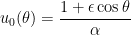
u_0(\theta) = \displaystyle \frac{1 + \epsilon \cos \theta}{\alpha},

which is the equation of an ellipse in polar coordinates.

Step 1. Solve the initial-value problem

u_1''(\theta) + u_1(\theta) = \displaystyle \frac{1}{\alpha} + \delta [u_0(\theta)]^2

u_1(0) = \displaystyle \frac{1 + \epsilon}{\alpha}

u_1'(0) = 0,

which partially incorporates the term due to general relativity. This is a first-order approximation to the real differential equation. After much effort, we found that the solution of this initial-value problem is

u_1(\theta) = \displaystyle \frac{1 + \epsilon \cos \theta}{\alpha} + \frac{\delta}{\alpha^2} + \frac{\delta \epsilon^2}{2\alpha^2} + \frac{ \delta\epsilon}{\alpha^2} \theta \sin \theta - \frac{ \delta \epsilon^2}{6\alpha^2} \cos 2\theta - \frac{\delta(3+\epsilon^2)}{3\alpha^2} \cos \theta.

For large values of \theta, this is accurately approximated as:

u_1(\theta) \approx \displaystyle \frac{1 + \epsilon \cos \theta}{\alpha} + \frac{ \delta\epsilon}{\alpha^2} \theta \sin \theta,

which can be further approximated as

u_1(\theta) \approx \displaystyle \frac{1}{\alpha} \left[ 1 + \epsilon \cos \left( \theta - \frac{\delta \theta}{\alpha} \right) \right].

From this expression, the precession in a planet’s orbit due to general relativity can be calculated.

Roughly 20 years ago, I presented this application of differential equations at the annual meeting of the Texas Section of the Mathematical Association of America. After the talk, a member of the audience asked what would happen if we did this procedure yet again to find a second-order approximation. In other words, I was asked to consider…

Step 2. Solve the initial-value problem

u_2''(\theta) + u_2(\theta) = \displaystyle \frac{1}{\alpha} + \delta [u_1(\theta)]^2

u_2(0) = \displaystyle \frac{1 + \epsilon}{\alpha}

u_2'(0) = 0.

It stands to reason that the answer should be an even more accurate approximation to the true solution u(\theta).

I didn’t have an immediate answer for this question, but I can answer it now. Letting Mathematica do the work, here’s the answer:

Yes, it’s a mess. The term in red is u_0(\theta), while the term in yellow is the next largest term in u_1(\theta). Both of these appear in the answer to u_2(\theta).

The term in green is the next largest term in u_2(\theta), with the highest power of \theta in the numerator and the highest power of \alpha in the denominator. In other words,

u_2(\theta) \approx \displaystyle \frac{1 + \epsilon \cos \theta}{\alpha} + \frac{ \delta\epsilon}{\alpha^2} \theta \sin \theta -\frac{\delta^2 \epsilon}{2\alpha^3} \theta^2 \cos \theta.

How does this compare to our previous approximation of

u(\theta) \approx \displaystyle \frac{1}{\alpha} \left[ 1 + \epsilon \cos \left( \theta - \frac{\delta \theta}{\alpha} \right) \right]?

Well, to a second-order Taylor approximation, it’s the same! Let

f(x) = \displaystyle \frac{1}{\alpha} \left[ 1 + \epsilon \cos \left( \theta - x \right) \right].

Expanding about x = 0 and treated \theta as a constant, we find

f(x) \approx f(0) + f'(0) x + \displaystyle \frac{f''(0)}{2} x^2 = \displaystyle \frac{1}{\alpha} \left[ 1 + \epsilon \cos \left( \theta\right) \right] + \frac{\epsilon}{\alpha} x \sin \theta - \frac{\epsilon}{2\alpha} x^2 \cos \theta.

Substituting x = \displaystyle \frac{\delta \theta}{\alpha} yields the above approximation for u_2(\theta).

Said another way, proceeding to a second-order approximation merely provides additional confirmation for the precession of a planet’s orbit.

Just for the fun of it, I also used Mathematica to find the solution of Step 3:

Step 2. Solve the initial-value problem

u_3''(\theta) + u_3(\theta) = \displaystyle \frac{1}{\alpha} + \delta [u_2(\theta)]^2

u_3(0) = \displaystyle \frac{1 + \epsilon}{\alpha}

u_3'(0) = 0.

I won’t copy-and-paste the solution from Mathematica; unsurpisingly, it’s really long. I will say that, unsurprisingly, the leading terms are

u_3(\theta) \approx \displaystyle \frac{1 + \epsilon \cos \theta}{\alpha} + \frac{ \delta\epsilon}{\alpha^2} \theta \sin \theta -\frac{\delta^2 \epsilon}{2 \alpha^3} \theta^2 \cos \theta  -\frac{\delta^3 \epsilon}{6\alpha^4} \theta^3 \sin \theta.

I said “unsurprisingly” because this matches the third-order Taylor polynomial of our precession expression. I don’t have time to attempt it, but surely there’s a theorem to be proven here based on this computational evidence.

Confirming Einstein’s Theory of General Relativity With Calculus, Part 7e: Computing Precession

In this series, I’m discussing how ideas from calculus and precalculus (with a touch of differential equations) can predict the precession in Mercury’s orbit and thus confirm Einstein’s theory of general relativity. The origins of this series came from a class project that I assigned to my Differential Equations students maybe 20 years ago.

We have shown that under general relativity, the motion of a planet around the Sun precesses by

\phi = \displaystyle \frac{6\pi GM}{ac^2 (1-\epsilon^2)} \qquad \hbox{radians per orbit},

where a is the semi-major axis of the planet’s orbit, \epsilon is the orbit’s eccentricity, G is the gravitational constant of the universe, M is the mass of the Sun, and c is the speed of light.

Notice that for \phi to be as observable as possible, we’d like a to be as small as possible and \epsilon to be as large as possible. By a fortunate coincidence, the orbit of Mercury — the closest planet to the sun — has the most elliptical orbit of the eight planets.

Here are the values of the constants for Mercury’s orbit in the SI system:

  • G = 6.6726 \times 10^{-11} \qquad \hbox{N-m}^2/\hbox{kg}^2
  • M = 1.9929 \times 10^{30} \qquad \hbox{kg}
  • a = 5.7871 \times 10^{10} \qquad \hbox{m}
  • c = 2.9979 \times 10^{8} \qquad \hbox{m/s}
  • \epsilon = 0.2056
  • T = 0.2408 \qquad \hbox{years}

The last constant, T, is the time for Mercury to complete one orbit. This isn’t in the SI system, but using Earth years as the unit of time will prove useful later in this calculation.

Using these numbers, and recalling that 1 ~ \hbox{N} = 1 ~ \hbox{kg-m/s}^2, we find that

\phi = \displaystyle \frac{6\pi \times 6.6726 \times 10^{-11} ~ \hbox{m}^3/(\hbox{kg-s}^2) \times 1.9929 \times 10^{30} ~ \hbox{kg}}{5.7871 \times 10^{10} ~ \hbox{m} \times (2.9979 \times 10^{8} ~ \hbox{m/s})^2 \times (1-(0.2408)^2)} \approx 5.03 \times 10^{-7}.

Notice that all of the units cancel out perfectly; this bit of dimensional analysis is a useful check against careless mistakes.

Again, the units of \phi are in radians per Mercury orbit, or radians per 0.2408 years. We now convert this to arc seconds per century:

\phi \approx 5.03 \times 10^{-7} \displaystyle \frac{\hbox{radians}}{\hbox{0.2408 years}} \times \frac{180 ~\hbox{degrees}}{\pi ~ \hbox{radians}} \times \frac{3600 ~ \hbox{arc seconds}}{1 ~ \hbox{degree}} \times \frac{100 ~ \hbox{years}}{1 ~ \hbox{century}}

\phi = 43.1 \displaystyle \frac{\hbox{arc seconds}}{\hbox{century}}.

This indeed matches the observed precession in Mercury’s orbit, thus confirming Einstein’s theory of relativity.

This same computation can be made for other planets. For Venus, we have the new values of a = 1.0813 \times 10^{11} ~ \hbox{m}, \epsilon = 0.0068, and T = 0.6152 ~ \hbox{years}. Repeating this calculation, we predict the precession in Venus’s orbit to be 8.65” per century. Einstein made this prediction in 1915, when the telescopes of the time were not good enough to measure the precession in Venus’s orbit. This only happened in 1960, 45 years later and 5 years after Einstein died. Not surprisingly, the precession in Venus’s orbit also agrees with general relativity.

Confirming Einstein’s Theory of General Relativity With Calculus, Part 7d: Predicting Precession IV

In this series, I’m discussing how ideas from calculus and precalculus (with a touch of differential equations) can predict the precession in Mercury’s orbit and thus confirm Einstein’s theory of general relativity. The origins of this series came from a class project that I assigned to my Differential Equations students maybe 20 years ago.

We have shown that the motion of a planet around the Sun, expressed in polar coordinates (r,theta) with the Sun at the origin, under general relativity is

u(\theta) \approx  \displaystyle \frac{1}{\alpha} \left[ 1 + \epsilon \cos \left( \theta - \frac{\delta \theta}{\alpha} \right) \right],

where u = \displaystyle \frac{1}{r}, \alpha = a(1-\epsilon^2), a is the semi-major axis of the planet’s orbit, \epsilon is the orbit’s eccentricity, \delta = \displaystyle \frac{3GM}{c^2}, G is the gravitational constant of the universe, m is the mass of the planet, M is the mass of the Sun, P is the planet’s perihelion, \ell is the constant angular momentum of the planet, and c is the speed of light.

The above function u(\theta) is maximized (i.e., the distance from the Sun r(\theta) is minimized) when \displaystyle \cos \left( \theta - \frac{\delta \theta}{\alpha} \right) is as large as possible. This occurs when \theta - \displaystyle \frac{\delta \theta}{\alpha} is a multiple of 2\pi.

Said another way, the planet is at its closest point to the Sun when \theta = 0. One orbit later, the planet returns to its closest point to the Sun when

\theta - \displaystyle \frac{\delta \theta}{\alpha} = 2\pi

\theta \displaystyle\left(1 - \frac{\delta}{\alpha} \right) = 2\pi

\theta = 2\pi \displaystyle\frac{1}{1 - (\delta/\alpha)}

We now use the approximation

\displaystyle \frac{1}{1-x} \approx 1 + x \qquad \hbox{if} \qquad x \approx 0;

this can be demonstrated by linearization, Taylor series, or using the first two terms of the geometric series 1 + x + x^2 + x^3 + \dots. With this approximation, the closest approach to the Sun in the next orbit occurs when

\theta = 2\pi \displaystyle\left(1 + \frac{\delta}{\alpha} \right) = 2\pi + \frac{2\pi \delta}{\alpha},

which is coterminal with the angle

\phi = \displaystyle \frac{2\pi \delta}{\alpha}.

Substituting \alpha = a(1-\epsilon^2) and \delta = \displaystyle \frac{3GM}{c^2}, we see that the amount of precession per orbit is

\phi = \displaystyle 2 \pi \frac{3GM}{c^2} \frac{1}{a(1-\epsilon^2)} = \frac{6\pi G M}{ac^2(1-\epsilon^2)}.

The units of \phi are radians per orbit. In the next post, we will use Mercury’s data to find \phi in seconds of arc per century.

Confirming Einstein’s Theory of General Relativity With Calculus, Part 7c: Predicting Precession III

In this series, I’m discussing how ideas from calculus and precalculus (with a touch of differential equations) can predict the precession in Mercury’s orbit and thus confirm Einstein’s theory of general relativity. The origins of this series came from a class project that I assigned to my Differential Equations students maybe 20 years ago.

We have shown that the motion of a planet around the Sun, expressed in polar coordinates (r,theta) with the Sun at the origin, under general relativity is

u(\theta) \approx  \displaystyle \frac{1}{\alpha} \left[ 1 + \epsilon \cos \left( \theta - \frac{\delta \theta}{\alpha} \right) \right],

where u = \displaystyle \frac{1}{r}, \displaystyle \frac{1}{\alpha} = \frac{GMm^2}{\ell^2}, \epsilon = \displaystyle \frac{\alpha - P}{P}, \delta = \displaystyle \frac{3GM}{c^2}, G is the gravitational constant of the universe, m is the mass of the planet, M is the mass of the Sun, P is the planet’s perihelion, \ell is the constant angular momentum of the planet, and c is the speed of light.

We notice that the orbit of a planet under general relativity looks very, very similar to the orbit under Newtonian physics:

u(\theta) \approx  \displaystyle \frac{1}{\alpha} \left[ 1 + \epsilon \cos \theta \right],

so that

r(\theta) = \displaystyle \frac{\alpha}{1 + \epsilon \cos \theta}.

As we’ve seen, this describes an elliptical orbit, normally expressed in rectangular coordinates as

\displaystyle \frac{(x-h)^2}{a^2} + \frac{y^2}{b^2} = 1,

with semimajor axis along the x-axis. In particular, for an elliptical orbit, the planet’s closest approach to the Sun occurs at \theta = 0:

r(0) = \displaystyle \frac{\alpha}{1 + \epsilon \cos 0} = \frac{\alpha}{1 + \epsilon},

and the planet’s further distance from the Sun occurs at \theta = \pi:

r(\pi) = \displaystyle \frac{\alpha}{1 + \epsilon \cos \pi} = \frac{\alpha}{1 - \epsilon}.

Therefore, the length 2a of the major axis of the ellipse is the sum of these two distances:

2a =  \displaystyle \frac{\alpha}{1 + \epsilon} +  \frac{\alpha}{1 - \epsilon}

2a = \displaystyle \frac{\alpha(1-\epsilon) + \alpha(1+\epsilon)}{(1 + \epsilon)(1 - \epsilon)}

2a= \displaystyle \frac{2\alpha}{1  - \epsilon^2}

a =  \displaystyle \frac{\alpha}{1  - \epsilon^2}.

Said another way, \alpha = a(1-\epsilon^2). This is a far more convenient formula for computing \alpha than \alpha = \displaystyle \frac{\ell^2}{GMm^2}, as the values of a (the semi-major axis) and \epsilon (the eccentricity of the orbit) are more accessible than the angular momentum \ell of the planet’s orbit.

In the next post, we finally compute the precession of the orbit.

Confirming Einstein’s Theory of General Relativity With Calculus, Part 7b: Predicting Precession II

In this series, I’m discussing how ideas from calculus and precalculus (with a touch of differential equations) can predict the precession in Mercury’s orbit and thus confirm Einstein’s theory of general relativity. The origins of this series came from a class project that I assigned to my Differential Equations students maybe 20 years ago.

We have shown that the motion of a planet around the Sun, expressed in polar coordinates (r,\theta) with the Sun at the origin, under general relativity is

u(\theta) \approx  \displaystyle \frac{1 + \epsilon \cos \theta}{\alpha} + \frac{ \delta\epsilon}{\alpha^2} \theta \sin \theta,

where u = \displaystyle \frac{1}{r}, \displaystyle \frac{1}{\alpha} = \frac{GMm^2}{\ell^2}, \delta = \displaystyle \frac{3GM}{c^2}, G is the gravitational constant of the universe, m is the mass of the planet, M is the mass of the Sun, \ell is the constant angular momentum of the planet, and c is the speed of light.

We will now simplify this expression, using the facts that \delta is very small and \alpha is quite large, so that \delta/\alpha is very small indeed. We will use the two approximations

\cos x \approx 1 \qquad \hbox{and} \qquad \sin x \approx x \qquad \hbox{if} \qquad x \approx 0;

these approximations can be obtained by linearization or else using the first term of the Taylor series expansions of \cos x and \sin x about x = 0.

We will also need the trig identity

\cos(\theta_1 - \theta_2) = \cos \theta_1 \cos \theta_2 + \sin \theta_1 \sin \theta_2.

With these tools, we can now simplify u(\theta):

u(\theta) \approx  \displaystyle \frac{1 + \epsilon \cos \theta}{\alpha} + \frac{ \delta\epsilon}{\alpha^2} \theta \sin \theta

=  \displaystyle \frac{1}{\alpha} \left[1 + \epsilon \cos \theta + \frac{ \delta\epsilon}{\alpha} \theta \sin \theta \right]

=  \displaystyle \frac{1}{\alpha} \left[1 + \epsilon \left(\cos \theta + \frac{ \delta}{\alpha} \theta \sin \theta \right) \right]

=  \displaystyle \frac{1}{\alpha} \left[1 + \epsilon \left(\cos \theta \cdot 1 + \sin \theta \cdot \frac{ \delta \theta}{\alpha}  \right) \right]

\approx  \displaystyle \frac{1}{\alpha} \left[1 + \epsilon \left(\cos \theta \cdot \cos \frac{\delta \theta}{\alpha} + \sin \theta \cdot \sin \frac{ \delta \theta}{\alpha}  \right) \right]

\approx  \displaystyle \frac{1}{\alpha} \left[1 + \epsilon \cos \left( \theta - \frac{\delta \theta}{\alpha}  \right) \right].