Engaging students: Solving two-step algebra problems

In my capstone class for future secondary math teachers, I ask my students to come up with ideas for engaging their students with different topics in the secondary mathematics curriculum. In other words, the point of the assignment was not to devise a full-blown lesson plan on this topic. Instead, I asked my students to think about three different ways of getting their students interested in the topic in the first place.

I plan to share some of the best of these ideas on this blog (after asking my students’ permission, of course).

This student submission again comes from my former student Jessica Bonney. Her topic, from Pre-Algebra: solving two-step algebra problems.

green line

How could you as a teacher create an activity or project that involves your topic?

A great activity to use in the classroom with students for this topic would have to be algebra tiles. The tiles are a good manipulative that can be used to improve the students’ understanding and offer contact to representative manipulation for students that are more kinesthetic learners. The algebra tiles can be used to help justify and explain the process of solving two-step equations. They were developed on the basis of two ideas: (1) we can isolate variables by using “zero pairs” and (2) equations don’t change when equal amounts of tiles are used on both sides of the equation. Algebra tiles come in different colors and sizes, which can be used to represent different parts of an equation that can help students solve two-step algebra problems.  I think this would be a fun and interactive activity to help students learn and understand how to go about solving these types of problems.


green line

How can this topic be used in your students’ future courses in mathematics or science?

Once a student gets to a certain grade level, they constantly start building upon what they learn. This material can be carried into high school and even college level courses.  Before a student learns two-step equations, they must master one-step equations, and even before that they need to understand basic arithmetical operations. Once mastery has been achieved, students will move onto solving larger polynomials, which can later be used in future algebra, geometry, and calculus courses. Another interesting use for two-step algebra problems is for future science and even computer science courses. In science, let’s say physics or chemistry, the students can use the two-step method for solving how fast a ball fell from a rooftop or for solving how fast a chemical evaporated at a certain temperature. Now in computer science students can learn how to develop algebraic functions in a computerized setting.


green line

What interesting things can you say about the people who contributed to the discovery and/or the development of this topic?

Rene’ Descartes, born in March of 1596, was a French mathematician, philosopher, and scientist. He is widely known for the statement, “I think, therefore I am,” deriving it from the foundation of intuition that, when he thinks, he exists. After obtaining a degree in law, his father wanted him to join Parliament, but sadly he was only 20 and the minimum age to join was 27. In turn, he moved to the Netherlands where he was influenced to study science and mathematics. During this time he formulated a common method of logical reasoning, centered on mathematics, which can be related to all sciences. This method is discussed in Discourse on Method, and is comprised of four rules: “(1) accept nothing as true that is not self-evident, (2) divide problems into their simplest parts, (3) solve problems by proceeding from simple to complex, and (4) recheck the reasoning.” We use these rules everyday when directly apply them to mathematical procedures.


References:

“Rene Descartes”. Encyclopædia Britannica. Encyclopædia Britannica Online. Encyclopædia

Britannica Inc., 2016. Web. 07 Sep. 2016 <https://www.britannica.com/biography/Rene-

Descartes>.


Teaching Parents to Talk Math with Their Kids

From a recent article in the Boston Globe, https://www.bostonglobe.com/ideas/2016/09/15/teaching-parents-talk-math-with-their-kids/kZ777JUPFW3Yewr31yMqSO/story.html:

Researchers with a group called the DREME Network (which stands for Development and Research in Early Math Education) say it’s time for parents to begin to teach their preschool-age children basic math concepts with the same urgency that they encourage reading…

The concepts and skills that make a difference with kids ages 3 to 5 (which is where the DREME Network is focused) are so basic that any adult can handle them: counting objects and recognizing that the last number stated describes the total number of objects, talking about patterns, going on “shape hunts,” ordering sets from biggest to smallest.

“People think of math in a very narrow way, but block play, puzzles, spatial aspects of our cognition, these are also important to mathematics. We’re not advocating drilling kids,” says Susan Levine, a psychologist at the University of Chicago and DREME Network member.

The Running Nerd: The US Marathoner Who Is Also a Statistics Professor

I loved these articles about Jared Ward, an adjunct professor of statistics at BYU who also happens to be a genuine and certifiable jock… he finished the 2016 Olympic marathon in 6th place with a time of 2:11:30.

Ward started teaching at his alma mater after graduating from BYU with a master’s degree in statistics in April 2015…

Ward wrote his master’s thesis on the optimal pace strategy for the marathon. He analyzed data from the St. George Marathon, and compared the pace of runners who met the Boston Marathon qualifying time to those who did not.

The data showed that the successful runners had started the race conservatively, relative to their pace, and therefore had enough energy to take advantage of the downhill portions of the race.

Ward employs a similar pacing strategy, refusing to let his adrenaline trick him into running a faster pace than he can maintain.

And, in his own words,

[A]t BYU, on our cross-country field, on the guys side, there were maybe 20 guys on the team; half of them were statistics or econ majors. There was one year when we thought if we pooled together all of the runners from our statistics department, we could have a stab with just that group of guys at being a top-10 cross-country team in the nation…

To be a runner, it’s a very internally motivated sport. You’re out there running on the road, trying to run faster than you’ve ever run before, or longer than you’ve ever gone before. That leads to a lot of thinking and analyzing.We’re out there running, thinking about what we’re eating, what we need to eat, energy, weightlifting, how our body feels today, how it’s going to feel tomorrow with how much we run today. We’re gauging all of these efforts based on how we feel and trying to analyze how we feel and how we can best get ourselves ready for a race. As opposed to all the time on a soccer field, you’re listening to do a drill that your coach tells you to do, and then you go home.

I think we have a lot of time to think about what we are doing and how it impacts our performance. And statistics is the same way. It’s thinking about how numbers and data lead to answers to questions.

Yes, I think there’s probably some sort of connection there to nerds and runners.

Sources: http://www.nbcolympics.com/news/running-nerd-us-marathoner-who-also-statistics-professor and http://www.chronicle.com/article/Trading-One-Marathon-for/237595?utm_source=Sailthru&utm_medium=email&utm_campaign=Issue:%202016-08-29%20Higher%20Ed%20Education%20Dive%20Newsletter%20%5Bissue:7064%5D&utm_term=Education%20Dive:%20Higher%20Ed

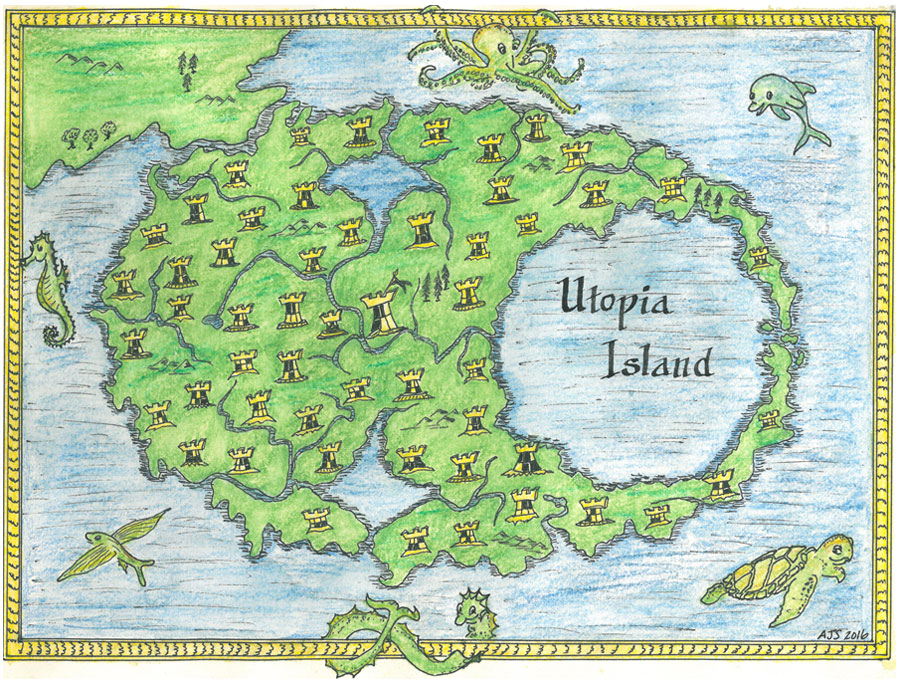
Math Maps The Island of Utopia

Under the category of “Somebody Had To Figure It Out,” Dr. Andrew Simoson of King University (Bristol, Tennessee) used calculus to determine the shape of the island of Utopia in the 500-year-old book by Sir Thomas More based on the description of island given in the book’s introduction.

News article: https://www.insidescience.org/news/math-maps-island-thomas-mores-utopia

Paper by Dr. Simoson: http://archive.bridgesmathart.org/2016/bridges2016-65.html

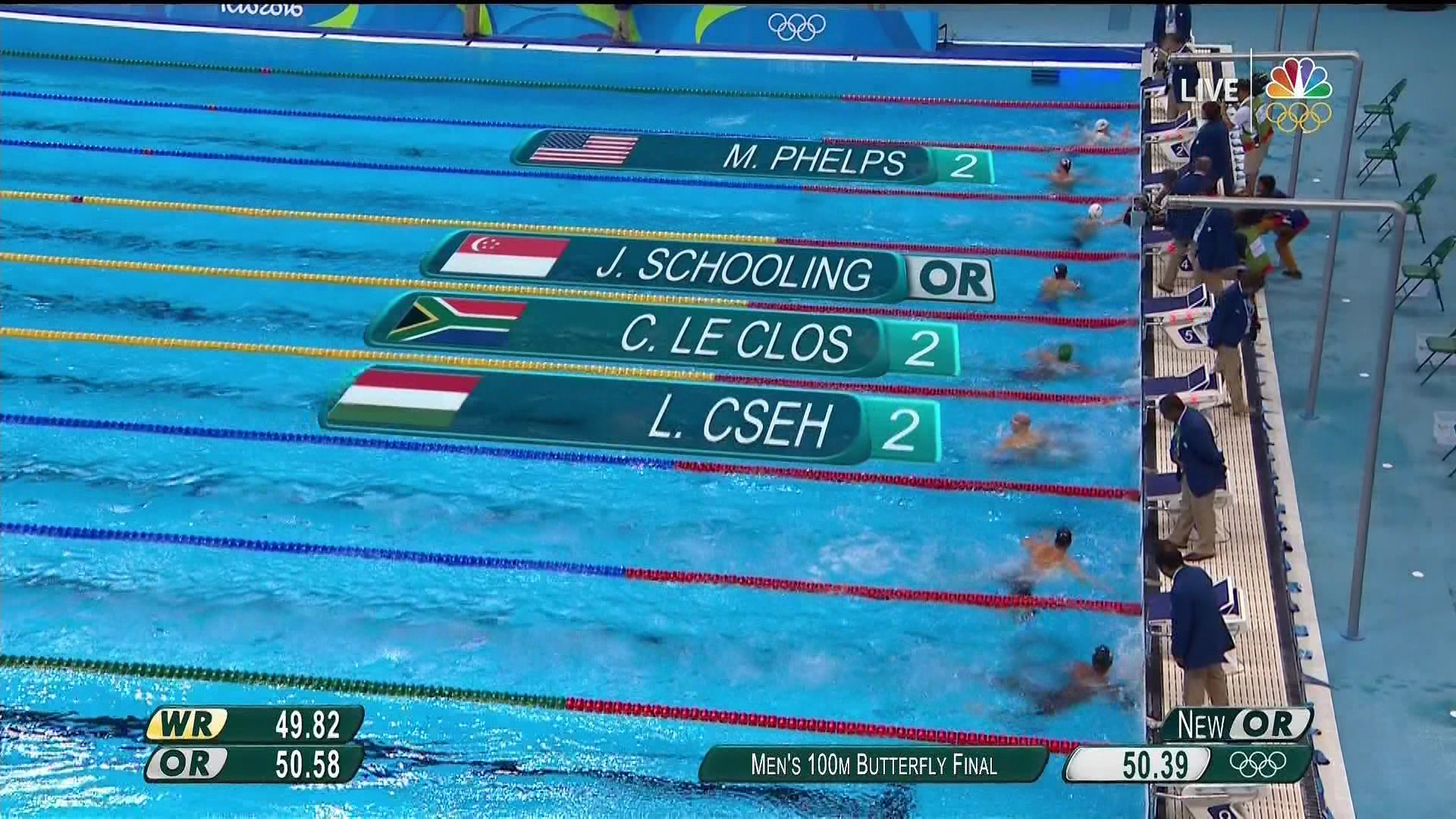
This Is Why There Are So Many Ties In Swimming

From the excellent article “This Is Why There Are So Many Ties In Swimming“, ties in swimming are allowed by the sport’s governing body because of the inevitability of roundoff error.

In 1972, Sweden’s Gunnar Larsson beat American Tim McKee in the 400m individual medley by 0.002 seconds. That finish led the governing body to eliminate timing by a significant digit. But why?

In a 50 meter Olympic pool, at the current men’s world record 50m pace, a thousandth-of-a-second constitutes 2.39 millimeters of travel. FINA pool dimension regulations allow a tolerance of 3 centimeters in each lane, more than ten times that amount. Could you time swimmers to a thousandth-of-a-second? Sure, but you couldn’t guarantee the winning swimmer didn’t have a thousandth-of-a-second-shorter course to swim. (Attempting to construct a concrete pool to any tighter a tolerance is nearly impossible; the effective length of a pool can change depending on the ambient temperature, the water temperature, and even whether or not there are people in the pool itself.)

Top 100 Math Blogs for Students and Teachers

Now this was an unexpected surprise. I recently received the following message:

Hi John,

My name is Anuj Agarwal. I’m Founder of Feedspot.

I would like to personally congratulate you as your blog Mean Green Math has been selected by our panelist as one of the Top 100 Math Blogs on the web.

http://blog.feedspot.com/math_blogs/

I personally give you a high-five and want to thank you for your contribution to this world. This is the most comprehensive list of Top 100 Math Blog on the internet and I’m honored to have you as part of this!

Also, you have the honor of displaying the following badge on your blog. Use the below code to display this badge proudly on your blog.

Best,
Anuj

I’m not gonna lie: it’s really, really flattering to see my blog listed on the same page (at #76) with some of the genuine heavy hitters out there in mathematical blogland.

This seems like as good an occasion as any to thank my former students — many of whom are now secondary teachers of mathematics somewhere in the Dallas-Fort Worth metroplex — for suggesting that I create this blog in the first place as a way of keeping touch with them after they graduated. I do hope that this blog has been a help.

Top 100