Can ants do math?

A hat-tip to my former student Matt Wolodko, who directed me to this interesting article about whether ants are able to count.

Reactions and commentary can be found in the links below.

http://inspiringscience.wordpress.com/2012/11/09/do-ants-really-count-their-steps/

http://www.npr.org/blogs/krulwich/2011/06/01/120587095/ants-that-count

http://www.livescience.com/871-ants-marching-count-steps.html

http://www.newscientist.com/article/dn9436-ants-use-pedometers-to-find-home.html#.UfAfsdhk31E

http://www.newscientist.com/data/images/ns/av/dn9436.mpg

The Stereotypes About Math That Hold Americans Back

I just read an interesting article about math education in The Atlantic: http://www.theatlantic.com/education/archive/2013/11/the-stereotypes-about-math-that-hold-americans-back/281303/. Among the great quotes:

Here’s the most shocking statistic I have read in recent years: 60 percent of the 13 million two-year college students in the U.S. are currently placed into remedial math courses; 75 percent of them fail or drop the courses and leave college with no degree…

[W]hen mathematics is opened up and broader math is taught—math that includes problem solving, reasoning, representing ideas in multiple forms, and question asking—students perform at higher levels, more students take advanced mathematics, and achievement is more equitable…

When all aspects of mathematics are encouraged, rather than procedure execution alone, many more students contribute and feel valued. For example, some students are good at procedure execution, but may be less good at connecting methods, explaining their thinking, or representing ideas visually. All of these ways of working are critical in mathematical work and when they are taught and valued, many more students contribute, leading to higher achievement.

If I had written this article, I would have been less effusive in praising the Common Core. But I am absolutely in sync with the author that there’s a whole lot more to grade-school mathematics than completing drill-and-kill procedures as quickly as possible.

The Beloit College Mindset Lists

These lists should be required reading for faculty and staff who wish to understand the perspective of today’s college students (with some applicability to today’s high school students also). And it’s a little scary how the Mindset Lists themselves have changed, contrasting the one for the Class of 2002 differs to that of the Class of 2017.

Sources: http://themindsetlist.org and http://www.beloit.edu/mindset

Calculator errors: When close isn’t close enough (Part 2)

In the previous post, I gave a simple classroom demonstration to illustrate that some calculators only approximate an infinite decimal expansion with a terminating decimal expansion, and hence truncation errors can propagate. This example addresses the common student question, “What’s the big deal if I round off to a few decimal places?”

TItrunc1

(For what it’s worth, I’m aware that some current high-end calculators are miniature computer algebra systems and can formally handle an answer of \displaystyle \frac{1}{3} instead of its decimal expansion.)

Students may complain that the above exercise is artificial and unlikely to occur in real life. I would suggest following up with a real-world, non-artificial, and tragic example of an accident that happened in large part due to truncation error. This incident occurred during the first Gulf War in 1991 (perhaps ancient history to today’s students). I’m going to quote directly from the website http://www.ima.umn.edu/~arnold/disasters/patriot.html, published by Dr. Douglas Arnold at the University of Minnesota. Perhaps students don’t need to master the details of this explanation (a binary expansion as opposed to a decimal expansion might be a little abstract), but I think that this example illustrates truncation error vividly.

On February 25, 1991, during the Gulf War, an American Patriot Missile battery in Dharan, Saudi Arabia, failed to track and intercept an incoming Iraqi Scud missile. The Scud struck an American Army barracks, killing 28 soldiers and injuring around 100 other people. Patriot missile A report of the General Accounting office, GAO/IMTEC-92-26, entitled Patriot Missile Defense: Software Problem Led to System Failure at Dhahran, Saudi Arabia reported on the cause of the failure.

It turns out that the cause was an inaccurate calculation of the time since boot due to computer arithmetic errors. Specifically, the time in tenths of second as measured by the system’s internal clock was multiplied by 1/10 to produce the time in seconds. This calculation was performed using a 24 bit fixed point register. In particular, the value 1/10, which has a non-terminating binary expansion, was chopped at 24 bits after the radix point. The small chopping error, when multiplied by the large number giving the time in tenths of a second, led to a significant error.

Indeed, the Patriot battery had been up around 100 hours, and an easy calculation shows that the resulting time error due to the magnified chopping error was about 0.34 seconds.

The number 1/10 equals

\displaystyle \frac{1}{2^4} + \frac{1}{2^5} +\frac{1}{2^8} + \frac{1}{2^9} + \frac{1}{2^{12}} + \frac{1}{2^{13}} + \dots

In other words, the binary expansion of 1/10 is

0.0001100110011001100110011001100....

Now the 24 bit register in the Patriot stored instead

0.00011001100110011001100

introducing an error of

0.0000000000000000000000011001100... binary,

or about 0.000000095 decimal. Multiplying by the number of tenths of a second in 100 hours gives

0.000000095 \times 100 \times 60 \times 60 \times 10=0.34.

A Scud travels at about 1,676 meters per second, and so travels more than half a kilometer in this time. This was far enough that the incoming Scud was outside the “range gate” that the Patriot tracked.

Ironically, the fact that the bad time calculation had been improved in some parts of the code, but not all, contributed to the problem, since it meant that the inaccuracies did not cancel.

The following paragraph is excerpted from the GAO report.

The range gate’s prediction of where the Scud will next appear is a function of the Scud’s known velocity and the time of the last radar detection. Velocity is a real number that can be expressed as a whole number and a decimal (e.g., 3750.2563…miles per hour). Time is kept continuously by the system’s internal clock in tenths of seconds but is expressed as an integer or whole number (e.g., 32, 33, 34…). The longer the system has been running, the larger the number representing time. To predict where the Scud will next appear, both time and velocity must be expressed as real numbers. Because of the way the Patriot computer performs its calculations and the fact that its registers are only 24 bits long, the conversion of time from an integer to a real number cannot be any more precise than 24 bits. This conversion results in a loss of precision causing a less accurate time calculation. The effect of this inaccuracy on the range gate’s calculation is directly proportional to the target’s velocity and the length of the the system has been running. Consequently, performing the conversion after the Patriot has been running continuously for extended periods causes the range gate to shift away from the center of the target, making it less likely that the target, in this case a Scud, will be successfully intercepted.

green line

A quick note of clarification. To verify the binary expansion of 1/10, we use the formula for an infinite geometric series.

S = \displaystyle \left(\frac{1}{2^4} + \frac{1}{2^5}\right) +\left(\frac{1}{2^8} + \frac{1}{2^9}\right) + \left(\frac{1}{2^{12}} + \frac{1}{2^{13}}\right) + \dots

S = \displaystyle \frac{3}{2^5} + \frac{3}{2^9} + \frac{3}{2^{13}} + \dots

S = \displaystyle \frac{\displaystyle \frac{3}{2^5}}{\quad \displaystyle 1 - \frac{1}{2^4} \quad}

S = \displaystyle \frac{\displaystyle \frac{3}{32}}{\quad \displaystyle \frac{15}{16} \quad}

S = \displaystyle \frac{3}{32} \times \frac{16}{15}

S = \displaystyle \frac{1}{10}

OK, that verifies the answer. Still, a curious student may wonder how one earth one could directly convert 1/10 into binary without knowing the above series ahead of time. I will address this question in a future post.

Calculator errors: When close isn’t close enough (Part 1)

Far too often, students settle for a numerical approximation of a solution that can be found exactly. To give an extreme example, I have met quite intelligent college students who were convinced that \displaystyle \frac{1}{3} was literally equal to 0.3.

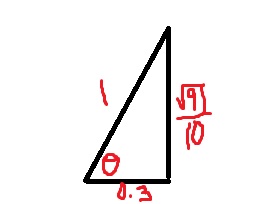
That’s an extreme example of something that nearly all students do — round off a complicated answer to a fixed number of decimal places. In trigonometry, many students will compute \sin \left( \cos^{-1} 0.3 \right) by plugging into a calculator and reporting the first three to six decimal places, like 0.95394. This is especially disappointing when there are accessible techniques for getting the exact answer (in this case, \displaystyle \frac{\sqrt{91}}{10}) without using a calculator at all.

pictsqrt9110

TIsqrt9110

Unfortunately, even maintaining eight, nine, or ten decimal places of accuracy may not be good enough, as errors tend to propagate as a calculation continues. I’m sure every math teacher has an example where the correct answer was exactly $\displaystyle\frac{3}{2}$ but students returned an answer of 1.4927 or 1.5031 because of roundoff errors.

Students may ask, “What’s the big deal if I round off to five decimal places?” Here’s a simple example — which can be quickly demonstrated in a classroom — of how such truncation errors can propagate. I’m going to generate a recursive sequence. I will start with \displaystyle \frac{1}{3}. Then I will alternate multiplying by 1000 and then subtracting 333. More mathematically,

 a_1 = \displaystyle \frac{1}{3}

a_{2n} = 1000 a_{2n-1}

a_{2n+1} = a_{2n} - 333 if n > 0

Here’s what happens exactly:

1000 \times \displaystyle \frac{1}{3} = \displaystyle \frac{1000}{3} = \displaystyle 333\frac{1}{3} = 333.\overline{3}

\displaystyle 333\frac{1}{3} - 333 = \displaystyle \frac{1}{3} = 0.\overline{3}

So, repeating these two steps, the sequence alternates between \displaystyle \frac{1}{3} and \displaystyle 333\frac{1}{3}.

But looks what happens if I calculate the first twelve terms of this sequence on a calculator.

TItrunc1

Notice that by the time I reach a_{11}, the terms of the sequence are negative, which is clearly incorrect.

So what happened?

This is a natural by-product of the finite storage of a calculator. The calculator doesn’t store infinitely many digits of $\displaystyle \frac{1}{3}$ in memory because a calculator doesn’t possess an infinite amount of memory. Instead, what gets stored is something like the terminating decimal 0.33333333333333, with about fourteen 3s. (Of course, only the first ten digits are actually displayed.)

So multiplying by 1000 and then subtracting 333 produces a new and different terminating decimal with three less 3s. Do this enough times, and you end up with negative numbers.

Local universities help train high school teachers

At UNT, we take very seriously our mission to improve both the quality and quantity of secondary teachers of science and mathematics. Part of this mission includes providing professional development for current high school teachers, including our alumni and the mentor teachers who provide the essential field experiences that form the backbone of our teacher education program. We had a nice write-up about these efforts in the local newspaper this week.

Local universities help train high school teachers,” by Jenna Duncan (Denton Record-Chronicle, July 16, 2013. Published online July 15, 2013.)

The “Don’t Suck” theory of improving graduation rates

From the Chronicle of Higher Education:

Maintaining an up-to-date list of available tutors, calculating financial aid accurately, placing students in the right classes, picking up garbage, and maintaining elevators aren’t “best” practices. They are “minimally competent” practices. Nobody is ever going to publish a research study finding a causal link between $125,000-per-photocopier contracts, Caribbean cruises, and graduation rates.

But I’m quite sure that these things are much more important to helping students graduate than the presence or absence of specific retention programs. They all go to the basic competence and quality of the institution. Well-run universities that have student-focused organizational cultures and are properly accountable to outside regulatory bodies simply don’t behave this way. Well-run universities are also much more successful in helping student earn degrees. It’s unreasonable to think that a university like Chicago State, which enrolls many part-time, low-income, and academically diverse students, will have a 100 percent graduation rate. But based on the research and examples cited in the article, it’s reasonable to expect that CSU could graduate 1 in 2 students, as opposed to 1 in 10.

Source: http://chronicle.com/blogs/brainstorm/the-dont-suck-theory-of-improving-graduation-rates/26483

What’s the State of High School Education? Bad, but Not as Bad as You Think

Taken from the Change the Equation blog, http://changetheequation.org/blog/what%E2%80%99s-state-high-school-education-bad-not-bad-you-think

Have U.S. twelfth graders made any progress in math since the 1970s? The answer is no, if we’re to believe news stories about the National Assessment of Educational Progress (NAEP), which released the results of its long-term math and science tests yesterday. Yet those news stories don’t have it quite right.

It is true that, overall, 17 year olds’ scores barely budged from 1973 to 2012. They rose a scant two points. But things look a bit different when you break down the data by racial and ethnic group. Every group made gains: black students gained 18 points, Hispanic students gained 17 points, Asian students gained six points, and white students gained four points.

The reason for this apparent impossibility? Black and Hispanic students, who unfortunately lag behind their white peers, make up a much bigger share of the population now than they did in 1973. That brings down the total score. (Jack Jennings noted this dynamic several years ago.) Yet those who imply that our students are no better served by the K-12 system than they were 40 years ago are ignoring the evidence.

So should we be popping the champagne corks? Hardly. Progress in high school has been much slower than in elementary and middle schools, where student gains have amounted to several grade levels worth of learning. In fact, high schools seem to be undoing some of the gains made by elementary and middle schools.

But gloomy fatalism and blanket indictments of K-12 won’t do us much good. One lesson NAEP teaches us  is that change is possible—we can move the needle when we set our minds to it. We’ve also got to step up our game. Students of color make up a growing share of our school enrollments. If we don’t accelerate the progress we have already made with them, we will pay a very high moral and economic price.

Beyond the Chalkboard: The Job of a Math Professor

About 15 years ago, when I was starting my career as an assistant professor, I was asked to write an article for Imagine magazine, which is targeted toward gifted students in grades 7-12, about what it’s like to be a math professor. While I would probably write something slightly different today (since my job responsibilities have shifted toward administration, academic advising, and the preparation of future secondary mathematics teachers), I think much of what I wrote still applies today.

Source: J. Quintanilla, “Beyond the Chalkboard: The Job of a Math Professor,” Imagine, Vol. 5, No. 4, p. 10 (March/April 1998).

green line

One part of my job is deceptively simple to explain: I teach math to college students. Some people think I’ve got the easiest job in the world. I teach only two classes a semester for just six hours a week, and I have a flexible schedule with summers off. How cozy!

This view of my job is, of course, misleading. The hours I spend actually lecturing are only the tip of the iceberg. Delivering lectures that make sense and maintain students’ interest for a full hour takes considerable practice and effort. Meanwhile, I am constantly fine-tuning the curriculum, writing exams, and of course grading homework assignments — tasks which keep me working late on many nights. My most time-consuming project in recent months, however, has been to write eighty–and counting–letters of recommendation for former students.

My work with students outside the classroom includes one-on-one tutoring, guiding student research projects, advising students about possible majors and careers, and sometimes just lending an ear when someone’s had a rough day. As a professor I am a public figure on campus, and my current and former students come to me for counsel on a wide range of issues, many of which are only tangentially related to mathematics. I hope that through my words and counsel I am contributing to my students’ development as people as well as scholars.

In addition to lecturing, writing recommendations and counseling, I also have to produce original research. At my university, the quality of my teaching and my research will be weighted equally when I am evaluated for tenure in five years. The relative importance of teaching and research, however, varies from college to college. In general, small liberal arts colleges tend to emphasize teaching, while major universities want their professors to be primarily researchers.

When I started graduate school, I was introduced to my current field of research: applying ideas from probability theory to study theoretical problems in materials science. I have found that my research evolves over four stages: months of frustration, several days of sheer ecstasy when I’m overflowing with ideas, weeks of double-checking that my ideas actually make sense, and finally months of writing up my results for publication in scientific journals. I purposely work on three or four research projects
simultaneously, hoping that the cycle of each is slightly out of phase with the others. Though I work on my research all year, it gets my undivided attention during the summer when I’m not teaching.

Of the many aspects of this job, teaching is for me the most satisfying. I know that most of my students will not become professional mathematicians, so I incorporate “fun lectures” into the curriculum. These lectures illustrate how the mathematics we’re studying can be applied to fields of science. In my “Hunt for Red October” lecture, for example, I talk about applying trigonometry to linguistics, opera, and submarine detection; in my “Voyager 2” lecture, I describe how conic sections are used in planetary exploration. For my favorite fun lecture, I dress up in knickers, carry my golf clubs into class, and use calculus
to analyze the trajectory of golf balls. These lectures have become quite popular with my students, and I love to watch their eyes
light up when they’re excited about learning new things, such as how mathematics can be applied to real life.

Does this career sound appealing to you? If so, heed these words of warning: To become a successful professor, you have to really, really want this career. I am not a math professor for its financial rewards; friends of mine in industry earn salaries that are triple what I make. I don’t mind, and I’m not envious of them–I get to do what I love for a living, and I’m not starving. But this job isn’t for everyone. There are innumerable distractions and frustrations along the way that will derail aspiring professors who are not entirely focused on the goal.

For example, I always thought that I would be assured a job after graduation. In 1987, the National Science Foundation projected a shortfall of 675,000 scientists and engineers over the coming two decades. I was a high school senior in 1987, so I assumed I would be able to write my own ticket after earning a doctorate.

Time would show that this NSF projection, now derisively labeled “The Myth,” was amazingly inaccurate. There is currently an overproduction of Ph.D.s in mathematics, and the job market for aspiring math professors is tight. The unemployment rate for freshly-minted Ph.D.s in mathematics has hovered around 10% throughout the 1990s. A new Ph.D. can expect a nomadic
life — bouncing all over the country from one postdoctoral appointment to another — before finally landing a tenure-track position.

Faced with such daunting employment prospects, I braced myself for an unstable life in pursuit of my dream of becoming a professor. Even so, I must admit that getting avalanched by more than a hundred rejection letters was extremely disheartening. In the end, though, I was blessed with a tenure-track position straight out of grad school.

Like many jobs, the job of a math professor is frustrating at times and can feel overwhelming. But when it does, I think about the excited, curious students at a recent fun lecture and remind myself: I love this job!

Put Understanding First

From a great article by G. Wiggins and J. McTighe, “Put Understanding First,” Reshaping High Schools, Vol. 65, No. 8, pp. 36-41 (May 2008)

Out-of-context learning of skills is arguably one of the greatest weaknesses of the secondary curriculum—the natural outgrowth of marching through the textbook instead of teaching with meaning and transfer in mind. Schools too often teach and test mathematics, writing, and world language skills in isolation rather than in the context of authentic demands requiring thoughtful application. If we don’t give students sufficient ongoing opportunities to puzzle over genuine problems, make meaning of their learning, and apply content in various contexts, then long-term retention and effective performance are unlikely, and high schools will have failed to achieve their purpose.