
This witty essay about teachers complaining about their students made me laugh. Hope you enjoy it.
http://www.insidehighered.com/blogs/education-oronte-churm/very-first-unteachable-students
This witty essay about teachers complaining about their students made me laugh. Hope you enjoy it.
http://www.insidehighered.com/blogs/education-oronte-churm/very-first-unteachable-students
I’ve never been a fan of the Dallas Cowboys, but Jon Kitna remains one of the good guys of the NFL. After retirement, he went to work as a math teacher and football coach at his high school alma mater, getting students with learning disabilities to understand algebra (and thus be prepared for higher-level math classes in later years).
After the unfortunate injury to starting quarterback Tony Romo, the Dallas Cowboys called upon Kitna for emergency service. He plans to donate his one-game salary back to the high school.
Reference: http://bleacherreport.com/articles/1901693-jon-kitnas-salary-decision-proves-his-return-is-noble
In 1990 and 1991, columnist Marilyn vos Savant (who once held the Guinness World Record for “Highest IQ”) set off a small firestorm when a reader posed the famous Monty Hall Problem to her:
Suppose you’re on a game show, and you’re given the choice of three doors. Behind one door is a car, behind the others, goats. You pick a door, say #1, and the host, who knows what’s behind the doors, opens another door, say #3, which has a goat. He says to you, “Do you want to pick door #2?” Is it to your advantage to switch your choice of doors?
She gave the correct answer: it’s in your advantage to switch. This launched an avalanche of mail (this was the early 90’s, when e-mail wasn’t as popular) complaining that she gave the incorrect answer. Perhaps not surprisingly, none of the complainers actually tried the experiment for themselves. She explained her reasoning — in two different columns — and then offered a challenge:
And as this problem is of such intense interest, I’m willing to put my thinking to the test with a nationwide experiment. This is a call to math classes all across the country. Set up a probability trial exactly as outlined below and send me a chart of all the games along with a cover letter repeating just how you did it so we can make sure the methods are consistent.
One student plays the contestant, and another, the host. Label three paper cups #1, #2, and #3. While the contestant looks away, the host randomly hides a penny under a cup by throwing a die until a 1, 2, or 3 comes up. Next, the contestant randomly points to a cup by throwing a die the same way. Then the host purposely lifts up a losing cup from the two unchosen. Lastly, the contestant “stays” and lifts up his original cup to see if it covers the penny. Play “not switching” two hundred times and keep track of how often the contestant wins.
Then test the other strategy. Play the game the same way until the last instruction, at which point the contestant instead “switches” and lifts up the cup not chosen by anyone to see if it covers the penny. Play “switching” two hundred times, also.
You can read the whole exchange here: http://marilynvossavant.com/game-show-problem/
For much more information — and plenty of ways (some good, some not-so-good) of explaining this very counterintuitive result, just search “Monty Hall Problem” on either Google or YouTube.
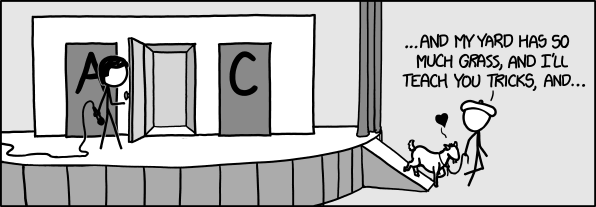
Source: http://www.xkcd.com/1282/
I took a statistics course at MIT. I would go study and do problems, and have high confidence that I understood the material. Then I’d go to the lecture, and be more confused than I was when I entered the classroom. Thus, I discovered that some teachers were capable of conveying negative knowledge, so that after listening to them, I knew less than I did before.
It was also clear that knowledge varies considerably in quantity among people, and this convinced me that real knowledge varies over a very wide range.
Then I encountered people who either did not know what they were talking about, or were clearly convinced of things that were wrong, and so I learned that there was imaginary knowledge.
Once I understood that there was both real and imaginary knowledge, I concluded that knowledge is truly complex.
– Hillel J. Chiel, Case Western Reserve University
Source: American Mathematical Monthly, Vol. 120, No. 10, p. 923 (December 2013)
An amusing video from Training Camp 2013 for illustrating that each side of a triangle (including right triangles) is shorter than the sum of the other two sides. The speaker is Jason Garrett, head coach of the Dallas Cowboys.
A hat-tip to my former student Matt Wolodko, who directed me to this interesting article about whether ants are able to count.
Reactions and commentary can be found in the links below.
http://inspiringscience.wordpress.com/2012/11/09/do-ants-really-count-their-steps/
http://www.npr.org/blogs/krulwich/2011/06/01/120587095/ants-that-count
http://www.livescience.com/871-ants-marching-count-steps.html
http://www.newscientist.com/article/dn9436-ants-use-pedometers-to-find-home.html#.UfAfsdhk31E
I just read an interesting article about math education in The Atlantic: http://www.theatlantic.com/education/archive/2013/11/the-stereotypes-about-math-that-hold-americans-back/281303/. Among the great quotes:
Here’s the most shocking statistic I have read in recent years: 60 percent of the 13 million two-year college students in the U.S. are currently placed into remedial math courses; 75 percent of them fail or drop the courses and leave college with no degree…
[W]hen mathematics is opened up and broader math is taught—math that includes problem solving, reasoning, representing ideas in multiple forms, and question asking—students perform at higher levels, more students take advanced mathematics, and achievement is more equitable…
When all aspects of mathematics are encouraged, rather than procedure execution alone, many more students contribute and feel valued. For example, some students are good at procedure execution, but may be less good at connecting methods, explaining their thinking, or representing ideas visually. All of these ways of working are critical in mathematical work and when they are taught and valued, many more students contribute, leading to higher achievement.
If I had written this article, I would have been less effusive in praising the Common Core. But I am absolutely in sync with the author that there’s a whole lot more to grade-school mathematics than completing drill-and-kill procedures as quickly as possible.
These lists should be required reading for faculty and staff who wish to understand the perspective of today’s college students (with some applicability to today’s high school students also). And it’s a little scary how the Mindset Lists themselves have changed, contrasting the one for the Class of 2002 differs to that of the Class of 2017.
Sources: http://themindsetlist.org and http://www.beloit.edu/mindset
In the previous post, I gave a simple classroom demonstration to illustrate that some calculators only approximate an infinite decimal expansion with a terminating decimal expansion, and hence truncation errors can propagate. This example addresses the common student question, “What’s the big deal if I round off to a few decimal places?”

(For what it’s worth, I’m aware that some current high-end calculators are miniature computer algebra systems and can formally handle an answer of 
Students may complain that the above exercise is artificial and unlikely to occur in real life. I would suggest following up with a real-world, non-artificial, and tragic example of an accident that happened in large part due to truncation error. This incident occurred during the first Gulf War in 1991 (perhaps ancient history to today’s students). I’m going to quote directly from the website http://www.ima.umn.edu/~arnold/disasters/patriot.html, published by Dr. Douglas Arnold at the University of Minnesota. Perhaps students don’t need to master the details of this explanation (a binary expansion as opposed to a decimal expansion might be a little abstract), but I think that this example illustrates truncation error vividly.
On February 25, 1991, during the Gulf War, an American Patriot Missile battery in Dharan, Saudi Arabia, failed to track and intercept an incoming Iraqi Scud missile. The Scud struck an American Army barracks, killing 28 soldiers and injuring around 100 other people.
A report of the General Accounting office, GAO/IMTEC-92-26, entitled Patriot Missile Defense: Software Problem Led to System Failure at Dhahran, Saudi Arabia reported on the cause of the failure.
It turns out that the cause was an inaccurate calculation of the time since boot due to computer arithmetic errors. Specifically, the time in tenths of second as measured by the system’s internal clock was multiplied by
to produce the time in seconds. This calculation was performed using a 24 bit fixed point register. In particular, the value
Indeed, the Patriot battery had been up around 100 hours, and an easy calculation shows that the resulting time error due to the magnified chopping error was about
seconds.
The number
In other words, the binary expansion of
Now the 24 bit register in the Patriot stored instead
introducing an error of
binary,
or about
decimal. Multiplying by the number of tenths of a second in
hours gives
.
A Scud travels at about
meters per second, and so travels more than half a kilometer in this time. This was far enough that the incoming Scud was outside the “range gate” that the Patriot tracked.
Ironically, the fact that the bad time calculation had been improved in some parts of the code, but not all, contributed to the problem, since it meant that the inaccuracies did not cancel.
The following paragraph is excerpted from the GAO report.
The range gate’s prediction of where the Scud will next appear is a function of the Scud’s known velocity and the time of the last radar detection. Velocity is a real number that can be expressed as a whole number and a decimal (e.g., 3750.2563…miles per hour). Time is kept continuously by the system’s internal clock in tenths of seconds but is expressed as an integer or whole number (e.g., 32, 33, 34…). The longer the system has been running, the larger the number representing time. To predict where the Scud will next appear, both time and velocity must be expressed as real numbers. Because of the way the Patriot computer performs its calculations and the fact that its registers are only 24 bits long, the conversion of time from an integer to a real number cannot be any more precise than 24 bits. This conversion results in a loss of precision causing a less accurate time calculation. The effect of this inaccuracy on the range gate’s calculation is directly proportional to the target’s velocity and the length of the the system has been running. Consequently, performing the conversion after the Patriot has been running continuously for extended periods causes the range gate to shift away from the center of the target, making it less likely that the target, in this case a Scud, will be successfully intercepted.

A quick note of clarification. To verify the binary expansion of
OK, that verifies the answer. Still, a curious student may wonder how one earth one could directly convert







 Mean Green Math