What I Learned from Reading “Gamma: Exploring Euler’s Constant” by Julian Havil: Part 3

At the time of this writing, it is unknown if there are infinitely many twin primes, which are prime numbers that differ by 2 (like 3 and 5, 5 and 7, 11 and 13, 17 and 19, etc.) However, significant progress has been made in recent years. However, it is known (Gamma, page 30) the sum of the reciprocals of the twin primes converges:

\displaystyle \left( \frac{1}{3} + \frac{1}{5} \right) + \left( \frac{1}{5} + \frac{1}{7} \right) + \left( \frac{1}{11} + \frac{1}{13} \right) + \left( \frac{1}{17} + \frac{1}{19} \right) = 1.9021605824\dots.

This constant is known as Brun’s constant (see also Mathworld). In the process of computing this number, the infamous 1994 Pentium bug was found.

Although this sum is finite, it’s still unknown if there are infinitely many twin primes since it’s possible for an infinite sum to converge (like a geometric series).

green line

When I researching for my series of posts on conditional convergence, especially examples related to the constant \gamma, the reference Gamma: Exploring Euler’s Constant by Julian Havil kept popping up. Finally, I decided to splurge for the book, expecting a decent popular account of this number. After all, I’m a professional mathematician, and I took a graduate level class in analytic number theory. In short, I don’t expect to learn a whole lot when reading a popular science book other than perhaps some new pedagogical insights.

Boy, was I wrong. As I turned every page, it seemed I hit a new factoid that I had not known before.

In this series, I’d like to compile some of my favorites — while giving the book a very high recommendation.

Report Cards for Famous Mathematicians

From Math With Bad Drawings:

20151201070935_00008


Additionally, my favorites from the comments:

Evariste Galois gets an A+ in math and gets a D in behavior. Evariste is a very creative mathematician with potential for greatness. But he needs to get along better with others. Getting into fights is not the way to succeed.

Gödel is excellent at logic but his work is often incomplete.

I am missing Heisenberg’s report card here. “Werner refuses to give an exact answer and seems to be proud of his uncertainty.”

Benoit Mandelbrot C+, great at drawing designs but keeps going on and on and on about perimeters. Next time he should work on calculating areas as his answers were always zero…


Computing e to Any Power (Part 2)

In this series, I’m looking at a wonderful anecdote from Nobel Prize-winning physicist Richard P. Feynman from his book Surely You’re Joking, Mr. Feynman!. This story concerns a time that he computed e^x mentally for a few values of x, much to the astonishment of his companions.

Part of this story directly ties to calculus.

One day at Princeton I was sitting in the lounge and overheard some mathematicians talking about the series for e^x, which is 1 + x + x^2/2! + x^3/3! Each term you get by multiplying the preceding term by x and dividing by the next number. For example, to get the next term after x^4/4! you multiply that term by x and divide by 5. It’s very simple.

When I was a kid I was excited by series, and had played with this thing. I had computed e using that series, and had seen how quickly the new terms became very small.

As noted, this refers to the Taylor series expansion of e^x, which is can be used to compute e to any power. The terms get very small very quickly because of the factorials in the denominator, thus lending itself to the computation of e^x. Indeed, this series is used by modern calculators (with a few tricks to accelerate convergence). In other words, the series from calculus explains how the mysterious “black box” of a graphing calculator actually works.

Continuing the story…

“Oh yeah?” they said. “Well, then what’s e to the 3.3?” said some joker—I think it was Tukey.

I say, “That’s easy. It’s 27.11.”

Tukey knows it isn’t so easy to compute all that in your head. “Hey! How’d you do that?”

Another guy says, “You know Feynman, he’s just faking it. It’s not really right.”

They go to get a table, and while they’re doing that, I put on a few more figures.: “27.1126,” I say.

They find it in the table. “It’s right! But how’d you do it!”

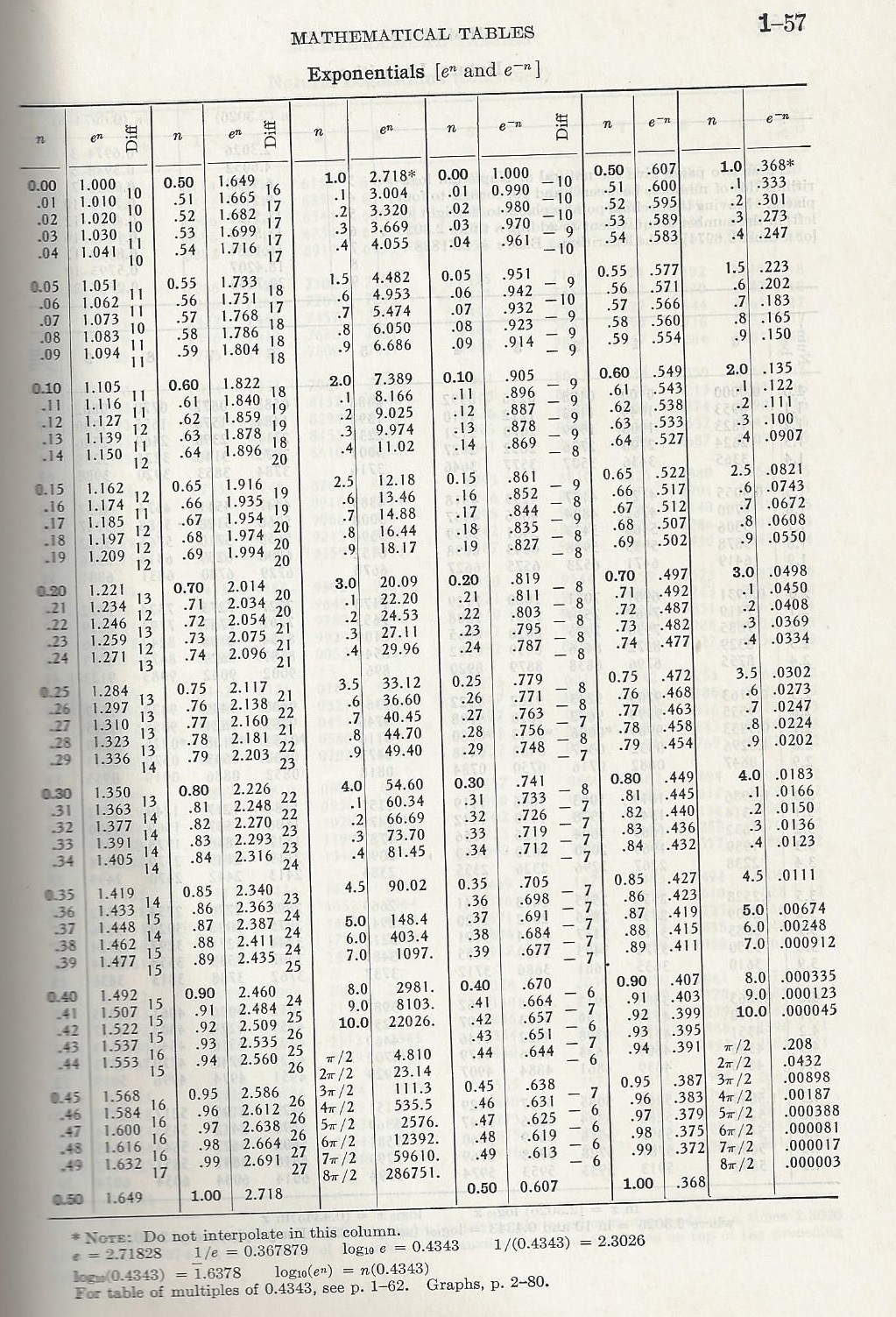
For now, I’m going to ignore how Feynman did this computation in his head and instead discuss “the table.” The setting for this story was approximately 1940, long before the advent of handheld calculators. I’ll often ask my students, “The Brooklyn Bridge got built. So how did people compute e^x before calculators were invented?” The answer is by Taylor series, which were used to produce tables of values of e^x. So, if someone wanted to find e^{3.3}, they just had a book on the shelf.

For example, the following page comes from the book Marks’ Mechanical Engineers’ Handbook, 6th edition, which was published in 1958 and which I happen to keep on my bookshelf at home.
ExponentTable

Look down the fifth and sixth columns of this table, we see that e^{3.3} \approx 27.11. Somebody had computed all of these things (and plenty more) using the Taylor series, and they were compiled into a book and sold to mathematicians, scientists, and engineers.

But what if we needed an approximation better more accurate than four significant digits? Back in those days, there were only two options: do the Taylor series yourself, or buy a bigger book with more accurate tables.

Teens do better in science when they know Einstein and Curie also struggled

From http://qz.com/622749/teens-do-better-in-science-when-they-know-einstein-and-curie-also-struggled/:

The study, published in the Journal of Educational Psychology, divided 402 ninth- and 10th-graders from four New York City public schools in Harlem and the Bronx into three groups. One group read an 800-word excerpt from a scientific textbook on the accomplishments of Albert Einstein, Marie Curie, and Michael Faraday (an English scientist who made discoveries about electromagnetism).

Another group learned about the scientists’ personal struggles, such as the fact that Einstein had to flee Nazi Germany to avoid persecution, or Marie Curie had to study in secret because women were discouraged from academic pursuits at the time. The third group learned about the scientists’ intellectual struggles and how they confronted them.

After six weeks, the two groups who learned about how the scientists struggled significantly improved their science grades and increased their motivation to study science. The lowest performing students showed the greatest gains.

Meanwhile, the students who learned only about the scientists’ achievements performed worse. They believed the scientists were innately gifted—unlike themselves.

The Shortest Known Paper Published in a Serious Math Journal

Source: http://www.openculture.com/2015/04/shortest-known-paper-in-a-serious-math-journal.html

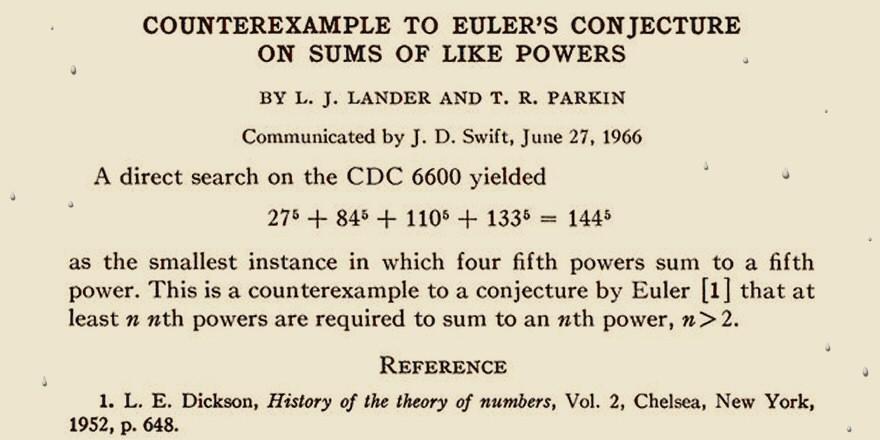
Euler’s conjecture, a theory proposed by Leonhard Euler in 1769, hung in there for 200 years. Then L.J. Lander and T.R. Parkin came along in 1966, and debunked the conjecture in two swift sentences. Their article — which is now open access and can be downloaded here — appeared in the Bulletin of the American Mathematical Society.


Irrational / Everything’s relative

One popular (though maybe apocryphal) story from the history of mathematics involves the discovery of irrational numbers by Pythagoras and his disciples. The following quote is from the book Fermat’s Last Theorem by Simon Singh:

One story claims that a young student by the name of Hippasus was idly toying with the number \sqrt{2}, attempting to find the equivalent fraction. Eventually he came to realize that no such fraction existed, i.e. that \sqrt{2} is an irrational number. Hippasus must have been overjoyed by his discovery, but his master was not. Pythagoras had defined the universe in terms of rational numbers, and the existence of irrational numbers brought his ideal into question. The consequence of Hippasus’ insight should have been a period of discussion and contemplation during which Pythagoras ought to have come to terms with this new source of numbers. However, Pythagoras was unwilling to accept that he was wrong, but at the same time he was unable to destroy Hippasus’ argument by the power of logic. To his eternal shame he sentenced Hippasus to death by drowning.

When I was a boy, the story was told that Pythagoras could not accept irrational (i.e.., cannot be written as the ratio of two integers) numbers because their existence would mean that we live in an irrational (i.e., insane, crazy) world, and so he had the unfortunate discoverer silenced.

When I present this story to my own students, they’re usually incredulous about the story, doubting that someone so smart could act so stupidly (or irrationally). Then I’ll tell them a much more recent story, from less than 100 years ago, about how a scientific principle morphed into a statement of ethics. Einstein’s theories of special relativity and general relativity were developed in the early 1900s; his theory of general relativity explained precession in the orbit of Mercury and predicted the deflection of starlight by the Sun’s gravity, which were both unexplained by Newtonian mechanics.

Writing to a popular audience, Einstein summarized his theory as follows:

The ‘Principle of Relativity’ in its widest sense is contained in the statement: The totality of physical phenomena is of such a character that it gives no basis for the introduction to the concept of “absolute motion”; or, shorter but less precise: There is no absolute motion.

The following sentences from Paul Johnson’s Modern Times summarize the popular reaction to Einstein’s work:

But for most people, to whom Newtonian physics, with their straight lines and right angles, were perfectly comprehensible, relativity never became more than a vague source of unease. It was grasped that absolute time and absolute length had been dethroned; that motion was curvilinear… At the beginning of the 1920s the belief began to circulate, for the first time at a popular level, that there were no longer any absolutes: of time and space, of good and evil, of knowledge, above all of value. Mistakenly, but perhaps inevitably, relativity became confused with relativism.

Indeed, the modern catchphrase “everything’s relative” was spawned shortly after the discovery of special and general relativity, a moral principle that Einstein himself abhorred.

So, after telling the story about Pythagoras and \sqrt{2}, I’ll use this story to hold up a mirror to ourselves, demonstrating that the passage of time has not made us immune from translating mathematical or scientific principles into statements of ethics.

10 Secret Trig Functions Your Math Teachers Never Taught You

Students in trigonometry are usually taught about six functions:

\sin \theta, \cos \theta, \tan \theta, \cot \theta, \sec \theta, \csc \theta

I really enjoyed this article about trigonometric functions that were used in previous generations but are no longer taught today, like \hbox{versin} \theta and \hbox{havercosin} \theta:

http://blogs.scientificamerican.com/roots-of-unity/10-secret-trig-functions-your-math-teachers-never-taught-you/

Naturally, Math With Bad Drawings had a unique take on this by adding a few more suggested functions to the list. My favorites:

1729

The following little anecdote probably deserves to be known by every secondary mathematics teacher. From Wikipedia (see references therein for more information):

1729 is known as the Hardy–Ramanujan number after a famous anecdote of the British mathematician G. H. Hardy regarding a visit to the hospital to see the Indian mathematician Srinivasa Ramanujan. In Hardy’s words:

I remember once going to see him when he was ill at Putney. I had ridden in taxi cab number 1729 and remarked that the number seemed to me rather a dull one, and that I hoped it was not an unfavorable omen. “No,” he replied, “it is a very interesting number; it is the smallest number expressible as the sum of two cubes in two different ways.”

The two different ways are these:

1729 = 13 + 123 = 93 + 103

The quotation is sometimes expressed using the term “positive cubes”, since allowing negative perfect cubes (the cube of a negative integer) gives the smallest solution as 91 (which is a divisor of 1729):

91 = 63 + (−5)3 = 43 + 33

Numbers that are the smallest number that can be expressed as the sum of two cubes in n distinct ways have been dubbed “taxicab numbers”. The number was also found in one of Ramanujan’s notebooks dated years before the incident, and was noted by Frénicle de Bessy in 1657.