Engaging students: Square Roots

In my capstone class for future secondary math teachers, I ask my students to come up with ideas for engaging their students with different topics in the secondary mathematics curriculum. In other words, the point of the assignment was not to devise a full-blown lesson plan on this topic. Instead, I asked my students to think about three different ways of getting their students interested in the topic in the first place.

I plan to share some of the best of these ideas on this blog (after asking my students’ permission, of course).

This student submission again comes from my student Allison Metzler. Her topic, from Pre-Algebra: square roots.

green line

A2. How could you as a teacher create an activity or project that involves your topic?

The following activity, http://ispeakmath.org/2012/05/03/square-roots-with-cheez-its-and-a-graphic-organizer/, effectively engages students because it’s hands-on and allows the students to work together. The students would start with their own cheez-its, creating the smaller squares (1, 4,9). Then, they would work in groups by combining their cheez-its to make bigger squares. Eventually, they would come together as a class to see how big of a square they could create. This involves square roots because each time the student would create a square (assuming they know the properties of a square), they would see that the square root would equal the base of the square. Also, they would see that the base of a square could be any of its four sides because they are all congruent or equal. Thus, the reasoning behind the name, “square root”, would become more apparent. Because they wouldn’t have a calculator as a resource, this visual method of teaching would give the students a more efficient way of calculating square roots. This activity is an effective way to get the students to remember the concept of square roots because it involves food, it’s hands-on, and they’ll learn a visual method of calculating square roots.

green line

D4. What are the contributions of various cultures to this topic?

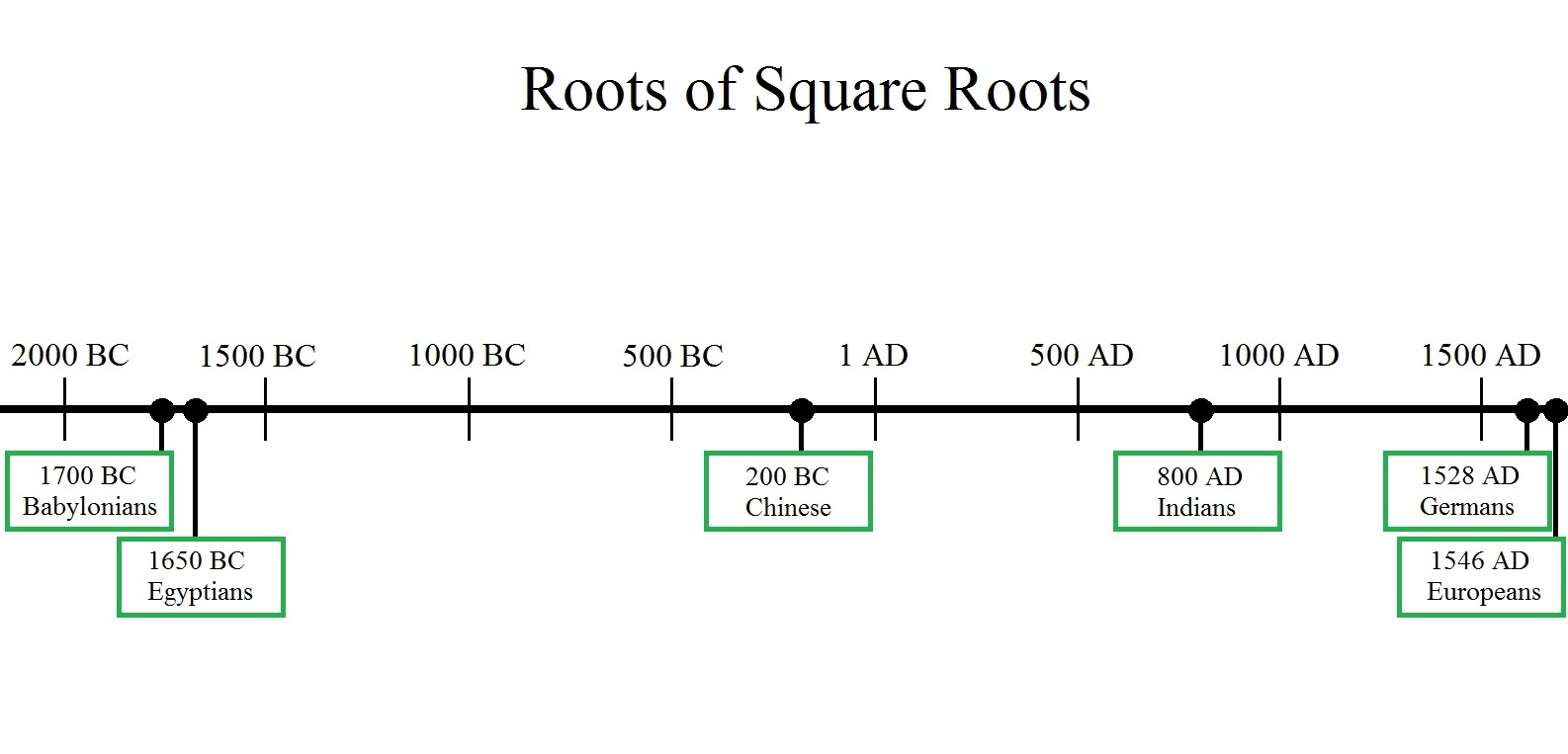
Many cultures have contributed to the concept of square roots. From 1800 BC to 1600 BC, the Babylonians created a clay tablet proving 2^1/2 and 30*2^1/2 using a square crossed by two diagonals. Within that time (1650 BC), a copy of an earlier work showed how the Egyptians extracted square roots. From 202 BC to 186 BC, the Chinese text Writings on Reckoning described a means to approximate the square roots of two and three. In the 9th century, the Indian mathematician Mahāvīra stated that square roots of negative numbers do not exist. Then, in 1546, Cantaneo introduced the idea of square roots to Europeans. The last major contribution to the concept of square roots was in 1528 when the German mathematician, Christoph Rudolff, introduced the modern root symbol in print for the first time.

To present this to the students, I would use the following timeline and proceed to briefly mention what each culture contributed to the topic of square roots.

Square Root Timelinegreen line

E1. How can technology (YouTube, Khan Academy [khanacademy.org], Vi Hart, Geometers Sketchpad, graphing calculators, etc.) be used to effectively engage students with this topic?

The video, https://www.youtube.com/watch?v=AfBQGLowyKU, uses Elvis’s (You’re So Square) Baby I Don’t Care and recreates it with lyrics relating to square roots. This video not only accurately describes the main components of square roots, but also includes actual examples of perfect squares and square roots. It points out that the square root is the inverse of the square of a number. It also describes the base and the exponent which are directly related to the square root. Because the video is based off an actual song, it should effectively engage students and help them remember it since it’s catchy. Also, it is a great way to introduce the topic to the students where they want to know more, but aren’t overwhelmed with the amount of new information.

green lineReferences:

Banta, Willy, prod. Think I’m a Square, Baby I Don’t Care. Perf. Elvis Presley. YouTube, 2011. Web. <http://www.youtube.com/watch?v=AfBQGLowyKU&gt;.

Reulbach, Julie. “Square Roots with Cheez-Its and a Graphic Organizer.” I Speak Math., 3 May 2012. Web. <http://ispeakmath.org/2012/05/03/square-roots-with-cheez-its-and-a-graphic-organizer/&gt;.

“Square Root.” Wikipedia. Wikipedia Foundation Inc., 10 Jan. 2014. Web. <http://en.wikipedia.org/wiki/Square_root#History&gt;.

For your enjoyment:

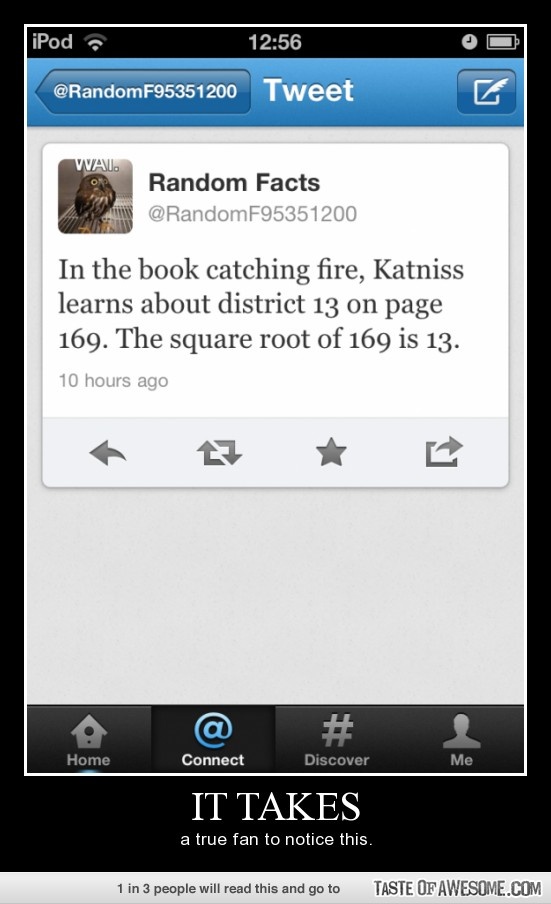
HungerGamesSquareRoot

Engaging students: Pascal’s triangle

In my capstone class for future secondary math teachers, I ask my students to come up with ideas for engaging their students with different topics in the secondary mathematics curriculum. In other words, the point of the assignment was not to devise a full-blown lesson plan on this topic. Instead, I asked my students to think about three different ways of getting their students interested in the topic in the first place.

I plan to share some of the best of these ideas on this blog (after asking my students’ permission, of course).

This student submission comes from my former student Roderick Motes. His topic, from Precalculus: Pascal’s triangle.

green line

History – What are the contributions of various cultures to this topic?

Through doing this project I learned that the history of Pascal’s triangle is actually pretty fascinating, and could be an excellent talking point for students.

Pascal’s Triangle was named after Blaise Pascal, who published the right angled version of the triangle, the binomial theorem, and the proof that n choose k corresponds to the kth element of the nth row of the triangle. But this wasn’t the first time interesting results about the triangle had been published, not even in the west.

The triangle was actually independently developed and worked on as early as the 11’th century in both China and modern day Iran. In China two mathematicians, Chia Hsien and Yang Hui, worked on the triangle and it’s applications to solving polynomials. Hsien used the triangle to aid in solving for cubic roots. Hui built upon the work of Hsien and actually gave us the first visual model of the triangle and used the triangle to aid in solving higher degree roots.

Pascals_triangle_China

Independently Omar Khayyam in Persia (modern Iran) used the triangle and binomial theorem (which was known to Arabic mathematicians at the time) to solve nth roots of polynomials.

In addition the triangle was used before Pascal to solve cubic equations, and in Europe in particular we get to the old controversy of Cardano and Del Ferro of ‘who found the general formula for cubic roots’ because another Italian man by the name of Niccolo Tartaglia claimed to have used the triangle to solve cubics and dervice the formula before Cardano published his formula.

So there were a variety of cultures who all independently recognized the significance of the triangle and used it well before Pascal. Consequently the triangle is called many things in many cultures. In China it is referred to as Yang Hui’s triangle, in Iran it is still called the Khayyam-Pascal triangle. All this goes to show that the history we think we know of mathematics may not be quite so true, and that mathematical understanding is the product of many cultures over many years.

green line

Technology- How can you effectively use technology to engage students on this subject?

There are a variety of technological resources you could use to craft a lesson. In particular I’m fond of the Texas Instruments exploration lessons. The lessons are available for free at education.ti.com and come with a slew of materials and handouts prepared for you. I’ve used the TI Nspire to teach the Law of Sines and the activity went tremendously well.

For Pascal’s Triangle and Binomial Theorem there are equivalent lessons with the TI Nspire and TI 84. The links are included at the end of this. The lessons allow the students to see Pascal’s triangle side by side with the triangle of coefficients which they are generating on the calculator. This could be backed up with having the students physically create the triangles on paper and see that they match up. The lesson then has the students conjecture what they believe the binomial theorem is.

This could be a powerful lesson for engaging learners of various strengths. Kinetic learners will love the physical action of the calculator, visual learners will love seeing the triangles update in real time.

green line

Curriculum- How can this topic be extended to your students future math courses?

Pascal’s triangle has a large relationship to probability and statistics. There are a variety of ways you can tie statistics lessons back to Pascal’s triangle and the binomial theorem. In particular we can examine how we might game a Pachinko machine in order to maximize our winnings.

Pachinko (or Plinko or a variety of other things depending on where you are) is fairly simple in idea.

You have a rectangular grid of pegs in which each row is slightly offset from the row above it. You drop a disc or puck of some kind down and attempt to get it into one of the small bins at the bottom. Sometimes prizes will be attached to certain bins (this is a popular carnival game) and sometimes money will (this is also a popular gambling game.)

The bin in which the puck will land follows a normal distribution based on the starting position. This is unsurprising and can be introduced very easily in a Statistics class when you’re teaching about probability distributions and normal distributions. What is more interesting is that this is very deeply related to Pascal’s Triangle.

Overlaying the triangle on top of the machine yields a triangle which shows the number of possible paths to get to each point. You can use this to make a statistical analysis and actually assign values to the probability of landing in a given spot. Using this knowledge you can game the machine and maximize your odds of getting the giant teddy bear or the fat stack of cash.

This application of Pascal’s triangle and its relationship to elementary combinatorics (which should hearken back to Middle School mathematics in addition to being extendable into Statistics,) is looked at in depth in a paper by Katie Asplund of Iowa State University. I have included this paper below. In addition to this suggestions she also relates a specific activity useful in the exploration where the students look at the various options of n choose k and relate the possibilities back to Pascal’s Triangle. I could not get the link for that specific activity as it requires access to Mathematics Teacher which I was unable to find using the UNT Library Resources.

plinko

References and Other Such Things

http://www.math.iastate.edu/thesisarchive/MSM/AsplundCCSS09.pdf

–          This paper is written by Katie Asplund. In it she explores a variety of patterns and connections between Pascal’s Triangle and various parts of the high school math curriculum. In particular she is interested in seeing how she can relate the patterns to her own high school pre calculus class. I recommend reading this entirely because it is simply illuminating and has quite a few suggestions you could implement.

http://pages.csam.montclair.edu/~kazimir/history.html

–          This website has a quick history of Pascal’s triangle as well as several applications. Using this and Wikipedia I was able to learn about the histories and cultures which led to our modern understanding of the triangle. In particular Omar Khayyam is a very interesting person to talk about if you feel like injecting some history of the Islamic Golden Age and the history of Mathematics after the fall of Rome. Khayyam was a Poet as well as a mathematician, and was one of the first to openly question Euclid’s use of the Parallel Postulate.

http://education.ti.com/calculators/downloads/US/Activities/Detail?id=11139&ref=%2fcalculators%2fdownloads%2fUS%2fActivities%2fSearch%2fKeywords%3fk%3dPascal

–          This is the TI Nspire activity on the Binomial Theorem and Pascal’s Triangle. It’s fairly straightforward but, like many of the TI Activities, it has some nice tricks that it uses the calculator to accomplish.

Engaging students: The area of a circle

In my capstone class for future secondary math teachers, I ask my students to come up with ideas for engaging their students with different topics in the secondary mathematics curriculum. In other words, the point of the assignment was not to devise a full-blown lesson plan on this topic. Instead, I asked my students to think about three different ways of getting their students interested in the topic in the first place.

I plan to share some of the best of these ideas on this blog (after asking my students’ permission, of course).

This student submission comes from my former student Dale Montgomery. His topic, from Geometry: the area of a circle.

green line

History

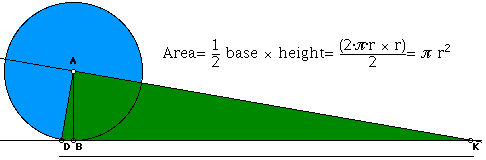
Archimedes was the mathematician who we attribute with finding the area of a circle to be  Where r is the radius and π is the ratio of circumference to diameter of a circle. (Note that Archimedes was not the first to find the area of a circle, but was the first to find π). I would really like to start the class with something along the lines of introducing Archimedes supposed final words “Do not disturb my circles.” And then go into the death of Archimedes and the mystery surrounding his tomb, such as the account of Cicero and the fact that no one knows where the tomb is now. Cicero said that his tomb had a sphere inscribed in a cylinder, which Archimedes considered to be his greatest mathematical proof. From there, the class should have great interest in what is going on. And we can talk about the fact that the area of a circle is the same as the area a triangle with the same base as the circumference and the same height as the radius. ArchimedesCircle

Rorres, Chris. “Tomb of Archimedes – Illustrations”. Courant Institute of Mathematical Sciences. Retrieved 2011-03-15.

green line

Culture

http://newsfeed.time.com/2013/02/02/are-crop-circles-more-than-just-modern-pranks/

I would show this article in class, most likely passing it out to read. I would ask if they thought it was a prank, and then give them a similar picture as presented in the article but mapped out with radiuses. Then I would say that the average person could do so many square feet of crop’s per hour. If it gets dark at 9 pm and the sun comes up at 6 am, could a person pull a prank like this?

After we discussed how to find the area of a circle I would have found one that it was impossible for one person to do. Then I would display this youtube video.

Seeing that there were 2 people working on it could display that it is possible for it to be a hoax. I like this because it gives the students a way to analyze information that they are given. Does it make sense for these things to be aliens? Not really, so let’s find other explanations. It both introduces the concept and teaches some critical thinking skills.

green lineApplications

You could apply the area of a circle to the diameter of a pizza. When you order pizza you order things like an 8 or a 12 inch. These are diameters and do not give the best idea of how much pizza you are actually getting. You can even include this lesson with a pizza party or something similar. This would easily get kids excited since it is something that most kids like, and they would have the possibility of getting pizza afterwards.

pizza

Engaging students: the difference of two squares

In my capstone class for future secondary math teachers, I ask my students to come up with ideas for engaging their students with different topics in the secondary mathematics curriculum. In other words, the point of the assignment was not to devise a full-blown lesson plan on this topic. Instead, I asked my students to think about three different ways of getting their students interested in the topic in the first place.

I plan to share some of the best of these ideas on this blog (after asking my students’ permission, of course).

This student submission comes from my former student Dale Montgomery. His topic, from Algebra II: the difference of two squares.

green line

Application/Future Curriculum (science)-

You can use difference of squares to find a basic formula to be used in any problem where you drop an object and want to find what time it will take to land. This physics concept will be of interest to your students considering any mechanical science and a useful tool to introduce problem solving by manipulating equations.

Take any height h. If you were to drop an object from this height then it could be modeled with a distance over time graph using the equation

(h- 9.8/2) t^2.

By applying difference of squares you get the expression

[\sqrt{h}+\sqrt{4.9}] t) \times ( [\sqrt{h} - \sqrt{4.9}] t).

Then by setting this expression equal to 0 and manipulating you would get that
t = \pm \displaystyle \frac{\sqrt{h}}{\sqrt{4.9}}.

I like a situation like this because it allows you to give them linking knowledge about quadratic equations. Most students may not have been exposed to this type of physics yet.  However, it is a requirement, and having this knowledge will help them in that class. On top of that it helps with equation manipulation and answering the question, “Does my answer make sense.” This question needs to be asked since it is possible for a student to get an answer of negative time. All of these skills combined with the new topic of difference of squares make for a multifaceted problem. This would probably not be great for day 1 of difference of squares, but I could see it as an engage for the continuance of the lesson.

green line

Curriculum:

You can use the idea of graphing to show that difference of squares works. This is a good way to give visual representation to your students who need it. If you compare the factoring of x^2-9 to the graph of y=x^2-9 and finding the roots of that graph, you can show that they have the same solutions. It is not that novel, but this visual can just help the idea click into students’ minds.

ParabolaGraph

green line

Manipulative

A manipulative that I got the idea for from http://www.gbbservices.com/math/squarediff.html is using squares to show the difference of squares. This is done quite easily as shown in the picture below. This could be done along a lesson on difference of squares. Maybe this would follow easily from a factoring using algebra tiles. The image below is fairly self explanatory and would really help if made into a hands-on manipulative that kinesthetic learners could make great use of.
DifferenceOfTwoSquares

Engaging students: Multiplying and dividing rational expressions

In my capstone class for future secondary math teachers, I ask my students to come up with ideas for engaging their students with different topics in the secondary mathematics curriculum. In other words, the point of the assignment was not to devise a full-blown lesson plan on this topic. Instead, I asked my students to think about three different ways of getting their students interested in the topic in the first place.

I plan to share some of the best of these ideas on this blog (after asking my students’ permission, of course).

This student submission comes from my former student Kayla (Koenig) Lambert. Her topic, from Pre-Algebra: solving proportions.

green line

B) Curriculum: How does this topic extend what your students have learned in previous courses?

Multiplying and dividing rational expressions extends so many topics because the students have to use what they have learned up to multiplying and dividing the rational expressions. For example, this topic extends multiplying and dividing fractions. For multiplying and dividing fractions the students need to multiply across the numerators and multiply across the denominators and then simplify when possible (Multiplying Rational Expressions). Students also use factoring, which they should have learned before getting to this topic. When factoring, the students should remember different ways to factor. Some different ways are finding the greatest common factor, factoring by grouping, and finding the perfect square. They should also remember how to factor polynomials of different degrees.

The students also need to remember how to divide numerical fractions because they use the same method when dividing rational expressions; multiplying by the reciprocal. Another topic students should have previously learned is how to simplify rational expressions and how to multiply polynomials. Lastly, the students should also remember what a term, coefficient, constant, degree of a term, degree of a polynomial and should remember different types of polynomials (monomial, binomial, etc.). I could keep going with what topics are used when multiplying and dividing rational expressions all the way down to counting, addition, and subtraction. There are obviously so many different topics students have learned in the past that are extended when multiplying and dividing rational expressions.

green line

D) History: What are the contributions of various cultures to this topic?

We can break multiplying and dividing rational expressions into many different mathematical subjects. In order to accomplish multiplying and dividing rational expressions, basic algebra and other basic mathematics had to come first. Methods of multiplication were documented by ancient Egyptian, Greek, and Chinese civilizations (Multiplication-Wikipedia). Around 1800 BC, Egyptians were the first known to use fractions. In 1600 BC, the Babylonians already knew solutions to quadratic equations and also solutions to equations to the third and fourth degree (Mathematics History). Egyptians used papyrus to make papers and used these to “calculate fractions” (Mathematics History).

The word polynomial comes from the Greek work “poly” meaning “many” and from the Latin word “binomium” meaning “binomial” and was introduced in Latin by a French mathematician, Franciscus Vieta (Polynomial-Wikipedia). The history of algebra goes back to ancient Egypt and Babylon where people learned to solve linear and quadratic equations. Also, Islamic mathematicians were able to multiply, divide and find the square root of polynomials.  The Hindu-Arabic numerical system was first described by Brahmagupta who gave rules for addition, subtraction, multiplication and division. In orient mathematics, algebra “ultimately evolved from arithmetic” (Mathematics History). Nicole Oresme, from Normandy, was the first person to use fraction and exponents. Many cultures have contributed to multiplying and dividing rational expressions, but I would have to say that the Egyptians, Babylonians, Chinese, and Arabic have contributed the most.

green line

E) Technology: How can technology (YouTube, Geometers Sketchpad, graphing calculator, etc.) be used to efficiently engage students with this topic?

Rational functions are used for many things including:

  • Fields and forces in physics
  • Spectroscopy in chemistry
  • Enzyme kinetics in biochemistry
  • Electronic circuitry
  • Aerodynamics
  • Medicine concentration
  • Wave functions for atoms and molecules
  • Optics and photography to improve image resolution
  • Acoustics and sound

Since the above topics are a little too advanced, I could show the student a video on YouTube to introduce the topic and to show them what multiplying and dividing rational functions are used for in the real world. After this, I would explain to the students that many other careers use rational functions like architects, foresters, and chemists. After talking about the topic, I could them give them a problem like the one below and ask them to graph the rational function with their calculator and can use their calculator to set up tables of values for their rational function. This will make it easy for them to see the maximum and minimum of the function and to see how the function behaves.

Example 9 from PreCalculus:

A rectangular page is designed to contain 48 square inches of print. The margins at the top and bottom of the page are 1 inch deep. The margins on each side are 1 ½ inches wide. What should the dimensions of the page be so the least amount of paper is used?

Works Cited

Larson, Ron, and David C. Falvo. “Precalculus – Ron Larson, David C. Falvo – Google Books.” 7 Feb. 2012. http://books.google.com/books?id=JRzhE6yqeFcC&pg=PA125&dq=what+are+rational+functions+used+for&hl=en&sa=X&ei=1lo1T9zDN-GusQLcrpyuAg&ved=0CFwQ6AEwBQ#v=onepage&q=what%20are%20rational%20functions%20used%20for&f=false.

“Mathematics History.” ThinkQuest : Library. 7 Feb. 2012. http://library.thinkquest.org/22584.

“Multiplication – Wikipedia, the free encyclopedia.” Wikipedia, the free encyclopedia. 7 Feb. 2012. <http://en.wikipedia.org/wiki/Multiplication&gt;.

“Multiplying Rational Expressions.” Purplemath. 7 Feb. 2012. http://purplemath.com/modules/rtnlmult.htm.

“Polynomial – Wikipedia, the free encyclopedia.” Wikipedia, the free encyclopedia. 7 Feb. 2012. http://en.wikipedia.org/wiki/Polynomial_Functions#Polynomial_functions.

“Who Created Fractions | Ask Kids Answers.” AskKids Answers | AskKids.com. 7 Feb. 2012. http://answers.askkids.com/Math/who_created_fractions.

Engaging students: Central and inscribed angles

In my capstone class for future secondary math teachers, I ask my students to come up with ideas for engaging their students with different topics in the secondary mathematics curriculum. In other words, the point of the assignment was not to devise a full-blown lesson plan on this topic. Instead, I asked my students to think about three different ways of getting their students interested in the topic in the first place.

I plan to share some of the best of these ideas on this blog (after asking my students’ permission, of course).

This student submission comes from my former student Theresa (Tress) Kringen. Her topic, from Geometry: central and inscribed angles.

green line

What interesting word problems using this topic can students do now?

After defining the terms central angle and inscribed angle, students can use a central angles to draw a pie graph or pie chart. They can depict the data using a visual. Based in the percentage of any part of a whole, they will crate a fraction of the whole circle by dividing 360 degrees by that percentage to give the piece of the pie in which they needed to find.

Say a student is given the data below and asked to graph the data into a pie chart:

Students’ favorite colors:

Blue                10

Yellow             3

Red                 7

Orange            3

Green              10

Purple             6

Pink                 9

Other              2

Students would be required to give percentages based on the 50 students with the percentages listed as: Blue 20%, Yellow 6%, Red 14%, Orange 6%, Green 20%, Purple 12%, Pink 18%, other 4%. This would correspond to the percentage of the 360 degree central angle.

To tie in inscribe angles, I would have to students explain why a pie chart would not work with inscribed angles.

green line

How does this topic appear in high culture?

In order to engage students I could help them understand inscribed angles by relating it to the camera angle in their video games. Describing an inscribed angle as a camera angle on their video game would help them understand it better. As they move throughout the game, their camera angle changes. Based on the camera’s location, you are able to see a certain portion of the screen. If there isn’t much of an angle, the range of view is small or zoomed in. This could be explained as the radius of the circle. The smaller the radius, the less view there is. Thus, the opposite is true. If the radius is large, the camera has a larger view of the object. If the camera has a larger angle of view, more is visible in the camera. I would then relate this to the arc length that the angle creates. I would explain that if the angle of the camera is small, the area of the arc length, or view of the camera would also be small. If the angle of the camera is larger, the arc length or view of the camera is much larger.

green line

How can technology be used to effectively engage students with this topic?

Once students are given the application problem listed above, I could then engage them further by asking them to use word or excel to graph the information given into a document. They would be required to make a chart of the data with the listed percentages of each parameter along with the degree of the angle that the parameter requires to make the pie graph. I would require this since the technology would calculate this on its own without the student having to put in the effort. To make it fun, I would give the students a few extra minutes to make their pie graph their own by customizing it to reflect their personality and style.

To further engage them, I could also ask that each student create a questionnaire that asked each student what their favorite choice of any given set of choices were. They would be required to have at least 7 responses as to make a 7 piece pie chart, but they would be able to choose the topic, and find the information for their parameters on their own. Once they did this, they would be required to make an additional pie chart with their results to present to the class.


Engaging students: Finding least common multiples

In my capstone class for future secondary math teachers, I ask my students to come up with ideas for engaging their students with different topics in the secondary mathematics curriculum. In other words, the point of the assignment was not to devise a full-blown lesson plan on this topic. Instead, I asked my students to think about three different ways of getting their students interested in the topic in the first place.

I plan to share some of the best of these ideas on this blog (after asking my students’ permission, of course).

This student submission comes from my former student Theresa (Tress) Kringen. Her topic, from Pre-Algebra: finding least common multiples.

green line

What interesting word problems using this topic can your students do now?

While having students working on finding the least common multiples I could engage them by having them solve some word problems that would bring up real world problems in a way that they can relate what they learned to problems that deal more than with just numbers. One problem that could be presented ot the students is the following:

If you’re given packages of notebooks that contain 6 each and you are required to repackage them to send them to a school in need in groups of 22, what it the least amount of groups and original packages of notebooks that you can get without any notebooks left over?

In this problem, the students would be required to find the least common multiple of both 6 and 21. Since six doesn’t not go into 22 without a remainder, they would have to find lcm(6,22). Since the least common multiple of both 6 and 22 is 66, the students would have to apply what they know about least common multiples of numbers to figure out the word problem.

To continue with this, the students could then be asked to do the same thing for three numbers.

green line

How does this topic extend what your students should have learned in previous courses?

Students should have covered factors and multiples of numbers around fifth grade. Therefore finding the least common multiple of a number extends the topic from these previous topics. Since students can figure out the factors of a number, they should also know if one number is a factor of the second. If it is, then they will know that the second number is the least common multiple of the two given numbers. Say the students are given 3 and 9. The students should be able to tell right away that 3 goes into 9. Since 3×3=9 and 9×1=9 and since no number smaller than 9 can also be a multiple of nine, the least common multiple of 3 and 9 is 9.

When also looking at the least common multiples of a number, students know what multiples of a number are from previous courses. They will know that 18 is a multiple of nine as well as 27, 36, and 45. Students know that 3 times 9 is 27, but they will also know that since the multiples of 3 are 3, 6, 9, 12, 15, 18, 21, 24, 27, and 30, etc. they will also know that even though 3 times 9 is 27, that there is a number smaller than 27 that is also a common multiple of 3 and 9.

green line

How can technology be used to effectively engage students with this topic?

Students like games and it’s even better for the teacher if they are able to play while they learn or practice a given subject that they have learned. In order to engage each student, there a number of online games students can play to help them practice finding the least common multiples of given numbers. I have found a number of online games that students could go to for an activity. It pushes them, allows the students to go at their own pace, and allows students to be less worried about how fast or slow they are compared to other students.

One game is a timed game that gives the students two numbers to find the least common multiple of. They are given two minutes to see how many they can compute in that amount of time. They are still permitted to go at their own pace, but they are also pushing themselves to do better than the time before.

http://www.basic-mathematics.com/least-common-multiple-game.html

 A second game give the students two numbers and asks for the least common multiple. It is basically multiple choice since they are to select a number our of five or six different numbers. If they select the correct answer, they are permitted to “throw a snowball.” Each correct response helps them win the snowball fight.

http://www.fun4thebrain.com/beyondfacts/lcmsnowball.html


Engaging students: Slope-intercept form of a line

In my capstone class for future secondary math teachers, I ask my students to come up with ideas for engaging their students with different topics in the secondary mathematics curriculum. In other words, the point of the assignment was not to devise a full-blown lesson plan on this topic. Instead, I asked my students to think about three different ways of getting their students interested in the topic in the first place.

I plan to share some of the best of these ideas on this blog (after asking my students’ permission, of course).

This student submission comes from my former student Theresa (Tress) Kringen. Her topic, from Algebra I: the point-slope intercept form of a line.

green line

What interesting word problem using this topic can your students do now?

When learning about slope-intercept from of a line, word problems would help my students engage and help process the information in a real world situation. I would present an equation for the speed of a ball that is thrown in a straight line up into the air. The equation given: v= 128-32t. I would explain that because we’re working with time and speed, height is not a variable in the equation. With v representing the speed or velocity of the ball in feet per second and t representing the time in seconds that has passed. I would include the following questions:

1. What is the slope of the given equation? Since the equation is given in slope intercept form, the students should be able to give the answer quickly if they understood the lesson. The answer is -32.

2. Without graphing the equation, which way would the line be headed, up and to the right or down and to the right? Because the students know that the slope is negative and given that they understood the lesson, they should be able to answer that the line is decreasing and is headed down and to the right.

http://www.purplemath.com/modules/slopyint.htm

green line

How can this topic be used in your students’ future courses in mathematics or science?

Students can use this topic for many math or science courses. When dealing with a linear equation, slope-intercept form of a line can help the student understand what the graph looks like without actually graphing it. This is useful when needing to find the y intercept (when x is equal to zero) and what the slope of the line is. This is also useful to know for understanding what slope is. When students understand that a slope of a particularly large number (a large whole number such as 1,000 or an improper fraction that equates to a large number such as 30,999/2) is rising quickly as opposed to a slope of a smaller number  (a smaller whole number such as two or a fraction that represents a very small portion of one such as 1/30,000) which is not rising quickly. It is helpful for the students to understand that a very large slope will look almost vertical and a small slope will look almost horizontal, with both depending on the degree of largeness or smallness.

green line

How can technology be used to effectively engage students with this topic?

When working with slope-intercept form, a student can actively be engaged through technology by attempting to make connections of how a graph looks on the graphing calculator and what the equation looks like in slope-intercept form. When allowing the students to make connections between them in small groups, they will have discovered the information form themselves. This will allow the students to more effectively program the information into their memories. To set this up, I would give each group a graphing calculator and a list of equations in slope-intercept form. On the paper with the list, I would have the students fill out information pertaining to the graph that they see. This information would include the slope and the y-intercept. I would split up the students into their cooperative learning groups two and ask them to draw a conclusion between where the line ends up compared to what the equation looks like. Once the students have typed their equation into the graphing calculator the students should fill out the paper provided. Once they have finished, I would ask them to see if they see any patterns between the equations and their answers.


Engaging students: Order of operations

In my capstone class for future secondary math teachers, I ask my students to come up with ideas for engaging their students with different topics in the secondary mathematics curriculum. In other words, the point of the assignment was not to devise a full-blown lesson plan on this topic. Instead, I asked my students to think about three different ways of getting their students interested in the topic in the first place.

I plan to share some of the best of these ideas on this blog (after asking my students’ permission, of course).

This student submission comes from my former student Theresa (Tress) Kringen. Her topic, from Pre-Algebra: order of operations.

green line

How can this topic be used in your students’ future courses in mathematics or science?

Order of operations is commonly used in most mathematics problem that involve more than one operation or when parenthesis are involved. It would be easy to show the students what the answer to a given problem, say 5+20/5, would be when using the proper order of operations, then solve the problem by solving left to right as you would read a book. It is clear, to a math major, that the answer is 9. For someone who does not know the order of operations, they most likely would come up with the answer of 5. The difference in the correct answer and the incorrect answer is only 4, but the problem is only working with numbers less than or equal to twenty. It would then be beneficial to point out that when dealing with more complex problems, that this answer may become even larger.  If the class was working on given problems, I would give them a few word problems to solve. Once they solved them on their own, I would show them that the difference between the correct way to answer the given problem and the incorrect way to answer the problem to help them connect the concept to why it is important to compute answers in the way.

green lineHow does this topic extend what your students should have learned in previous courses?

This topic extends what students should have previously learned by allowing them to use their skills of multiplication, division, exponents, addition, and subtraction to solve more complex problems. When learning how to solve problems more complicated than what they have been given in the past, they use this topic to guide them through to the next step. They must already be familiar with all of the operations by themselves prior to using the order of operations to solve a problem. Once they are accustomed to using the order of operations, the will be given more challenging problems and their math skills will build upon itself. It is clear that if a student is unable to solve a simple problem, such as an exponent problem or a more complicated division problem, they will not be able to use the order of operations for problems that contain what they have not learned.

green line

How did people’s conception of this topic change over time?

It is believed that the idea of using multiplication before addition became a concept adopted around the 1600s and was not disagreed about. The other operations took their place in the order over time, beginning in the 1600s. It seems that although it was not documented well, most mathematicians agreed upon the same order. It wasn’t until books stated being published that it was important to document the order of operations. The notation may have been different depending on who was writing on the subject, but the concept was the same. It seems that although it was not documented well, most mathematicians agreed upon the same order. Once books were being published, the order, PEMDAS (Parenthesis, Exponents, Multiplication, Division, Addition, and Subtraction), was put into print. Now, teachers use the phrase Please Excuse My Dear Aunt Sally as a way for students to remember the acronym and are able to put it to use.

http://jeff560.tripod.com/operation.html

http://mathforum.org/library/drmath/view/52582.html

Engaging students: Powers and exponents

In my capstone class for future secondary math teachers, I ask my students to come up with ideas for engaging their students with different topics in the secondary mathematics curriculum. In other words, the point of the assignment was not to devise a full-blown lesson plan on this topic. Instead, I asked my students to think about three different ways of getting their students interested in the topic in the first place.

I plan to share some of the best of these ideas on this blog (after asking my students’ permission, of course).

This student submission comes from my former student Kayla (Koenig) Lambert. Her topic, from Pre-Algebra: powers and exponents.

green line

A) Applications: What interesting word problems using this topic can your students do now?


I chose the problem below from http://www.purplemath.com because I think that solving a problem that deals with disease would be interesting to my students. People have to deal with sickness and disease everyday and I think that solving a real world problem would entice the students into wanting to learn more.

A biologist is researching a newly-discovered species of bacteria. At time t = 0 hours, he puts one hundred bacteria into what he has determined to be a favorable growth medium. Six hours later, he measures 450 bacteria. Assuming exponential growth, what is the growth constant “k” for the bacteria? (Round k to two decimal places.)

For this exercise, the units on time t will be hours, because the growth is being measured in terms of hours. The beginning amount P is the amount at time t = 0, so, for this problem, P = 100. The ending amount is A = 450 at t = 6. The only variable I don’t have a value for is the growth constant k, which also happens to be what I’m looking for. So I’ll plug in all the known values, and then solve for the growth constant:

A = Pe^{kt}

450 = 100 e^{6k}

4.5 = e^{6k}

\ln(4.5) = 6k

k = \displaystyle \frac{\ln(4.5)}{6} = 0.250679566129\dots

The growth constant is 0.25/hour.

I think this kind of problem would be beneficial to students because it would help them understand how bacteria grows and how easily they can get catch something and get sick.


green line

C) Culture: How has this topic appeared in pop culture?

Exponents and powers are everywhere around us without the students knowledge. Many movies and video games have ideas related to powers and exponents. Take, for example, the movie Contagion that was released in September 2011. This movie is about “the threat posed by a deadly disease and an international team of doctors contracted by the CDC to deal with the outbreak” (http://www.imdb.com/title/tt1598778). In this movie, there is a scene where the doctors are using mathematical equations with exponents to find out how fast the disease spreads and how much time they have left to save the majority of the population. There are many movies like this that involve powers and exponents, Contagion is just one example. There are also popular video games that deal with the spread of disease. For example, in the video game Call Of Duty: World At War the player is a soldier in WWII and his mission is to kill zombies, and zombie populations grow exponentially. Now, my brother plays this game and I know for a fact that he doesn’t think about the mathematics behind it, but I think talking about pop culture while teaching would really bring some excitement to the classroom and get the students thinking.


green line

D) History: Who were some of the people who contributed to the discovery of this topic?

Exponents and powers have been among humans since the time of the Babylonians in Egypt. “Babylonians already knew the solution to quadratic equations and equations of the second degree with two unknowns and could also handle equations to the third and fourth degree” (Mathematics History). The Egyptians also had a good idea about powers and exponents around 3400 BC. They used their “hieroglyphic numeral system” which was based on the scale of 10. When using their system, the Egyptians expressed any number using their symbols, with each symbol being “repeated the required number of times” (Mathematics History). However, the first actual recorded use of powers and exponents was in a book called “Artihmetica Integra” written by English author and Mathematician Michael Stifel in 1544 (History of Exponents). In the 14th century Nicole Oresme used “numbers to indicate powering”(Jeff Miller Pages). Also, James Hume used Roman Numerals as exponents in the book L’Algebre de Viete d’vne Methode Novelle in 1636. Exponents were used in modern notation be Rene Descartes in 1637. Also, negative integers as exponents were “first used in modern notation” by Issac Newton in 1676 (Jeff Miller Pages).


Works Cited

Ayers, Chuck. “The History of Exponents | eHow.com.” eHow | How to Videos, Articles & More – Discover the expert in you. | eHow.com. N.p., n.d. Web. 25 Jan. 2012. http://www.ehow.com/about_5134780_history-exponents.html.

“Contagion (2011) – IMDb.” The Internet Movie Database (IMDb). N.p., n.d. Web. 25 Jan. 2012. http://www.imdb.com/title/tt1598778/.

“Exponential Word Problems.” Purplemath. N.p., n.d. Web. 25 Jan. 2012. http://www.purplemath.com/modules/expoprob2.htm.

“Mathematics History.” ThinkQuest : Library. N.p., n.d. Web. 25 Jan. 2012. http://library.thinkquest.org/22584/.

juxtaposition.. “Earliest Uses of Symbols of Operation.” Jeff Miller Pages. N.p., n.d. Web. 25 Jan. 2012. http://jeff560.tripod.com/operation.html.