Engaging students: Ratios and rates of change

In my capstone class for future secondary math teachers, I ask my students to come up with ideas for engaging their students with different topics in the secondary mathematics curriculum. In other words, the point of the assignment was not to devise a full-blown lesson plan on this topic. Instead, I asked my students to think about three different ways of getting their students interested in the topic in the first place.

I plan to share some of the best of these ideas on this blog (after asking my students’ permission, of course).

This student submission again comes from my former student Avery Fortenberry. His topic, from Algebra: ratios and rates of change.

green line

In this viral YouTube video a man asks his wife the question “If you are traveling 80 miles per hour, how long does it take to travel 80 miles.” The wife overthinks the question and instead of trying to calculate how long it would take using the information of 80 miles per hour and how that they were going to travel one hour, she tries to think of how quick the tires are spinning and estimating the speed using her speed in running. The couple later goes on to talk on the Comedy Central show Tosh.0 where the wife explains the reason she was confused was that she had not slept well the night before and she was stressed with just finishing her finals. This video stresses the importance of making sure people understand that 80 miles per hour means you travel 80 miles in one hour.


green line

The history of a rate of change is interesting when you consider the history of calculus itself. An important concept of calculus is finding derivatives, which is finding the rate of change or slope of a line. Calculus’s discovery was credited to both Isaac Newton and Gottfried Leibniz who both published their work around roughly the same time. This caused a dispute between the two men and they both accused the other of stealing their work. While both contributed much to the world of mathematics, it was many of Leibniz’s concepts of calculus that we still use today such as his notation dy/dx used for derivatives. Despite that Leibniz died poor and dishonored while Newton had a state funeral.


green line

One of my favorite websites is khanacademy.org. This website has helped me from when I was in high school all the way to now it is still helping me understand concepts I may not have fully understood in class. It is a valuable resource to use when teaching about rates of change because there are countless videos over rates of change and slope and derivative that explain in detail all the concepts of it. Also, it has multiple practice problems that help you practice and study for an exam. I even used it for this project to help refresh my memory on rates of change and I was also looking at its word problems to help think of a word problem on my own for the A1 section of this project. Khan Academy also teaches you by reviewing all difficult steps in problems so that you can understand all the concepts.


Resources:

https://www.youtube.com/watch?v=Qhm7-LEBznk

http://www.uh.edu/engines/epi1375.htm

www.Khanacademy.org


How to Avoid Thinking in Math Class: Index

I’m doing something that I should have done a long time ago: collecting a series of posts into one single post. Recently, Math With Bad Drawings had a terrific series on how students try to avoid thinking in math class.

Part 1: Introduction: “In teaching math, I’ve come across a whole taxonomy of insidious strategies for avoiding thinking. Albeit for understandable reasons, kids employ an arsenal of time-tested ways to short-circuit the learning process, to jump to right answers and good test scores without putting in the cognitive heavy lifting. I hope to classify and illustrate these academic maladies: their symptoms, their root causes, and (with any luck) their cures.”

Part 2: Students’ natural desire to mindlessly plug numbers into a formula without conceptual understanding.

Part 3: The importance of both computational proficiency and conceptual understanding.

Part 4: Fears of word problems.

Part 5: What happens when students get stuck getting started on a problem.

Part 6: Is only getting the right answer important?


Engaging students: Deriving the Pythagorean theorem

In my capstone class for future secondary math teachers, I ask my students to come up with ideas for engaging their students with different topics in the secondary mathematics curriculum. In other words, the point of the assignment was not to devise a full-blown lesson plan on this topic. Instead, I asked my students to think about three different ways of getting their students interested in the topic in the first place.

I plan to share some of the best of these ideas on this blog (after asking my students’ permission, of course).

This student submission comes from my former student Belle Duran. Her topic, from Geometry: deriving the Pythagorean theorem.

green line

How can technology be used to effectively engage students with this topic?

Using the video in which the scarecrow from The Wizard of Oz “explains” the Pythagorean theorem, I can get the students to review what the definition of it is. Since the scarecrow’s definition was wrong, I can ask the students what was wrong with his phrasing (he said isosceles, when the Pythagorean theorem pertains to right triangles). Thus, I can ask why it only relates to right triangles, starting the proof for the Pythagorean theorem.

green line

What interesting things can you say about the people who contributed to the discovery and/or the development of this topic?

While Pythagoras is an important figure in the development of mathematics, little is truly known about him since he was the leader of a half religious, half scientific cult-like society who followed a code of secrecy and often presented Pythagoras as a god-like figure. These Pythagoreans believed that “number rules the universe” and thus gave numerical values to many objects and ideas; these numerical values were endowed with mystical and spiritual qualities. Numbers were an obsession for these people, so much so that they put to death a member of the cult who founded the idea of irrational numbers through finding that if we take the legs of measure 1 of an isosceles right triangle, then the hypotenuse would be equal to sqrt(2). The most interesting of all, is the manner in which Pythagoras died. It all roots back to Pythagoras’ vegetarian diet. He had a strong belief in the transmigration of souls after death, so he obliged to become a vegetarian to avoid the chance of eating a relative or a friend. However, not only did he abstain from eating meat, but also beans since he believed that humans and beans were spawned from the same source, hence the human fetal shape of the bean. In a nutshell, he refused access to the Pythagorean Brotherhood to a wealthy man who grew vengeful and thus, unleashed a mob to go after the Brotherhood. Most of the members were killed, save for a few including Pythagoras (his followers created a human bridge to help him out of a burning building). He was meters ahead from the mob, and was about to run into safety when he froze, for before him stretched a vast bean field. Refusing to trample over a single bean, his pursuers caught up and immediately ended his life.


green line

How has this topic appeared in the news?

Dallas Cowboys coach, Jason Garrett recently made it mandatory for his players to know the Pythagorean theorem. He wants his players to understand that “’if you’re running straight from the line of scrimmage, six yards deep…it takes you a certain amount of time…If you’re doing it from ten yards inside and running to that same six yards, that’s the hypotenuse of the right triangle’” (NBC Sports). Also, recently the Museum of Mathematics (MoMath) and about 500 participants recently proved that New York’s iconic Flatiron building is indeed a right triangle. They measured the sides of the building by first handing out glow sticks for the participants to hold from end to end, then by counting while handing out the glow sticks, MoMath was able to estimate the length of the building in terms of glow sticks.

The lengths came out to be 75^2 + 180^2 = 38,025. After showing their Pythagorean relationship, MoMath projected geometric proofs on the side of the Flatiron building.


References

http://www.youtube.com/watch?v=DUCZXn9RZ9s

http://www.youtube.com/watch?v=X1E7I7_r3Cw

http://www.geom.uiuc.edu/~demo5337/Group3/hist.html

http://profootballtalk.nbcsports.com/2013/07/24/jason-garrett-wants-the-cowboys-to-know-the-pythagorean-theorem/

http://www.businessinsider.com/500-math-enthusiasts-prove-the-flatiron-building-is-a-right-triangle-2013-12

Engaging students: Factoring polynomials

In my capstone class for future secondary math teachers, I ask my students to come up with ideas for engaging their students with different topics in the secondary mathematics curriculum. In other words, the point of the assignment was not to devise a full-blown lesson plan on this topic. Instead, I asked my students to think about three different ways of getting their students interested in the topic in the first place.

I plan to share some of the best of these ideas on this blog (after asking my students’ permission, of course).

This student submission again comes from my former student Banner Tuerck. His topic, from Algebra: factoring polynomials.

green line

A1. What interesting (i.e., uncontrived) word problems using this topic can your students do now?

In relation to a specific case one can generate a word problem well within their students reach by relating the factors of a said quadratic polynomial to the length and width of a rectangle or perfect square. Many online resources, such as http://www.purplemath.com/, offer diverse and elaborate examples one could use in order to facilitate this concept. Nevertheless, this way of viewing a factored polynomial may appear more comfortable to a class because it is applying the students preexisting knowledge of area to the new algebraic expressions and equations. Furthermore, it has been my experience that geometric activities interrelating algebra aid in straying students away from ignoring the variable in an expression as a value.

A garden measuring 12 meters by 16 meters is to have a pedestrian pathway installed all around it, increasing the total area to 285 square meters. What will be the width of the pathway?

garden

The above problem is a prime example pulled from the Purple Math website one could use to illustrate a physical situation in which we need to actually determine the factors in order to formulate a quadratic expression to solve for the width. It should be noted that some of these particular word problems can quickly fall into a lesson relating more towards distributing and foiling factors to form an expanded form equation. However, as an instructor one can easily work backwards from an expanded equation to interpret what the factored form can tell us, say about the garden with respect to the example given above.


green line

B1. How can this topic be used in your students’ future courses in mathematics or science?

Factoring polynomials allows students to further comprehend the properties of these expressions before they are later applied as functions in areas such as mathematics and physics. For example, projectile motion stands as a great real world topic capable of enlightening students further on the factors of the polynomial. Specifically, how these factors come about geometrically and how knowing their role will benefit our understanding of the functions potential real world meaning. Lastly, factoring polynomials and evaluating them as roots during middle and high school mathematics will definitely be used when students approach college level calculus courses in relation to indefinite and definite integrals. The previous are just a few examples of how factoring polynomials plays a role in students’ future courses.


green line

How can technology (YouTube, Khan Academy [khanacademy.org], Vi Hart, Geometers Sketchpad, graphing calculators, etc.) be used to effectively engage students with this topic?

Doing a simple YouTube search of the phrase “factoring polynomials” allows anyone access to nearly 57,000 videos of various tutors, instructors, and professors discussing factoring and distributing respectfully. I would say that future generations will definitely not be without resources. That is not even to mention the revolutionary computation website that is www.wolframalpha.com. This website in and of itself will allow so many individuals to see various forms of a factored polynomial, as well as the graph, roots (given from factors), domain, range, etc. Essentially, computation websites like Wolfram Alpha are intended to allow students the opportunity to discover properties, relationships, and patterns independently. However, there is a potential risk for such websites to become a crutch the students use in order to get good grades as opposed to furthering their understanding. Similarly, with the advancing technology of graphing calculators students will become more engaged when discussing polynomial factorization for the first time in class. Many modern calculators have the ability to identify roots, give a table of coordinates, trace graphs, etc. Some even have a LCD screen or a backlit display to aid in viewing various graphs. Although, just as with computation engines, calculators could potentially distract students from thinking about their problem solving method by them just letting the calculator take over the calculation process. Therefore, I would suggest using caution regarding how soon calculators are introduced when initially engaging a class in factoring polynomials.


References:

http://www.purplemath.com/

http://www.purplemath.com/modules/quadprob2.htm

http://www.wolframalpha.com/

https://www.youtube.com/results?search_query=factoring+polynomials


Mathematics A to Z: Part 5

Last summer, Nebus Research had a fun series on the definitions of 26 different mathematical terms, one for each letter of the alphabet. Here are the words from U to Z:

U is for unbounded, which comes up again and again in calculus.

V is for vertex, as used in graph theory (and not a special point on a parabola or a hyperbola).

W is for well-posed problem, which essentially means “satisfies a set of conditions so that the problem can be numerically solved.”

X is for xor (or exclusive or), a concept from discrete mathematics and logic.

Y is for y-axis, a common notion from algebra class that gets surprisingly deeper once students are introduced to linear algebra.

Z is for z-transform, a notion from signal processing.

Mathematics A to Z: Part 4

Last summer, Nebus Research had a fun series on the definitions of 26 different mathematical terms, one for each letter of the alphabet. Here are the words from P to T:

P is for proper, a synonym for non-trivial.

Q is for quintile, which is similar to “percentile” from descriptive statistics.

R is for ring, a concept from abstract algebra (along with “group” and “field”). I had not known, before reading this post, that there was actually controversy behind how a ring should be defined.

S is for step, as in “How many steps does this proof require?” (I distinctly remember a two-column proof from my high-school geometry class that required something like 80 or 100 steps and the exhilarating triumph of completing it.)

T is for tensor, a generalization of matrices.

Mathematics A to Z: Part 3

Last summer, Nebus Research had a fun series on the definitions of 26 different mathematical terms, one for each letter of the alphabet. Here are the words from K to O:

K is for knot, a seemingly abstract area of mathematics that has surprising applications in biology.

L is for locus, a word that’s unfamiliar to today’s math majors but was hammered into my head when I was a student. I distinctly remember learning the definition of an ellipse as the locus of points so that the sum of the distances from two fixed points to that point is a constant.

M is for measure, as in “measure theory” behind Lebesgue integration. There’s also a nice discussion of the paradoxical Cantor set that has dimension \ln 2/\ln 3.

N is for n-tuple, of which the most common type is a vector in \mathbb{R}^n.

O is for orthogonal, a synonym for perpendicular.

Mathematics A to Z: Part 2

Last summer, Nebus Research had a fun series on the definitions of 26 different mathematical terms, one for each letter of the alphabet. Here are the words from F to J:

F is for fallacy, or a mathematical argument can includes incorrect reasoning.

G is for graph, as in graph theory (as opposed to an ordinary x-y Cartesian graph.

H is for hypersphere, which is the generalization of a circle or sphere into n-dimensional space. As a student, one of my favorite formulas was the one for the volume of a hypersphere in \mathbb{R}^n:
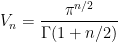
V_n = \displaystyle \frac{\pi^{n/2}}{\Gamma(1 + n/2)}

I is for into, a possible characteristic of a function f : A \to B.

J is for jump discontinuity, of the concepts that shouldn’t be brand-new to students at the start of a calculus class but often is.

Mathematics A to Z: Part 1

Last summer, Nebus Research had a fun series on the definitions of 26 different mathematical terms, one for each letter of the alphabet. Here are the words from A to E:

A is for ansatz, a uniquely mathematical bit of lingo.

B is for bijection, which I called a one-to-one correspondence when I was a student in the 1980s-1990s. This is a fundamental notion in real analysis and explains why there are exactly as many integers as there are rational numbers, even though the integers are a proper subset of the rational numbers.

C is for characteristic function, which only takes values of 0 and 1. This is similar to an indicator random variable in probability but is different than the characteristic equation encountered in differential equations.

D is for dual, a common notion in graph theory. See also the follow-up post referring to this article on Saving School Math.

E is for error, not in the sense of “a mistake,” but in the sense of the difference between a number and a partial sum of an infinite series whose sum is that number.