Engaging students: Finding the volume and surface area of a pyramid or cone

In my capstone class for future secondary math teachers, I ask my students to come up with ideas for engaging their students with different topics in the secondary mathematics curriculum. In other words, the point of the assignment was not to devise a full-blown lesson plan on this topic. Instead, I asked my students to think about three different ways of getting their students interested in the topic in the first place.

I plan to share some of the best of these ideas on this blog (after asking my students’ permission, of course).

This student submission comes from my former student Natalie Moore. Her topic, from Geometry: finding the volume and surface area of a pyramid or cone.

green line

How could you as a teacher create an activity or project that involves your topic?

A great thing that first came to my mind was using manipulatives, especially for finding surface area. I would prefer to use legos as a manipulative, but that will not work very well when trying to find surface area of a pyramid or a cone. Using the traditional math manipulatives will work fine for these types of shapes. I always loved using manipulatives as a student. However, we did not use them at all, from what I can remember, in high school and most of middle school. It would be great to bring more manipulative use into the high school classrooms. It makes learning more fun for the students, and it also helps the student with retaining the information better. In regards to finding the volume of a pyramid or cone with manipulatives, it will be a little more of a challenge. Instead of maybe using manipulatives though, I was thinking about a different fun activity. The activity I have in mind will not necessarily tell us the exact volume of these shapes, but it will give the students an idea of what volume is. That way, once students have an understanding of volume, once they have a formula, it will be easier for them to use it and it apply it to a problem. The activity I have in mind is taking large versions of these shapes and filling them up with a different object and counting how many of that object can fit into different sizes of the shapes. For example, I would use a camping tent to represent a pyramid. I would have two or three different sizes of tents. I would then see how many students can fit in each sized tent. That way, they can see X amount of students can fit in one tent while Y amount of students fit in a different sized tent. For cones, I would do the same type of thing but the object I would use would be an ice cream cone and see how many scoops can fit into various sizes.

green line

How can this topic be used in your students’ future courses in mathematics or science?

Surface area, mainly just area, and volume show up all the time in other math classes, especially calculus based courses. In these types of higher level thinking courses, students will not necessarily have to find the area or volume of shapes, but if a student has to answer a word problem involving area and/or volume and they do not of a good grasp on these concepts, it will be harder for them to solve the word problem. There are times too where the student will have to solve the area or volume of a specific shape, and it will not always be something as simple as a square or rectangle. We need to make sure as teachers that we are doing all we can to instill these concepts into the students since they will need to know them for classes later on.



green line

How does this topic extend what your students should have learned in previous courses?

Before students will learn about the volume and surface area of pyramids and cones, they will typically learn about finding the area of rectangles and squares since those are the easiest to work with. Students are taught pretty early on how to find area of squares, rectangles, triangles, and circles. As they get older, they will learn about other shapes as well, especially 3-d shapes. After students have the basics of area down, then they will begin to learn about surface area and volume of these 3-d shapes. This is taking what they already know and taking it a step further to deepen their understanding.


Engaging students: Defining sine, cosine and tangent in a right triangle

In my capstone class for future secondary math teachers, I ask my students to come up with ideas for engaging their students with different topics in the secondary mathematics curriculum. In other words, the point of the assignment was not to devise a full-blown lesson plan on this topic. Instead, I asked my students to think about three different ways of getting their students interested in the topic in the first place.

I plan to share some of the best of these ideas on this blog (after asking my students’ permission, of course).

This student submission comes from my former student Loc Nguyen. His topic, from Geometry: defining sine, cosine and tangent in a right triangle.

green line

What interesting (i.e., uncontrived) word problems using this topic can your students do now?

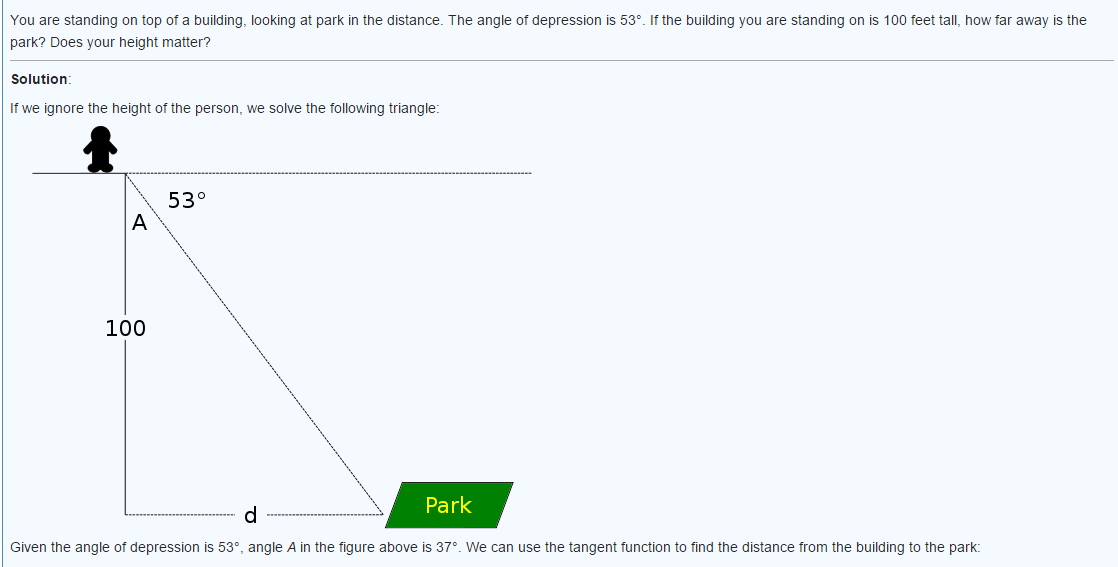
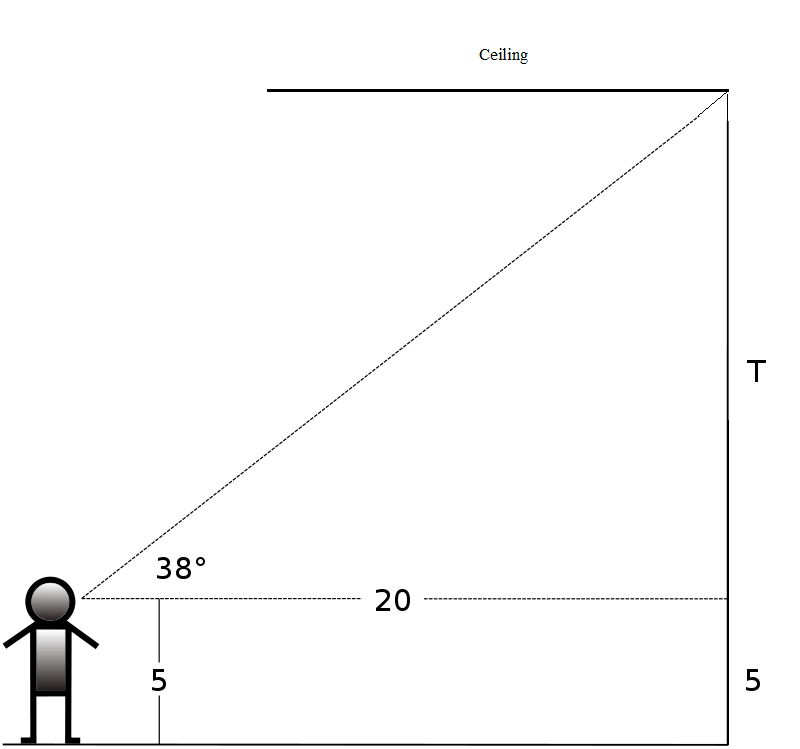
There are many real world applications that involve in this topic and I will incorporate some problems in real life to engage the students.  Suppose I have a classroom that has the shape of rectangular prism.  I will begin my lesson by challenging the students to find the height of the classroom and of course I will award them with something cool.  I believe this will ignite students’ curiosity and excitement to participate into the problem.  In the process of finding the height, I will gradually introduce the concept of right triangle trigonometry.  The students will learn the relationship of ratios of the sides in the triangle.  Eventually, the students will realize that they need this concept for finding the height of the classroom.  I will pose some guiding questions to drive them toward the solution.  Such questions could be: what can I measure? Can we measure the angle from our eyes to the opposite corner of the ceiling point?   What formula will help me to find the height?
trig1


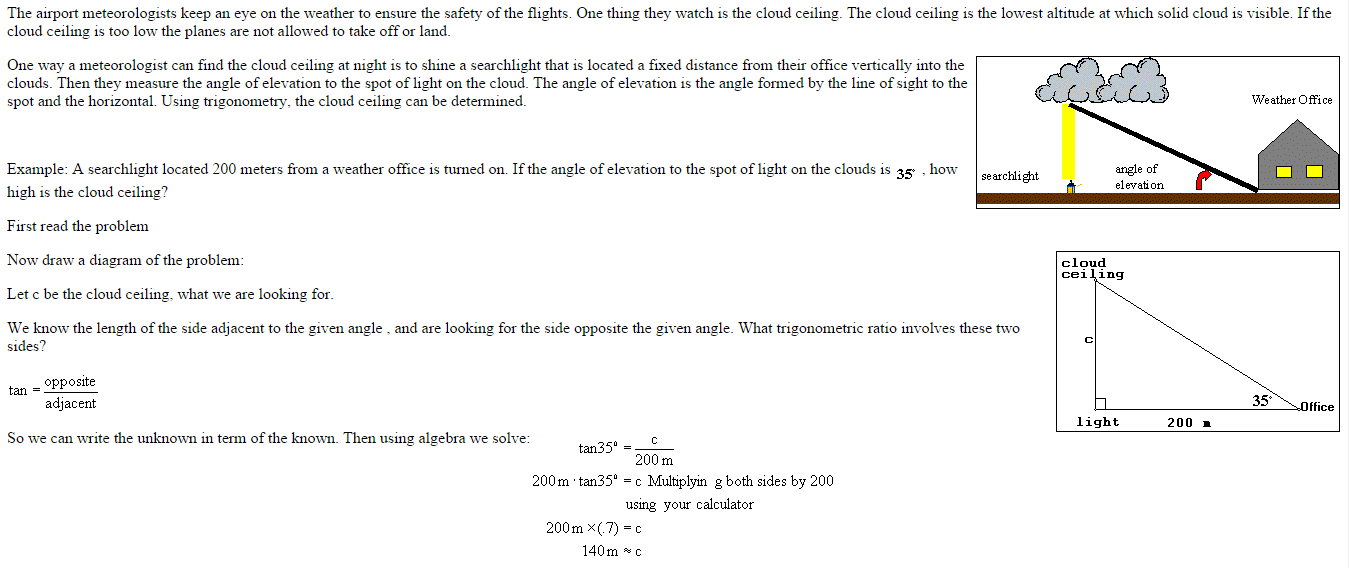
After this problem I will provide them many different real world problems to practice such as:

trig2 trig3


green line

How can this topic be used in your students’ future courses in mathematics or science?

Knowing how to compute sine, cosine or tangent in the right triangle will help students a lot when they get to higher level math or other science class, especially Physics.  In higher level math, students will always have the chance to encounter this concept.  For example, in Pre-Calculus, the students will likely learn about polar system.  This requires students to have the strong fundamental understandings of sine, cosine and tangent in a right triangle.  Students will be asked to convert from the Cartesian system to polar system, or vice versa.  If they do not grasp the ideas of this topic, they will eventually encounter huge obstacles in future.  In science, especially physics, the students will learn a lot about the motions of an objects.  This will involve concepts of force, velocity, speed, momentum.  The students will need to understand the how to compute sine, cosine and tangent in the right triangle so that they can easily know how to approach the problems in physics.

green line

How can technology (YouTube, Khan Academy [khanacademy.org], Vi Hart, Geometers Sketchpad, graphing calculators, etc.) be used to effectively engage students with this topic?

This website, https://www.geogebra.org/material/simple/id/48148 , can be a great tool for the students to understand the relationships of the sides in the right triangle.  The website creates an activity for students to explore the ratios of the sides such as AC/BC, AC/AB, and BC/AB.  The students will observe the changes of the ratios based on the changes of theta and side BC which is the hypotenuse.  At this point, the students will be introduced the name of each side of the right triangle which corresponds to theta such as opposite, adjacent and hypotenuse.  This activity allows the students to visualize what happens to the triangle when we change the angle or its side lengths.  The students will then explore the activity to find interesting facts about the side ratios.  I will pose some questions to help the students understand the relationships of side ratios. Such questions could be:  What type of triangle is it?  Tell me how the triangle changes as we change the hypotenuse or angle.  If we know one side length and the angle, how can we find the other side lengths?  Those questions allow me to introduce the terms sine, cosine, and tangent in the right triangle.

trig4

References

https://en.wikibooks.org/wiki/High_School_Trigonometry/Applications_of_Right_Triangle_Trigonometry

https://www.geogebra.org/material/simple/id/48148


Engaging students: Using the undefined terms of points, line and plane

In my capstone class for future secondary math teachers, I ask my students to come up with ideas for engaging their students with different topics in the secondary mathematics curriculum. In other words, the point of the assignment was not to devise a full-blown lesson plan on this topic. Instead, I asked my students to think about three different ways of getting their students interested in the topic in the first place.

I plan to share some of the best of these ideas on this blog (after asking my students’ permission, of course).

This student submission again comes from my former student Kevin Kim. His topic, from Geometry: using the undefined terms of points, line and plane

green line

A Point, line and plane are basic concepts for geometry. Without these concepts, students cannot go far in geometry at all. If we plot two dots and connect them, then it becomes a line. This simple concept is very important, and I will make sure my students understand the concepts of point, line and plane. Although they are simple concepts, they are being used a lot in math. Triangle, square, and rectangle cannot be learned effectively without these concepts. Also, it affects higher math other than geometry. Calculus, and one of the most complicated math topology cannot even start without these concepts. Moreover, the idea of dimensions came from these basic concepts. Therefore, it would worth teaching these simple concepts for one entire class period.


green line

In ancient Korea (About 1,200 B.C.), there was one argument between two high officers. The topic was, “does point come first, or line?”. Officer A ( Yeong-An Choi) argued “It is very simple concept that is not even worth to argue. If we plot a lot of dots, they become a line, and if we do the same thing with line, then they become a plane. So point is the smallest thing which means point comes first”. Officer B ( Sae-Yong Oh) countered that, “No, point itself is meaningless. In fact point itself is plane. Point is made of a lot of lines and lines make plane. Points are just imaginary thing to help make sense of line. So, line comes first.” The argument became too serious due to their pride, so they decided to take one’s life if the other was wrong. Both of them agreed to ask this question to the famous astronomy teacher in the capital. The problem was that the teacher did not really know the answer, but officer B’s theory made some what sense to him so he said Officer B is right, and immediately officer B Killed officer A.

(Fact: Officer B was born into an upper class family while officer A was from working class. Officer A was just promoted to a higher position than officer B, and officer B could not accept that. So, officer B planned to kill Officer A. For their gambling part, the astronomy teacher actually knew the answer, but he was already threatened by officer B. So, the astronomy teacher said officer B was right, and Officer A got killed. After 2 years, this event was reported to the king. Because of Officer B’s family, he could avoid capital punishment, but he got fired from his position, and got killed by his own father for dishonoring family.)


green line

I prefer to use technology because I believe using technology may minimize students from becoming bored. As always, I checked Khan Academy and found one good explanation about the basic language of geometry (except the teacher stammered too much….).

Also, for the engagement part, I would like to show one part of movie “Interstellar” to show how point, line and plane are interesting. (The reason that I chose math as my major was because of this concept. Before I knew this, I never passed math in middle school, and I am sure, one day, I will meet students just like me. The second reference shows the brief idea that brought me to the math field.) I would like to use more technology if possible, but showing some scenes of scientific movies is the most effective way. I am not sure if it would fit to technology part, but I would like to distribute some mini white boards so that students can actually determine what happens if they connect two points. It is very easy to erase their mistakes so they will have fun with it as I did in middle school.


References

http://blog.naver.com/esbeak/220017437105

Engaging students: Finding the area of a circle

In my capstone class for future secondary math teachers, I ask my students to come up with ideas for engaging their students with different topics in the secondary mathematics curriculum. In other words, the point of the assignment was not to devise a full-blown lesson plan on this topic. Instead, I asked my students to think about three different ways of getting their students interested in the topic in the first place.

I plan to share some of the best of these ideas on this blog (after asking my students’ permission, of course).

This student submission comes from my former student Joe Wood. His topic, from Geometry: finding the area of a circle.

green line

The students would be greeted with Lion King’s “Circle of Life” song. While the song has nothing to do with area of a circle, it would create a different and exciting buzz in the classroom that wouldn’t always be offered in this form. (Plus, who doesn’t want to hear a little Lion King music?)

C1. How has this topic appeared in pop culture (movies, TV, current music, video games, etc.)?

A1. What interesting (i.e., uncontrived) word problems using this topic can your students do now?

A great activity I found on the Mathbits website tackles both questions C1 and A1.
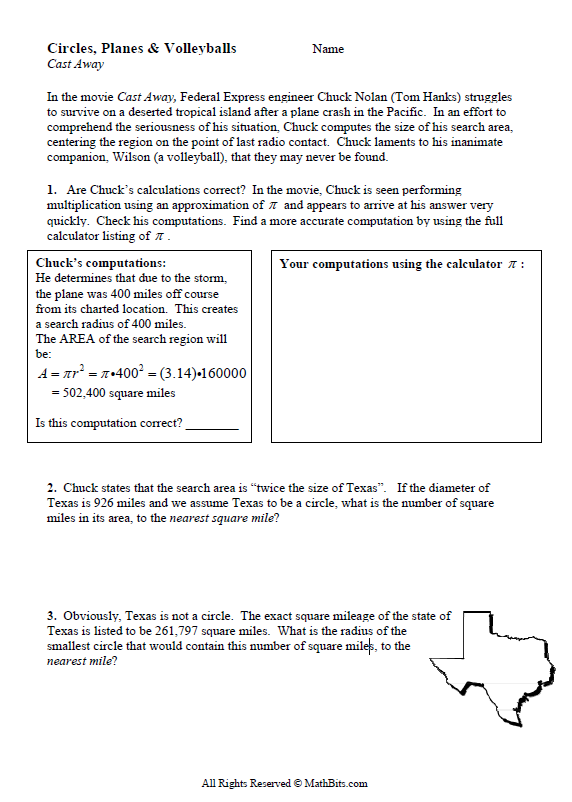
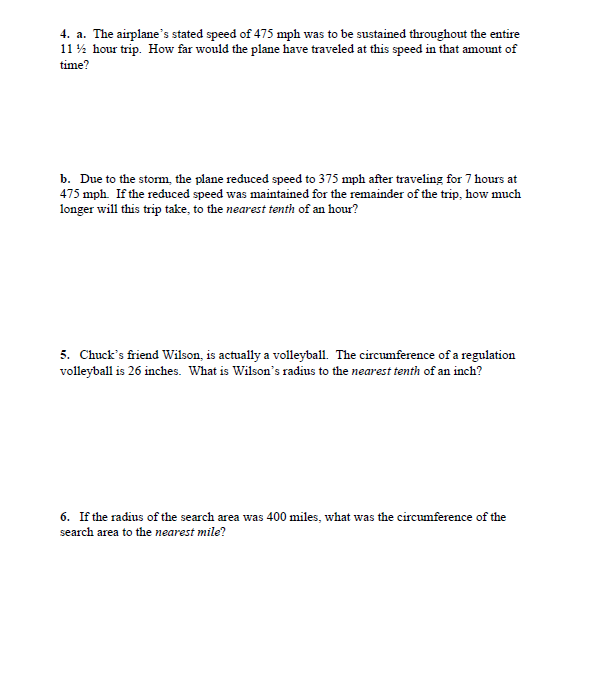
The two-page worksheet below is based off a scene from the movie Castaway. In the scene, Tom Hanks calculates the area of a circle to figure out the likelihood of his rescue. He then compares his calculated area to the area of Texas (which for young students who are all about Texas like I was, this is another attention getter on its own). I would show the clip (having sent a permission slip home since Tom Hanks is shirtless) which can be seen at https://www.youtube.com/watch?v=y89VE9_2Cig so that students can have a good laugh and also understand the scene described on the worksheet. While most, if not all students will never be stranded on a deserted island, this would be an interesting real world problem for the “survivalist” kid in the class.

The worksheet is great because it starts off asking if Tom’s calculations were even correct. It then has several example problems for area of a circle so they can practice, but it also brings in linear speed calculations, and a circumference problem which is great review (and a good warm up if you were maybe moving into angular speed later).

castaway1 castaway2


green line

A1. What interesting (i.e., uncontrived) word problems using this topic can your students do now?

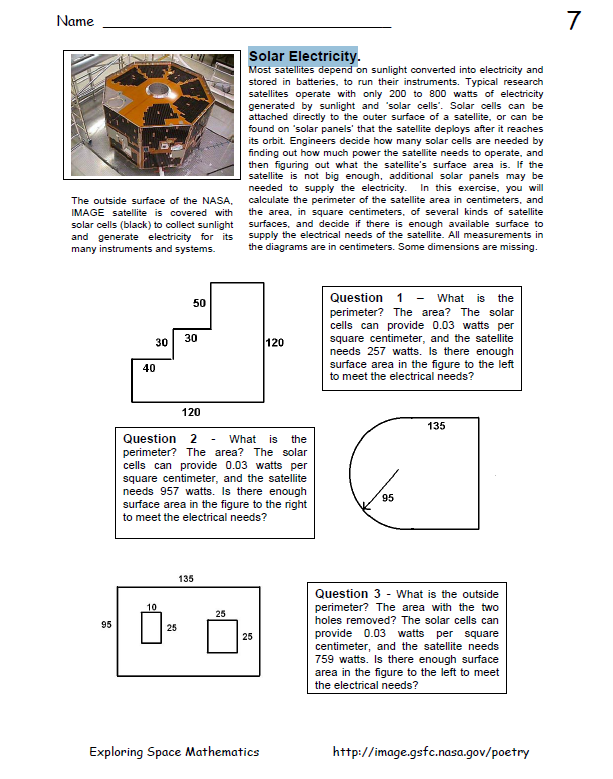
Another interesting real world problem can be found at http://spacemath.gsfc.nasa.gov/geometry.html. The problem deals with solar energy on satellites (or solar panels in general). It talks about how much energy is needed to operate a satellite, tells the student how much energy is provided by solar cells per square centimeter, gives them different shaped solar panels, and ask is the solar panel can produce enough energy.

This specific worksheet only uses half of a circle on one problem, so it should be revised by the teacher to include more circles; however, once again, I think keeping all the different shapes is a great review for students. I also think having the semicircular shaped panel is a great idea to keep the students on their toes.

solar


green line

A2. How could you as a teacher create an activity or project that involves your topic?

If one stereotype can be made about middle/high school students (especially the boys), it is that they love to eat! And, what do they like to eat? PIZZA! There are several ways this next idea could be carried out (pun intended), but for the purposes of this assignment I will call it a class project that ends in a pizza party.
The idea is that each pair of student will be assigned a pizza restaurant in the area, and they will do a presentation on why we should order pizza from this pizza place specifically. They will have find all the pizza sizes (small, medium, large, etc.) , their  prices, their diameters, the areas of  each pizza, the price per square inch of each of the pizzas, and the best buy. They can talk about anything else they want (such as quality vs price or customer service or whatever) so long as they are trying to sway the class on why the pizza should be purchased from this specific place. Finally, the students will need to provide some kind of proof of their work (menus, calculations, etc) in an organized fashion: PowerPoint, poster board, or some other method.

After the project is complete, the teacher can select the place to buy from, or hold it to a class vote, and have a pizza party during lunch hour or after school or in class.


Engaging students: Defining the terms perpendicular and parallel

In my capstone class for future secondary math teachers, I ask my students to come up with ideas for engaging their students with different topics in the secondary mathematics curriculum. In other words, the point of the assignment was not to devise a full-blown lesson plan on this topic. Instead, I asked my students to think about three different ways of getting their students interested in the topic in the first place.

I plan to share some of the best of these ideas on this blog (after asking my students’ permission, of course).

This student submission comes from my former student Irene Ogeto. Her topic, from Geometry: defining the terms perpendicular and parallel.

green line

How could you as a teacher create an activity or project that involves your topic?


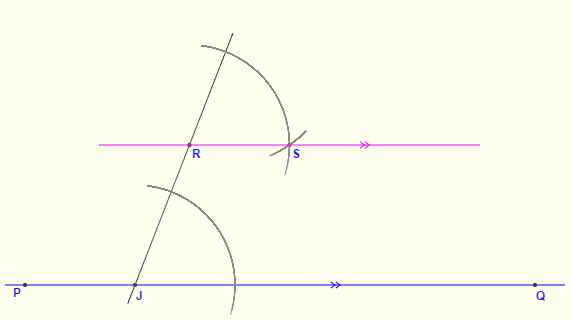
In order to explore the terms perpendicular and parallel the students could create their own parallel and perpendicular lines using a compass and ruler. I would provide compasses and rulers for the class and we would do the activity together. I would walk the students through the step-by-step process. This activity would allow the students to not only see parallel and perpendicular lines but to actually create them. We could explore different methods of constructing parallel lines about a given point: Angle copy method, translated triangle method, rhombus method. Likewise, we could explore different methods of constructing perpendicular lines: perpendicular from a line through a point, perpendicular from a line to a point and perpendicular at the endpoint of a ray. If we have time we could also go in depth and prove why these constructions work. In addition, the students can use Geometers Sketchpad to do the constructions as well.
sketchpad1


sketchpad2

green line

How has this topic appeared in pop culture (movies, TV, current music, video games, etc.)?


The topic of parallel and perpendicular lines has appeared in the “real” portion of the Cyberchase show on television. In this episode, Harry is meeting his cousin to get tickets to go to a game. Harry and his cousin are both on the same street but have trouble meeting up. Harry decides it would be best to meet his cousin where Amsterdam Ave intersects with 79th street. This video could be shown at the beginning of a lesson as an engage when defining the terms parallel and perpendicular. Parallel and perpendicular lines are commonly found in roads and streets. Although this does not show that Amsterdam Ave and 79th street necessarily intersect at a right angle, it shows the difference between parallel and intersecting lines.


http://pbskids.org/video/?guid=302989e5-9265-4110-ac81-0b1e89ac2c40


green line

How has this topic appeared in high culture (art, classical music, theatre, etc.)?


Parallel and perpendicular lines are all around us, specifically in high culture. Parallel and perpendicular lines can be found in architecture. Many buildings have features that contain parallel and perpendicular lines. Most windows have parallel and perpendicular lines. Skyscrapers such as the New York Times Building, churches, schools, hospitals are all examples of some buildings that contain parallel and perpendicular lines. Parallel and perpendicular lines are also found in knitting, crocheting, and quilting patterns. Crochet scarfs can be made with parallel line patterns. Quilting is a technique which requires attention to detail and knowing the terms parallel and perpendicular can help speed up the quilting process. In addition, parallel and perpendicular lines can be found in art paintings. There are many paintings in the Dallas Museum of Art that contain parallel and perpendicular lines. An example is the painting Ocean Park No.29 done by American painter Richard Diebenkorn (1922-1993).

References:

http://www.mathopenref.com/constperpendray.html

http://www.pbslearningmedia.org/resource/6fb2456e-3696-4daa-863e-f76ea17f8f61/6fb2456e-3696-4daa-863e-f76ea17f8f61/

http://pbskids.org/video/?guid=302989e5-9265-4110-ac81-0b1e89ac2c40

http://www.threadsmagazine.com/item/4286/quilt-it-freehand/page/all

https://www.dma.org/collection/artwork/richard-diebenkorn/ocean-park-no-29


Engaging students: Deriving the Pythagorean Theorem

In my capstone class for future secondary math teachers, I ask my students to come up with ideas for engaging their students with different topics in the secondary mathematics curriculum. In other words, the point of the assignment was not to devise a full-blown lesson plan on this topic. Instead, I asked my students to think about three different ways of getting their students interested in the topic in the first place.

I plan to share some of the best of these ideas on this blog (after asking my students’ permission, of course).

This student submission comes from my former student Emma Sivado. Her topic, from Geometry: deriving the Pythagorean Theorem.

green line

How has this topic appeared in pop culture?

What if I told you that knowing the Pythagorean Theorem could help you become a millionaire? We’re all familiar with the popular game show “Who Wants to be a Millionaire” so let me take you back to 2007 when Ryan was playing for $16,000. The question asks “which of these square numbers is the sum of two smaller square numbers.” We see the sweat immediately begin to accumulate on his brow as he struggles to find the right answer. He quickly goes to his life lines and asks the audience. The majority say the answer is 16. Ryan contemplates for a minute before going with the audience and selecting 16. Disappointment follows as we discover this is the wrong answer and Meredith explains that the answer is 25 or 42+32=52.

green line

How can this topic be used in your student’s future courses in mathematics or science?

The Pythagorean Theorem is first taught in Geometry, according to the TEKS, and is expected to be defined, proved, and executed by these students. However, many people say that the Pythagorean Theorem is the basis of trigonometry, which is studied in depth in the student’s pre-calculus course. Beyond pre-calculus applications, the Pythagorean Theorem is used in physics to calculate kinetic energy, in computer science to compute processing time, and in social media to prove Metcalfe’s Law. Beyond math and science, the theorem is used in architecture and construction to determine distances, heights, and angles, in video games to draw in 3-D, and in triangulation to locate cell phone signals.


Engaging students: Proving that the measures of a triangle’s angles add to 180 degrees

In my capstone class for future secondary math teachers, I ask my students to come up with ideas for engaging their students with different topics in the secondary mathematics curriculum. In other words, the point of the assignment was not to devise a full-blown lesson plan on this topic. Instead, I asked my students to think about three different ways of getting their students interested in the topic in the first place.

I plan to share some of the best of these ideas on this blog (after asking my students’ permission, of course).

This student submission comes from my former student A’Lyssa Rodriguez. Her topic, from Geometry: proving that the measures of a triangle’s angles add to 180 degrees.

green line

How could you as a teacher create an activity or project that involves your topic?

People generally do not believe something until they can see it for themselves. So this activity can help do just that. Each student will receive a sheet of paper. They are then asked to draw a triangle on that sheet of paper and cut it out. Having each student draw their own triangle allows for many types of triangles and further proving the point later. Once the triangles are cut, each student will rip off each angle from the triangle. Next, they will arrange those pieces so that each vertex is touching the other. Once all the vertices are touching, they will notice that a straight line is formed and therefore proving that the sum of a triangles angles all add up to 180 degrees.

green line

What interesting things can you say about the people who contributed to the discovery and/or the development of this topic?

Euclid proves that the measures of a triangle’s angles add up to two right angles (I. 32) in the compilation geometrical proofs better known as Euclid’s Elements. This compilation was actually all the known mathematics at the time.  So not all of the theorems were written or discovered by Euclid, rather by several individuals such as Pythagoras, Hippocrates, Theudius, Theaetetus and Eudoxus. Euclid’s Elements actually consist of 465 theorems, all of which are proven with only a ruler (straight edge) and compass. This book was so important to the mathematical community that it remained the main book of geometry for over 2,000 years. It wasn’t until the early 19th century that non-Euclidean geometry was considered.

green line

How has this topic appeared in high culture (art, classical music, theatre, etc.)?

Students can be given a variety of images such as the Louvre, the pyramids in Egypt, certain types of sports plays, and the Epcot center in Disney World and then be asked what they all have in common. It may or may not be hard for them to notice but they all have triangles. Then, hand the students the same images but with the triangles outlined and with the measurement of all the angles. They can then compute the sum of the angles for each triangle. Each triangle obviously looks different and all the angles are different but the sum will always be 180 degrees.


Resources
http://www.storyofmathematics.com/hellenistic_euclid.html


Engaging students: Finding the volume and surface area of spheres

In my capstone class for future secondary math teachers, I ask my students to come up with ideas for engaging their students with different topics in the secondary mathematics curriculum. In other words, the point of the assignment was not to devise a full-blown lesson plan on this topic. Instead, I asked my students to think about three different ways of getting their students interested in the topic in the first place.

I plan to share some of the best of these ideas on this blog (after asking my students’ permission, of course).

This student submission comes from my former student Avery Fortenberry. His topic, from Algebra: finding the volume and surface area of spheres.

green line

How does this topic extend what your students should have learned in their previous courses?

The topic of volume and surface area of spheres is building upon the students’ knowledge of area and circumference of a circle.  A sphere is similar to a circle in that a circle is a closed shape with all points equidistant from the centerpoint (the distance is the radius) and a sphere is a closed object with all points at an equal distance from its centerpoint (the distance is also r).  Students will be familiar with the area of a circle formula, which is A=πr2 and will be able to easily use and understand the formula for volume of a sphere V=(4/3)πr3.  The same is true for circumference in relation with surface area.

green line

What interesting things can you say about the people who contributed to the discovery and/or the development of this topic?

Archimedes was the first mathematician to discover the most important ratio in all of mathematics, π.  He did this by finding the area of a circle using shapes that were incrementally closer and closer to the same size as that circle.  In other words, he would start with a circle and enclose it within a square, then a pentagon, then a hexagon, and so on until he came extremely close to the same shape.  He used this same method to find the volume of a sphere by enclosing it within a cylinder of a known volume and cutting out piece by piece and measuring until he found the parabolic segment is 4/3 that of an inscribed triangle.

Source: http://www.storyofmathematics.com/hellenistic_archimedes.html


green line

What are the contributions of various cultures to this topic?

This topic had many cultures contribute to the understanding of it.  These contributions came from Greek, Chinese, and Arabic mathematicians.  The Greek contribution came mainly from Archimedes, which I discussed in D1.  The Arithmetic Art in Nine Chapters is a Chinese book written in the 1st century that gave a formula that was close but not exact to finding the volume of a sphere.  The author of the book calculated pi as being equal to 25/8 or even as just 3 at times.  Ancient Arabic mathematicians submitted very similar ideas to the Chinese in terms of the volume of a sphere.  While it is known the Chinese derived some ideas from the Greeks, it is still unclear today how the ideas were spread to the Arabic mathematicians.

Source: http://www.muslimheritage.com/article/volume-sphere-arabic-mathematics-historical-and-analytical-survey#sec2.2


Engaging students: Finding the slope of a line

In my capstone class for future secondary math teachers, I ask my students to come up with ideas for engaging their students with different topics in the secondary mathematics curriculum. In other words, the point of the assignment was not to devise a full-blown lesson plan on this topic. Instead, I asked my students to think about three different ways of getting their students interested in the topic in the first place.

I plan to share some of the best of these ideas on this blog (after asking my students’ permission, of course).

This student submission again comes from my former student Jason Trejo. His topic, from Algebra: finding the slope of a line.

green line

A2) How could you as a teacher create an activity or project that involves your topic?

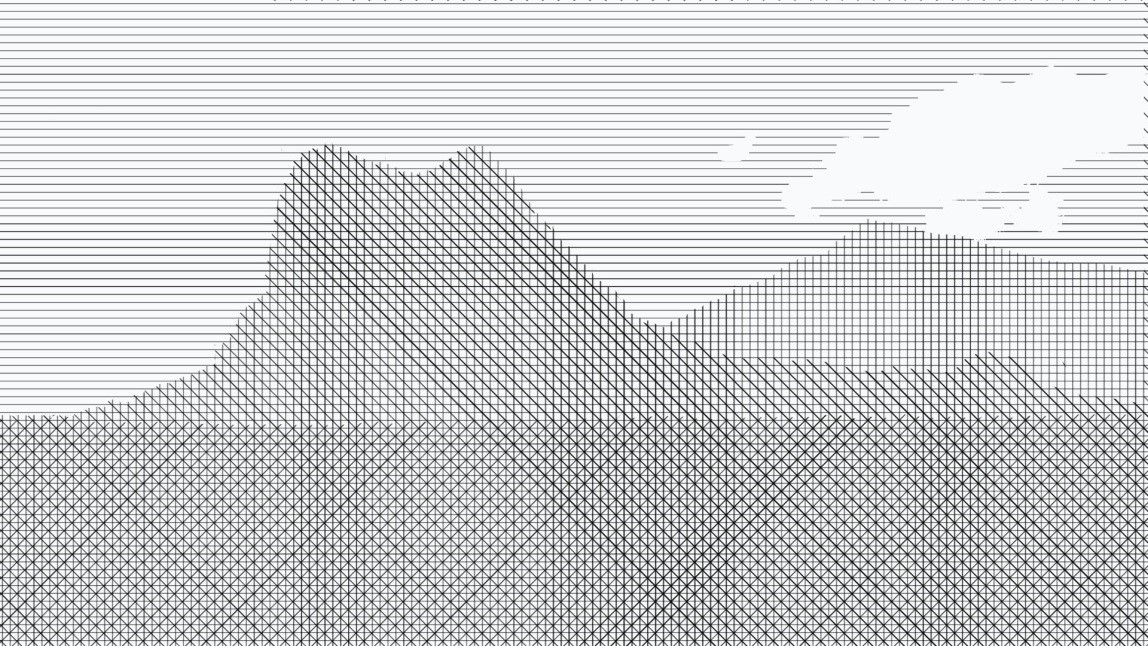
I have to start off by giving some credit to my 5th grade math teacher for giving me the idea on how I could create an activity involving this topic. You see, back in my 5th grade math class, we were to plot points given to us on a Cartesian plane and then connect the dots to create a picture (which turned out to be a caveman). Once we created the picture, we were to add more to it and the best drawing would win a prize. My idea is to split the class up into groups and give them an assortment of lines on separate pieces of transparent graphing sheets. They would then find the slopes and trace over the line in a predetermined color (e.g. all lines with m=2 will be blue, when m=1/3 then red, etc.). Next they stack each line with matching slopes above the other to create pictures like this:

slopeart

slopeart2

Of course, what I have them create would be more intricate and colorful, but this is the idea for now. It is also possible to have the students fine the slope of lines at certain points to create a picture like I did back in 5th grade and then have them color their drawing. They would end up with pictures such as:

slopeart3


green line

C1) How has this topic appeared in pop culture (movies, TV, current music, videogames, etc.)?

Sure there aren’t many places where finding the slope of a line will be the topic that everyone goes on and one about on TV or on the hottest blog or all over Vine (whatever that is), but take a look around and you will be able to see a slope maybe on a building or from the top of Tom Hank’s head to the end of his shadow. Think about it, with enough effort, anyone could imagine a coordinate plane “behind” anything and try to find the slop from one point to another. The example I came up with goes along with this picture I edited:

motorcycle

*Picture not accurately to scale

This is the infamous, first double backflip ever landed in a major competition. The athlete: Travis Pastrana; the competition: the 2006 X-Games.

I would first show the video (found here: https://www.youtube.com/watch?v=rLKERGvwBQ8), then show them the picture above to have them solve for each of the different slopes seen. In reality this is a parabola, but we can break up his motion to certain points in the trick (like when Travis is on the ground or when Travis is upside down for the first backflip). When the students go over parabolas at a later time, we could then come back to this picture.


green line

B2) How does this topic extend what your students should have learned in previous courses?

It has been many years since I was first introduced to finding the slope of the line so I’m not sure exactly when I learned it, but I do know that I at least saw what a line was in 5th grade based on the drawing project I stated earlier. At that point, all I knew was to plot points on a graph and “connect the dots”, so this builds on that by actually being able to give a formula for those lines that connected the dots. Other than that, finding slopes on a Cartesian plane can give more insight on what negative numbers are and how they relate to positive numbers. Finally, students should have already learned about speed and time, so by creating a representation how those two relate, a line can be drawn. The students would see the rate of change based on speed and time.


References:

Minimalistic Landscape: http://imgur.com/a/44DNn

Minimalistic Flowers: http://imgur.com/Kwk0tW0

Graphing Projects: http://www.hoppeninjamath.com/teacherblog/wp-content/uploads/2014/03/Photo-Feb-25-5-32-24-PM.jpg

Double Backflip Image: http://cdn.motocross.transworld.net/files/2010/03/tp_doubleback_final.jpg

Double Backflip Video: : https://www.youtube.com/watch?v=rLKERGvwBQ8


Engaging students: Equations of two variables

In my capstone class for future secondary math teachers, I ask my students to come up with ideas for engaging their students with different topics in the secondary mathematics curriculum. In other words, the point of the assignment was not to devise a full-blown lesson plan on this topic. Instead, I asked my students to think about three different ways of getting their students interested in the topic in the first place.

I plan to share some of the best of these ideas on this blog (after asking my students’ permission, of course).

This student submission again comes from my former student Zacquiri Rutledge. His topic, from Algebra: equations of two variables.

green line

Seeing equations with two variables becomes quite common once students have been introduced to independent and dependent variables. However seeing equations in the form x+4y=16 would start as a confusing concept after being taught that equations are written in the format 4x-16=y. However, this concept is highly required when a teacher goes to explain about a system of equations. The reason for this is because a common method that is taught for solving a system of equations is substitution. In order to utilize the substitution method, a student must understand how to solve for a variable by using order of operations to isolate the variable. In fact, a student will use the same skills they did when learning to solve an equation that only has one variable, such as 3x+6=12. However, now the student must apply it to something new.

Another lesson that uses the knowledge from the Equations of Two Variables is interpretation of a graph for an equation with two variables. Before, the students would have learned what independent and dependent variables are, and how they are represented on a graph. Later on the students would further their understanding by finding the graphical representation of equations with two variables. The students would learn that, while the line on the graph during lessons over independent and dependent variables was only to show where the left side of an equation equaled y, the line can also show where x and y combine to equal a certain value. An example of this would be comparing x+4y=16 and (-1/4)x+4=y. They are the same equation, however one equation shows that x and 4y combine to equal 16, so every point on the line are the values of x and y required to equal 16. The second equation says that to find y for a given point x, x must be multiplied by (-1/4) and add 4. Just changing the nature of the equation can change what it is that the equation is saying, as well as give a different perspective one that could be useful when dealing with real life word problems.

green line

Two variable equations are very subtle, but are all around us. Even when we do not think it is being used, it is. The most common modern example of two variable equations is the American dollar, and how many coins of two different values are needed to make a dollar. Although this is a very easy explanation to use it can be very boring at times. How about classical music or concert music? While it may not seem obvious at first, it is in fact there. The standard set-up for a sheet of music is Four-Four time. What this means is that within every measure there are four beats and a quarter note counts as a whole beat. There are also other kinds of notes which are used in combination with quarter notes to fill a measure, examples being a whole note (four beats), half note (two beats), and eighth notes (half beat). So when a composer sits down to write a piece of music, he/she must keep in mind how many beats are in each measure. This is where the concept of two variable equations comes into play. Suppose the composer wants a measure made up of only half notes and quarter notes in four-four time, then his equation to figure out how many of each note he can have would be 2h+q=4, where h is half notes and q is quarter notes. Then, the next measure is going to be made up of eighth and half notes, therefore 2h+(1/2)e=4 would be the equation, where e is eighth notes. There are many different combinations someone can use when writing music to create a piece that is to be played in front of a live audience. Centuries ago, men like Beethoven and Mozart used this concept every day to create classic pieces such as Beethoven’s Symphony #5 or Mozart’s Moonlight Sonata. This is an excellent example that can be used for classes that include a large number of band students or choir students, to relate the music they are studying in their music classes to their math courses.


green line

With the previous response in mind, a teacher could very well use Youtube as an excellent method to engage their students. A lot of children today are not familiar with how classical music is written or how music is written at all. By playing pieces of music for their students that students are likely to have heard befor, via Youtube or even iTunes, such as Ride of the Valkyries or Beethoven’s Symphony #5, can spark an interest not only musically, but mathematically. A teacher could begin by asking students if they had heard the piece before, then go to the next piece and see who has heard it before. Repeat this process for about 2-4 clips of pieces, then ask which of the students know anything about how music is written. This would lead into what was discussed in the previous response. However, by including the technology as a way for the students to hear the music, and not just see it, can have tremendous effects on their attention.