Engaging students: Distinguishing between axioms, postulates, theorems, and corollaries

In my capstone class for future secondary math teachers, I ask my students to come up with ideas for engaging their students with different topics in the secondary mathematics curriculum. In other words, the point of the assignment was not to devise a full-blown lesson plan on this topic. Instead, I asked my students to think about three different ways of getting their students interested in the topic in the first place.

I plan to share some of the best of these ideas on this blog (after asking my students’ permission, of course).

This student submission comes from my former student Roderick Motes. His topic, from Geometry: distinguishing between axioms, postulates, theorems, and corollaries.

green line

How could you as a teacher create an activity or project that involves your topic?

This topic lends itself well to projects, and to activities. Axiom systems are fundamental to the study of math. In high school geometry in particular we start to ask students to do proofs. When students begins proofs it’s important that we define what we’re working with. All students know definitions, these tell us what the objects ARE. Postulates and Axioms tell us the most basic rules of how an object behaves.

There are various options you can use to communicate the differences here. My suggestion would be to take an interesting, visual, and intuitive problem and find the simplest rule set you can. Find the rules from which you can easily (though not trivially) solve the question. Take for example the Seven Bridges of Konnisburg. The website http://www.mathsisfun.com/activity/seven-bridges-konigsberg.html has a GREAT activity based around the Seven Bridges problem. Towards the middle, after the initial exploration, the activity introduces some vocabulary central to the student of graphs. The definitions are, as Euclid would have them, definitions. The activity then assumes some things implicitly:

“A path leads into a vertex by one edge and out of the vertex by a second edge.”

This is an example of an axiom.

With careful choice of activity you can distinguish between theorem and corollary.  In geometry in particular we can use the theorem that opposite angles are congruent to quickly prove that the sum of the angles when a line cuts another is 4 right angles. This is a quick corollary, and so the difference between corollary and theorem could be shown AS PART OF an activity you already have.

So there are really two places that you can fit this. Adapting an explore will allow you to quickly demonstrate the difference between theorem and corollary. Having students prove solutions from axioms is another method of showing everything.

Below I have included several axiom systems you could fit in. Euclids Elements defines Euclidean Geometry, and so whenever you are proving something from there you could consider adapting your activity to require proof from axioms and prior proofs.

Peano axiomatized the basics of number theory. You could potentially adapt this if you’re teaching middle school, but that would be more tricky. Alligator Eggs is a GREAT manipulative for advanced high school students who are going to be taking computer science around the same time. Alligator eggs has cut outs, colors, gives definitions, and shows the axiomatic assumptions of typed lambda calculus in a greatly intuitive way (chomp chomp chomp.)

http://worrydream.com/AlligatorEggs/

http://en.wikipedia.org/wiki/Axiomatic_system#Example:_The_Peano_axiomatization_of_natural_numbers

http://aleph0.clarku.edu/~djoyce/java/elements/elements.html


green line

What interesting things can you say about the people who contributed to the discovery and/or the development of this topic? 

The axiomatic method took us a while to work the kinks out of and, accordingly, it’s history is rife with interesting figures. We can start at the beginnings with Euclid though, to be fair to those before him, his work built upon the works of the Pythagoreans, Plato, and Theaetetus (the first two of which have countless fun asides you can discuss.) Euclid wrote down his ‘postulates and common notions’ and proceeded to build up Euclidean Geometry from them.  Euclid is a rather mysterious figure for all we know about him. He is alleged to have published many books. Interestingly he is thought to have published the book “Music: Elements of Music” in which he extends on the Pythagoreans musings on the connection between intervals in music, and mathematics.

After the Greeks the seat of mathematical progress moved to the Middle East. During this time many mathematicians would continue to use the axiomatic method of Euclid, but none doubted his own axioms save for a few. Among these men was one Omar Al-Khayyam. Al-Khayyam raised some objections to Euclids use of the 5th postulate (the parallel postulate.) This same objection would later be noted and used as the basis for the study of non-euclidean geometries. Outside of mathematics Al-Khayyam was an interesting man. He was a poet as well as a mathematician, philosopher, and astronomer. Quite interesting he was brazen enough to publish the idea that the year was actually 365.24219858156 days. I say it was a brazen idea because the degree to which he was claiming accuracy was more or less unheard of for astronomical calculations at the time. What’s amazing is how right he was. His calculation is accurate to the sixth decimal place which, we now know, actually varies naturally. It would be like someone coming into a room and telling you that you are 5.62536412 feet tall based on their calculations and then having them be correct.

After Al-Khayyam the next most notable figures in the refinement of the axiomatic method are probably Hilbert, who refined Euclids axiom system, Whitehead and Russell (who tried and failed to axiomatize ALL of mathematics,) and Cantor. A quick search on the internet will pull up many many interesting facts, but here are some of my favorites:

  • “David Hilbert used to have a garden attached to his house, with a chalkboard allowing him to do research out in the fresh air. Reportedly, he would stand at the board working for periods of time, but would occasionally, without warning, hop onto his bicycle, make a circuit or two of the garden’s path, then just as abruptly hop off and return to his chalkboard.”
  •  “Bertrand Russell (British mathematician) – reported in print as having died in 1937, had to have his obituary reprinted when he actually died in 1970.”

Cantor is particularly interesting, I think, since his mathematics earned him such admonition as a “scientific charlatan”, a “renegade” and a “corrupter of youth.” It wasn’t until the tail end of his life, having been driven to fits of madness and depression, that he finally started to be realized as one of the great mathematicians, and his set theory to be one of mathematics crowning achievements.

Sources:

green line

How does this topic extend what your students should have learned in previous courses?

Axiomatic methods can be used to prove everything is true (well… mostly. Incompleteness Theorem throws a wrench into the works but is well beyond the scope of a high school course.) Have the students ever wondered why we factorize things into primes? Or wondered how any of the mechanical routines they’ve learned (like synthetic division) can be justified or proven? If so, then they’ve been looking for the same kind of path that we’ve taken all throughout Math 4050.

We take some simple basic principles about numbers, and show that they have complex consequences. Moreover we show that we can extend these principles to many different areas. In geometry in particular we can give geometric, visual, intuitive ideas some very rigorous backing. Moreover much of Euclids Elements gives us an intuition for algebra without explicitly using it. Consider when Euclid proves Pythagorean Theorem. Nowadays we say a2 + b2 = c2 . But Euclid actually proves it by showing that the area of a square with side A, plus the area of a square with side B sum to the area of a square with sides C. He takes the literal square of the sides, and shows they are equal. This is a very interesting way you could discuss these points, and connect back with your students.

Area of a triangle: Pick’s theorem (Part 8)

The following is one of my all-time favorite paragraphs to ever appear in a professional mathematical journal.

Some years ago, the Northwest Mathematics Conference was held in Eugene, Oregon. To add a bit of local flavor, a forester was included on the program, and those who attended his session were introduced to a variety of nice examples which illustrated the important role that mathematics plays in the forest industry. One of his problems was concerned with the calculation of the area inside a polygonal region drawn to scale from field data obtained for a stand of timber by a timber cruiser. The standard method is to overlay a scale drawing with a transparency on which a square dot pattern is printed. Except for a factor dependent on the relative sizes of the drawing and the square grid, the area inside the polygon is computed by counting all of the dots fully inside the polygon, and then adding half of the number of dots which fall on the bounding edges of the polygon. Although the speaker was not aware that he was essentially using Pick’s formula, I was delighted to see that one of my favorite mathematical results was not only beautiful, but even useful.

D. DeTemple, cited in Branko Grunbaum and G. C. Shephard, “Pick’s Theorem,” American Mathematical Monthly, Vol. 100, pp. 150-161 (February 1993).

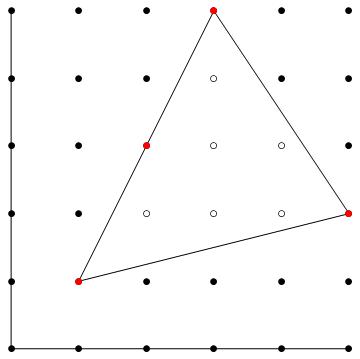
Suppose that the vertices of a triangle are (1,1), (3,5), and (4,2). What is the area of the triangle?

latticetriangleBecause the vertices of the triangle have integer coordinates, Pick’s Theorem offers an exceedingly simple way of finding the area of this triangle.

  1. There are 6 points (marked white) that are inside the triangle.
  2. There are 4 points (marked red) that are on the boundary of the triangle, including the three corners.
  3. Therefore, the area is A = 6 + \frac{1}{2} (4) - 1 = 7.

You can confirm this area by drawing the rectangle with corners at (1,1), (5,1), (5,5), and (1,5) and then taking away the three right triangles, leaving the triangle shown in the figure above.

Amazingly, this theorem is true for any polygonal figure — not just triangles — whose vertices have integer coordinates.

A decent classroom activity so that students can discover Pick’s theorem for themselves has been published by the National Council of Teachers of Mathematics. I modified this activity to teach my daughter and her friends last summer, so I say from first-hand experience that fourth-graders can use inductive reasoning to guess Pick’s theorem.

Additional references:

http://www.cut-the-knot.org/ctk/geoboard.shtml

http://www.cut-the-knot.org/ctk/Pick_proof.shtml

Area of a triangle: Vertices (Part 7)

Suppose that the vertices of a triangle are (1,2), (2,5), and (3,1). What is the area of the triangle?

At first blush, this doesn’t fall under any of the categories of SSS, SAS, or ASA. And we certainly aren’t given a base b and a matching height h. The Pythagorean theorem could be used to determine the lengths of the three sides so that Heron’s formula could be used, but that would be extremely painful to do.

Fortunately, there’s another way to find the area of a triangle that directly uses the coordinates of the triangle. It turns out that the area of the triangle is equal to the absolute value of

\displaystyle \frac{1}{2} \left| \begin{array}{ccc} 1 & 2 & 1 \\ 2 & 5 & 1 \\ 3 & 1 & 1 \end{array} \right|

Notice that the first two columns contain the coordinates of the three vertices, while the third column is just padded with 1s. Calculating, we find that the area is

\left| \displaystyle \frac{1}{2} \left( 5 + 6 + 2 - 15 - 4 - 1 \right) \right| = \left| \displaystyle -\frac{7}{2} \right| = \displaystyle \frac{7}{2}

In other words, direct use of the vertices is, in this case, a lot easier than the standard SSS, SAS, or ASA formulas.

A (perhaps) surprising consequence of this formula is that the area of any triangle with integer coordinates must either be an integer or else a half-integer. We’ll see this again when we consider Pick’s theorem in tomorrow’s post.

green line

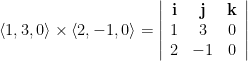
There is another way to solve this problem by considering the three vertices as points in \mathbb{R}^3. The vector from (1,2,0) to (2,5,0) is \langle 1,3,0 \rangle, while the vector from (1,2,0) to (3,1,0) is \langle 2,-1,0 \rangle. Therefore, the area of the triangle is one-half the length of the cross-product of these two vectors. Recall that the cross-product of the two vectors is
\langle 1,3,0 \rangle \times \langle 2,-1,0 \rangle = \left| \begin{array}{ccc} {\bf i} & {\bf j} & {\bf k} \\ 1 & 3 & 0 \\ 2 & -1 & 0 \end{array} \right|

\langle 1,3,0 \rangle \times \langle 2,-1,0 \rangle = -7{\bf k}

So the length of the cross-product is clearly 7, so that the area of the triangle is (again) \displaystyle \frac{7}{2}.

green line

The above technique works for any triangle in \mathbb{R}^3. For example, if we consider a triangle in three-dimensional space with corners at (1,2,3), (4,3,0), and (6,1,9), the area of the triangle may be found by “subtracting” the coordinates to find two vectors along the sides of the triangle and then finding the cross-product of those two vectors.

Furthermore, determinants may be used to find the volume of a tetrahedron in \mathbb{R}^3. Suppose that we now consider the tetrahedron with corners at (1,2,3), (4,3,0), (6,1,9), and (2,5,2). Let’s consider (1,2,3) as the “starting” point and subtract these coordinates from those of the other three points. We then get the three vectors

\langle 3,2,-3 \rangle, \langle 5,-1,6 \rangle, and \langle 1,3,-1 \rangle

One-third of the absolute value of the determinant of these three vectors will be the volume of the tetrahedron.

green line

This post has revolved around one central idea: a determinant represents an area or a volume. While this particular post has primarily concerned triangles and tetrahedra, I should also mention that determinants are similarly used (without the factors of 1/2 and 1/3) for finding the areas of parallelograms and the volumes of parallelepipeds.

This central idea is also the basis behind an important technique taught in multivariable calculus: integration in polar coordinates and in spherical coordinates.
In two dimensions, the formulas for conversion from polar to rectangular coordinates are

x = r \cos \theta and y = r \sin \theta

Therefore, using the Jacobian, the “infinitesimal area element” used for integrating is

dx dy = \left| \begin{array}{cc} \partial x/\partial r & \partial y/\partial r \\ \partial x/\partial \theta & \partial y/\partial \theta \end{array} \right| dr d\theta

dx dy = \left| \begin{array}{cc} \cos \theta & \sin \theta \\ -r \sin \theta & r \cos \theta \end{array} \right| dr d\theta

dx dy = (r \cos^2 \theta + r \sin^2 \theta) dr d\theta

dx dy = r dr d\theta

Similarly, using a 3 \times 3 determinant, the conversion dx dy dz = r^2 \sin \phi dr d\theta d\phi for spherical coordinates can be obtained.
References:

http://www.purplemath.com/modules/detprobs.htm

http://mathworld.wolfram.com/Parallelogram.html

http://en.wikipedia.org/wiki/Parallelogram#Area_formulas

http://mathworld.wolfram.com/Parallelepiped.html

http://en.wikipedia.org/wiki/Parallelopiped#Volume

Area of a triangle: Incenter (Part 6)

Incenter_750Source: http://mathworld.wolfram.com/Incircle.html

The incenter I of a triangle \triangle ABC is defined by the intersection of the angle bisectors of its three angles. A circle can be inscribed within \triangle ABC, as shown in the picture.

This incircle provides a different way of finding the area of \triangle ABC commonly needed for high school math contests like the AMC 10/12. Suppose that the sides a, b, and c are known and the inradius r is also known. Then \triangle ABI is a right triangle with base c and height r. So

\hbox{Area of ~} \triangle ABI = \displaystyle \frac{1}{2} cr

Similarly,

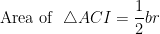
\hbox{Area of ~} \triangle ACI = \displaystyle \frac{1}{2} br

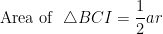
\hbox{Area of ~} \triangle BCI = \displaystyle \frac{1}{2} ar

Since the area of \triangle ABC is the sum of the areas of these three smaller triangles, we conclude that

\hbox{Area of ~} \triangle ABC = \displaystyle \frac{1}{2} r (a+b+c),

or

\hbox{Area of ~} \triangle ABC = rs,

where s = (a+b+c)/2 is the semiperimeter of \triangle ABC.

green lineThis also permits the computation of r itself. By Heron’s formula, we know that

\hbox{Area of ~} \triangle ABC = \sqrt{s(s-a)(s-b)(s-c)}

Equating these two expressions for the area of \triangle ABC, we can solve for the inradius r:

r = \displaystyle \sqrt{ \frac{(s-a)(s-b)(s-c)}{s} }

For much more about the inradius and incircle, I’ll refer to the MathWorld website.

Area of a triangle: SSS (Part 5)

triangle

In yesterday’s post, we discussed how the area K of a triangle can be found using SAS: two sides and the angle between the two sides. We found that

K = \displaystyle \frac{1}{2} a b \sin C

This can be used as the starting point for the derivation of Heron’s formula, which determines the area of a triangle using SSS (i.e., only the three sides). I won’t give the full derivation in this post — there’s no point in me retyping the details — but will refer to the Wikipedia page and the MathWorld page for the details. However, I will give the big ideas behind the derivation.

1. We begin by recalling that \sin^2 C + \cos^2 C = 1. Since 0 < C < 180^o, we know that \sin C must be positive, so that

\sin C = \sqrt{1 - \cos^2 C}

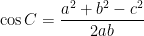
2. From the Law of Cosines, we know that

c^2 = a^2 + b^2 - 2 a b \cos C,

or

\cos C = \displaystyle \frac{a^2 + b^2 - c^2}{2ab}

3. Substituting, we see that

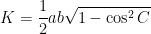
K = \displaystyle \frac{1}{2} ab \sqrt{1 - \cos^2 C}

K = \displaystyle \frac{1}{2} ab \sqrt{1 - \frac{(a^2+b^2-c^2)^2}{4a^2b^2}}

4. This last expression only contains the side lengths a, b, and c. So the “only” work that’s left is simplifying this right-hand side and seeing what happens. After considerable work — requiring factoring the difference of two squares on two different steps — we end up with Heron’s formula:

K = \sqrt{s (s-a) (s-b) (s-c)}

where s = \displaystyle \frac{a+b+c}{2} is the semiperimeter, or half the perimeter of the triangle.
A final note: If you actually are able to start with Step 3 and end with Heron’s formula on your own — without consulting a textbook or the Internet if you get stuck — feel free to cry out “More power!” and grunt like Tim “The Toolman” Taylor:

Area of a triangle: SAS, ASA, and the Law of Sines (Part 4)

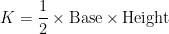
The typical way students remember the area K of a triangle is

K = \displaystyle \frac{1}{2} \times \hbox{Base} \times \hbox{Height}

However, there are other formulas for the area of a triangle which can be helpful if the height is not immediately known.

Case 1: SAS. Suppose that two sides and the angle between the sides — say, b and c and the measure of angle A — are known.

triangle

If \overline{CD} is an altitude for \triangle ABC, then \triangle ACD is a right triangle. Therefore,

\sin A = \displaystyle \frac{\hbox{opposite}}{\hbox{hypotenuse}} = \displaystyle \frac{h}{b}, or h = b \sin A.

Therefore,

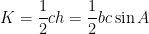
K = \displaystyle \frac{1}{2} ch = \displaystyle \frac{1}{2} bc \sin A.

Using the same picture, one can also show that

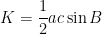
K = \displaystyle \frac{1}{2} ac \sin B

Also, with a different but similar picture, one can show that

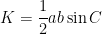
K = \displaystyle \frac{1}{2} ab \sin C

green lineAn important consequence of the SAS area formula is the Law of Sines. Since all three formulas must give the same area K, we have

\displaystyle \frac{1}{2} bc \sin A = \displaystyle \frac{1}{2} ac \sin B = \displaystyle \frac{1}{2} ab \sin C

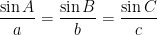
Multiplying by \displaystyle \frac{2}{abc} produces the Law of Sines:

\displaystyle \frac{\sin A}{a} = \displaystyle \frac{\sin B}{b} = \displaystyle \frac{\sin C}{c}

green lineCase 2: ASA. Now suppose that we are given the measures of two angles and the length of the side in between them — say, angles A and B and side c. Naturally, we can also get the measure of angle C since the sum of the measures of the three angles must be 180^o.

From the SAS formula and the Law of Sines, we have

K = \displaystyle \frac{1}{2} bc \sin A \quad \hbox{and} \quad \displaystyle b = \frac{c \sin B}{\sin C}

Combining these, we find

K = \displaystyle \frac{1}{2} \frac{c \sin B}{\sin C} \cdot c \sin A

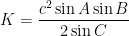
K = \displaystyle \frac{c^2 \sin A \sin B}{2 \sin C}

By similar reasoning, we can also find that

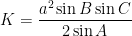
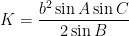
K = \displaystyle \frac{a^2 \sin B \sin C}{2 \sin A} ~~ and ~~ K = \displaystyle \frac{b^2 \sin A \sin C}{2 \sin B}

Volume of pyramids, cones, and spheres (Part 3)

I’m in the middle of a series of posts concerning the area of a triangle. Today, however, I want to take a one-post detour using yesterday’s post as a springboard. In yesterday’s post, we discussed a two-dimensional version of Cavalieri’s principle. From Wikipedia:

Suppose two regions in a plane are included between two parallel lines in that plane. If every line parallel to these two lines intersects both regions in line segments of equal length, then the two regions have equal areas.

In other words, if I have any kind of shape that has cross-sections that match those of the triangles above, then the shape has the same area as the triangles. Geometrically, we can think of each triangle a bunch of line segments joined together. So while the positioning of the line segments affects the shape of the region, the positioning does not affect the area of the region.

There is also a three-dimensional statement of Cavalieri’s principle, and this three-dimensional version is much more important than the above two-dimensional version. From MathWorld:

If, in two solids of equal altitude, the sections made by planes parallel to and at the same distance from their respective bases are always equal, then the volumes of the two solids are equal.

Pedagogically, I would recommend introducing Cavalieri’s principle with two-dimensional figures like those from yesterday’s post since cross-sections in triangles are much easier for students to visualize than cross-sections in three-dimensional regions.

This three-dimensional version of Cavalieri’s principle is needed to prove — without calculus — the volume formulas commonly taught in geometry class. Based on my interactions with students, they are commonly taught without proof, as my college students can use these formulas but have no recollection of ever seeing any kind of justification for why they are true. When I teach calculus, I show my students that the volume of a sphere can be found by integration using the volume of a solid of revolution:

V = \displaystyle \int_{-R}^R \pi \left[ \sqrt{R^2 - x^2} \right]^2 \, dx = \frac{4}{3} \pi R^3

Without fail, my students (1) already know this formula from Geometry but (2) do not recall ever being taught why this formula is correct. Curious students also wonder (3) how the volume of a sphere (or a pyramid or a cone) can be obtained only using geometric concepts and without using calculus.

For the sake of brevity, I only give the logical flow for how these volumes can be derived for students without using calculus. I’ll refer to this excellent site for more details about each step.

  • Using a simple foldable manipulative (see also this site), students can see that V = \displaystyle \frac{1}{3} Bh for a certain pyramid — called a yangma — with a square base and a height that is equal to the base length.
  • Enlarging the yangma will not change the ratio of the volume of the pyramid to the volume of the prism.
  • Cavalieri’s principle then shows that V = \displaystyle \frac{1}{3} Bh for any square pyramid.
  • Cavalieri’s principle then shows that V = \displaystyle \frac{1}{3} Bh for any pyramid with a non-square base or even a cone with a circular base.
  • Finally, a clever use of Cavalieri’s principle — comparing a sphere to a cylinder with a cone-shaped region removed — can be used to show that the volume of a sphere is V = \displaystyle \frac{4}{3} \pi R^3.

green line

I note in closing that there are other ways for students to discover these formulas, like filling an empty pyramid with rice, pouring into an empty prism of equal base and height, and repeating until the prism is filled.

Area of a triangle: Equal cross-sections (Part 2)

Let’s take a second look at the familiar formula for the area of a triangle, A = \displaystyle \frac{1}{2}bh.

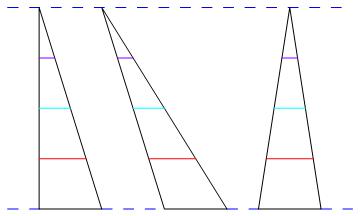
trianglecross1The picture above shows three different triangles: one right, one obtuse, and one acute. The three triangles have bases of equal length and also have the same height. Therefore, even though the triangles have different shapes (i.e., they’re not congruent), they have the same height.

Let’s take a second look at these three triangles. In each triangle, I’ve drawn in three “cross-section” line segments which are parallel to the base. Notice that corresponding cross-sections have equal length. In other words, the red line segments have the same length, the light-blue line segments have the same length, and the purple line segments have the same length.

Why is this true? There are two ways of thinking about this (for the sake of brevity, I won’t write out the details).

  • Algebraically, the length of the cross-section increases linearly as they descend from the top vertex to the bottom base. This linear increase does not depend upon the shape of the triangle. Since the three triangles have bases of equal length, the cross-sections have to have the same length.
  • Geometrically, the length of the cross-sections can be found with similar triangles, comparing the big original triangle to the smaller triangle that has a cross-section as its base. Again, the scale factor between the similar triangles depends only on the height of the smaller triangle and not on the shape of the original triangle. So the cross-sections have to have the same length.

So, since the three triangles share the same height and base length, the three triangles have the same area, and the corresponding cross-sections have the same length.

The reverse principle is also true. This is called Cavalieri’s principle. From Wikipedia:

Suppose two regions in a plane are included between two parallel lines in that plane. If every line parallel to these two lines intersects both regions in line segments of equal length, then the two regions have equal areas.

In other words, if I have any kind of shape that has cross-sections that match those of the triangles above, then the shape has the same area as the triangles. Geometrically, we can think of each triangle a bunch of line segments joined together. So while the positioning of the line segments affects the shape of the region, the positioning does not affect the area of the region.

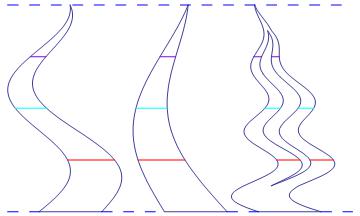
For example, here are three non-triangular regions whose cross-sections match those of the above triangles. The region on the right is especially complex since it has a curvy hole in the middle, so that the cross-sections shown are actually two distinct line segments. Nevertheless, we can say with confidence that, by Cavalieri’s principle, the area of each region matches those of the triangles above.

trianglecross2

Though we wouldn’t expect geometry students to make this connection, Cavalieri’s principle may be viewed as a geometric version of integral calculus. In calculus, we teach that the area between the curves x = f(y) and x = F(y) is equal to

A = \displaystyle \int_{y_1}^{y_2} [F(y) - f(y)] \, dy = \displaystyle \int_{y_1}^{y_2} d(y) \, dy

where $d(y) = F(y) – f(y)$ is the difference in the two curves. In the above formula, I chose integration with respect to y since the $y-$coordinates are constant in the above cross-sections. The difference d(y) is precisely the length of the cross-sections. As with the triangles, the positioning of the cross-sections will affect the shape of the region, but the positioning of the cross-sections does not affect the length d(y) and hence does not affect the area A of the region.

Area of a triangle: Base and height (Part 1)

This begins a series of post concerning how the area of a triangle can be computed. This post concerns the formula that students most often remember:

A = \displaystyle \frac{1}{2} b h

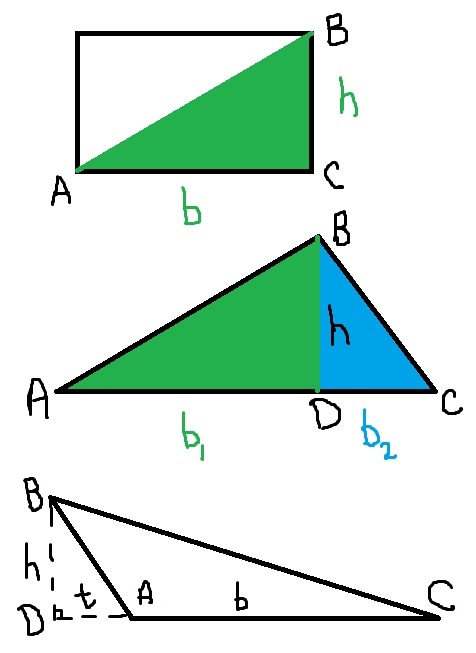
Why is this formula true? Consider \triangle ABC, and form the altitude from B to line AB. Suppose that the length of AC is b and that the altitude has length h. Then one of three things could happen:

triangles

Case 1. The altitude intersects AC at either A or C. Then \triangle ABC is a right triangle, which is half of a rectangle. Since the area of a rectangle is bh, the area of the triangle must be \displaystyle \frac{1}{2} bh.

Knowing the area of a right triangle will be important for Cases 2 and 3, as we will act like a good MIT freshman and use this previous work.

Case 2. The altitude intersects AC at a point D between A and C. Then \triangle ABD and \triangle BCD are right triangles, and so

\hbox{Area of~} \triangle ABC = \hbox{Area of ~} \triangle ABD + \hbox{~Area of~} \triangle BCD

\hbox{Area of~} \triangle ABC = \displaystyle \frac{1}{2} b_1 h + \frac{1}{2} b_2 h

\hbox{Area of~} \triangle ABC = \displaystyle \frac{1}{2} (b_1 + b_2) h

\hbox{Area of~} \triangle ABC = \displaystyle \frac{1}{2} bh

Case 3. The altitude intersects AC at a point D that is not in between A and C. Without loss of generality, suppose that A is between D and C. Then \triangle ABD and \triangle BCD are right triangles, and so

\hbox{Area of~} \triangle ABC = \hbox{Area of ~} \triangle BCD - \hbox{~Area of~} \triangle ACD

\hbox{Area of~} \triangle ABC = \displaystyle \frac{1}{2} (b+t) h + \frac{1}{2} t h

\hbox{Area of~} \triangle ABC = \displaystyle \frac{1}{2} (b+t-t) h

\hbox{Area of~} \triangle ABC = \displaystyle \frac{1}{2} bh

Engaging students: Completing the square

In my capstone class for future secondary math teachers, I ask my students to come up with ideas for engaging their students with different topics in the secondary mathematics curriculum. In other words, the point of the assignment was not to devise a full-blown lesson plan on this topic. Instead, I asked my students to think about three different ways of getting their students interested in the topic in the first place.

I plan to share some of the best of these ideas on this blog (after asking my students’ permission, of course).

This student submission comes from my former student Claire McMahon. Her topic, from Algebra: completing the square.

green line

There were a lot of famous mathematicians that contributed to the notion of completing the square.  The first of the mathematicians was that of the Babylonians.  This culture started the notion of not only solving the quadratics but of arithmetic itself.  The Babylonians started with the equations and then proceeded to solve them algebraically.  Back then; they used pre-calculated tables to help them with solving for the roots.  They were basically solving by the quadratic equation at this point.  The man that came along has a very hard name to not only pronounce but to spell, and I will do my best.  I will refer to him as Muhammad from here on out but his full name, or one of the common names to which he is referred is Muhammad ibn Musa al-Khwarizmi.  He developed the term algorithm, which led to an algorithm for solving quadratic equations, namely completing the square.

The notion of completing the square has gone through a series of transformations throughout the history of mathematics.  As mentioned before the Babylonians started with the notion and increased the knowledge by developing the quadratic formula to find the roots of a given quadratic equation.  This spurred the thought that I can solve any equation and find its solution and roots by completing the square.  Muhammad brought this notion to us, of which was mentioned before.  More specifically the text that he developed was “The Compendious Book of Calculations by Completion and Balancing.”  This book of course has been translated several times over but the general idea is laid out in the title.  Modern mathematicians have developed a less compendious form that is now being taught in the math classes today.  They take on many different forms and can be taught with manipulates as well.


green line

The fabulous part to the story is there are a lot of resources that help the kids of today to deal with this “trick” of the math trade.  There are numerous You Tube videos on the different methods of which show every step along the way with encouraging thoughts.  Another great online resource is any of the math websites.  I find it a little unfair that these resources were not readily available when I was struggling with such concepts.  One of my personal favorites is the PurpleMath.com website.  This website breaks everything down to basically that of a fourth grade level.  They have pictures and fun problems to work out on your own.  My favorite part is that you get your answers checked instantaneously to build the self-confidence and self-efficacy it takes to be a successful student.  These particular websites are great tools for teachers as well, as they have a lot of great examples that can be used in the classroom and different ways that a student might present and calculate a problem.